


The 400-page draft bill is meant to stoke conversation around the often contentious topic.


 Your new post is loading...
 Scoop.it! The 400-page draft bill is meant to stoke conversation around the often contentious topic. 
No comment yet.
Sign up to comment
Scoop.it!

Last November, the President outlined his plan to keep the Internet open to new competition and innovation by safeguarding net neutrality — which will help ensure no one company can act as a gatekeeper to digital content. But there is more work to do so that every American has access to a free and open internet.
Scoop.it!

Regular exercise is key to cognitive development, researchers have found. But more and more, higher education is leaving the body behind.
Scoop.it!

Are you wondering How To Use Audio in eLearning? Check the Top 10 Audio in eLearning Tips For eLearning Professionals!
Scoop.it!

Sir Ken Robinson on "Do schools ignores talents?". Here is a full transcribe of his interview with Aurora Velez.

Mrs. Everett's curator insight,
January 14, 2015 10:22 AM
Another excellent analysis of modern education by Sir Ken Robinson

Michael Harding's curator insight,
January 14, 2015 6:00 PM
Perhaps we also need to be concerned about the expectations of those who are successful in the "traditional" modes... 
Jason Robert LeClair's curator insight,
January 15, 2015 8:37 AM
Important insight. I must get his new book.
Scoop.it!

Last night during our Google Hangout about volunteer opportunities for the 2015 K-12 Online Conference, Karen Fasimpaur (@kfasimpaur) mentioned the possibility of using Vialogues or other websites ...
Scoop.it!

Even though the year is 2015, students struggle with essay writting. Teaching the complex skills of analysis and synthesis will always be a challenge for students. Below I have created a video ...
Scoop.it!

The secretary of education calls the law "tired," asserting that much of it ought to be scrapped. But he still wants to keep the annual exams that serve as the law's centerpiece.
Scoop.it!

What questions should you ask when looking for a learning management system Questions For Choosing a Learning Management System.
Scoop.it!

Three-quarters of online Americans know which is bigger, a megabyte or a kilobyte, but only 9% are able to correctly identify the first widely popular graphical web browser. How much do you know about the web and digital technology?
Scoop.it!

Boricua gana concurso y se abre paso en la tecnología
Scoop.it!

Find lessons, tutorials, and activities for K-12 computer science education
|
Scoop.it!

2015 will be a tumultuous and transformational year in many areas of corporate talent. The global economic recovery, changing demographics, and rapid changes in the technology landscape have come together to redefine the entire nature of work. While many talk about the “new world of work,” in reality we now have a “new world of life”—one in which work, home, family, and personal lives are completely interconnected in a real-time way. Via Edumorfosis
Scoop.it!

Kokori es un videojuego gratuito de estrategia para mejorar el aprendizaje de biología celular en forma lúdica y en 3D y que puedes descargar desde su página.
Scoop.it!

Popular and well-known universities around the world that are offering free online courses.
Scoop.it!

Sign up for our new Canvas.net MOOC on QGIS and FOSS4G. It's Free! What is the GeoAcademy? The Academy is a series of five GIS courses, all based on the US Department of Labor Geospatial Technolog... Via Fernando Gil
Scoop.it!

El pensamiento crítico consiste en analizar y evaluar la consistencia de los razonamientos, en especial aquellas afirmaciones que la sociedad acepta como
Scoop.it!

This blog post shares a few ways to spice up your eLearning courses.Read more ›
Scoop.it!

When a computer runs a classroom, is it more efficient? Do kids learn more? A middle school in New York is finding out.
Scoop.it!

Will governments and corporations expand current tracking policies? Or will innovators create new ways for individuals to control personal information? Experts are divided on whether a secure and balanced privacy-rights infrastructure will be in place by 2025.
Scoop.it!
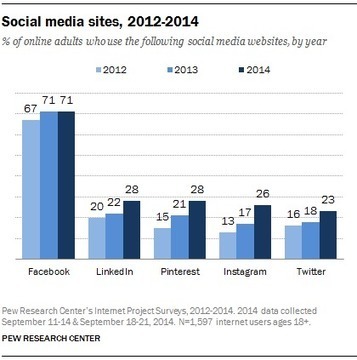
While Facebook remains the most popular social media site, other platforms — like LinkedIn, Pinterest, Instagram and Twitter — saw higher rates of growth over the past year. In 2014, 52% of online adults used two or more social media sites, up from 42% in 2013.
Scoop.it!

Seccion Docentes de Área - EDUTEKA es el Portal gratuito para docentes y directivos escolares interesados en mejorar la educación con el apoyo de las Tecnologías de la Información y las Comunicaciones y en formar a sus estudiantes en el manejo de esas Tecnologías. Via SMRK
|





