Your new post is loading...

|
Scooped by
William delmas
October 24, 2013 4:12 AM
|
Let’s explore how to use Decorators to enhance AngularJS logging and supercharge the $log service. AngularJS has a great hidden feature $provider.decorator() that allows developers to intercept services and substitute, monitor, or modify features of those intercepted services. The decorator feature is not deliberately hidden… rather it is masked by so many other great AngularJS features. In this article, I will introduce the Decorator and show how to incrementally add functionality to the $log service… with practically no changes to your custom services and controllers.
|
|
Scooped by
William delmas
October 2, 2013 9:13 AM
|
Over the last few months, I've been digging into the Angular framework. One of the things that I really like about Angular, and hope to learn to use extremely well as I progress, is their notion of a "Directive". Directives provide a means for extending both the semantic meaning and functionality of your markup. There are many different ways to implement directives, and the documentation on the angular site is still a work in progress, so I would like to share how I've used them up to this point.
Angular.js is built from the ground up with testing in mind. In our opinion this makes Angular different from all other frameworks out there. It is the reason we chose it. This testability is due to the feature set of Angular and the tooling available. Feature wise,dependency injection (DI), modules, directives, data binding, and the internal event loop all work together to create a testable architecture. Angular maintains its own event loop outside the browser event loop to do dirty checking and make sure data is in sync. It will check all known objects for changes on every loop tick. This is done asynchronously. Because this loop is maintained by Angular, you can flush the queue of any outstanding request or pending change at any time, meaning you can test async code in a synchronous manner. The test runner Karma, makes testing directives exceptionally easy. It transparently loads your templates as scripts and exposes them as Angular modules. You can use the same concept to package your app for production.
Via Jan Hesse

|
Suggested by
Brian Petro
July 11, 2013 2:15 PM
|
AngularJS is a fast growing JavaScript framework. It is clear that this technology is having a major impact on cloud development. As a recruiter it is important
|
|
Scooped by
William delmas
June 30, 2013 6:05 AM
|
When I started to work on this little experiment I was not a big expert in the matter of Facebook’s api (and even now I’m really far from that); in this case I think that the smarter thing you can do is start reading the Facebook’s document about Facebook’s authentication system.
You’ll discover that Facebook makes available different ways to authenticate the users of your website, or application, on the basis of the device they are using (iOS, or Android), and even for a web app is possible to choose between two different flows: with or without JavaScript SDK.
I choose to follow the login flow with Javascript SDK.
|
|
Scooped by
William delmas
June 26, 2013 2:05 PM
|
This article covers the additional changes that has been made to my angularjs-localizationservice project out on GitHub. The new service, has the following new features: A new directive to help improve performance and handle dynamic localized resource stringsUpdated the localize service to allow changing of the language on the flyFixed an issue with getLocalizedResourceString to be more efficient and simpler - See more at: http://codingsmackdown.tv/blog/2013/04/23/localizing-your-angularjs-apps-update/#sthash.3aTonusD.dpuf
|
|
Scooped by
William delmas
June 19, 2013 6:35 AM
|
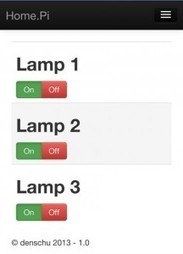
In this blog post I show how you can quickly setup and implement a control software for your switches at home with some modern JavaScript stuff. This project should primarily help me to get more in touch with these kinds of freaky scripting and this is maybe helpful for other Java Developers or people who want to play around with the Raspberry Pi. So I decided to share it with you. There is no line of old-fashioned Java code here, but maybe some really technical C++-code . Please note, that this is not a tutorial for the usage of the frameworks. The tutorials that you can find in the internet are very good and I don’t want to repeat all of the basic fundamentals in this post. The complete code is also available at Github.
|
|
Scooped by
William delmas
June 14, 2013 5:13 AM
|
Between legacy code that has been around for N years jumping from developer to developer with no documentation. To over complicated interfaces that are over complicating the code. To a mixture of N technologies in one single app. Lets face it, these things were not built with maintainability and support in mind. The problem we face today is, how do we fix all these apps? Where do we start? How do we bring sanity into them? How do we bring them into state of the art tech stacks?
|
|
Scooped by
William delmas
June 12, 2013 3:18 AM
|
Recently, for a project built over AngularJS, I found myself in front of an unusual requirement: I need to define dinamically the routes of the web application, on the basis of a response from the server.
This post is meant to share the process I followed.
|
|
Scooped by
William delmas
June 8, 2013 11:53 AM
|
I got an email from a developer who asked me ressources about AngularJSand I think many developers are lost about this wonderful framework, so this is a post for that purpose. At first, you need to check the official tutorial. If you already read it, do it again to refresh you the basics. One thing that developers don’t do a lot is to reading the documentation just out of curiosity. Check all the possibilities that the framework gives you before starting to do it by your own.
|
|
Scooped by
William delmas
June 8, 2013 7:14 AM
|
We need Analytics to improve our app. However, most analytics (Like Google Analytics) aren’t yet fully prepared for Single Page Apps (SPA). Google Analytics tracks page views once your browser refreshes the page, which in old pages meant changing the URL. Now, with AngularJS, we never refresh the page. We have a complete WebApp which changes URLs, changes resources, but never does a refresh. So, the question is how can we track page views and events now?
|
|
Scooped by
William delmas
June 8, 2013 7:08 AM
|
A bunch of links to blog posts, articles, videos, etc for learning AngularJS. This list is in its early stages. Feel free to submit a pull request if you have some links/resources to add. Also, I try to verify that the articles below have some real content (i.e. aren't 2 paragraph blog posts with little information) to ensure I'm not listing "fluff" pieces. If you have an idea for a better way to organize these links, please let me know. As I find similar posts in the "General Topics" section, I will break them out into their own categories.
|
|
Scooped by
William delmas
June 8, 2013 6:50 AM
|
Many developers struggle with how to organize an application's code base once it grows in size. I've seen this recently in AngularJS and JavaScript applications but historically it's been a problem across all technologies including many Java and Flex apps I've worked on in the past. The general trend is an obsession with organizing things by type. It bears a striking resemblance to the way people organize their clothing.
|
|
|
Scooped by
William delmas
October 6, 2013 6:55 AM
|
Welcome to the final article in a series on my experience developing with AngularJS. I learned its concepts, beat my head against-the-wall with and finally tamed it enough to create a "My Dashboard" feature for a client. For previous articles, please see the following: Part I: The BasicsPart II: Dialogs and DataPart III: Services The last mile of development for the My Dashboard feature was to spice things up a bit and make it look better. We hired a design company to come up a new look and feel and they went to work. Within a week, we had a meeting with them and they presented a few different options. We picked the one we liked the best and went to work. Below are screenshots that I used to implement the new design.
|
|
Scooped by
William delmas
August 22, 2013 3:13 AM
|
One of the tasks I find myself performing a lot when building Line of Business (LOB) applications is displaying dialogs. Some of the dialogs are modal (the user can’t click on the background to dismiss it) and some are non-modal. For example, I’m currently working on a LOB application that displays modal dialogs as users delete items on a page.
|
|
Scooped by
William delmas
August 6, 2013 5:18 AM
|
Here is a quick snippet of a directive that utilizes the$compile service to dynamically render some html content for the boot strap popover component.
|
|
Scooped by
William delmas
July 5, 2013 2:57 PM
|
I have been hacking with AngularJS since the start of the year. I really enjoy the framework, though outside of personal and side projects, I really hadn’t found a good way to get it into the toolkit at work. I thought maps would be a good opportunity. I had already chipped in with two Google Maps pieces this year. Unfortunately though, I was only helping some people who were inexperienced with javascript, and wouldn’t be maintaining those projects. I looked into using some of the open source google maps directives out there (great job on all of them), but at the end it was too much to hand off to someone who wasn’t the strongest javascript developer, and ending up acquiescing to use jQuery and Handlebars.
Angular offers several ways to interact with data from the server. The easiest way is to use the$resource factory, which lets you interact with RESTful server-side data sources. When we started the My Dashboard project, we were hoping to interact with a REST API, but soon found out that it didn't have all the data we needed. Rather than loading the page and then making another request to get its data, we decided to embed the JSON in the page. For communication back to the server, we used our tried-and-true Ajax solution:DWR.
Via Jan Hesse
|
|
Scooped by
William delmas
June 21, 2013 3:50 PM
|
The AngularJS documentation is great for getting started and for looking up specific API calls. However, it doesn't really tell you how to organize and manage your app as it grows to tens or hundreds of thousands of lines of code. I've collected here some of my observations and best practices for how to manage your sprawling application. First we'll take a look at organization, then move on to some tips on improving performance, and conclude with a brief summary on tools, servers, and build processes. While this post will focus on big apps in particular, there's a great video on YouTube from the December 2012 AngularJS meetup on best practices that's also worth checking out.
|
|
Scooped by
William delmas
June 18, 2013 2:34 PM
|
AngularJS Directive is what we have close to Web Components at this time and is the most crucial and difficult piece in AngularJS. I’ve not found any suitable article on the web to fully understand directives behavior based on options it takes so I’m writing one. Fingers crossed!
|
|
Scooped by
William delmas
June 13, 2013 4:25 AM
|
This Thursday at 7pm Pacific we are hosting a Twitter party to celebrate the release of Bleeding Edge Press' AngularJS book. Panelist, author, and Angular-UI contributor Christopher Hiller will be answering questions. We will also be giving away free books. Date & Time: Thursday, June 13, 2013 from 7-8pm Pacific Hosted by: @troymott Panelist: @misterhiller Sponsored by: @edgepress Hashtag: #angularjsbook If you've never joined a Twitter party, it's simple. Follow the above hashtag. For every tweet that you want viewed by the other people participating in the party, just use the #angularjsbook hashtag somewhere in your 140 characters. That's basically it! Throughout the party, we will randomly choose party participants to receive complimentary books of their choice from our catalog at www.bleedingedgepress.com. We hope you are able to join us this Thursday on Twitter!
|
|
Scooped by
William delmas
June 8, 2013 12:15 PM
|
There are some cases where one needs to perform some sort of timeout operation and we frequently achieve this using JavaScript's setTimeout() function. However, if we use setTimeout() in an AngularJS application we also need to use$scope.$apply() to ensure that any changes to the scope will be reflected elsewhere (i.e. data-bound in a view).
|
|
Scooped by
William delmas
June 8, 2013 7:15 AM
|
Recently AngularJS, an MVC style JavaScript framework fromGoogle, has been gaining more momentum. I’ve been curious about it for awhile and when I read this article recently, I decided it was finally time to give it a whirl. I was pleasantly surprised with what I found. I first watched these two videos by John Lindquist which I highly recommend as a starting point to get your feet wet. They are short and totally worth the time: Simple ToDo’s AppSimple Twitter Search App
|
|
Scooped by
William delmas
June 8, 2013 7:12 AM
|
Continuing on with our adventure with PhoneGap and AngularJs we are going to explore the PhoneGap Notification API and create a AngularJs service that lets the two work together a bit better.
The Notification API for PhoneGap allows for us to present native alerts, confirms, prompts, and beeps to the user of the iOS app. Most of these are fairly straight forward but will go into detail ofalert as it is a good basis for the rest of the exposed API.
|
|
Rescooped by
William delmas
from Libraries and Tools
June 8, 2013 7:06 AM
|
We wanted to share our experiences in this space and decided to re-frame them in the context ofAngularJS from a .NET developer's point of view. While in the past, we've communicated our experiences via books and magazine articles, these rather slow mediums did not seem to be the right choice. Instead we've decided to release the information in a continuous deployment fashion on this web site.
|