Your new post is loading...

|
Scooped by
Gilbert C FAURE
October 22, 11:26 AM
|
The wellness industry rebranded normal immune system function as food sensitivities and figured out how to charge you for a problem you don’t have.
|
|
Scooped by
Gilbert C FAURE
October 12, 4:07 AM
|
Your child tested positive for a food allergy.
But does that mean they are actually allergic?
Not necessarily.
This is one of the most common misunderstandings I see in my allergy clinic.
A positive skin prick test or blood IgE test does not automatically mean someone has a food allergy.
It means their immune system has made IgE antibodies that recognize the food.
But whether eating that food will cause a reaction is a different question.
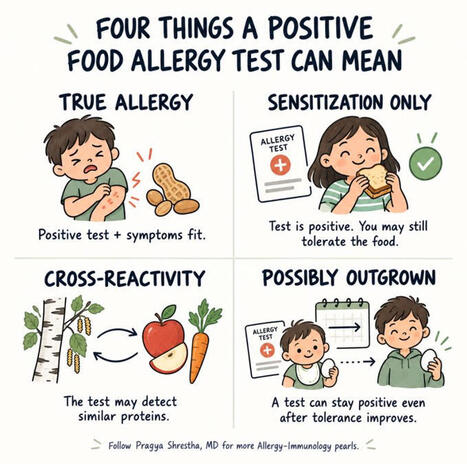
Here are 4 things a positive food allergy test can mean:
1️⃣ TRUE FOOD ALLERGY
The test is positive AND the clinical history supports an allergic reaction.
For example:
A child develops hives, vomiting, or wheezing shortly after eating peanuts, and peanut testing is positive.
The history and test results fit together.
2️⃣ SENSITIZATION WITHOUT ALLERGY
This is where confusion often begins.
A child may test positive to milk, egg, or peanut but eat that food regularly without any symptoms.
That is called sensitization.
And sensitization does not always mean allergy.
👉 If someone regularly eats a food without problems, a positive test alone is generally not a reason to remove it from their diet.
3️⃣ CROSS-REACTIVITY
Sometimes, the immune system recognizes proteins that look similar.
For example:
Someone with birch pollen allergy may test positive to apple or carrot because these foods contain proteins similar to birch pollen.
Some people develop itching in the mouth when eating these foods, called pollen-food allergy syndrome.
Others may have positive tests without symptoms.
A positive result does not always mean a dangerous food allergy.
4️⃣ AN ALLERGY THAT MAY HAVE BEEN OUTGROWN
This is particularly important in children.
Some children outgrow milk, egg, wheat, or other food allergies over time.
But their allergy tests may remain positive even after they develop tolerance.
That is why we look at:
↳ Previous reactions
↳ Changes in skin test or specific IgE results over time
↳ Whether a supervised oral food challenge is appropriate
An oral food challenge, performed under medical supervision, is the gold standard for confirming whether someone can tolerate a food when the diagnosis remains uncertain.
Here is what I wish more parents knew:
A positive test does not tell us the whole story.
And a larger skin test or higher IgE level does not reliably predict how severe a future reaction will be.
Testing should be guided by the clinical history, not used as a broad screening tool without a clear reason.
Unnecessary food avoidance can affect nutrition, quality of life, and create significant anxiety for families.
Before eliminating a food based only on a test result, discuss it with an allergist.
If there is a history of a possible allergic reaction, do not try reintroducing the food at home without appropriate guidance.
We treat patients, not just positive test results.
Have you or your child ever been told to avoid a food based only on a positive allergy test?
|
|
Scooped by
Gilbert C FAURE
October 2, 10:40 AM
|
Basophil activation testing may allow clinicians to bypass the potentially dangerous oral food challenge in the diagnostic workup for food allergies. For an update on lab testing for the diagnosis of food allergies, refer to the new ARUP Consult Food Allergies topic: https://bit.ly/3VlK0xN
|
|
Scooped by
Gilbert C FAURE
August 18, 8:42 AM
|
If your food sensitivity panel flagged 20 foods,
the problem may be the test - not your diet.
I see patients who arrive with pages of results showing “high” IgG to milk, wheat, egg, corn, soy, and dozens of other foods.
Naturally, they ask:
“Do I need to stop eating all of these?”
Usually, no.
Here is what is important to understand.
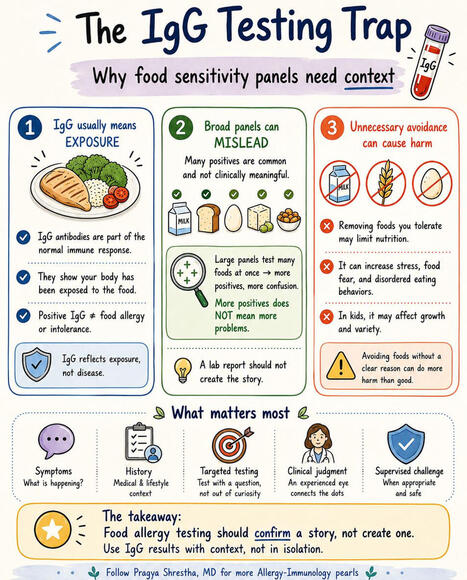
IgG is not the antibody we use to diagnose a typical food allergy.
Food allergy is usually evaluated with the history plus targeted testing for IgE, using skin testing or blood testing when appropriate.
Sometimes an oral food challenge is needed to confirm the diagnosis.
Food-specific IgG tells us something very different.
↳ It often means your immune system has been exposed to that food.
↳ Finding IgG against a food does not prove that the food is causing your symptoms.
↳ IgG4 responses may even be associated with immune tolerance rather than allergy.
That is why major allergy organizations recommend against using food IgG or IgG4 panels to diagnose food allergy or food intolerance.
And there is a real downside to these tests.
A report may label 20, 30, or even 50 foods as problematic.
Then someone starts removing:
Milk.
Wheat.
Egg.
Soy.
Nuts.
Fruit.
Vegetables.
Suddenly the diet becomes extremely limited, even though many of those foods were being eaten without any problem.
For children, unnecessary restriction can be especially concerning because they need enough calories, protein, vitamins, and minerals for normal growth.
So if a test tells you that you are “sensitive” to a long list of foods, ask an important question:
What exactly is this test measuring?
A positive antibody result is not automatically a diagnosis.
Your symptoms, the timing of the reaction, the food involved, and the right type of testing all matter.
Sometimes the best answer after an IgG panel is not to remove more foods.
It is to put foods back.
Have you ever been told to avoid a long list of foods based on an IgG test?
|
|
Scooped by
Gilbert C FAURE
August 6, 10:42 AM
|
Peanut allergy dropped 81%.
Not from a new drug. From a baby snack.
Here's how we found out.
Jewish children living in the UK had about 10 times higher rates of peanut allergy than Jewish children living in Israel.
The genetics were nearly identical.
The environment was not.
Many Israeli infants regularly ate Bamba, a peanut puff snack, during infancy.
That observation led to one of the most important food allergy studies ever performed.
The LEAP trial enrolled 640 infants at high risk for peanut allergy (severe eczema, egg allergy, or both).
Half were introduced to peanut between 4 and 11 months of age and kept eating about 6 grams of peanut protein a week until age 5. The other half avoided peanut completely.
The numbers at age 5:
↳ 17.2% of the avoidance group developed peanut allergy
↳ 3.2% of the consumption group developed peanut allergy
↳ An 81% relative risk reduction
It held up. LEAP-On followed the same kids after 12 months off peanut:
18.6% allergic in the avoidance group vs. 4.8% in the consumption group.
LEAP-Trio followed them into adolescence: 15.4% vs. 4.4%.
Younger siblings introduced to peanut early had an 18.3% sensitization rate, vs. 44.4% in siblings who weren't (a different outcome measure than clinical allergy).
For context: peanut allergy prevalence in Western countries had roughly doubled over the decade before LEAP, reaching 1.4% to 3.0% of children, during the era when avoidance was standard advice.
But LEAP teaches us something beyond peanut.
Culture matters.
Families around the world introduce peanut, sesame, lentils, yogurt, fermented foods, and tree nuts at very different ages, and that may shape how the developing immune system learns what is safe.
Separately, some population-level observations (different literature than LEAP) suggest children raised on minimally processed, legume- and fish-rich diets have lower food allergy rates in parts of Asia compared with Western populations. Associative, not causal.
That does not mean one food, or one country's diet, is the answer.
Food allergy is influenced by many factors.
↳ Genetics
↳ Early food introduction
↳ Eczema and skin barrier health
↳ The microbiome
↳ Vitamin D and other environmental exposures
↳ Diet diversity and food processing
Most likely, it's the combination that determines risk.
One observation from Israeli children eating Bamba changed how we feed infants around the world.
Sometimes the biggest advances in medicine begin with someone noticing that one community does things differently.
The next breakthrough may already be happening in someone's kitchen.
Have you noticed cultural food practices that you think medicine should study more closely?
|
|
Scooped by
Gilbert C FAURE
May 17, 4:16 AM
|
Allergy clinic looks simple.
It rarely is.
What people see
↳ Skin testing
↳ Patch testing
↳ Food challenges
↳ Allergy shots
↳ Biologics
What they do not see
↳ Sorting out whether a reaction was IgE-mediated, delayed, irritant, infectious, mast cell-related, bradykinin-mediated, or not allergy at all
↳ Explaining why a positive test does not always mean clinical allergy
↳ Rebuilding trust after broad food panels turn tolerated foods into sources of anxiety
↳ Reviewing ingredient lists, cofactors, timing, and symptom patterns in detail
↳ Figuring out whether “sinus allergy” is allergic rhinitis, vasomotor rhinitis, reflux, chronic sinus disease, or something else
↳ Deciding when hives are spontaneous urticaria and when swelling may be hereditary angioedema, ACE inhibitor angioedema, or another non-histamine process
↳ Recognizing when the story fits alpha-gal, especially when reactions are delayed and the timing feels “off”
↳ Working through drug allergy labels that have followed patients for years
↳ Sorting eczema from allergic contact dermatitis, then using patch testing when the story fits
↳ Explaining why flushing is not always allergy, swelling is not always angioedema, and eczema is not always food driven
↳ Figuring out whether “uncontrolled asthma” is persistent airway inflammation, poor inhaler technique, adherence issues, rhinitis, reflux, vocal cord dysfunction, or the wrong diagnosis altogether
↳ Working up recurrent sinus, lung, or skin infections and asking whether the problem is allergy, immune deficiency, or both
↳ Evaluating for antibody deficiency or other immune problems when the infection history does not add up
↳ Prior authorizations, school forms, biologic renewals, and portal messages in between visits
↳ Helping patients unlearn years of misinformation from social media, panel testing, and vague “sensitivity” reports
That is the part people miss.
A good allergy visit is not just about finding a trigger.
It is about asking better questions.
It is about narrowing a differential.
It is about knowing when the answer is allergy, and when it is not.
A big part of this specialty is not diagnosing more allergy.
It is ruling it out correctly.
And honestly, that is where a lot of the value lives.
Because the right diagnosis does two things:
↳ It finds what truly needs treatment
↳ It frees patients from avoiding things they were never actually allergic to
That can mean fewer false labels.
Less fear.
Less unnecessary restriction.
And better care.
Allergy-immunology sits at a strange intersection of detective work, pattern recognition, patient education, skin disease, airway disease, swelling disorders, immune evaluation, and long-term management.
It looks lighter from the outside than it really is.
Clinical allergists know otherwise.
What do you think is the most misunderstood part of allergy practice? | 14 comments on LinkedIn
|
|
Scooped by
Gilbert C FAURE
May 15, 11:15 AM
|
Beyond Early Allergen Introduction: A New Paradigm for Pediatric Allergy Prevention 👶💡
As healthcare professionals, we’ve long focused on the timing of introducing peanuts and eggs to prevent food allergies. But a new EAACI interest group report (2025),co-authored by leading experts in the field such as Carina Venter , Emilia Vassilopoulou , Berber Vlieg-Boerstra RD PhD , and Alexandra Santos, MD PhD ,reminds us that the quality of the entire diet matters just as much.
The latest guidance emphasizes a holistic "Healthy Complementary Feeding" approach to support immune maturation and a diverse gut microbiome.
Key Clinical Takeaways:
⏱️ Timing is Key (4-6 Months): Start complementary feeding around this window to meet increasing needs for iron and zinc and to utilize the "window of opportunity" for immune tolerance.
🥦 Prioritize Diversity: Encourage a high variety of whole, nutrient-dense, and home-cooked plant-based foods (vegetables, legumes, grains).
🐟 Nutrient Focus: Aim for diets rich in fiber, iron, zinc, and omega-3 fatty acids, while including fermented foods like natural yogurt.
🚫 The "Whole Food" Advantage: Discourage over-reliance on ultra-processed commercial baby foods and pouches, which are often low in nutrients and may delay the development of oral motor skills.
🥜 Allergen Integration: Continue the early and regular introduction of regional allergens (especially egg and peanut), particularly for high-risk infants with eczema.
By shifting our focus from "avoidance" to "diverse inclusion," we can better support the development of a healthy immune system in our youngest patients.
Reference: Vlieg-Boerstra B, et al. Pediatr Allergy Immunol. 2025;36:e70150.
|
|
Scooped by
Gilbert C FAURE
May 12, 10:24 AM
|
A positive allergy test is not a diagnosis.
It's a data point.
🧪 What looks like good medicine:
Treating every positive the same.
Same restriction. Same fear. Same label.
That’s not expertise. It’s one-size-fits-all thinking.
✅ This is expertise:
→ Positive test, no history = sensitization only. Watch, don't restrict.
→ Oral allergy syndrome = raw fruit tingles, rarely systemic. Context matters.
→ Cross-reactivity = depends on the pair. Not all cross-reactive allergens carry equal risk.
→ Clear symptoms + positive test = that's your diagnosis. Act on it.
→ Anaphylaxis history = full glass. Treat accordingly. No second-guessing.
The test confirms your clinical story.
It doesn't replace it.
When we over-restrict based on a number, we create food fear, nutritional gaps, and patients avoiding safe foods for years.
When we under-act on a real history, we miss the diagnosis entirely.
The skill isn't ordering the test.
It's knowing what to do with the result.
💬 What's the most common positive test misinterpretation you see in your practice?
|
|
Scooped by
Gilbert C FAURE
February 2, 3:28 AM
|
What Your IgG Test Results Mean (and Don’t Mean)
TL;DR: IgG sensitivity tests can’t tell you what foods you're sensitive to.
IgG sensitivity tests claim to work by measuring levels of IgG antibodies in your blood against specific foods. Some test up to 100 foods, and the idea is that if your body makes a lot of IgG to a certain food, it means your immune system sees that food as a “problem.” Companies that make these tests say this immune response may be linked to symptoms like bloating, fatigue, headaches, or skin issues. Based on the results, they recommend avoiding foods that show high IgG levels.
However, these tests measuring IgG antibodies, aren't scientifically proven. Experts, including the American Academy of Allergy, Asthma, and Immunology (AAAAI), say IgG antibodies actually show normal exposure and tolerance to a food. Meaning that your body tolerates those foods, not that you're sensitive to them!
These tests are expensive and can lead to unnecessary food restrictions and can cause anxiety, nutrient deficiencies, and a bad relationship with food.
✅ An elimination diet, done with a healthcare professional, is still the best way to pinpoint food sensitivities. It takes time, but it’s the most trusted method!
https://lnkd.in/dBhYfZf2
https://lnkd.in/dYJ47Wjh
#Debunked #FoodSensitivity #GutHealth #EliminationDiet
|
|
Scooped by
Gilbert C FAURE
December 13, 2025 9:05 AM
|
The era of avoidance is over. Dr William Basco explains why early exposure is the new prevention and offers a protocol for introducing allergens at the 4- to 6-month mark.
|
|
Scooped by
Gilbert C FAURE
August 28, 2025 2:36 PM
|
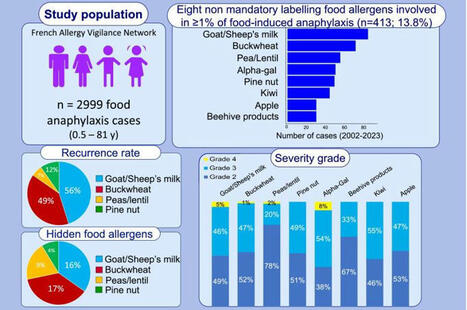
#allergies Le réseau d'allergovigilance souhaite rendre obligatoire, en Europe, la déclaration de quatre allergènes alimentaires émergents supplémentaires, sur la base d'une étude rapportée dans APMnews en décembre 2023, publiée dans Clinical & Experimental Allergy
https://lnkd.in/erY6v8_M?
|
|
Scooped by
Gilbert C FAURE
February 15, 2025 2:43 AM
|
FOOD ALLERGY NEWS: Eating gradually increasing doses of store-bought, home-measured peanut butter for about 18 months in a clinical trial enabled 100% of…
|
|
Scooped by
Gilbert C FAURE
December 14, 2024 4:40 AM
|
|
|
|
Scooped by
Gilbert C FAURE
October 17, 12:46 PM
|
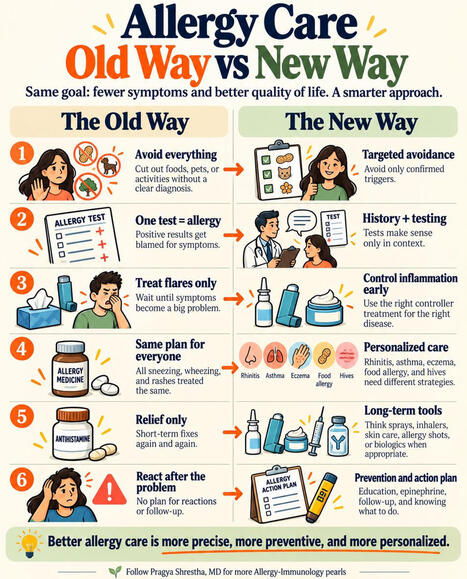
Allergy care has changed.
And in many ways, that is a good thing.
The old approach often looked like this:
↳ Avoid more and more things
↳ Blame every symptom on a positive test
↳ Wait until symptoms get bad
↳ Treat everyone the same
↳ Reach for short-term relief again and again
↳ Make a plan only after a reaction happens
That is not the direction we want to keep going.
Better allergy care is more precise.
It starts with the right question:
What is actually going on here?
Because sneezing, wheezing, eczema, hives, and food reactions are not all the same problem.
And they should not all be treated the same way.
The newer approach is more thoughtful:
1️⃣ Targeted avoidance
Avoid only confirmed triggers, not everything “just in case.”
2️⃣ History plus testing
A test alone does not diagnose allergy. Test results need context.
3️⃣ Earlier control of inflammation
For asthma, rhinitis, and eczema, the goal is not just to chase flares. It is to control disease earlier.
4️⃣ Personalized care
Rhinitis, asthma, eczema, food allergy, and hives each need their own strategy.
5️⃣ Long-term tools when needed
Sprays, inhalers, skin care, allergy shots, biologics, and food allergy planning all have a role in the right patient.
6️⃣ Prevention and action plans
Education matters. Follow-up matters. Knowing what to do in a reaction matters.
7️⃣ Early food introduction for babies
One of the biggest shifts has been infant feeding.
The old idea was to delay common allergenic foods like peanut and egg.
Now we know that, when babies are developmentally ready, early introduction of common allergenic foods can help lower food allergy risk, especially in the right setting and with the right guidance.
So the “new way” is not doing more for the sake of doing more.
It is doing the right thing, for the right condition, at the right time.
That means less fear.
Less guesswork.
And better care.
What change in allergy care do you think patients or even clinicians still misunderstand the most?
|
|
Scooped by
Gilbert C FAURE
October 7, 4:51 AM
|
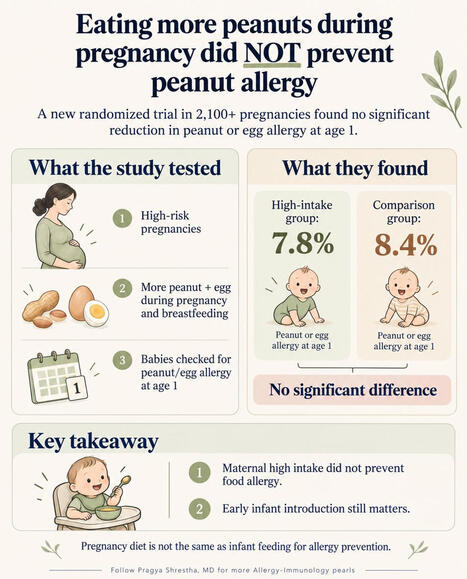
More peanuts in pregnancy ≠ less peanut allergy in babies.
A major new NEJM trial just tested this.
For years, families have asked whether eating more peanut during pregnancy could lower their baby’s risk of developing peanut allergy.
Now we have much better data.
A new randomized trial included more than 2,100 pregnancies in families at higher risk for allergic disease.
One group was asked to eat at least:
🥜 60 peanuts per week
🥚 6 eggs per week
They continued this during pregnancy and through the first 4 months after delivery while breastfeeding.
The comparison group ate substantially less peanut and egg.
At 1 year of age, the babies were evaluated for IgE-mediated peanut or egg allergy.
The result?
7.8% of babies in the high peanut-and-egg group developed peanut or egg allergy.
8.4% in the comparison group did.
That difference was not statistically significant.
So eating substantially more peanut and egg during pregnancy and breastfeeding did not prevent food allergy in the baby.
But here is the important part:
This does not mean peanut exposure does not matter.
The stronger evidence for prevention comes after the baby is born.
Early introduction of peanut into an infant’s diet, followed by regular ingestion, can reduce the risk of developing peanut allergy.
So the practical message for parents is:
👉 You generally do not need to avoid peanut or egg during pregnancy just to prevent allergy.
👉 Eating extra peanut during pregnancy has not been shown to prevent peanut allergy.
👉 Introducing allergenic foods at the right time during infancy still matters.
Food allergy prevention may be less about what mom eats during pregnancy and more about when the baby starts eating the food.
Were you ever told to eat more, or avoid, certain foods during pregnancy because of allergy risk?
|
|
Scooped by
Gilbert C FAURE
September 15, 4:03 AM
|
|
|
Scooped by
Gilbert C FAURE
August 13, 4:38 AM
|
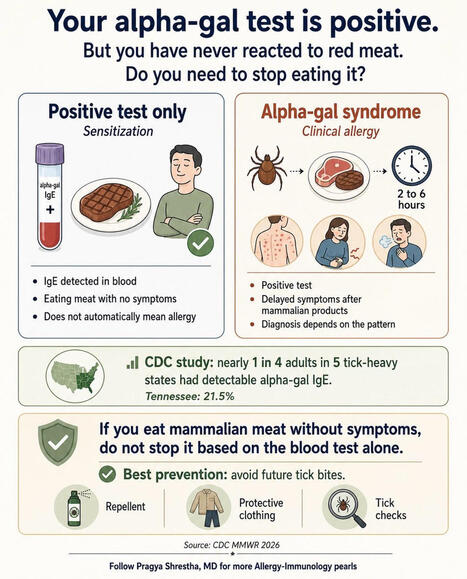
Positive alpha-gal test. No reaction to red meat.
Should you stop eating it?
I am seeing more patients with positive alpha-gal testing who have never had symptoms.
Many are worried that continuing to eat red meat could trigger a future reaction.
But a positive test alone does not mean someone has alpha-gal syndrome.
A recent CDC study found that nearly 1 in 4 adults tested in five tick-heavy states had detectable alpha-gal IgE.
In Tennessee, the rate was 21.5%.
These were mostly healthy blood donors, not patients with known allergic reactions.
This highlights an important difference:
↳ Sensitization: Alpha-gal IgE is detectable in the blood.
↳ Alpha-gal syndrome: Exposure to alpha-gal causes compatible symptoms.
If someone regularly eats beef, pork, lamb, or dairy without symptoms, they generally do not need to avoid those foods solely because a blood test is positive.
Unnecessary food avoidance can lead to:
↳ Anxiety around eating
↳ Nutritional restrictions
↳ Confusion about medications and vaccines
↳ An allergy diagnosis the patient may not actually have
Before diagnosing alpha-gal syndrome, we look for delayed symptoms after mammalian products:
↳ Hives or swelling
↳ Abdominal pain, vomiting, or diarrhea
↳ Wheezing or trouble breathing
↳ Dizziness or anaphylaxis
Symptoms often begin 2 to 6 hours after exposure.
That delay can make the connection easy to miss.
For someone with a positive test but no symptoms, the most useful preventive step is usually not automatically avoiding red meat.
It is preventing more tick bites.
Additional tick bites may increase alpha-gal IgE and may increase the risk of developing clinical reactions.
Use tick repellent.
Wear protective clothing outdoors.
Check your skin, clothing, children, and pets after spending time outside.
A positive allergy test shows immune recognition.
It does not always prove clinical allergy.
Have you ever been told to avoid a food because of a positive test, even though you had been eating it safely?
|
|
Scooped by
Gilbert C FAURE
July 29, 3:27 AM
|
As part of the ECOBIOTIC project - Physiological and Ecological Impact of Pre- and Probiotic Interventions in Relation to Food Allergy in Early Life - I’m very pleased to share our new open-access article, now published in Allergy EAACI:
“Microbiota Signatures in Early Life and Their Association With Food Allergy: A Systematic Review.”
We synthesized evidence from 40 studies involving 6,530 participants, including 2,077 food-allergy cases, to examine how infant, maternal, environmental and extraintestinal microbiota may be associated with food allergy and food sensitization.
Across studies, food allergy was frequently associated with:
🦠 Early differences in overall microbial composition
📉 Lower abundance of Bifidobacterium, Blautia and several butyrate-producing bacteria.
📈 Early enrichment of Proteobacteria/Pseudomonadota, particularly Enterobacteriaceae, as well as selected taxa such as Clostridium, Streptococcus and Sutterella.
⚙️ Microbial profiles suggestive of delayed maturation and reduced short-chain fatty-acid production capacity.
Although substantial heterogeneity remains across food-allergy phenotypes, populations, sampling periods and analytical methods, our findings support the existence of distinct early-life microbial configurations associated with food-allergy susceptibility or the development of oral tolerance.
This work also highlights the need for larger longitudinal studies integrating metagenomics, metabolomics, standardized clinical definitions and careful control of early-life exposures.
A sincere thank you to all my co-authors and collaborators: Jeremy Corriger, Hélène Omer, Marie Bodinier, Dirk Haller, Tomer Hertz, Martin Larsen, MCarmen Collado and to all the institutions involved Instituto de Agroquímica y Tecnología de Alimentos, INRAE, Technical University of Munich, Sorbonne Université, WHI CCC Fred Hutchinson Cancer Research Center, and Ben-Gurion University of the Negev.
https://lnkd.in/eeNvgG-T
|
|
Scooped by
Gilbert C FAURE
May 17, 3:48 AM
|
If you treat anaphylaxis,
this lab matters.
But it is often drawn too late. Or not at all.
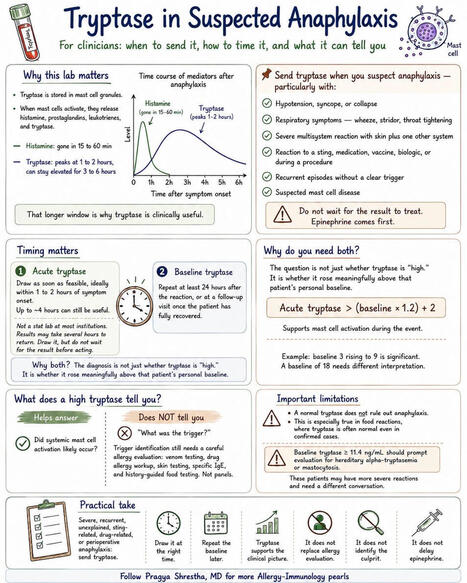
Serum tryptase.
Tryptase is stored in mast cell granules.
When mast cells activate, they release histamine, prostaglandins, leukotrienes, and tryptase.
Here is the key difference:
Histamine disappears within 15 to 60 minutes.
Tryptase peaks around 1 to 2 hours and can stay elevated for 3 to 6 hours.
That longer window is why it is clinically useful.
📌 Send tryptase when you suspect anaphylaxis — particularly with:
→ Hypotension, syncope, or collapse
→ Respiratory symptoms — wheeze, stridor, throat tightening
→ Severe multisystem reaction with skin plus one other system
→ Reaction to a sting, medication, vaccine, biologic, or during a procedure
→ Recurrent episodes without a clear trigger
→ Suspected mast cell disease
Epinephrine comes first.
The blood draw happens after the patient is stabilized.
🧪 Timing matters
1️⃣ Acute tryptase — within 1 to 2 hours of symptom onset (up to ~4 hours is still useful)
Note: tryptase is not a stat lab at most institutions. Results may take hours. Do not wait for the result before acting.
2️⃣ Baseline tryptase — at least 24 hours post-reaction or at follow-up
Why both?
Because the question is not whether tryptase is “high.”
It is whether it rose above that patient’s baseline.
📌 The formula: Acute > (baseline × 1.2) + 2
That supports mast cell activation during the event.
⚠️ Two limitations to know:
A normal tryptase does not rule out anaphylaxis — especially in food reactions.
An elevated baseline (≥11.4 ng/mL) should prompt evaluation for hereditary alpha-tryptasemia or mastocytosis.
Tryptase supports the clinical picture.
It does not replace allergy evaluation.
It does not identify the culprit.
It does not delay epinephrine.
PCPs, ER clinicians, and hospitalists — are you routinely getting tryptase when anaphylaxis is on the table? What gets in the way?
|
|
Scooped by
Gilbert C FAURE
May 13, 3:38 AM
|
👩⚕️ One of the biggest mistakes I see in allergy care:
broad food panel testing.
If you come to my clinic expecting a 50-food scratch test on your child’s back, you are probably going to be disappointed.
Here’s why:
1️⃣ Skin prick testing without a history is a guessing game
A positive wheal (that little bump on the skin) means sensitization.
It does not automatically mean your child will react if they eat that food.
Without a credible reaction history to guide us, broad skin testing creates false alarms - not answers.
2️⃣ IgE blood panels have the same problem
A positive specific IgE does not equal food allergy.
It can simply mean sensitization.
When these panels are ordered without the right clinical context, the positive predictive value is low. We end up managing numbers on a lab report instead of treating the patient in front of us.
3️⃣ IgG “sensitivity” panels are a different category - and even less supported
IgG to foods usually reflects exposure and normal immune tolerance.
No major allergy society recommends IgG food panels to diagnose food allergy or food sensitivity.
A positive IgG to egg usually just means… your child eats egg.
It tells me more about what they had for dinner than what is actually making them sick.
4️⃣ These tests create fear around safe foods
Test 50 foods without a good history, and you are almost guaranteed to get positives.
Then families are left avoiding nutritious foods for months or years with no real reaction history to justify it.
I’ve seen children unnecessarily avoiding: Egg, Tree nuts, Wheat, Dairy
…all because of a “number” on a page.
5️⃣ They delay the right diagnosis
This is the part that bothers me most.
When we chase panel results, we can miss what is actually going on.
Chronic GI symptoms may be: FPIES, EoE, Celiac, reflux, constipation, or something non-immunologic entirely
Eczema has many drivers beyond food.
Broad panels do not clarify the picture - they often cloud it.
✅ What I do instead
I start with a detailed history. Always.
Then, if needed, I order:
🔹 Targeted skin testing
🔹 Targeted specific IgE testing
🔹 Oral food challenge when we need a real answer
The story a parent tells me in clinic is often worth far more than 50 wheals on a back. | 14 comments on LinkedIn
|
|
Scooped by
Gilbert C FAURE
May 9, 10:56 AM
|
A #basophil #activation #test (#BAT) performed better than #skin #prick #tests and standard sesame-specific #blood #tests for diagnosing #sesame #seed #allergy in children and was projected to reduce the need for oral #food #challenges. https://lnkd.in/eYvPynqF
|
|
Scooped by
Gilbert C FAURE
January 15, 3:54 AM
|
We are proud to share a new review published in #Allergy, the leading journal in the field of allergy research. Authored by an international team including Dr. Annette Kuehn from the Department of Infection & Immunity at the Luxembourg Institute of Health and Prof. Thomas Eiwegger of Karl Landsteiner University in Austria 👏
The paper synthesizes key insights into the immune mechanisms underlying #food allergies.
By linking current research with open questions, it provides a solid foundation for future advances in allergy research and ultimately improved care for patients 🤍🚀
Coauthors: Noémi Anna Nagy, Diana Schnoegl, Vikki Houghton, Liam O'Mahony, Alexandra Santos, MD PhD , Edward Knol
|
|
Scooped by
Gilbert C FAURE
October 1, 2025 10:12 AM
|
The report updates the AAP’s 2010 guidance and emphasizes a proactive role for pediatricians in collaborating to manage student food allergies.
|
|
Scooped by
Gilbert C FAURE
June 12, 2025 11:14 AM
|
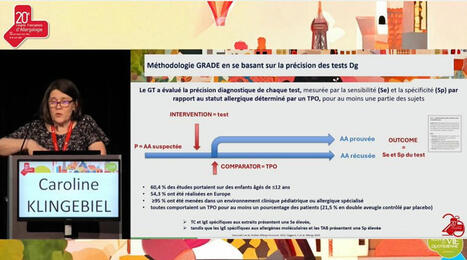
On behalf of the Allergy Diagnosis Working Group Of the French Society of Allergology (GTBA – SFA), I’m proud to have contributed to the dissemination of the EAACI guidelines on the diagnosis of IgE-mediated Food Allergy within the French-speaking medical community:
- French translation of the food allergy guidelines on diagnosis for a special issue of the French Allergy Journal (RFA) dedicated to Food Allergy: https://lnkd.in/dBAxRQXC
- Plenary presentation at the French National Congress of Allergology (CFA 2025) in Paris with a focus on methodology based on the accuracy of diagnostic tests to understand the recommended diagnostic approach: https://lnkd.in/dGAEc7PK
- Presentation at a workshop/controversy at the 30th National Congress of AMAFORCAL in Rabat, Morocco
Julien Goret, Joana Vitte, Alexandra Santos, MD PhD, Société Française d'Allergologie - SFA, European Academy of Allergy and Clinical Immunology - EAACI, @GTBA, Youness EL GUEDDARI, Elleni-Sofia Vaia
|
|
Scooped by
Gilbert C FAURE
January 21, 2025 12:21 PM
|
#Food #allergies are an increasing global health concern, presenting with symptoms ranging from mild reactions to severe, life-threatening anaphylaxis. The…
|




 Scoop.it!