Your new post is loading...
From 2017-08-01 to 2017-08-03, Harbin, China, IUFRO Unit(s) involved: 8.00.00, 1.00.00
The topics of this symposium are (1) the restoration and reconstruction, (2) the sustainable management, and (3) the service function of forest ecosystems in the context of global change.
Exploring the vital connections between nature's well-being and our own.
ations, et l'aide à la constitution de réseaux de coopération.
By Vincent Gitz, Director, CGIAR Research Program on Forests, Trees and Agroforestry, and Meine van Noordwijk, Landscape Research Leader, CGIAR Research Program on Forests, Trees and Agroforestry. FTA recently organized a two-day virtual symposium entitled Trees, forests and water: cool insights for a hot world to share live online the findings of a recent review paper by David Ellison and …
Les rencontres nationales de l'éco-pâturage ont lieu ce 23 mars à Angers. L'occasion de s'interroger sur le développement sans précédent de cette pratique, utilisée dans des centaines de …
Forest management, agroforestry and tree planting are some of the key approaches to sustainable rural development, and climate change adaptation and mitigation in West African savannas. However, the planning of land management interventions is hindered by the lack of information at relevant spatial resolution. We examined predictive models for mapping various tree, soil and species diversity attributes with a comparison of RapidEye and Landsat imagery.
Trees for Food Security Project goal is to enhance food security for resource-poor people in rural Eastern Africa through research that supports national programmes to scale up the use of trees within farming systems in Ethiopia and Rwanda and then scale out successes to relevant ago-ecological zones in Uganda and Burundi. Through the project, 5 Rural Resource Centers (2 in …
Publication date: July 2017
Source:International Journal of Applied Earth Observation and Geoinformation, Volume 59
Author(s): R. Tortini, S.M. van Manen, B.R.B Parkes, S.A. Carn
Although the impacts of large volcanic eruptions on the global environment have been frequently studied, the impacts of lower tropospheric emissions from persistently degassing volcanoes remain poorly understood. Gas emissions from persistent degassing exceed those from sporadic eruptive activity, and can have significant long-term (years to decades) effects on local and regional scales, both on humans and the environment. Here, we exploit a variety of high temporal and high spatial resolution satellite-based time series and complementary ground-based measurements of element deposition and surveys of species richness, to enable a comprehensive spatio-temporal assessment of sulfur dioxide (SO2) emissions and their associated impacts on vegetation at Turrialba volcano (Costa Rica) from 2000 to 2013. We observe increased emissions of SO2 coincident with a decline in vegetation health downwind of the vents, in accordance with the prevalent wind direction at Turrialba. We also find that satellite-derived vegetation indices at various spatial resolutions are able to accurately define the vegetation kill zone, the extent of which is independently confirmed by ground-based sampling, and monitor its expansion over time. In addition, ecological impacts in terms of vegetation composition and diversity and physiological damage to vegetation, all spatially correspond to fumigation by Turrialba’s plume. This study shows that analyzing and relating satellite observations to conditions and impacts on the ground can provide an increased understanding of volcanic degassing, its impacts in terms of the long-term vegetation response and the potential of satellite-based monitoring to inform hazard management strategies related to land use.
An understanding of wood physical properties and the interrelationships that govern them is required for efficient utilization of timber tree species. Guazuma crinita is a fast-growing timber tree of agroforestry systems in the Peruvian Amazon. The aim of this study was to assess variation in wood physical properties within the G. crinita stem.
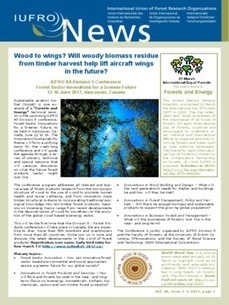
"Forests and Energy" is the 2017 theme of the International Day of Forests on 21 March! IUFRO Division 5 - Forest Products will address this and related themes in a major conference this June.
The highest deforestation and forest degradation rates in Africa occur in the dry forests and woodlands where pressure for land is increasing, poverty is rampant, livelihood options are few and climate change effects are severe. This paper examines factors that cause land and forest degradation in the Sahel and dry forests and woodlands of eastern and southern Africa and highlights some successful restoration practices, technologies and approaches.
Presentation by Maria Brockhaus, Professor of International Forest Policy at the University of Helsinki, Finland, at a workshop on ‘Sharing insights across REDD+ countries: Opportunities and obstacles for effective, efficient, and equitable REDD+ carbon and non-carbon results’, held from 21-23 February 2017 in Naypyidaw, Myanmar. Forests, Climate Change and REDD+: A brief introduction from Center for International Forestry Research (CIFOR)
Subsistence farmers in sub-Saharan Africa are highly vulnerable to food insecurity given their low adaptive capacity against ecological and socio-economic shocks. Therefore, food security is one of their main challenges. Participatory action research across food value chains (FVCs) can help stabilize and enhance food security by developing upgrading strategies (UPS) that enhance specific aspects of crop production, post-harvest processing, marketing, income generation, and consumption.
|
The International Tropical Timber Organization (ITTO) Official Web Site.
Publication date: 1 August 2017
Source:Geoderma, Volume 299
Author(s): Chunfeng Chen, Wenjie Liu, Xiaojin Jiang, Junen Wu
Rubber-based agroforestry (Hevea brasiliensis) systems are considered the best way to improve soil properties and the overall environmental quality of rubber monoculture, but few reports have examined soil aggregate stability in such systems. The objective of this study was to examine the management and landscape effects on water stable soil aggregates, soil aggregate-associated carbon, nitrogen content and soil carbon, and nitrogen accumulation in Xishuangbanna, southwestern China. Treatments were rubber monoculture (Rm) and four rubber-based agroforestry systems: H. brasiliensis–C. arabica (CAAs), H. brasiliensis–T. cacao (TCAs), H. brasiliensis–F. macrophylla (FMAs) and H. brasiliensis–D. cochinchinensis (DCAs). The results showed that, with the exception of CAAs, the rubber-based agroforestry treatments significantly increased total soil organic carbon (SOC) and N contents and enhanced the formation of macroaggregates compared to the rubber monoculture treatment. SOC and N contents in all water-stable aggregate fractions were significantly higher in rubber-based agroforestry systems (except CAAs) compared to rubber monoculture. The macroaggregate fractions contained more organic carbon and nitrogen than the microaggregate fractions. The proportions of C and N loss from slaking and sieving were shown to have significantly negative correlations with the mean weight diameter and the SOC and N concentrations in bulk soil. The results suggest that soil surface cover with constant leaf litter fall and extensive root systems in the rubber-based agroforestry systems increased soil organic carbon and nitrogen, helped improve soil aggregation, reduced soil erosion, decreased carbon and nitrogen loss, and ultimately improved the carbon and nitrogen accumulation rates. Given that the soil physical-chemical properties improvement and the patterns of the intercropping system played key roles in managing artificial forests, we recommend that local governments and farmers should prefer T. cacao, F. macrophylla and D. cochinchinensis and not C. arabica as the alternative interplanted tree species within rubber plantations.
Publication date: July 2017
Source:Resources, Conservation and Recycling, Volume 122
Author(s): Camila T.D. Numazawa, Sueo Numazawa, Sergio Pacca, Vanderley M. John
Forest management has been repeatedly mentioned as a strategy to reduce damage caused by logging when compared with conventional logging. Much has been learned about logging impacts and prospects for forest management, but there are still too many gaps regarding the CO2 emissions in logging, due to residues and their impact on the carbon balance. Here we compare CO2 emissions between two timber harvesting intensity systems. Logging with an intensity of 30m3 ha−1 (L30) and logging with an intensity of 15m3 ha−1 (L15) were compared over 4 rotation periods (120 year total timeframe). Original logging residues (LR) data was used to determine emissions from residues decomposition. On average, L30 has produced more LR (41.60tha−1), than L15 (20.90tha−1); for each tonne of commercial stem in L30, 2.13 tonnes of logging residues were obtained and 2.05 tonnes of residues were found in L15. Moreover, we have created a scenario representing the carbon balance (emissions from residues versus carbon uptake from biomass re-growth) over a 120 year long period to evaluate the outcomes for both logging intensities. We find that it will need about 38.3 years under L30; whereas 18.2 years were required in the case of L15. The L30 growth period is greater than the cutting cycle, which means that aboveground standing biomass is not able to fully recover until the next cutting cycle. Fully biomass recovery was only achieved when L15 was applied. Furthermore, the diameter of the commercial tree species takes a longer time to recover than the cutting cycle. Finally, ignoring the post harvesting life cycle phases, both CO2 balances were negative, which means that both practices ended up uptaking CO2 from the atmosphere.
Portail de veille thématique pour les sciences sociales en Agriculture, Alimentation, Espace et Environnement
Agricultural advisory systems aim to improve livelihoods and well-being of the rural community by enhancing information exchange and capacity for collective action. In East Africa, advisory systems are becoming more demand driven and are being provided by an increasingly complex range of actors using participatory approaches. Social network analysis (SNA) provides a tool to examine farmer networks for broad assessment of agricultural advisory systems.
L'Autorité environnementale (AE) a émis le 24 mars un avis sévère sur la stratégie nationale de mobilisation de la biomasse (SNMB) et le plan d’actions que celle-ci sous-tend. Or cette …
By Pablo Pacheco, Coordinator of Flagship 3 of the CGIAR Research Program on Forests, Trees and Agroforestry, originally published at CIFOR’s Forests News Recently, I came across a much publicized article in The New York Times about the impact of two of the world’s biggest grain traders, Cargill and Bunge, on deforestation trends in the agricultural frontiers of Brazil and …
Une récente publication dans eLIFE, cosignée par Sylvie Gourlet-Fleury (UPR Forêts & Sociétés) remet en cause l'idée d'une forêt tout à fait primaire dans les forêts du Bassin du Congo.
La sélection participative du sorgho au Burkina Faso : créer de nouvelles variétés avec et pour les paysans : Au milieu des années 1990, les sélectionneurs de sorgho adoptent, au Burkina Faso, une nouvelle méthode de création variétale : la sélection participative. Elle est fondée sur un princip
La journée internationale des forêts offre une tribune aux ONG pour appeler la FAO à revoir sa définition de la forêt pour mettre fin à des activités potentiellement écocides.
Transformations agricoles et agroalimentaires - Entre écologie et capitalisme : L’ouvrage synthétise des recherches récentes sur l’évolution de l’agriculture et de l’alimentation dans la dynamique du capitalisme. Il s’appuie sur des approches peu connues en France comm
|


 Scoop.it!