Your new post is loading...
2015 The Center for International Forestry Research (CIFOR), the World Agroforestry Centre (ICRAF) and the International Union of Forest Research Organisations (IUFRO) joined forces at UNFF11 aiming to enhance the interaction...
Cashew tree in Burkina Faso. Photo: Ollivier Girard/CIFOR
A new report on the link between forests, food and nutrition highlights the important roles trees play in the dual challenges of ending hunger and addressing climate change.
The Planting Empowerment project is restoring deforested land for future generations
“During dry season you see huge trucks loaded with enormous logs rolling out of the Darien jungle every day.
A project in 3 African countries is seeking to overcome the problem of low yields by making farmers aware of the links between climate change and soil fertility, and what can be done to improve the read more...
Au sommaire du dernier numéro de BFT :
“Perceptions of Climate Change Risk to Forest Ecosystems: A Case Study of Patale Community Forestry User Group, Nepal”, International Journal of Environmental, Ecological, Geological and Geophysical Engineering, vol.
Source: Bioversity publications
“Enforcing sustainable logging and assigning a monetary value to the carbon stored in forest concessions managed under the REDD+ mechanism will not be enough to curb deforestation in Central Africa.” That’s from CIFOR’s Forest News Blog, in a post...
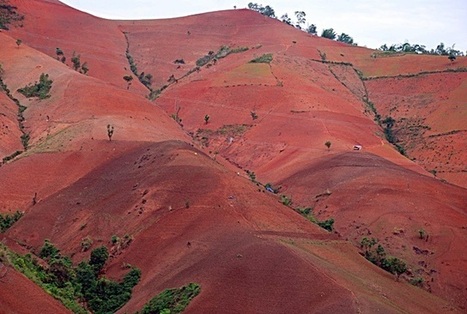
Land degradation owing to monocropping is the main reason for reduced agricultural productivity in Northwest Viet Nam. But after four years of agroforestry research, results show positive signs for farmers.
This presentation by Dietrich Schmidt-Vogt provides information on the dynamics of land use change in the Mekong region and its implication for forest cover, livelihoods and biodiversity.
Implicit in all development work is the quest for impact. Positively influencing livelihoods, landscapes and ecosystems is the goal of our work.
|
Accroître la connaissance sur les systèmes agroforestiers et leurs bénéfices économiques, développer la formation et le conseil, simplifier les dispositifs de soutien, mettre en place une certification du bois agroforestier...
Forests, Trees and Landscapes for Food Security and Nutrition. A Global Assessment Report.
It’s tough to wrap your head around the concept of owning something like carbon, or having “carbon rights.” Unlike resources such as water, it’s not clear what direct value carbon has. You can’t drink it or eat it.
Jeudi 30 avril, le ministère de l'Ecologie a publié une note méthodologique relative à l'évaluation environnementale stratégique des plans, programmes et schémas. L'objectif ? Donner une vision complète de la démarche à conduire ainsi que des cons...
The Democratic Republic of Congo (DRC) is home to the second-largest single block of forest in the world, and its forests make up two-thirds of the Congo Basin forest area.
BOGOR, Indonesia—In an opinion article in Science magazine more than 45 scientists asked policymakers and environmental agencies to “get the science right when paying for nature’s services”.
The Democratic Republic of the Congo (DRC) is one of the first REDD+ target countries due its huge forest ecosystem...
Deux ans après l'application du règlement européen interdisant l'importation et la production de bois illégal, la France déploie ses moyens de contrôle des entreprises pour s'assurer de l'origine et de la traçabilité de leurs stocks.
En 2015, ce Congrès constituera la meilleure opportunité pour les forestiers et les partisans de la forêt de partager leurs expériences et expertise, de forger de nouveaux partenariats et de définir une vision cohérente et globale du rôle des...
Forest carbon sequestration has become an important ecological service for human society.
Source: CIRAD
A vast amount of work has been carried out on the impact of or adaptation to climate change by players in Languedoc-Roussillon.
Source: CIFOR publications
|


 Scoop.it!