Your new post is loading...
En raison de son extraordinaire richesse floristique et faunistique, l’étude de l’écologie de la forêt amazonienne impose des choix. Ceux que j’ai privilégiés s’enracinent dans mon parcours au Muséum national d’Histoire naturelle. Avec l’illustrateur Julien Norwood, je raconte et illustre la biologie et le fonctionnement de l’écosystème forestier tropical de Guyane. J’y propose une synthèse de l’histoire et du quotidien des populations qui y vivent, de leurs usages, de leurs liens avec la biodiversité qui les entoure, ainsi que des recherches menées sur le terrain par les scientifiques. Au cours de cette conférence, je vous invite à parcourir une “année écologique” en douze tableaux, un par mois, au rythme des cycles annuels de reproduction et de phénologie des organismes végétaux et animaux, au fil de l’alternance des saisons sèches et humides.
Les systèmes de compensation sont plus pertinents, vis-à-vis des petits paysans, qu’une approche réglementaire. Mais leur efficacité dépend aussi du contexte.
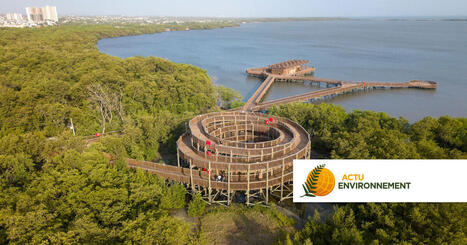
Protéger le vivant : une exigence que le changement climatique ravive à chaque instant. La COP biodiversité rassemble, jusqu’à vendredi, les experts en Arménie pour évaluer les progrès réalisés. Exemple…
La pollution n'est pas toujours une transgression. Parfois, elle est le résultat d'un cadre réglementaire assumé, d'une décision publique parfaitement légale au moment où elle est prise. C'est ce que l'on appelle la pollution légale : des substances autorisées, des seuils jugés acceptables, une surveillance parfois lacunaire et, des années plus tard, des effets sanitaires et écologiques irréversibles.
The 2026 edition of Tracking Economic Instruments and Finance for Biodiversity provides the latest data on the use of biodiversity-relevant economic instruments (known as positive incentives under the Convention on Biological Diversity’s Kunming-Montreal Global Biodiversity Framework). It also includes data on the finance they mobilise or revenues they generate. Drawing on the OECD database on Policy Instruments for the Environment (PINE), which covers data from over 150 countries, it includes information on biodiversity-positive taxes and fees, tradable permits, environmentally motivated subsidies, payments for ecosystem services and biodiversity offsets.
New mapping by Brazil’s agricultural research agency, Embrapa, found that the area on which cacao grows in Pará state rose 33% between 2022 and 2024, with 96% of mapped cacao on land cleared before 2020. That record leaves Amazon cacao well positioned to meet the EU’s new deforestation rules, with the sector keen to secure better prices for farmers who grow cacao without clearing forest. Most new plantings are full-sun monocultures, which are less sustainable than agroforestry, but sources say Brazil is unlikely to follow West African countries in clearing forest for cacao.
Un rapport de l'ONU publié dans le cadre de la COP 17 d'Erevan révèle que 252 millions d'hectares dans 149 pays sont en cours de restauration. Mais les financements doivent quadrupler et les écosystèmes aquatiques sont à la peine.
What will it take for proven practices like farmer managed natural regeneration (FMNR) to reach millions more farms across the Great Green Wall?The last cross-learning event of 2026 builds on a new collection of five policy briefs recently published by the Landscape Alliance, and takes place just...
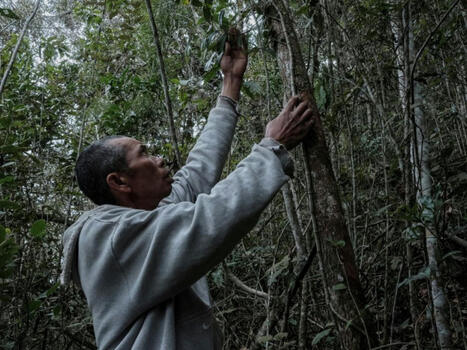
Victime de son succès, le poivre sauvage commence à se faire rare à Madagascar. Menacée de surcroit par les feux de brousses allumés pour le charbon ou la culture sur brulis, l'épice tente de se faire domestiquer par quelques entrepreneurs sur place.
Le dernier rapport sur l’état des rhinocéros dans le monde révèle la situation alarmante des populations de rhinocéros de Java et de Sumatra.
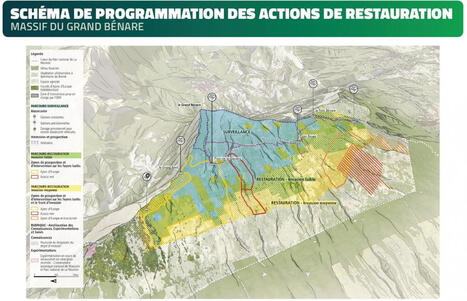
Au cœur du massif du Grand Bénare, à La Réunion, une cartographie fine des milieux naturels et de leur degré d’invasion devient une véritable feuille de route. Issue du croisement de données de terrain, de télédétection et de l’expertise des gestionnaires, elle permet désormais de passer du diagnostic à la programmation concrète des actions de conservation et de restauration.
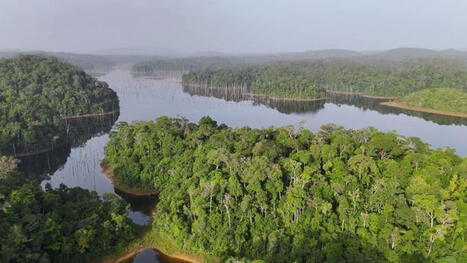
Un nouveau projet piloté par Cécile Richard-Hansen, chercheuse OFB associée EcoFoG a démarré depuis quelques mois et s’intéresse à la biodiversité insulaire sur le lac de petit saut.
|
Depuis une trentaine d’années, une série de mots colonisent le vocabulaire employé par les scientifiques en présentant la situation écologique sous un angle managérial.
Au Cameroun, des scientifiques étudient le devenir des graines du noisetier d’Afrique dans deux forêts aux faunes contrastées.
At the midpoint of the UN Decade on Ecosystem Restoration, this report provides the first comprehensive global assessment of progress towards restoring degraded ecosystems and achieving international restoration targets and commitments. Drawing on data from national reporting to the Rio Conventions and other multilateral environmental agreements, as well as global restoration monitoring initiatives and other sources, it evaluates the extent to which restoration efforts are contributing to the goals of the Kunming-Montreal Global Biodiversity Framework, with a particular focus on Target 2.Covering terrestrial, freshwater, marine and coastal ecosystems, the report examines restoration achievements to date, the scale and drivers of ecosystem degradation, documented restoration efforts, and the financing supporting implementation. It assesses whether current progress is sufficient to meet global ambitions and identifies key gaps in monitoring, implementation, policy and investment that continue to constrain action.Recognizing that restoration success depends on more than the number of hectares restored, the report also considers the social, institutional and governance dimensions that underpin lasting outcomes. Secure tenure rights, gender equality,...
Vingt ans après son lancement, la Grande Muraille Verte africaine affiche des résultats que personne n'attendait vraiment à cette échelle.
Après deux semaines de difficiles débats, les participants à la COP17 ont adopté une cinquantaine de textes essentiels pour poursuivre la lutte contre la destruction du vivant. La quête de consensus entre pays a toutefois contraint à édulcorer une partie des décisions.
Healthy, productive landscapes must be part of the biodiversity solution in order to achieve the targets of the Kunming-Montreal Global Biodiversity Framework (KMGBF). Biodiversity cannot be fenced off in isolation. This was the key message ITTO Executive Director Sheam Satkuru delivered to delegates at the high-level segment of the 17th Conference of the Parties to the Convention on Biological Diversity.
La quasi-totalité des récifs coralliens en eaux peu profondes à travers le monde est exposée à un « risque extrêmement élevé » de disparition d’ici 2075 en raison du changement climatique, a averti jeudi l’Union internationale pour la conservation de la nature (UICN).
Dans la région du Sebungwe (Zimbabwe), au cœur de l’aire transfrontalière de conservation du Kavango-Zambèze (KAZA), le projet BRIDGES (Biodiversity, Resilience & Inclusive Development for Growth, Equity & Sustainability) innove en associant conservation de la biodiversité, réduction des conflits...
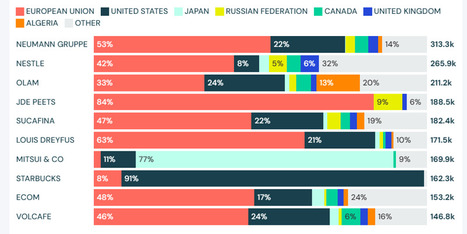
Règlement européen contre la déforestation, règles de traçabilité et marché mondial du café -...
This new edition of the book A guide to sugarcane diseases is a revised and updated version of the first edition published in 2000 by the International Society of Sugar Cane Technologists (ISSCT) and CIRAD, with the same objective of gathering practical and updated information in sugarcane pathology. During the last two decades, new diseases have developed and distribution of known diseases has expanded. Furthermore, significant progress was made in disease diagnosis with the emergence of powerful new molecular methods.
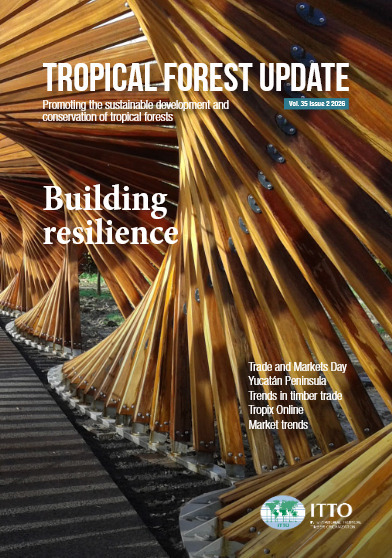
Tropical forestry’s resilience continues to be tested by, amongst others, regulatory shifts, economic uncertainty, and ecosystem pressures. Yet, encouragingly, the articles in this edition of Tropical Forest Update reveal that the sector continues to move and evolve in ways that strengthen its resilience for the future. From international conferences and regional dialogues to field projects, from technological innovation to trade reconfiguration, stakeholders across the tropics are adapting, ensuring forests and their value chains remain sustainable, competitive, and inclusive, with ITTO persisting in its vital supporting and enabling role.
Invasion fronts are the advancing edges of non-native species' ranges and represent dynamic, non-equilibrium boundaries where colonization, biotic interactions and rapid evolutionary processes interact. Although biological invasions are increasingly well studied, the ecological and evolutionary mechanisms operating at invasion fronts remain conceptually fragmented despite their disproportionate influence on spread dynamics, exerted impact and management. Here, we synthesize how invasion-front geometries arise from interactions among propagule pressure, landscape permeability, long-distance dispersal and environmental heterogeneity, producing continuous (including satellite colonies), patchy/fragmented or coalescing fronts that shift with invasion stage and spatiotemporal scales. We integrate ecological and evolutionary evidence from macro-organisms to show how gradients from core to front can result in declining population density, increased trait divergence, spatial sorting, serial founder effects, expansion load, and behavioural and physiological differentiation. We further draw parallels with climate-driven ...
|