


A comperlation of 20 color photos of Lancaster bombers, their crews and the ground staff who maintained them in WW2 1942-45.

 Your new post is loading...
 Scoop.it! A comperlation of 20 color photos of Lancaster bombers, their crews and the ground staff who maintained them in WW2 1942-45. 
No comment yet.
Sign up to comment
Scoop.it!

RUSI will hold an exhibition to highlight the contribution of Bomber Command to the Allied victory during the Second World War. This will coincide with the launch of the new memorial to Bomber Command Servicemen, due to be erected in London later this year.
The exhibition has been put together by the Bomber Command Association and will include an architect’s model and illustrations of the commemorative memorial scheduled to open in Green Park this summer. The display will illustrate the history of Bomber Command and its role during the Second World War by using information panels, photographs and exhibits, including a bombsight, aircrew logbook, flak maps and targeting material.
Of the approximately 125,000 aircrew who served in the Command an astonishing 55,573 were killed. The UK nationals killed serving in Bomber Command represent ten per cent of all British servicemen killed in the War. The new memorial will mark the extraordinary sacrifice made by these aircrews.
The exhibition is free and RUSI members can visit at any time during the Institute’s opening hours.
Monday 30 January, 1000–1700
Scoop.it!
From
yfrog

Newsreel 1944: Lancaster bombers sink German battleship Tirpitz!
Scoop.it!
My tribute to the lads from Bomber Command Revamped a little bit.
Scoop.it!
Thanks to YouTube for agreeing to re-instate this video. It would be a fitting tribute to all who served with Bomber Command, British, Commonwealth and Allies, to be recognised by the British Government by means of a national memorial - not to celebrate war but to recognise the great sacrifice made by so many - more than 57,200 mainly young people. Although a Lancaster bomber is depicted in this video, we must not forget that a great variety of aircraft were flown during WWII and I personally salute all aircrew, groundcrew and support staff involved in this epic struggle.
Scoop.it!

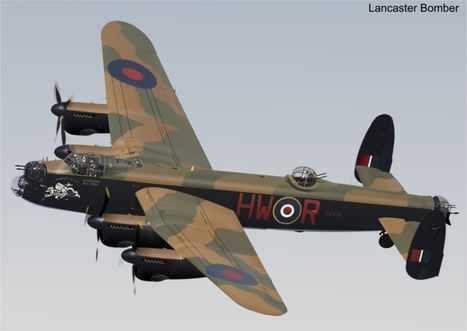
The Avro Lancaster is a British four-engined Second World War heavy bomber made initially by Avro for the Royal Air Force (RAF). It first saw active service in 1942, and together with the Handley Page Halifax it was one of the main heavy bombers of the RAF, the RCAF, and squadrons from other Commonwealth and European countries serving within RAF Bomber Command.
Scoop.it!

WWII pilot's invite from Tendulkar Reg Ellis, Lancaster bomber pilot and last surviving member of the post war Australian side, at the Sir Donald Bradman Oration.
Scoop.it!
..(I favorited a @YouTube video http://t.co/O7M0miHb Lancaster Bomber and Spitfires, Battle of Britain Memor...)...
Scoop.it!

"There are no words with which I can do justice to the aircrew who fought under my command. There is no parallel in warfare to such courage and determination in the face of danger over so prolonged a period. . . it was, moreover, a clear and highly conscious courage, by which the risk was taken with calm forethought. . . it was, furthermore, the courage of the small hours, of men virtually alone, for at his battle-station the airman is virtually alone. It was the courage of men with long-drawn apprehensions of daily 'going over the top'. Such devotion must never be forgotten!" - Sir Arthur Harris, Marshall of the Royal Air Force - Lest we forget!
Scoop.it!
"The Lancaster Bomber was used in the war to drop the bouncing bomb. The RAF practice for the attack on the dams in Germany's Ruhr Valley at Ladybower Reservoir not far from where I live. These dams were used by Dr. Barnes Wallis and his team to test his bouncing bomb and the film 'The Dam Busters' telling this interesting story was shot here." A.Wrigley
Scoop.it!

image: A head and shoulder portrait of Flight Lieutenant Coffey in uniform, turning left.
Scoop.it!

image: Head and shoulder portrait of Flight Lieutenant Baird in uniform, turning to the right.
Scoop.it!

EVERY day for nearly 70 years, Dennis Bartlett silently thanked bomber pilot Bill North for saving his life.
|
Scoop.it!

I quote a figure of 'over 57,000' names commemorated in this Roll of Honour; it is now necessary to be much more precise and explain in some detail the reasoning and methods used in garnering the statistics that follow. In recent years various figures have been bandied about as to how many airmen, and airwomen, died while serving with Bomber Command, the general consensus of opinion settling on '55,500'. The first question now must be; from where did this figure originate? Turning to the quite invaluable work of Martin Middlebrook and Chris Everitt in compiling their epic Bomber Command War Diaries and in particular to their analysis of the operational statistics for the period 3rd September, 1939 to 7th-8th May, 1945, the breakdown of aircrew casualties are shown as, and I now quote precisely from what is reported on page 708 of the diaries: 'The Air Ministry was able to compile the following figures up to 31 May 1947:

Pam Browne's comment,
March 9, 2017 7:34 PM
Hi Peter. Thanks for taking my call and your kind offer to point us in the right direction. All we know if that his mother said that her brother was killed while in the RAF during WW2. Only have the surname of Ainsworth no first names. His mother Dorita Blundell bee Ainsworth was in the WAAF as a telephonist at Andover UK. She said she won a Military Medal for coming to operate the telephones while being bombed. There were only 6 awarded to women's auxiliary airforce. I can find a complete list of the names for this either. Any assistance would be greatly appreciated. Psbrowne@hotmail.com 0408 579 781 Bowral NSW
Scoop.it!
Lancaster Bomber Takes off at RAF Fairford
Scoop.it!

A site selling many Lancaster Bomber T-Shirts, mugs, ties, posters, cards, mousepads and caps.
Scoop.it!

Remembering youngest bomber squadron commanding officer in the history of RAFGrimsby TelegraphIn just two years, a young man stationed near Grimsby during the war rose to become one of the most elite of the Bomber Command.
Scoop.it!

The first one is the Lancaster Bomber, the mainstay of the British RAF during the war and the second one is the Vulcan Bomber, which is one of the most beautiful, nay pretty planes in the world. Happy flying.
Scoop.it!

The Australians at War Film Archive contains the transcripts of interviews with representative veterans from all conflicts dating back to World War I. This search result includes the stories of 38 Australians that were involved in some way with 460 Squadron.
Scoop.it!

Yorkshire Evening PostQuest to solve riddle of war hero is overYorkshire Evening PostWhen Sgt Sullivan died he had been flying with 460 squadron of the RAAF, based in Lincolnshire , which was part of the RAF's bomber command.
Scoop.it!

Here is the journey from ariving in Brighton in England as a individual to leaving Lichfield as a bomber crew ready to fly the Lancaster Bombers of 460 Squdron over Europe in 1943-44.
Scoop.it!

Remember. Squadron Leader James CLARK. DFC, AFC. No. 460 Squadron (RAF). Royal Australian Air Force. Killed In Action on the 12th December 1944 aged 29.
Scoop.it!

A typical group of 'Aussie' aircrew of No 460 Squadron, RAAF, photographed at Breighton, Yorkshire, 21 April 1942.
Scoop.it!

A head and shoulder portrait of Flight Sergeant Prout wearing a flying suit and turning slightly towards the left.
Scoop.it!

Fortunately I vividly remember the words of a now long-dead Lancaster pilot who had also flown just about everything else that was capable of taking to the air in the Second World War: "The Lancaster was the most boring bomber I ever flew. She had no character, no temperament, no vices... simply the dullest plane one could imagine flying. And that is exactly how war time pilots like their bombers: docile, trustworthy, doing exactly as they're told, without a will of their own".
|





