


RAF Bombing Offensive Against Germany...

460 Squadron - Bomber Command: 1942-45
47.8K views |
+2 today
Dedicated to the air and ground crews of 460 squadron (1941-45) and the Lancaster Bombers they flew.
Curated by
Peter John Baskerville
 Your new post is loading...
 Scoop.it! 
After 65 years one of the longest serving political ghosts of the Second World War has finally been put to rest, in a planning meeting at Westminster Council. 
Scoop.it!
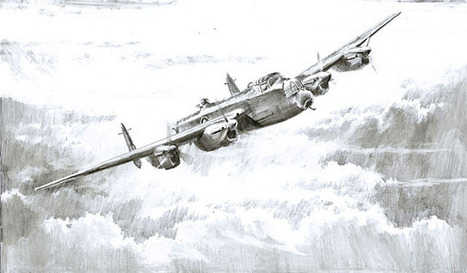
Drawing of a Lancaster Bomber by Simon W. Atack - A selection of original paintings, prints and original drawings covering WW2 aircraft are available to purchase from sales@simonatack.com or phone 07971 060639.
Scoop.it!

Amazingly these photos were not taken 70 years ago but this week, at the Lincolnshire Aviation Heritage Centre at the former Lancaster bomber base at RAF East Kirkby.
Scoop.it!

A montague of Lancaster bomber photos.
Scoop.it!
Probably the most famous allied bomber of World War Two was the Avro Lancaster of Bomber Command. It was born out of the failure of the twin engine Manchester bomber. Avro took the basically sound Manchester airframe and redesigned it to take four Rolls Royce Merlin engines.
Scoop.it!

Harris was "a forceful man", said author Keith Lowe. "[He] possessed of almost boundless energy and a bluntness that verged upon rudeness." He was known for his attitude toward the Army, noting that the conservative generals would never adopt mobile warfare until the tanks could "eat hay and shit" like the generals' beloved cavalry. He had few friends as a result of his brashness, but the few who he held dear were extreme loyal. To friends such as Charles Portal, Robert Saundly, and Ira Eaker, he was "Butcher" or "Butch" for short, a nickname that referred to his can-do attitude, always out there to get the job done. This nickname, however, was later taken out of context after his bombing campaign against Germany during the European War.
Scoop.it!
|


|
Scooped by
Peter John Baskerville
February 17, 2012 10:54 PM
|
Scoop.it!

At RAF museum and a Lancaster bomber crew has been reunited.
Photo taken at RAF museum by madtrace using Instagram.
|
|
Scooped by
Peter John Baskerville
February 10, 2012 7:22 AM
|
Scoop.it!
As seen on PBS stations around the US comes a new "living history" series reliving the early days of World War II. Using a unique blend of living history elements, CGI, first-person interviews and never-before-seen W.W.II footage. This dramatic four-part documentary series "Bomber Boys: The Fighting Lancaster" follows a new generation of "Bomber Boys" as they train to become a Lancaster Bomber crew. Joe English was nineteen when he joined the Air Force. He learned to fly a bomber before he could drive a car. The pilot of a Lancaster known as 'the Lucky H', Joe and six other hardy young men flew thirty combat missions over Germany. Sixty years later, Joe's grandson, Mathew English, will try to walk in his grandfather's footsteps. Matthew is one of seven young volunteers from the U.S., UK Australia and Canada who make up 'Baker Flight." All are descendents of World War Two flight crews, ready to test themselves against the original training regime of the British Commonwealth Air Training Plan. They're up at dawn, marching and saluting, cleaning and polishing, in classrooms and period planes, struggling to see whether they are the men their grandfathers once were.

|
Suggested by
gary
February 8, 2012 2:44 PM
|
Scoop.it!

Evocative photorealistic digital realisation of a flight of Lancasters taking off into the sunset.
|
|
Scooped by
Peter John Baskerville
January 31, 2012 4:05 PM
|
Scoop.it!
Colin and Ewan McGregor fly in an original Lancaster bomber used in WW2 and explore the awesome WW2 fighting force that was Bomber Command.
|
|
Scooped by
Peter John Baskerville
January 26, 2012 11:17 PM
|
Scoop.it!
Lancasters from RAF Hemswell taking off for a raid on Berlin. It is from the film which is actually called Night Bombers and is from the Archive of War series.
|
|
Scooped by
Peter John Baskerville
April 13, 2012 8:14 AM
|
Scoop.it!
RAF Bombing Offensive Against Germany (Bomber Command and smashing infrastructure; then smashing cities: http://t.co/uBEVw1ug...)...
|
|
Scooped by
Peter John Baskerville
April 8, 2012 5:52 AM
|
Scoop.it!

It held the line for the free world against the advancing scourge of the Nazis during the Second World War, now the Royal Air Force Bomber Command is being honoured with its own hallowed memorial in London, England.
|
|
Scooped by
Peter John Baskerville
April 6, 2012 4:43 PM
|
Scoop.it!

Ewan McGregor and his aviator brother Colin tell the story of the RAF's Bomber Command and the men who fought and died in the skies above Europe during World War Two. Ewan and Colin meet a number of key surviving members of Bomber Command and take on a variety of practical challenges. While Colin fulfils his lifetime ambition of flying one of the only two surviving Lancaster Bombers, Ewan learns what it was like being a tail-gunner - perhaps the most lonely and dangerous job of all bomber aircrew.
|
|
Scooped by
Peter John Baskerville
March 19, 2012 4:52 PM
|
Scoop.it!

HE was a member of the legendary Dambusters – Allied airmen including Australians who risked their lives in extreme circumstances during the Second World War.
When a force of Lancaster bombers, with bomb-aimer George Clark and his buddies in the 617 Squadron on board, breached or damaged three of Germany’s mighty Ruhr Valley dams, there was little doubt their gallant exploits would give them an immortal place in Australian war history.
|
|
Scooped by
Peter John Baskerville
March 16, 2012 5:42 AM
|
Scoop.it!

The Avro Lancaster was the best, most effective, British workhorse bomber for the RAF in World War II. It was developed from a previous, unsuccessful two engine bomber effort, the Manchester, which was plagued with unreliable engines, appropriately named Vultures. The Lancaster used many of the Manchester’s parts including its extraordinarily sturdy fuselage. The resulting aircraft had remarkable flying characteristics and was powered by the famous Rolls Royce Merlin XX engine, the same powerplant used by the Spitfire.
|
|
Scooped by
Peter John Baskerville
March 7, 2012 5:42 AM
|
Scoop.it!
My dad's Lancaster Bomber WW2 - "O" for Oboe

ND968 - AR-O - "O" Oboe on Brinbrook UK dispersal 1944. My dad's crew did 26 trips in her between 17/9/44 and 27/12/44. No wonder they felt attached to her.
|
|
Scooped by
Peter John Baskerville
February 23, 2012 3:12 PM
|
Scoop.it!

“The Nazis entered this war under the rather childish delusion that they were going to bomb everyone else, and nobody was going to bomb them. At Rotterdam, London, Warsaw, and half a hundred other places, they put their rather naive theory into operation. They sowed the wind, and now they are going to reap the whirlwind.”
|
|
Scooped by
Peter John Baskerville
February 17, 2012 11:00 PM
|
Scoop.it!

A LANCASTER bomber crew were yesterday reunited with the famous aircraft for what will probably be the last time.
Eight veterans met at RAF Coningsby in Lincolnshire, which is home to one of only two airworthy Lancasters. The war heroes stepped inside the four-engined bomber where they spent night after night dodging enemy re while ying sorties over Nazi-occupied Europe.
Former pilot, Wing Commander James Flint, 97, above, said: "Some of the missions were a bit naughty but you just got on with it. "The Lancaster was a beautiful aircraft and was all sorts of fun to fly." He added: "It's nice to come back and hear the stories."
Flight Sergeant Jim McGillivay, 84, sat in his rear gunner's seat for the rst time in 65 years. He said: "It's feet first, like slipping a cork in to a bottle."
|
|
Scooped by
Peter John Baskerville
February 10, 2012 3:29 PM
|
Scoop.it!

A collection of photos, design details, specifications, usage and production details for the Lancaster bomber.
Over 156,000 missions were flown by Lancasters with 608,612 tons of bombs dropped. Approximately 3,836 Lancasters were lost during World War II in operations over Germany. Famously used in the "Dambusters" raid where a rotating bomb skipped across the water to sink next to the dam and then detonate. The dams that were destroyed were the Möhne, Eder, and Sorpe. Also used in the sinking of the Tirpitz in Tromso Fjord in Norway on November 12, 1944.
|
|
Scooped by
Peter John Baskerville
February 9, 2012 7:39 AM
|
Scoop.it!

Fitting tribute to brave men. But Bomber Boys, in which the Scottish movie star and his brother Colin paid tribute to the Lancaster bomber and the courageous men who crewed it during World War II, was excellent.
|
|
Scooped by
Peter John Baskerville
February 7, 2012 4:10 PM
|
Scoop.it!
Recording of nightingale birdsong from a garden in Surrey, England on May 19th 1942 as 197 Wellington and Lancaster bombers fly overhead on a bombing raid to Germany. This is genuine video recording byBBC sound engineers who were recording the sound of Nightingales in the Countryside when hundreds of RAF Bombers flew overhead on route to attack Germany. This recording was meant to go live on air at the time but a quick-thinking engineer, realising a live broadcast of the bombers could warn Nazi spies of the impending attack, pulled the plug. 70 years latter the recording finds it way to YouTube. A surreel sound of beauty and terror which was the world at war in 1942.

's comment February 8, 2012 4:52 AM
That photo shows a Halifax. The recording featured in a 1975 Mannfred Mann album! - http://en.wikipedia.org/wiki/Nightingales_and_Bombers

Guido Landolt's comment,
April 1, 2013 11:51 PM
This is just brilliant and awesome words can not describe, Thanks BBC
|
|
Scooped by
Peter John Baskerville
January 28, 2012 7:23 PM
|
Scoop.it!

Tribute to Bomber Command to the guys who came back and to those that didn't. Eternally grateful. @bomber_command
Drawings by http://www.simonatack.com/simon-atack-gallery.php




