Your new post is loading...
Current selected tag: 'Learning 2 Learn'. Clear
|
|
|
Scooped by
Gust MEES
March 21, 2015 7:22 PM
|
Songs and rhymes can be used to remember all kinds of information. A study just published in the journal Memory and Cognition finds that adults learned a new language more effectively when they sang the words instead of spoke them. Even great literature is susceptible to this treatment. Book Tunes, a collaboration between educational entrepreneur Jonathan Sauer and hip-hop artist Andy Bernstein (he performs under the name Abdominal), turns long, wordy books into compact, catchy raps, spoken over an insistent beat.
Learn more:
- http://www.scoop.it/t/21st-century-learning-and-teaching/?tag=Music
|
|
Scooped by
Gust MEES
March 21, 2015 9:17 AM
|
For years, Finland has been the by-word for a successful education system, perched at the top of international league tables for literacy and numeracy.
.
Pasi Silander, the city’s development manager, explained: “What we need now is a different kind of education to prepare people for working life.
.
“Young people use quite advanced computers. In the past the banks had lots of bank clerks totting up figures but now that has totally changed.
.
“We therefore have to make the changes in education that are necessary for industry and modern society.”
.
Subject-specific lessons – an hour of history in the morning, an hour of geography in the afternoon – are already being phased out for 16-year-olds in the city’s upper schools. They are being replaced by what the Finns call “phenomenon” teaching – or teaching by topic. For instance, a teenager studying a vocational course might take “cafeteria services” lessons, which would include elements of maths, languages (to help serve foreign customers), writing skills and communication skills.
.
More academic pupils would be taught cross-subject topics such as the European Union - which would merge elements of economics, history (of the countries involved), languages and geography.
.
This is what school librarians have been doing forever!
The world around us is not labelled or divided in categories, then why is academic content? Can we not relate topics and elaborate meaning on the basis of relationships and intertwined data?
I wonder if this would work in the U.S.? Also, in Finland, students do not take standardized tests until the end of high school (Zhao, 2012, p. 111), so thankfully, perhaps the drill and kill process is diminished.
*Zhao, Y. (2012). World Class Learners.
|
|
Scooped by
Gust MEES
March 19, 2015 9:54 AM
|
Auf der CeBIT präsentieren 50 Start-ups aus 17 Ländern innovative Geschäftsmodelle im Rahmen des CODE_n Wettbewerbs. Der mit 30.000 Euro dotierte CODE_n Award blieb allerdings in Deutschland.
Mehr erfahren:
- https://gustmees.wordpress.com/2014/08/24/coding-a-new-trend-in-education-and-a-big-responsibility/
- http://www.scoop.it/t/21st-century-learning-and-teaching/?tag=Coding
- http://www.scoop.it/t/21st-century-learning-and-teaching/?tag=relayr
|
|
Scooped by
Gust MEES
March 18, 2015 6:31 AM
|
The purpose of this article is simply to remove some of the negative connotations around smartphones and to consider new possibilities which we have at our disposal. In order for students to use smartphones in school responsibly, it is important that we set limits and rules beforehand.
A MUST READ!
The purpose of this article is simply to remove some of the negative connotations around smartphones and to consider new possibilities which we have at our disposal. In order for students to use smartphones in school responsibly, it is important that we set limits and rules beforehand.
A MUST READ!
Oso interesgarria ikasleen motibazioa sustatzeko!!
|
|
Scooped by
Gust MEES
March 17, 2015 2:40 PM
|
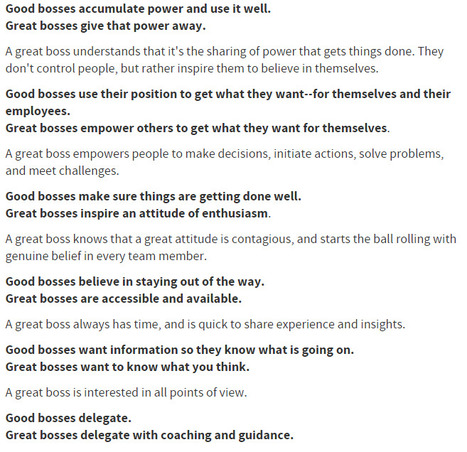
Anyone who's ever had a bad boss aspires to do better. It's fine to be a good boss, but honing your leadership skills can make you a great boss.
|
|
Scooped by
Gust MEES
March 17, 2015 1:30 PM
|
“There are different aspects to cyber security and cyber-attacks. But all current security approaches tend to make use of the same technology, making it difficult to judge who is attacking what and why. Within this context, it should be examined what cyber security can offer at another level, contributing and protecting the EU citizens. Cyber security is the EU’s ‘digital frontier.”
Helmbrecht said that the security of network and information systems is essential to the security of all the critical sectors in society, noting that disruptions to these infrastructures and services are becoming more frequent and are estimated to result in annual losses in the range of €260- €340 billion Euros ($416-$544 billion dollars).
“Various recent studies, including those of ENISA, demonstrate that the threat landscape will get worse, unless we take firm action,” Helmbrecht said.
Learn more:
- https://gustmees.wordpress.com/2013/05/13/visual-cyber-security-see-attacks-on-real-time/
There are different aspects to cyber security and cyber-attacks. But all current security approaches tend to make use of the same technology, making it difficult to judge who is attacking what and why. Within this context, it should be examined what cyber security can offer at another level, contributing and protecting the EU citizens. Cyber security is the EU’s ‘digital frontier.”
Helmbrecht said that the security of network and information systems is essential to the security of all the critical sectors in society, noting that disruptions to these infrastructures and services are becoming more frequent and are estimated to result in annual losses in the range of €260- €340 billion Euros ($416-$544 billion dollars).
“Various recent studies, including those of ENISA, demonstrate that the threat landscape will get worse, unless we take firm action,” Helmbrecht said.
Learn more:
- https://gustmees.wordpress.com/2013/05/13/visual-cyber-security-see-attacks-on-real-time/
|
|
Scooped by
Gust MEES
March 14, 2015 6:05 PM
|
Recently I explored the notion of the “Innovator’s Mindset”, and have thought a lot about this idea. As I look to write on the topic of “Leading Innovative Change” within schools, we are looking to develop educators as innovators. To be innovative, you have to look at yourself as an innovator first, and to create schools that embody this mindset as a “culture”, we must develop this in individuals first.
Learn more:
- http://www.scoop.it/t/21st-century-learning-and-teaching/?tag=Growth+Mindset
- http://www.scoop.it/t/21st-century-learning-and-teaching/?tag=innovation
- https://gustmees.wordpress.com/2014/03/29/practice-learning-to-learn/
- https://gustmees.wordpress.com/2015/01/28/practice-learning-to-learn-example-2/
- https://gustmees.wordpress.com/2014/10/03/design-the-learning-of-your-learners-students-ideas/
- https://gustmees.wordpress.com/2014/07/10/education-collaboration-and-coaching-the-future/
I love everything about this. All so true, and all so attainable.
Like the article and the links Struck me that we all have an innovators mindset It's a matter of using it!
Creating a culture which embraces innovation is essential and this infographic outlines some key characteristics of innovators to be aware of.
|
|
Rescooped by
Gust MEES
from Ressources pour le eLearning
March 13, 2015 1:58 PM
|
Il faut apprendre à coopérer pour faire des choses qu'on ne saurait faire individuellement. Mais les systèmes éducatifs sont fondés sur la compétition.
Pourquoi est-il si important d’apprendre à travailler en collectif ?
Nous sommes confrontés dans le monde entier à des problèmes qu’on ne sait pas résoudre. Il faut donc développer les différentes formes d’intelligence et apprendre à coopérer pour faire des choses qu’on ne saurait pas faire individuellement. Typiquement, les entreprises embauchent des profils différents et complémentaires, qui peuvent ensemble faire des choses qu’aucun d’entre eux ne pourrait faire seul. Il est donc fondamental d’apprendre à travailler de manière collaborative le plus tôt possible, d’autant qu’on apprend beaucoup les uns des autres. Plus, on est formé à écouter et à prendre en compte des avis différents, plus on a de chance de façonner un produit ou un service que des gens différents vont aimer.
Si l’on pense dans une seule et unique dimension, on aura peut-être une solution parfaite dans cette dimension là mais avec tout un tas d’effets secondaires ou négatifs dans d’autres dimensions. Si dès le départ, on a impliqué des gens de mondes différents, avec des modes de pensées différents, on va optimiser le résultat de manière multidimensionnelle. Comme la réalité est multidimensionnelle, il y a plus de chances d’arriver à quelque chose qui fonctionne dans le monde réel.
En savoir plus / Learn more:
- https://gustmees.wordpress.com/2014/03/29/practice-learning-to-learn/
- https://gustmees.wordpress.com/2015/01/28/practice-learning-to-learn-example-2/
- https://gustmees.wordpress.com/2014/10/03/design-the-learning-of-your-learners-students-ideas/
- https://gustmees.wordpress.com/2014/07/10/education-collaboration-and-coaching-the-future/
Mais sommes nous tous nés chercheurs ? ...
A lire, j'aime particulièrement la formule : “écosystèmes d’apprentissage coopératif et d’innovation” & " les équipes collectives sont souvent plus performantes que les joueurs individuels."
Ce qui me fais penser aux centres de coworking et incubateurs pour entreprises.
Quand dans un monde où les pratiques habituelles présentent les résultats habituels (sauf exceptions), les innovations sont de plus en plus demandées. Et des pratiques anciennes qui étaient mises au placard reviennent au goût du jour et sont liée à l'innovation.
Il s'en pratique bien trop peu pour que cela ait une quelconque efficacité en France. Il faut faire de ces pratiques une priorité avec l'interdisciplinarité dans l'école à tous les niveaux du secondaire.
Mais la formation et le recrutement des enseignants est à repenser d'urgence !!.
|
|
Scooped by
Gust MEES
March 6, 2015 10:53 AM
|
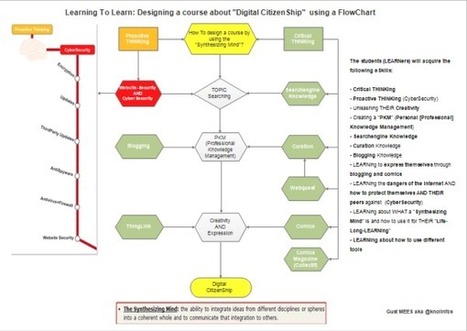
LEARNing To LEARN-Where To Start!? In previous posts WE were discussing about the design of LEARNing for ===> DigitalCitizenShip <===, the different possibilities. Now WE will see about the How-To on where to start, my advice by PracTICE. Let us remember what was taught on previous posts.
Learn more:
- https://gustmees.wordpress.com/2014/03/29/practice-learning-to-learn/
- https://gustmees.wordpress.com/2015/01/28/practice-learning-to-learn-example-2/
- https://gustmees.wordpress.com/2014/10/03/design-the-learning-of-your-learners-students-ideas/
- https://gustmees.wordpress.com/2014/07/10/education-collaboration-and-coaching-the-future/
must read for both, my colleagues and students!
This is an interesting site, because in the last fifteen years many people talk about "learning to learn", but few know and orientate students to get it. Here we have an indication.
Thanks.
|
|
Scooped by
Gust MEES
March 4, 2015 8:45 AM
|
A smart teacher professional program is essential for classroom success. Here are seven questions to ask yourself before you build one.
Learn more:
- https://gustmees.wordpress.com/2014/10/03/design-the-learning-of-your-learners-students-ideas/
- https://gustmees.wordpress.com/2015/01/28/practice-learning-to-learn-example-2/
- https://gustmees.wordpress.com/2013/01/23/is-your-professional-development-up-to-date/
|
|
Scooped by
Gust MEES
March 2, 2015 1:20 AM
|
Short version - Professional Learning Animation AITSL
Professional Learning Animation AITSL
|
|
Scooped by
Gust MEES
February 26, 2015 5:46 AM
|
So, as educators, what could a blog do for you? Here are seven reasons why you should consider starting a your own, school or class blog.
Learn more:
- http://www.scoop.it/t/21st-century-learning-and-teaching/?tag=Blogging
- https://gustmees.wordpress.com/2013/03/25/practice/
So, as educators, what could a blog do for you? Here are seven reasons why you should consider starting a your own, school or class blog.
Learn more:
- http://www.scoop.it/t/21st-century-learning-and-teaching/?tag=Blogging
- https://gustmees.wordpress.com/2013/03/25/practice/
|
|
Scooped by
Gust MEES
March 22, 2015 9:22 AM
|
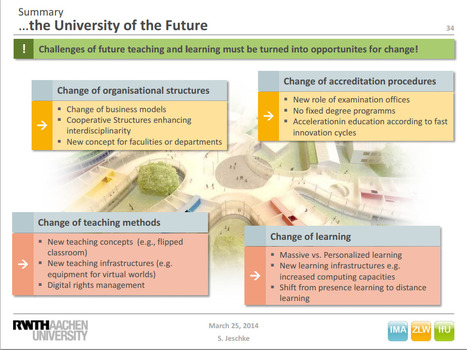
EDUcation 4.0 ===> A MUST READ!
Learn more:
- http://www.scoop.it/t/21st-century-learning-and-teaching/?tag=EDUcation+4.0
EDUcation 4.0 ===> A MUST READ!
Learn more:
- http://www.scoop.it/t/21st-century-learning-and-teaching/?tag=EDUcation+4.0
|
|
Scooped by
Gust MEES
March 21, 2015 11:54 AM
|
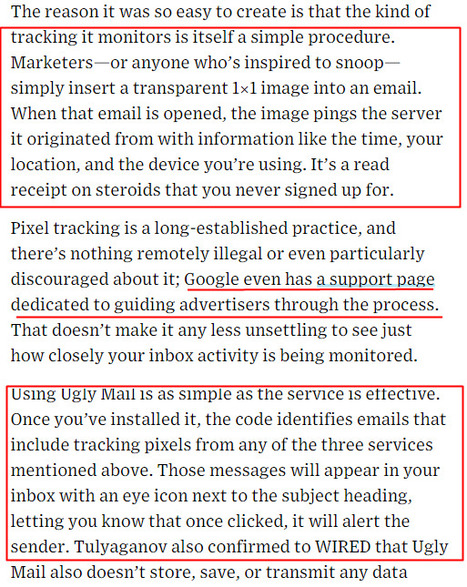
A Chrome extension called Ugly Mail shows you who’s guilty of tracking your emails.
Learn more:
- https://gustmees.wordpress.com/2013/12/21/privacy-in-the-digital-world-shouldnt-we-talk-about-it/
A Chrome extension called Ugly Mail shows you who’s guilty of tracking your emails.
Learn more:
- https://gustmees.wordpress.com/2013/12/21/privacy-in-the-digital-world-shouldnt-we-talk-about-it/
|
|
Scooped by
Gust MEES
March 20, 2015 7:36 PM
|
Ten Disciplines of a Learner
We decided to continue the conversation on this topic at a faculty meeting. Several meetings later we had a new report card. We decided to give two grades and average them—one for “Learning,” the other for “Mastery.”
Sara might get an “F” in mastery and an “A” in learning, culminating in a “C” for the course. To be rigorous we picked ten observable behaviors and named them “Disciplines of a Learner:”
1. Asks questions
2. Builds on other people’s ideas
3. Uses mistakes as learning opportunities
4. Takes criticism constructively
5. Speaks up
6. Welcomes a challenge
7. Takes risks
8. Listens with an openness to change
9. Perseveres in tasks
10. Decides when to lead and when to follow.
Learn more:
- http://www.scoop.it/t/21st-century-learning-and-teaching/?tag=Criticism
Ten Disciplines of a Learner
We decided to continue the conversation on this topic at a faculty meeting. Several meetings later we had a new report card. We decided to give two grades and average them—one for “Learning,” the other for “Mastery.”
Sara might get an “F” in mastery and an “A” in learning, culminating in a “C” for the course. To be rigorous we picked ten observable behaviors and named them “Disciplines of a Learner:”
1. Asks questions
2. Builds on other people’s ideas
3. Uses mistakes as learning opportunities
4. Takes criticism constructively
5. Speaks up
6. Welcomes a challenge
7. Takes risks
8. Listens with an openness to change
9. Perseveres in tasks
10. Decides when to lead and when to follow.
Mastery versus Learning - Lots of thought provoking ideas here...
Love this examination of 'Disciplines of a Learner" that clearly distinguishes between master and learning. I think we should demonstrate greater value to the lifelong skill of learning .
|
|
Scooped by
Gust MEES
March 18, 2015 7:38 AM
|
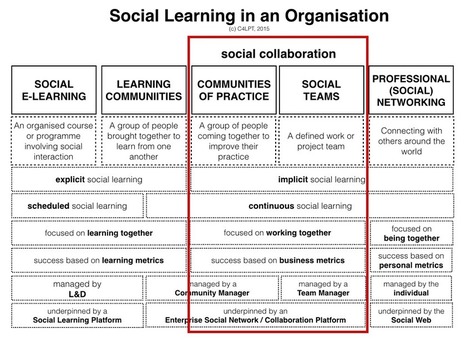
In my framework of Modern Workplace Learning (see diagram on right) I use the term social collaboration to label an important new element of work of the modern-day L&D department. I deliberately chose not to label it social learning. So what is the difference – or rather connection – between these two terms?
Learn more:
- http://www.scoop.it/t/21st-century-learning-and-teaching/?tag=Social+Learning
Nice article and charts on social learning and collaboration.
|
|
Scooped by
Gust MEES
March 17, 2015 4:39 PM
|
What are the Biggest Mistakes Teachers Make When Integrating Technology into the Classroom?
The word “mistake” is a harsh word. It implies flaws, pointing fingers, errors in judgement, something wrong and possibly even a dead end. I would rather think or connect the word “mistake” to first steps, stepping stones, experimentation and exploration. With that being said, those “first steps” or that exploration cannot become a routine cemented in stone how technology is being used in the classroom. Stepping stones are meant to lead to something else.
For the sake of the prompt given, here are my top 5 “Mistakes” (in no particular order) which I see, read and hear about as I travel the world to learn and work with schools, teachers and students:
- Technology being used to substitute an analog activity
- Technology use being seen as an add-on to allow students to use devices, the Internet, a program or an app as a reward, for entertainment, as a time filler for students who finish early
- Technology use as a separate subject area
- Technology as a $1000 pencil initiative
- Technology seen as the solution to motivate and engage students
There certainly are a bunch of problems with adding new stuff to a course that already exists!
- Technologie utilisée pour substituer une activité analogique. (NDLR: Quoiqu'il faille bien commencer quelque part!)
- Utilisation de la technologie considérée comme un add-on pour permettre aux étudiants d'utiliser des dispositifs, l'Internet, un programme ou une application comme une récompense, pour le divertissement, comme un passe-temps pour les étudiants qui terminent plus tôt.
- Utilisation de la technologie comme un sujet distinct du cours.
- La technologie comme un crayon à € 1000.
- Technologie vu comme la solution pour motiver et engager les élèves.
Nem sempre, nem nunca.
Tecnologia em sala de aula: só quando faz sentido!
|
|
Scooped by
Gust MEES
March 17, 2015 2:24 PM
|
Seriously. I can't believe I need to write this post. I thought most teachers understood social media do's and don'ts. But I am finding they don't. Really? Okay. Here it goes. Teachers - you are in...
Learn more:
- http://www.scoop.it/t/21st-century-learning-and-teaching/?tag=Digital+Footprint
- http://www.scoop.it/t/social-media-and-its-influence
- https://gustmees.wordpress.com/2014/03/29/practice-learning-to-learn/
- https://gustmees.wordpress.com/2015/01/28/practice-learning-to-learn-example-2/
- https://gustmees.wordpress.com/2014/10/03/design-the-learning-of-your-learners-students-ideas/
- https://gustmees.wordpress.com/2014/07/10/education-collaboration-and-coaching-the-future/
|
|
Scooped by
Gust MEES
March 15, 2015 7:04 PM
|
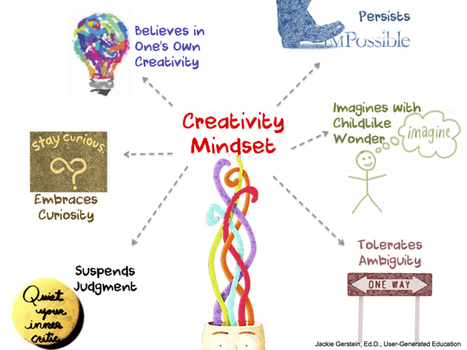
Suspends Judgment – Silences the Inner Critic
The ability to hold off on judging or critiquing an idea is important in the process of creativity. Often great ideas start as crazy ones – if critique is applied too early the idea will be killed and never developed into something useful and useable. (note – this doesn’t mean there is never a time for critique or judgement in the creative process – it’s actually key – but there is a time and place for it). (http://www.problogger.net/archives/2007/05/09/9-attitudes-of-highly-creative-people/)
Many new ideas, because they are new and unfamiliar, seem strange, odd, bizarre, even repulsive. Only later do they become “obviously” great. Other ideas, in their original incarnations, are indeed weird, but they lead to practical, beautiful, elegant things. Thus, it is important for the creative thinker to be able to suspend judgment when new ideas are arriving, to have an optimistic attitude toward ideas in general.
Tolerates Ambiguity
Ambiguity tolerance may be… the “willingness to accept a state of affairs capable of alternate interpretations, or of alternate outcomes,” (English & English 1958). In other words, ambiguity tolerance may be central to creative thinking. (http://knowinnovation.com/tolerating-ambiguity/#sthash.XqxhaQh3.dpuf)
With the toleration of ambiguity, creativity gives way to new ideas, stimulates the acceptance of others’ viewpoints, and thus raises tolerance, understanding and cooperation. (http://www.academia.edu/2506344/Creative_climate_as_a_means_to_promote_creativity_in_the_classroom
Persists Even When Confronted with Skepticism & Rejection
Learn more:
- http://www.scoop.it/t/21st-century-learning-and-teaching/?tag=Creativity
From the article: "Mindsets are simply defined as 'the ideas and attitudes with which a person approaches a situation.' Mindsets imply that mental and attitudinal states can assist one in being successful with a given skill set. I believe this to be true for engaging in the creative process, that a creative mindset is a prerequisite to being creative." Of particular interest to brainstormers.
Creatives are simultaneously essential and aggravating. You know who you are, you are the person at the board table asking why? No one wants to answer you so they pass you over. But that is one of the strongest attributes of a creative mind: why? Why have we always done it this way? Why are we promoting our products this way? Why are we meeting?
Ask one why question a day - just to keep limber.
I love the graphic here and so agree with this overview of creativity
|
|
Scooped by
Gust MEES
March 14, 2015 9:34 AM
|
Accelerated by the information age, knowledge is becoming more dominant of the world’s economy. While a huge gap resides between developing countries and developed ones, bridging the breach seems more conceivable than it ever was. Education systems are at the core of building knowledge, it’s where human capital competences are developed. With holistic change around us and an immense knowledge evolving, students need to become active learners.
Student centered learning has a wide prospective, while some perceive it as an approach where students learn by doing, others debate that it happens when students have control over what to learn. However, regardless of the framework used to put students at the heart of learning process, the literature highlights it as a constructive approach, where power shifts from the teacher to the student.
En savoir plus / Learn more:
- https://gustmees.wordpress.com/2014/03/29/practice-learning-to-learn/
- https://gustmees.wordpress.com/2015/01/28/practice-learning-to-learn-example-2/
- https://gustmees.wordpress.com/2014/10/03/design-the-learning-of-your-learners-students-ideas/
- https://gustmees.wordpress.com/2014/07/10/education-collaboration-and-coaching-the-future/
Because LEARNING in Life's Most Important Skill
|
|
Scooped by
Gust MEES
March 11, 2015 1:20 PM
|
WE are living in a very quick changing world as the internet opens NEW possibilities, NOT ONLY for searching and publishing. WE are talking actually a lot about the ===> Internet of Things, Internet of Everything <=== whereby a lot of people have it already at home without knowing WHAT it actually is! So, does ALSO EDUcation which need to adapt to it as the internet is a common right for anyone.
EDUcation is STILL looking on the How-To to implement it for LEARNing and TEACHing and (like usual…) struggling and behind that evolution, an evolution that is NOT temporary but will certainly go much further when one is watching on each day (thanks to the internet) the NEW discoveries, new technology, new materials based on Nano-Technology. WHAT was true YESTERDAY isn’t anymore TODAY!
Therefore it is important, actually a MUST, that in EDUcation the students, learners, will get prepared for the (not so anymore unknown) near future, they MUST get prepared for ===> LEARNing-To-LEARN <===, to be able to adapt their knowledge by daily routines, they will become ===> Life-Long-LEARNing <=== persons!
|
|
Scooped by
Gust MEES
March 4, 2015 2:40 PM
|
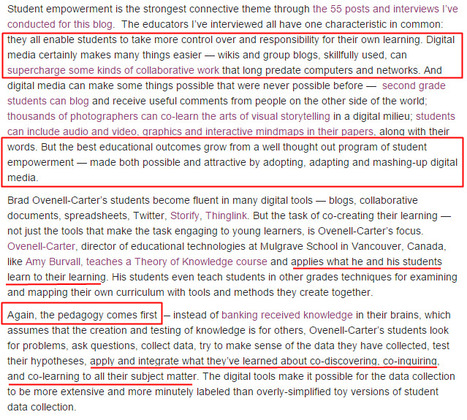
Student empowerment is the strongest connective theme through the 55 posts and interviews I’ve conducted for this blog. The educators I’ve interviewed all have one characteristic in common: they all enable students to take more control over and responsibility for their own learning.
.
Learn more:
.
- https://gustmees.wordpress.com/2014/10/03/design-the-learning-of-your-learners-students-ideas/
.
.
- https://gustmees.wordpress.com/2015/01/28/practice-learning-to-learn-example-2/
.
- https://gustmees.wordpress.com/2013/01/23/is-your-professional-development-up-to-date/
.
Absolutely agree, students who take responsibility for their learning do so much better when taking exams. In addition, when a student can teach you and put forward their own evaluative commentary, they are ready for university.
Audrey for http://www.homeschoolsource.co.uk
|
|
Rescooped by
Gust MEES
from Eclectic Technology
March 2, 2015 1:28 AM
|
This topic shows how to put professionalism in our Routine and get it accommodate in our work.
|
|
Scooped by
Gust MEES
February 28, 2015 8:59 AM
|
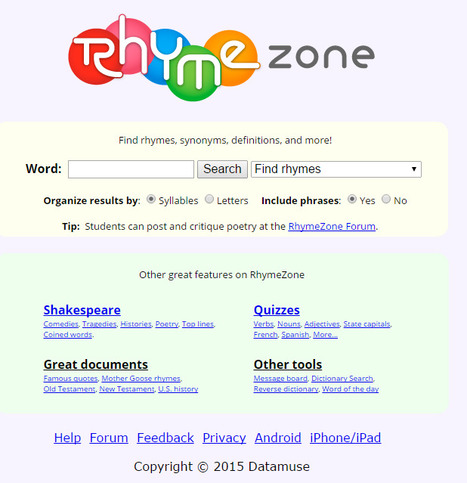
A language arts reference tool and comprehensive search engine for words. Includes the functions of a rhyming dictionary, thesaurus, and spelling checker, as well as an integrated full-text search engine for all of Shakespeare's works and thousands of quotations and poems.
Learn more:
- http://www.scoop.it/t/21st-century-learning-and-teaching/?tag=Poems
Your new post is loading...
Learn more:
- http://www.ima-zlw-ifu.rwth-aachen.de/fileadmin/user_upload/INSTITUTSCLUSTER/Publikation_Medien/Vortraege/download//DHV_Tag_25Maerz2014.pdf
Learn more:
- http://www.scoop.it/t/21st-century-learning-and-teaching/?tag=EDUcation+4.0