21st Century Learning and Teaching
791.7K views | +4 today
21st Century Learning and Teaching
Related articles to 21st Century Learning and Teaching as also tools...
Curated by Gust MEES
Your new post is loading...

Popular Tags

Current selected tag: 'Learning 2 Learn'. Clear
Scooped by Gust MEES
June 9, 2016 12:50 PM
Scoop.it!

#Backup A MUST With ALL The #Malware AND Especially #Ransomware Around! | #CyberSecurity #eSkills #Awareness

#Backup A MUST With ALL The #Malware AND Especially #Ransomware Around! | #CyberSecurity #eSkills #Awareness | 21st Century Learning and Teaching | Scoop.it

Backup A MUST With ALL The Malware AND Especially Ransomware Around! NOT sure if YOU followed OR if YOU are conscientious about WHAT is going around actually on the internet concerning "Malware" and "CyberSecurity", BUT YOU SHOULD!!! THIS is a Wake-UP Call take it serious please! That is called ALSO <===> Proactive THINKing <===> eSkills


Learn more / En savoir plus / Mehr erfahren:


http://www.scoop.it/t/securite-pc-et-internet/?tag=RANSOMWARE


Gust MEES's insight:

Backup A MUST With ALL The Malware AND Especially Ransomware Around! NOT sure if YOU followed OR if YOU are conscientious about WHAT is going around actually on the internet concerning "Malware" and "CyberSecurity", BUT YOU SHOULD!!! THIS is a Wake-UP Call take it serious please! That is called ALSO <===> Proactive THINKing <===> eSkills


Learn more / En savoir plus / Mehr erfahren:


http://www.scoop.it/t/securite-pc-et-internet/?tag=RANSOMWARE


No comment yet.
Scooped by Gust MEES
June 8, 2016 7:39 AM
Scoop.it!

SOCIAL AND EMOTIONAL LEARNING: EQUIPPING STUDENTS FOR THE DIGITAL ECONOMY

SOCIAL AND EMOTIONAL LEARNING: EQUIPPING STUDENTS FOR THE DIGITAL ECONOMY | 21st Century Learning and Teaching | Scoop.it
In the report ‘New Vision for Education: Fostering Social and Emotional Learning through Technology', the World Economic Forum explores how "character qualities" such as collaboration, communication and critical thinking will equip students to succeed in the swiftly evolving digital economy.

To thrive in the 21st century, students need more than traditional academic learning. They must be adept at collaboration, communication and problem-solving, which are some of the skills developed through social and emotional learning (SEL).

In 2015, the World Economic Forum (WEF) published the report New Vision for Education: Unlocking the Potential of Technology that focused on the pressing issue of the 21st-century skills gap and ways to address it through technology. In that report, WEF defined a set of 16 crucial proficiencies for education. Of those skills, 10 were labelled either “competencies” or “character qualities”. Competencies are the means by which students approach complex challenges; they include collaboration, communication and critical thinking and problem-solving. Character qualities are the ways in which students approach their changing environment; they include curiosity, adaptability and social and cultural awareness.


Learn more / En savoir plus / Mehr erfahren:


https://gustmees.wordpress.com/2016/05/19/a-holistic-view-of-what-will-influence-education-in-the-future/


Gust MEES's insight:
In the report ‘New Vision for Education: Fostering Social and Emotional Learning through Technology', the World Economic Forum explores how "character qualities" such as collaboration, communication and critical thinking will equip students to succeed in the swiftly evolving digital economy.

To thrive in the 21st century, students need more than traditional academic learning. They must be adept at collaboration, communication and problem-solving, which are some of the skills developed through social and emotional learning (SEL).

In 2015, the World Economic Forum (WEF) published the report New Vision for Education: Unlocking the Potential of Technology that focused on the pressing issue of the 21st-century skills gap and ways to address it through technology. In that report, WEF defined a set of 16 crucial proficiencies for education. Of those skills, 10 were labelled either “competencies” or “character qualities”. Competencies are the means by which students approach complex challenges; they include collaboration, communication and critical thinking and problem-solving. Character qualities are the ways in which students approach their changing environment; they include curiosity, adaptability and social and cultural awareness.


Learn more / En savoir plus / Mehr erfahren:


https://gustmees.wordpress.com/2016/05/19/a-holistic-view-of-what-will-influence-education-in-the-future/


No comment yet.
Scooped by Gust MEES
June 7, 2016 7:39 AM
Scoop.it!

The Future of Professional Learning: 4 Design Principles that Transform | Out of #SchoolCocoon

The Future of Professional Learning: 4 Design Principles that Transform | Out of #SchoolCocoon | 21st Century Learning and Teaching | Scoop.it
The Future of Professional Learning

Design Principles for Professional Learning

In Preparing Teachers for Deeper Learning, Digital Promise and Getting Smart outline four design principles for professional learning. These apply to credentialing programs, ongoing professional learning opportunities and school or district-based initiatives. Graduate schools of education are in a perfect position to be leaders in applying these design principles.


Learn more / En savoir plus / Mehr erfahren:


https://gustmees.wordpress.com/2014/10/03/design-the-learning-of-your-learners-students-ideas/


https://gustmees.wordpress.com/2015/07/19/learning-path-for-professional-21st-century-learning-by-ict-practice/


Gust MEES's insight:

The Future of Professional Learning

Design Principles for Professional Learning

In Preparing Teachers for Deeper Learning, Digital Promise and Getting Smart outline four design principles for professional learning. These apply to credentialing programs, ongoing professional learning opportunities and school or district-based initiatives. Graduate schools of education are in a perfect position to be leaders in applying these design principles.


Learn more / En savoir plus / Mehr erfahren:


https://gustmees.wordpress.com/2014/10/03/design-the-learning-of-your-learners-students-ideas/


https://gustmees.wordpress.com/2015/07/19/learning-path-for-professional-21st-century-learning-by-ict-practice/


No comment yet.
Rescooped by Gust MEES from Daily Newspaper
October 28, 2016 5:52 AM
Scoop.it!

A Gamified e-Learning Design Model to Promote and Improve Learning | #Gamification

A Gamified e-Learning Design Model to Promote and Improve Learning | #Gamification | 21st Century Learning and Teaching | Scoop.it
This paper takes a deeper look at techniques suitable for education and e-learning, and comes out with a model that describes the design of educational gamification.


Learn more / En savoir plus / mehr erfahren:


http://www.scoop.it/t/21st-century-learning-and-teaching/?tag=Gamification


Via THE OFFICIAL ANDREASCY
Gust MEES's insight:
This paper takes a deeper look at techniques suitable for education and e-learning, and comes out with a model that describes the design of educational gamification.


Learn more / En savoir plus / mehr erfahren:


http://www.scoop.it/t/21st-century-learning-and-teaching/?tag=Gamification


Andreas Christodoulou's curator insight, June 2, 2016 1:03 AM
Share your insight
delta14's curator insight, October 28, 2016 11:46 AM
Describe los componentes lúdicos que favorecen los aprendizajes en ambientes virtuales.
Scooped by Gust MEES
June 1, 2016 7:04 PM
Scoop.it!

Update Twitter Chats: WHAT To DO BETTER!? | #SocialMedia #eSkills 

Update Twitter Chats: WHAT To DO BETTER!? | #SocialMedia #eSkills  | 21st Century Learning and Teaching | Scoop.it

Update Twitter Chats: WHAT To DO BETTER!? WE were already discussing about Twitter-Chats to use for Professional Development, called ALSO "Teacher Training" (in Luxembourg/Europe) in my following blog posts: How-To use Twitter with success for Education and more… What YOU should know about Twitter-Chat’s. After Analyzing My Online Presence On Social Media Twitter…


Rhi Parkes's curator insight, June 2, 2016 7:52 AM
Need to use M & R of #SAMR model to transform what is being done via twitter
Rescooped by Gust MEES from Supports for Leadership
June 1, 2016 3:08 PM
Scoop.it!

To Become a More Visionary Leader, Become Stronger at Visualization

To Become a More Visionary Leader, Become Stronger at Visualization | 21st Century Learning and Teaching | Scoop.it
To Become a More Visionary Leader, Become Stronger at Visualization

In our research with thousands of leaders, one skill stands out — by far — as the most common improvement area: their ability to sell a vision to employees. Over 50 percent of leaders we’ve assessed struggle to demonstrate this form of visionary leadership, a larger deficiency percentage than for any other leadership skill. Leaders are consistently unable to vividly paint a compelling picture of the future in a way that inspires others to follow them along a challenging route toward a new business reality. This is an improvement area for most leaders because it requires them to synthesize and clarify ambiguous, complex business concepts into a clear path forward.


Via Marc Wachtfogel, Ph.D., Dean J. Fusto, Mark E. Deschaine, PhD
Gust MEES's insight:
To Become a More Visionary Leader, Become Stronger at Visualization

In our research with thousands of leaders, one skill stands out — by far — as the most common improvement area: their ability to sell a vision to employees. Over 50 percent of leaders we’ve assessed struggle to demonstrate this form of visionary leadership, a larger deficiency percentage than for any other leadership skill. Leaders are consistently unable to vividly paint a compelling picture of the future in a way that inspires others to follow them along a challenging route toward a new business reality. This is an improvement area for most leaders because it requires them to synthesize and clarify ambiguous, complex business concepts into a clear path forward.


Lacey Mack's curator insight, June 2, 2016 6:31 AM
Not only do we lead the students to achieve, but we want to educate them to become the leaders.  Ensuring they are able to achieve this, we need to learn the skills to develop their capability and confidence in this area.
Scooped by Gust MEES
May 28, 2016 8:43 AM
Scoop.it!

The Future of Learning — Learning {Re}imagined | #LEARNing2LEARN #ModernEDU 

The Future of Learning - Learning {Re}imagined - Medium
It’s as if we agreed that the purpose of education was simply content distribution and testing, and therefore we don’t really need skilled teachers. We could actually offload that to technology.


In my opinion, that’s wrong. I think there’s much more to teaching and learning than that and I think we should allow much more freedom in the say that technology is used in the classroom and we should be able to use technology to amplify our ability to learn and our ability to teach rather than effectively imprison us.


For example, in testing, in examinations, in 2016 why are students not allowed to take their computer connected to the internet into the examination room? Why are they not allowed to share their answers with their colleagues? Why are they not allowed to phone their mother or phone a subject specialist? Why do we suddenly pretend that the twenty-first century never happened when a child enters an examination room?


Learn more / En savoir plus / Mehr erfahren:


https://gustmees.wordpress.com/2015/07/19/learning-path-for-professional-21st-century-learning-by-ict-practice/


https://gustmees.wordpress.com/2015/03/04/learning-to-learn-preparation-for-better-learning-how-to/


https://gustmees.wordpress.com/2014/10/03/design-the-learning-of-your-learners-students-ideas/


https://gustmees.wordpress.com/2015/12/19/teaching-was-yesterday-today-is-coaching-the-learners-students-for-learning-to-learn/


https://gustmees.wordpress.com/?s=PracTICE


Gust MEES's insight:
It’s as if we agreed that the purpose of education was simply content distribution and testing, and therefore we don’t really need skilled teachers. We could actually offload that to technology.


In my opinion, that’s wrong. I think there’s much more to teaching and learning than that and I think we should allow much more freedom in the say that technology is used in the classroom and we should be able to use technology to amplify our ability to learn and our ability to teach rather than effectively imprison us.


For example, in testing, in examinations, in 2016 why are students not allowed to take their computer connected to the internet into the examination room? Why are they not allowed to share their answers with their colleagues? Why are they not allowed to phone their mother or phone a subject specialist? Why do we suddenly pretend that the twenty-first century never happened when a child enters an examination room?


Learn more / En savoir plus / Mehr erfahren:


https://gustmees.wordpress.com/2015/07/19/learning-path-for-professional-21st-century-learning-by-ict-practice/


https://gustmees.wordpress.com/2015/03/04/learning-to-learn-preparation-for-better-learning-how-to/


https://gustmees.wordpress.com/2014/10/03/design-the-learning-of-your-learners-students-ideas/


https://gustmees.wordpress.com/2015/12/19/teaching-was-yesterday-today-is-coaching-the-learners-students-for-learning-to-learn/


https://gustmees.wordpress.com/?s=PracTICE


Tony Guzman's curator insight, May 31, 2016 2:45 PM
This blog entry and video interview pose an interesting question: why do we send students to school? To what end? A question well worth considering regardless of the student's age. Thoughts?
Scooped by Gust MEES
May 25, 2016 8:39 AM
Scoop.it!

9 of the Best Snap Circuits Electronics Kits for Bright Sparks | #Maker #MakerED #MakerSpace #EdTech 

9 of the Best Snap Circuits Electronics Kits for Bright Sparks | #Maker #MakerED #MakerSpace #EdTech  | 21st Century Learning and Teaching | Scoop.it
If your child has shown an interest in electronics, they will love snap circuits. A wonderful educational toy, there is also a lot of fun to be had.


Learn more / En savoir plus / Mehr erfahren:


https://gustmees.wordpress.com/2014/08/20/maker-space-a-new-trend-in-education-and-a-big-responsibility/


Gust MEES's insight:
If your child has shown an interest in electronics, they will love snap circuits. A wonderful educational toy, there is also a lot of fun to be had.


Learn more / En savoir plus / Mehr erfahren:


https://gustmees.wordpress.com/2014/08/20/maker-space-a-new-trend-in-education-and-a-big-responsibility/


Heraclio Muñoz Cruz's curator insight, May 26, 2016 9:10 AM
9 mejores kits de circuitos electrónicos
Barbara Goebel's curator insight, May 29, 2016 9:26 AM
MakerStuff
Scooped by Gust MEES
May 24, 2016 10:52 AM
Scoop.it!

Sarkasmus – Wikipedia | #Rhetorik 

Sarkasmus

Sarkasmus bezeichnet beißenden, bitteren Spott und Hohn, in der Literatur oft in Form der Satire oder - verschärft - der Polemik angewandte Form der Kritik an gesellschaftlichen Gegebenheiten unterschiedlicher Art. Sarkasmus ist ein latinisiertes griechisches Substantiv (σαρκασμός sarkasmós „die Zerfleischung, der beißende Spott", von altgriechisch sarkazein „sich das Maul zerreißen, zerfleischen, verhöhnen", von σάρξ sarx „das (rohe) Fleisch").


Da die Absicht eines Spottes nur dem Spötter selbst bekannt ist, ist eine Unterscheidung von außen äußerst schwierig. Den Begriffen gemeinsam ist die Tatsache, dass der Angreifer weniger Gegenangriffsfläche bietet, als wenn er sachlich vorgehen würde.

Spott ist häufig offener und eindeutiger als Sarkasmus; letzterer ist oft subtiler und doppeldeutig. Deshalb kann mancher Sarkasmus z. B. ein diktatorisches Regime kritisieren, ohne dass der Absender der sarkastischen Nachricht im Gefängnis landet.

Sarkasmus und Ironie[Bearbeiten | Quelltext bearbeiten]
Umgangssprachlich wird Sarkasmus oft als Form der Ironie betrachtet[6] oder Ironie als eine nette Variante und Sarkasmus demgegenüber als dem Angriff dienend aufgefasst, teilweise gar als Spott und Angriff streng von Ironie abgegrenzt.[7] Tatsächlich ist Ironie jedoch eine Technik, ein Mittel, etwas auszudrücken, während Sarkasmus eine bestimmte Absicht einer Aussage beschreibt, unabhängig von sprachlichen Mitteln, mit denen sie formuliert wurde. Ironie bezeichnet Aussagen, die als das Gegenteil des tatsächlich Gemeinten formuliert werden; dies kann zum Schutz des Sprechers verhüllend sein oder die Aussage verstärken. Sarkasmus ist bitterer, beißender Spott – unabhängig davon, wie das Gemeinte ausgedrückt wird, ob direkt oder indirekt mittels Ironie.

Für Arthur Schopenhauer ist Ironie objektiv. Sie verweist durch Über- oder Untertreibung auf die Kehrseite, wobei sie die Ianus­natur der Erscheinungen humorvoll gelten lässt. Sarkasmus dagegen ist einseitig; seine Fokussierung der Kehrseite zielt auf Vernichtung.


Learn more / En savoir plus / Mehr erfahren:


http://www.scoop.it/t/21st-century-learning-and-teaching/?tag=Irony


http://www.scoop.it/t/21st-century-learning-and-teaching/?tag=Rhetorik


Gust MEES's insight:

Sarkasmus bezeichnet beißenden, bitteren Spott und Hohn, in der Literatur oft in Form der Satire oder - verschärft - der Polemik angewandte Form der Kritik an gesellschaftlichen Gegebenheiten unterschiedlicher Art.


Learn more / En savoir plus / Mehr erfahren:


http://www.scoop.it/t/21st-century-learning-and-teaching/?tag=Irony


http://www.scoop.it/t/21st-century-learning-and-teaching/?tag=Rhetorik


No comment yet.
Rescooped by Gust MEES from Effective Education
May 23, 2016 11:13 AM
Scoop.it!

10 training design tips for Instructional Designers and Trainers

10 training design tips for Instructional Designers and Trainers | 21st Century Learning and Teaching | Scoop.it
You have completed the training needs analysis. You have documented the results and confirmed with the business unit manager that training is indeed warranted, because you have confirmed a lack of needed skills and knowledge. For part two of my three-part series, I’m sharing 10 tips that will help you design learner-centered training.


Learn more / En savoir plus / Mehr erfahren:


http://www.scoop.it/t/21st-century-learning-and-teaching/?tag=instructional+coaching


https://gustmees.wordpress.com/2014/10/03/design-the-learning-of-your-learners-students-ideas/


https://gustmees.wordpress.com/2015/07/19/learning-path-for-professional-21st-century-learning-by-ict-practice/


https://gustmees.wordpress.com/2015/12/27/what-are-the-best-ways-of-teaching-and-learning-ideas-and-reflections/


Via Edumorfosis, juandoming, michel verstrepen, THE OFFICIAL ANDREASCY, Educational Peaks, Mark E. Deschaine, PhD
Gust MEES's insight:
You have completed the training needs analysis. You have documented the results and confirmed with the business unit manager that training is indeed warranted, because you have confirmed a lack of needed skills and knowledge. For part two of my three-part series, I’m sharing 10 tips that will help you design learner-centered training.


Learn more / En savoir plus / Mehr erfahren:


http://www.scoop.it/t/21st-century-learning-and-teaching/?tag=instructional+coaching


https://gustmees.wordpress.com/2014/10/03/design-the-learning-of-your-learners-students-ideas/


https://gustmees.wordpress.com/2015/07/19/learning-path-for-professional-21st-century-learning-by-ict-practice/


https://gustmees.wordpress.com/2015/12/27/what-are-the-best-ways-of-teaching-and-learning-ideas-and-reflections/


Scooped by Gust MEES
May 21, 2016 6:25 AM
Scoop.it!

Colorblind Web Page Filter | Colblindor

Colorblind Web Page Filter | Colblindor | 21st Century Learning and Teaching | Scoop.it
The Colorblind Web Page Filter is a great web application to get an impression how a web page is viewed by people affected by any kind of color blindness. After indicating the URL and choosing the appropriate color filter the view is directly shown inside the browser window.


Gust MEES's insight:

The Colorblind Web Page Filter is a great web application to get an impression how a web page is viewed by people affected by any kind of color blindness. After indicating the URL and choosing the appropriate color filter the view is directly shown inside the browser window.


Barbara Goebel's curator insight, May 29, 2016 9:40 AM
Interesting tool for developing lesson delivery platforms
Scooped by Gust MEES
May 21, 2016 5:35 AM
Scoop.it!

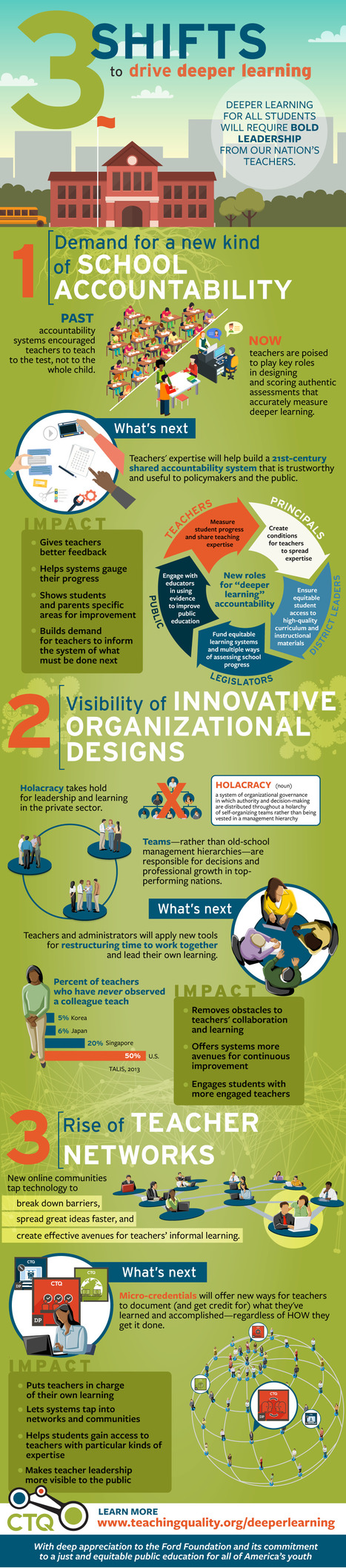
Teacher leadership & deeper learning for all students [#Infographic] | #CTQ #CTQCollab

Teacher leadership & deeper learning for all students [#Infographic] | #CTQ #CTQCollab | 21st Century Learning and Teaching | Scoop.it

TEACHER LEADERSHIP & DEEPER LEARNING FOR ALL STUDENTS

In this new paper commissioned by the Ford Foundation, Barnett Berry makes the case for how a system of teacher leadership and learning can fuel deeper learning for all students. 

Here is what the paper tackles:

examines current reforms’ limitations and notes some promising emergent examples, (like Social Justice Humanitas Academy in LAUSD); summarizes 30 years of research about how teachers learn and lead (also drawing on stories of teachers CTQ has worked with since our founding in 1998); identifies three promising shifts that could be leveraged to create an effective system of teacher leadership and learning; and
describes next steps that stakeholders (including policymakers, USDOE, state education leaders, superintendents, and others) can take to advance teacher leadership toward a more equitable public education system.  


The infographic below reveals 3 big changes we can leverage now to improve public education for all students.


Learn more / En savoir plus / Mehr erfahren:


http://www.scoop.it/t/21st-century-learning-and-teaching/?tag=LeaderShip


http://www.scoop.it/t/21st-century-learning-and-teaching/?tag=Situational+Leadership+Theory


Gust MEES's insight:

TEACHER LEADERSHIP & DEEPER LEARNING FOR ALL STUDENTS

In this new paper commissioned by the Ford Foundation, Barnett Berry makes the case for how a system of teacher leadership and learning can fuel deeper learning for all students. 

Here is what the paper tackles:

examines current reforms’ limitations and notes some promising emergent examples, (like Social Justice Humanitas Academy in LAUSD); summarizes 30 years of research about how teachers learn and lead (also drawing on stories of teachers CTQ has worked with since our founding in 1998); identifies three promising shifts that could be leveraged to create an effective system of teacher leadership and learning; and
describes next steps that stakeholders (including policymakers, USDOE, state education leaders, superintendents, and others) can take to advance teacher leadership toward a more equitable public education system.  


The infographic below reveals 3 big changes we can leverage now to improve public education for all students.


Learn more / En savoir plus / Mehr erfahren:


http://www.scoop.it/t/21st-century-learning-and-teaching/?tag=LeaderShip


http://www.scoop.it/t/21st-century-learning-and-teaching/?tag=Situational+Leadership+Theory


Barbara Goebel's curator insight, May 29, 2016 9:41 AM
Share your insight
Rescooped by Gust MEES from Educational Technology News
May 22, 2016 11:40 AM
Scoop.it!

Social learning: the revolution in eLearning

Social learning: the revolution in eLearning | 21st Century Learning and Teaching | Scoop.it
How can an age-old learning strategy, like social learning, make your eLearning course pop? Read this article and find out the benefits of social learning!


What is Social Learning?

Before we delve into the benefits of this type of learning, we need to understand what research in social learning tells us.

Social learning theory: The social learning theorists Bandura and Walters have described this theory as follows:

· Learning is not purely behavioral; rather, it is a cognitive process that takes place in a social context. This points to the learners’ preference to learn in groups. The interchange of knowledge and perspective creates new knowledge that is personal to the learner.

· Learning can occur by observing a behavior and by observing the consequences of the behavior (vicarious reinforcement).

· Learning involves observation, extraction of information from those observations, and making decisions about the performance of the behavior (observational learning ormodeling). Thus, learning can occur without an observable change in behavior.

· Reinforcement plays a role in learning, but is not entirely responsible for learning.

· The learner is not a passive recipient of information. Cognition, environment, and behavior all mutually influence each other (reciprocal determinism).


Learn more / En savoir plus / Mehr erfahren:


http://www.scoop.it/t/21st-century-learning-and-teaching/?tag=Social+Learning


Via EDTECH@UTRGV
Gust MEES's insight:
How can an age-old learning strategy, like social learning, make your eLearning course pop? Read this article and find out the benefits of social learning!


What is Social Learning?

Before we delve into the benefits of this type of learning, we need to understand what research in social learning tells us.

Social learning theory: The social learning theorists Bandura and Walters have described this theory as follows:

· Learning is not purely behavioral; rather, it is a cognitive process that takes place in a social context. This points to the learners’ preference to learn in groups. The interchange of knowledge and perspective creates new knowledge that is personal to the learner.

· Learning can occur by observing a behavior and by observing the consequences of the behavior (vicarious reinforcement).

· Learning involves observation, extraction of information from those observations, and making decisions about the performance of the behavior (observational learning ormodeling). Thus, learning can occur without an observable change in behavior.

· Reinforcement plays a role in learning, but is not entirely responsible for learning.

· The learner is not a passive recipient of information. Cognition, environment, and behavior all mutually influence each other (reciprocal determinism).


Learn more / En savoir plus / Mehr erfahren:


http://www.scoop.it/t/21st-century-learning-and-teaching/?tag=Social+Learning


Tony Guzman's curator insight, May 23, 2016 2:57 PM
Are you a social learner? What is social learning?
Annie Mey's curator insight, May 26, 2016 6:32 AM
Share your insight
Scooped by Gust MEES
June 8, 2016 3:30 PM
Scoop.it!

Designing Learning That Matters | #LEARNing2LEARN #LEARNingByDoing 

Designing Learning That Matters | #LEARNing2LEARN #LEARNingByDoing  | 21st Century Learning and Teaching | Scoop.it
Foster deep learning experiences for your students by using inquiry, seeking lessons and projects that inspire, always asking "why?", and letting them loose on projects.


Learn more / En savoir plus / Mehr erfahren:


http://www.scoop.it/t/21st-century-learning-and-teaching/?tag=design


http://www.scoop.it/t/21st-century-learning-and-teaching/?tag=Design-Thinking


https://gustmees.wordpress.com/2014/10/03/design-the-learning-of-your-learners-students-ideas/


Gust MEES's insight:
Foster deep learning experiences for your students by using inquiry, seeking lessons and projects that inspire, always asking "why?", and letting them loose on projects.


Learn more / En savoir plus / Mehr erfahren:


http://www.scoop.it/t/21st-century-learning-and-teaching/?tag=design


http://www.scoop.it/t/21st-century-learning-and-teaching/?tag=Design-Thinking


https://gustmees.wordpress.com/2014/10/03/design-the-learning-of-your-learners-students-ideas/


No comment yet.
Scooped by Gust MEES
June 7, 2016 6:57 PM
Scoop.it!

A Holistic View Of WHAT Will Influence EDUcation In The Future | #ModernEDU #eSkills #ICT 

A Holistic View Of WHAT Will Influence EDUcation In The Future | #ModernEDU #eSkills #ICT  | 21st Century Learning and Teaching | Scoop.it

WHAT Will Influence EDUcation In The Future? Through ICT the Real-World and especially the Virtual-World (both are influencing each other...) are changing quicker then WE can learn about, BUT WE must adapt to it and so must EDUcation! Therefore Universities must do research about the How-To to adapt and teaching about it... Luxembourg,…

 

Gust MEES's insight:

WHAT Will Influence EDUcation In The Future? Through ICT the Real-World and especially the Virtual-World (both are influencing each other...) are changing quicker then WE can learn about, BUT WE must adapt to it and so must EDUcation! Therefore Universities must do research about the How-To to adapt and teaching about it... Luxembourg,…

 

No comment yet.

Scooped by Gust MEES
June 6, 2016 12:04 PM
Scoop.it!

Blogging: Is It Difficult!? I Guess Not At ALL! Follow My Advice | #Blogs #Communication #ICT #eSkills 

Blogging: Is It Difficult!? I Guess Not At ALL! Follow My Advice | #Blogs #Communication #ICT #eSkills  | 21st Century Learning and Teaching | Scoop.it

Blogging: Is It Difficult!? I Guess Not At ALL! Follow My Advice I hear nearly each day: Blogging, WHY and How and THEN I don't have THAT time to do it and WHY SHOULD I do it!? Well, a GOOD question anyway! I will try to explain... Anybody has a story to tell,…


Learn more / En savoir plus / Mehr erfahren:


http://www.scoop.it/t/21st-century-learning-and-teaching/?tag=Blogging


Gust MEES's insight:

Blogging: Is It Difficult!? I Guess Not At ALL! Follow My Advice I hear nearly each day: Blogging, WHY and How and THEN I don't have THAT time to do it and WHY SHOULD I do it!? Well, a GOOD question anyway! I will try to explain... Anybody has a story to tell,…


Learn more / En savoir plus / Mehr erfahren:


http://www.scoop.it/t/21st-century-learning-and-teaching/?tag=Blogging


No comment yet.
Scooped by Gust MEES
June 1, 2016 8:21 PM
Scoop.it!

What's the Rush? | #Society #LEARNing2LEARN about #Priorities 

What's the Rush? | #Society #LEARNing2LEARN about #Priorities  | 21st Century Learning and Teaching | Scoop.it
In the world in which we live, everything has to be done right away. What's the rush? It's time to wake up and smell the coffee.


Learn more / En savoir plus / Mehr erfahren:


http://www.scoop.it/t/21st-century-learning-and-teaching/?tag=Frank+SONNENBERG


Gust MEES's insight:
In the world in which we live, everything has to be done right away. What's the rush? It's time to wake up and smell the coffee.


Learn more / En savoir plus / Mehr erfahren:


http://www.scoop.it/t/21st-century-learning-and-teaching/?tag=Frank+SONNENBERG


No comment yet.
Scooped by Gust MEES
June 1, 2016 2:44 PM
Scoop.it!

The Critical 21st Century Skills Every Student Needs and Why

The Critical 21st Century Skills Every Student Needs and Why | 21st Century Learning and Teaching | Scoop.it
Our Big List of 21st Century Skills
The Global Digital Citizen Foundation has given hundreds of presentations to educators and administrators in several countries over the years. Each time we’ve spoken, we have asked them what they feel are the most important 21st century skills students need above all others.
The answers that we’ve recieved most often are narrowed down below. This list comes from our book Literacy is Not Enough (Crockett, Lee et. al.; 2011). You’ll be able to see that these points correlate rather well with both the New Zealand’s capabilities list and the IB Learner Profile. They certainly cover the Common Core’s bases, too. It’s good to know we’re all on the same page, isn’t it? That’s great news for our students!
So, according to the folks we’ve asked, the consensus is that students need to acquire transparency-level skills in the following areas:


Problem solving
Creativity
Analytic thinking
Collaboration
Communication
Ethics, action, and accountabillty


Learn more / En savoir plus / Mehr erfahren:


https://gustmees.wordpress.com/2015/05/26/what-are-the-skills-needed-from-students-in-the-future/


https://gustmees.wordpress.com/2016/02/18/the-new-possibilities-to-learn-and-teach-with-ict/


https://gustmees.wordpress.com/2015/07/19/learning-path-for-professional-21st-century-learning-by-ict-practice/


Gust MEES's insight:
Our Big List of 21st Century Skills
The Global Digital Citizen Foundation has given hundreds of presentations to educators and administrators in several countries over the years. Each time we’ve spoken, we have asked them what they feel are the most important 21st century skills students need above all others.
The answers that we’ve recieved most often are narrowed down below. This list comes from our book Literacy is Not Enough (Crockett, Lee et. al.; 2011). You’ll be able to see that these points correlate rather well with both the New Zealand’s capabilities list and the IB Learner Profile. They certainly cover the Common Core’s bases, too. It’s good to know we’re all on the same page, isn’t it? That’s great news for our students!
So, according to the folks we’ve asked, the consensus is that students need to acquire transparency-level skills in the following areas:


Problem solving
Creativity
Analytic thinking
Collaboration
Communication
Ethics, action, and accountabillty


Learn more / En savoir plus / Mehr erfahren:


https://gustmees.wordpress.com/2015/05/26/what-are-the-skills-needed-from-students-in-the-future/


https://gustmees.wordpress.com/2016/02/18/the-new-possibilities-to-learn-and-teach-with-ict/


https://gustmees.wordpress.com/2015/07/19/learning-path-for-professional-21st-century-learning-by-ict-practice/


Lacey Mack's curator insight, June 2, 2016 8:54 AM
We aim to teach students the skills to be active citizen in modern society - but this article explains in detail what it is that we can actually teach.
Scooped by Gust MEES
June 1, 2016 8:34 AM
Scoop.it!

50 Ideas for Issuing Badges in Education

50 Ideas for Issuing Badges in Education | 21st Century Learning and Teaching | Scoop.it
There are countless possibilities and experiments for issuing badges in education, but here are 50 to get you started.


Learn more / En savoir plus / Mehr erfahren:


http://www.scoop.it/t/21st-century-learning-and-teaching/?tag=Badges


Gust MEES's insight:
There are countless possibilities and experiments for issuing badges in education, but here are 50 to get you started.


Learn more / En savoir plus / Mehr erfahren:


http://www.scoop.it/t/21st-century-learning-and-teaching/?tag=Badges


No comment yet.
Scooped by Gust MEES
May 27, 2016 12:18 PM
Scoop.it!

Open innovation, open science, open to the world - Research policy and organisation - EU Bookshop

Open innovation, open science, open to the world - Research policy and organisation - EU Bookshop | 21st Century Learning and Teaching | Scoop.it
A vision for Europe
Gust MEES's insight:

A vision for Europe...


No comment yet.
Scooped by Gust MEES
May 24, 2016 10:58 AM
Scoop.it!

Sarcasm - Wikipedia, the free encyclopedia | #Rhetoric #Irony 

Sarcasm

Sarcasm is the use of irony to mock or convey contempt. "The distinctive quality of sarcasm is present in the spoken word and manifested chiefly by vocal inflections". The sarcastic content of a statement will be dependent upon the context in which it appears.

Sarcasm is the use of irony to mock or convey contempt.[1] "The distinctive quality of sarcasm is present in the spoken word and manifested chiefly by vocal inflections".[2] The sarcastic content of a statement will be dependent upon the context in which it appears.[3]


Learn more / En savoir plus / Mehr erfahren:


http://www.scoop.it/t/21st-century-learning-and-teaching/?tag=Irony


http://www.scoop.it/t/21st-century-learning-and-teaching/?tag=Rhetorik


Gust MEES's insight:
Sarcasm is the use of irony to mock or convey contempt.[1] "The distinctive quality of sarcasm is present in the spoken word and manifested chiefly by vocal inflections".[2] The sarcastic content of a statement will be dependent upon the context in which it appears.[3]


Learn more / En savoir plus / Mehr erfahren:


http://www.scoop.it/t/21st-century-learning-and-teaching/?tag=Irony


http://www.scoop.it/t/21st-century-learning-and-teaching/?tag=Rhetorik


No comment yet.
Scooped by Gust MEES
May 23, 2016 10:22 AM
Scoop.it!

Do Self-Directed Learners Use Mentors, Guides & Coaches? | #Autodidact #Coaching #Mentoring #LEARNing2LEARN 

Do Self-Directed Learners Use Mentors, Guides & Coaches? | #Autodidact #Coaching #Mentoring #LEARNing2LEARN  | 21st Century Learning and Teaching | Scoop.it
For those not familiar with self-directed learning, they sometimes have a stereotype about what it means to be a self-directed learner. One of them includes this vision of the solitary and independent learner who does things her way. She only depends upon herself, not relying upon teachers or others. Yet, in my study of self-directed learning, that tends to be far from true. In fact, many self-directed learners actively seek out different guides and mentors in their pursuit of new learning goals. They own the learning, but they seek out mentors and guides to accomplish their learning goals.

Self-directed learning is not solitary learning. It is not anti-teacher, anarchist, nor is it selfish. At least that is not the vision for most advocates and champions of self-directed learning. What makes it distinct is that the learner, not a teacher or other authority, takes increasing ownership for the what, why and how of learning. It stems from a conviction that teaching self-sufficiency and self-regulation is effectively done by providing contexts where one is able to practice self-regulating and being increasingly self-sufficient.


Learn more / En savoir plus / Mehr erfahren:


http://www.scoop.it/t/21st-century-learning-and-teaching/?tag=Heutagogy


Andragogy | Adult Teaching: How-To Teach ICT!? | PracTICE


LEARNing To LEARN For MY Professional Development | I Did It MY Way


https://gustmees.wordpress.com/2012/06/27/how-to-use-twitter-with-success-for-education-and-more/


https://gustmees.wordpress.com/2013/02/20/what-you-should-know-about-twitter-chats/


https://gustmees.wordpress.com/2014/07/10/education-collaboration-and-coaching-the-future/


http://www.scoop.it/t/21st-century-learning-and-teaching/?tag=Peer-to-Peer-Learning


Gust MEES's insight:
For those not familiar with self-directed learning, they sometimes have a stereotype about what it means to be a self-directed learner. One of them includes this vision of the solitary and independent learner who does things her way. She only depends upon herself, not relying upon teachers or others. Yet, in my study of self-directed learning, that tends to be far from true. In fact, many self-directed learners actively seek out different guides and mentors in their pursuit of new learning goals. They own the learning, but they seek out mentors and guides to accomplish their learning goals.

Self-directed learning is not solitary learning. It is not anti-teacher, anarchist, nor is it selfish. At least that is not the vision for most advocates and champions of self-directed learning. What makes it distinct is that the learner, not a teacher or other authority, takes increasing ownership for the what, why and how of learning. It stems from a conviction that teaching self-sufficiency and self-regulation is effectively done by providing contexts where one is able to practice self-regulating and being increasingly self-sufficient.


Learn more / En savoir plus / Mehr erfahren:


http://www.scoop.it/t/21st-century-learning-and-teaching/?tag=Heutagogy


Andragogy | Adult Teaching: How-To Teach ICT!? | PracTICE


LEARNing To LEARN For MY Professional Development | I Did It MY Way


https://gustmees.wordpress.com/2012/06/27/how-to-use-twitter-with-success-for-education-and-more/


https://gustmees.wordpress.com/2013/02/20/what-you-should-know-about-twitter-chats/


https://gustmees.wordpress.com/2014/07/10/education-collaboration-and-coaching-the-future/


http://www.scoop.it/t/21st-century-learning-and-teaching/?tag=Peer-to-Peer-Learning


Barbara Goebel's curator insight, May 29, 2016 9:34 AM
Self-direction must be the most meaningful path to learning. Now, to align motivation with REQUIRED learning. Gimme strategies! 
Scooped by Gust MEES
May 21, 2016 7:15 AM
Scoop.it!

What Blockchain Means for Higher Education | #FinTech #Bitcoin #EdTech

What Blockchain Means for Higher Education | #FinTech #Bitcoin #EdTech | 21st Century Learning and Teaching | Scoop.it
When you hear the word blockchain does it make your head spin? Wall Street analysts and fintech experts claim it could make traditional banking obsolete; Airbnb just acquired a team of blockchain experts; and the country of Estonia will use it to secure a million patient health records.

But what exactly is blockchain, and what are its implications for higher education?

Originally created as the underlying database for bitcoin (the peer-to-peer digital asset and payment system), blockchain’s technology is now being seen as valuable and purposeful beyond the financial sector. The advantages blockchain provides to store information on a secure, permanent, historical ledger that can be both public and private will change how edtech applications approach student data.


Learn more / En savoir plus / Mehr erfahren:


http://www.scoop.it/t/luxembourg-europe/?tag=Blockchain


http://www.scoop.it/t/21st-century-learning-and-teaching/?tag=blockchain


Gust MEES's insight:
When you hear the word blockchain does it make your head spin? Wall Street analysts and fintech experts claim it could make traditional banking obsolete; Airbnb just acquired a team of blockchain experts; and the country of Estonia will use it to secure a million patient health records.

But what exactly is blockchain, and what are its implications for higher education?

Originally created as the underlying database for bitcoin (the peer-to-peer digital asset and payment system), blockchain’s technology is now being seen as valuable and purposeful beyond the financial sector. The advantages blockchain provides to store information on a secure, permanent, historical ledger that can be both public and private will change how edtech applications approach student data.


Learn more / En savoir plus / Mehr erfahren:


http://www.scoop.it/t/luxembourg-europe/?tag=Blockchain


http://www.scoop.it/t/21st-century-learning-and-teaching/?tag=blockchain


Scooped by Gust MEES
May 21, 2016 6:21 AM
Scoop.it!

Quick Tips For Color Blind Internet Users

Some tips that may hopefully benefit color blind readers - but I really hope that our visitors can add a few more


Gust MEES's insight:
Some tips that may hopefully benefit color blind readers - but I really hope that our visitors can add a few more


No comment yet.
Scooped by Gust MEES
May 19, 2016 5:53 PM
Scoop.it!

MIT and Google team up to develop the next generation of Scratch | #Coding 

MIT and Google team up to develop the next generation of Scratch | #Coding  | 21st Century Learning and Teaching | Scoop.it
Here's some great news for fans of Scratch, an extremely popular game that teaches kids the conceptual "language" around computer programming, using cartoon-y animated characters. The MIT Scratch Team said Tuesday that it will collaborate with Google to create the next generation of the game.

MIT says this collaboration will first result in a new generation of graphical programming blocks, called Scratch Blocks, which is an open source project that allows developers to create and share the "blocks" (or code) of each game with one another. Developers can also easily integrate the blocks into apps, games and toys they create for kids. Scratch Blocks makes it easier to create programming experiences for a wider range of people that will work on a wider range of devices.


Learn more / En savoir plus / Mehr erfahren:


https://gustmees.wordpress.com/2014/08/24/coding-a-new-trend-in-education-and-a-big-responsibility/


http://www.scoop.it/t/21st-century-learning-and-teaching/?tag=Coding


http://www.scoop.it/t/21st-century-learning-and-teaching/?tag=Scratch


http://www.scoop.it/t/21st-century-tools-for-teaching-people-and-learners/?tag=Scratch


Gust MEES's insight:
Here's some great news for fans of Scratch, an extremely popular game that teaches kids the conceptual "language" around computer programming, using cartoon-y animated characters. The MIT Scratch Team said Tuesday that it will collaborate with Google to create the next generation of the game.

MIT says this collaboration will first result in a new generation of graphical programming blocks, called Scratch Blocks, which is an open source project that allows developers to create and share the "blocks" (or code) of each game with one another. Developers can also easily integrate the blocks into apps, games and toys they create for kids. Scratch Blocks makes it easier to create programming experiences for a wider range of people that will work on a wider range of devices.


Learn more / En savoir plus / Mehr erfahren:


https://gustmees.wordpress.com/2014/08/24/coding-a-new-trend-in-education-and-a-big-responsibility/


http://www.scoop.it/t/21st-century-learning-and-teaching/?tag=Coding


http://www.scoop.it/t/21st-century-learning-and-teaching/?tag=Scratch


http://www.scoop.it/t/21st-century-tools-for-teaching-people-and-learners/?tag=Scratch


Vivalist's curator insight, May 20, 2016 4:04 AM
Great to hear that new development will allow for a richer / wider pool of 'block" to choose from.

"MIT says this collaboration will first result in a new generation of graphical programming blocks, called Scratch Blocks, which is an open source project that allows developers to create and share the "blocks" (or code) of each game with one another. Developers can also easily integrate the blocks into apps, games and toys they create for kids. Scratch Blocks makes it easier to create programming experiences for a wider range of people that will work on a wider range of devices."
Rosemary Tyrrell, Ed.D.'s curator insight, June 21, 2016 6:25 PM
Cool! Why play games when you can create them?