




Dès l’automne prochain, les élèves de niveau secondaire de la Commission scolaire de la Capitale auront leur code d’éthique.

 Your new post is loading...
 Your new post is loading...
Your new post is loading...
 Scoop.it!
Dès l’automne prochain, les élèves de niveau secondaire de la Commission scolaire de la Capitale auront leur code d’éthique. 
No comment yet.
Sign up to comment
Scoop.it!

The 41-year-old was arrested at his home in Stoke-on-Trent, central England, on suspicion of encouraging a distributed denial of service (DDoS) attack, Scotland Yard said.
===> He is suspected of encouraging other web users to bombard the websites with requests, causing them to crash. <===
=============================================
Gust MEES
A bad example about what sharing means :( Sharing means to share ethic sharing, NOT sharing about what to do bad! There are rules and laws which everybody has to respect for the well-being of a society! This should get taught to the students and learners, includes the knowledge of being a good Cyber-Citizen. Hashtags for Twitter are #eCitizen, #digcit, #digitalcitizen
Check out also my Curation about people who got hard prison for such actions and talk with your students about that, please:
- http://www.scoop.it/t/securite-pc-et-internet?q=prison
- http://www.scoop.it/t/securite-pc-et-internet?q=jail
=============================================
Read more:
Scoop.it!

Notre Dame Philosophical Reviews is an electronic, peer-reviewed journal that publishes timely reviews of scholarly philosophy books.
Damien Freeman takes on the monumental task of developing a theory of aesthetic experience that accounts for its emotional aspects, its ethical aspects, and the role certain kinds of aesthetic experience can play in a fulfilling life. Despite the enormity of the task, he does an excellent job in so few pages. There are, of course, problems, but the issues that I take with the argument are largely in the details and not in the big picture.
Freeman's main argument is that aesthetic experience can uniquely offer a form of what he calls a plenary experience of emotion. This particular kind of experience is significant to the aesthetic experience because it deals with our emotions as a whole (what he calls the whole emotional economy rather than just parts of the emotions) and thereby offers a unique kind of experience that plays a significant role in our overall thriving emotional life.
Freeman's argument takes as its context the expressivist theories of Tolstoy, Collingwood, and Wollheim; but I believe that he advances his argument to a more comprehensive account of the ways in which we engage with art emotionally and why it is good for us to do so.
Read more, very interesting...: http://ndpr.nd.edu/news/32199-art-s-emotions-ethics-expression-and-aesthetic-experience/

Patrizia Splendiani's comment,
July 30, 2012 3:37 AM
Hi; about my suggestion, in italian, it was my mistake... Sorry!

Gust MEES's comment,
July 30, 2012 6:01 AM
@Patrizia Splendiani,
Hi Patrizia, don't worry, it's OK. I already publish in English, French and German and that's a lot of work; can't publish more languages ;) Have a nice day, Gust
Scoop.it!

by Marilyn Price-Mitchell, PhD. In the 3rd of a 4-part series on character strengths, this article focuses on how teachers can create positive learning environments that uses character strengths as the foundation to a core curriculum.
In his recent article School Made Easy: Character Education is the Key, Dr. Neal Mayerson, Chairman of the VIA Institute, points out that teachers choose the type of culture to create in their classrooms.
===> Cultures of collaboration, confidence, mutual respect, and engagement help nurture the development of character strengths. <===
Read more, very interesting and very important for best "eCitizen" and "Digital Citizen-Ship"...
http://rootsofaction.com/blog/developing-character-strengths-a-vital-goal-of-education-part-3/
Scoop.it!

When I think about the “ethics and responsibilities of the 21st century classroom,” I think not only about our ethical responsibilities toward students but about our ethical responsibilities toward teachers. I am very concerned that the drop-out rate of K-12 teachers is even higher than the drop-out rate of K-12 students in the U.S. and in many other countries around the world.
As I’ve gone around the U.S. and abroad talking with teachers, I’ve seen over and over how beleaguered they are: by (a) too many rules, (b) too many constantly-changing systems and theories, by (c) too many “learning objectives,” by (d) too much pressure to deliver “content,” by (e) too many expectations about high test scores (on standardized tests that often do not measure real learning and content), by (f) ever-escalating and rigid standards of “accountability,” and, added to all of this, by (g) too much faddish, expensive new technology dumped not only on kids but on teachers as if the technology itself magically will take care of a, b, c, d, e, and f.
Read more...
Via Ana Cristina Pratas
|
Scoop.it!
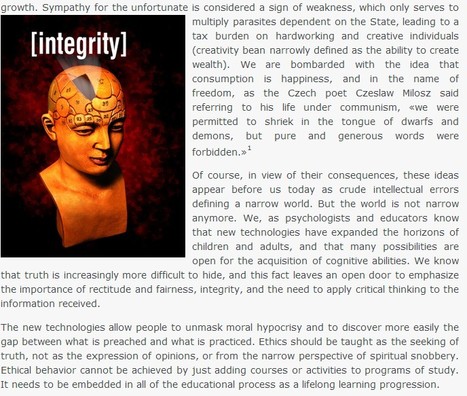
Lack of social ethics is one of the causes of violence and it is at the root of our present social and economic crises We live in a world in turmoil, a
Gust MEES's insight:
A MUST read!!!
Scoop.it!

Journey School in California puts increased emphasis on teaching computer ethics.
You can protect a classroom computer from malware and viruses, but how do you prevent students from using a classroom computer to harm someone else?
One school thinks it has an answer. Journey School in Aliso Viejo, a city in southern California, puts increased emphasis on teaching computer ethics. This task is made all the more interesting considering the school contains zero internet-ready devices for its sixth through eighth graders.
“As the children mature we recognize that, as they get into middle school, we want them to use these tools that we have for the good and for their learning,” Journey School administrator Shaheer Faltas said to The Orange County Register. “We don’t think they need a lot of instruction in how you use Excel or Microsoft Word – what they need to know is what is the appropriate use of these resources.”
Read more: http://www.faronics.com/2012/teaching-empathy-in-an-online-world/
Scoop.it!

The social world is messy and ethics helps us muddle through. By Arthur Dobrin, DSW...
All of morality aims at the same thing but there are several basic ways to get there. If you prefer, each approach is like a different tool—a hammer, a nail, a level. Using the right tool for the right job makes it easier to do your work and increases the chances that you’ll wind up with a quality product.
If you can grasp the basic ideas of each of the different approaches to ethics, you will be in a better position to make a sound ethical decision.
There are other ways in which moral philosophy and philosophers can be categorized, but establishing ethical theories into their three schools is a useful way to understand ethics.
Read more...
Scoop.it!

Ethical Leadership Involves Much More Than Avoiding Risk
Gust MEES's insight:
|






Le code d’éthique est le résultat d’une réflexion du comité jeunesse visant à déterminer les moyens collectifs pour persévérer et réussir à l’école. L’obtention de bons résultats en cours et un climat sain dans en classe ne sont pas nécessairement du ressort de l’enseignant.
La responsabilisation entre les élèves grâce à ce projet vise également à diminuer le nombre d’interventions liées à la discipline.
Check also:
- http://www.scoop.it/t/21st-century-learning-and-teaching?tag=Ethics