STEM+ innovation is required both to develop new pedagogies for learning and to encourage new approaches and discoveries within science. Networks and communi...
Your new post is loading...
STEM+ innovation is required both to develop new pedagogies for learning and to encourage new approaches and discoveries within science. Networks and communi... No comment yet.
Sign up to comment
You're never too old to make your mind agile, flexible, self-aware, and able to see patterns and connections that more rigid minds miss... Via Jim Lerman
What do we mean when we say that beyond skills and knowledge, an arts education better prepares students for the 21st century?
In the book Teaching 2030 by Barnett Berry and 12 classroom experts, the authors pinpoint specific skills educators will need to teach in the schools of tomorrow.
They say teachers must be prepared to find and adapt new technologies to engage the digital generation, as well as work across traditional subject areas using project learning. They must be able to use data and evidence to inform their practice and know how to work in both virtual learning environments and brick-and-mortar schools.
And they’ll need to collaborate with community-based organizations and work in schools that provide all kinds of other services for students and their families.
Dans cet article Valerie Payotte retranscrit une présentation de Corinne Weisgerber, explicitant la différence entre la curation et la simple agrégation de contenus.
A lire ! Via Hélène Brevet
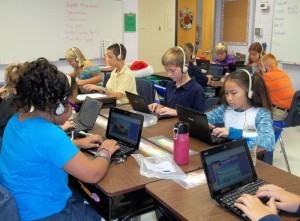
Our school is piloting a 1:1 netbook program this year, and our administration is interested in how the program is going and the different ways the netbooks are being incorporated into our curriculum. I started putting together a list, and even surprised myself at how much the availability of wifi-ready technology engages my students and supports instruction during the course of a regular school day.
===> A MUST READ <===
By Justin Marquis Ph.D. Call me a skeptic, but the idea of having random people from around the Web collaborating in the creation of e-learning content for accredited online degree programs seems absurd.
European Commission - Education & Training - lifelong learning programme - The Lifelong Learning Programme: education and training opportunities for all...
I teach in an inquiry, project-based, technology embedded classroom. A mouthful, I know. So what does that mean? It means I lecture less, and my students explore more. It means that I create a classroom where students encounter concepts, via labs and other methods, before they necessarily understand all the specifics of what is happening.
Ergonomic use of Laptop or Computer devices for recreation or work at home, office or school can bring you great benefits, including your children or kids, i...
Right now you’re looking at a website. Okay you’re actually looking at a computer which is displaying a website. Stop being so picky.
So what actually goes into the creation of a website? Into the actual running of the Internet itself? I’m not talking about the people wfriting the content or designing web pages, etc. I’m talking about the hardware that it takes to keep your favorite sites and LOLcats humming right along on the Internet superhighway.
Thanks to an infographic by Broadband Choices, it’s now easier to understand the mess system behind each website. Enjoy!
I had the chance to talk with a class of college undergraduates (real, live people in an actual classroom) a few weeks ago and one of the topics that came up made me re-examine a common problem for online teachers– cheating.
Academic cheating is nothing new but the impact it has on online education seems easier, and more widespread, than in face-to-face classrooms. This is a gut feeling, and the research suggests cheating and plagiarism are widespread in every educational environment, at any age, across every culture.
(Those of us in direct, live contact with smiling students are fooling ourselves to think classroom cheating is less prevalent, or that we can somehow catch evil-doers more easily in person.) I’ve written about ways to prevent online cheating here at On Teaching Online before, here.
Why Is Team Building Important?
The benefits of team building programs that incorporate the differences in the four basic personalities as well as team bonding and camaraderie activities are so significant that many schools have incorporated team building strategies into their standard training curriculum for staff development. |
Kids love having the opportunity to learn online but it’s not merely the medium or the technology that students enjoy. At the recent iNacol Virtual Schools Symposium I listened to high school students who have experience learning this way as well as teachers who have experience with these students, share some advice for making this type of learning even better. Here is their advice as well as suggestions for tools that teachers can use to heed this advice.
A head of English gets to the heart of the curriculum debate and shares his X Factor-based teaching resource on using solo taxonomy...
Because if you believe in what Ian Gilbert calls The Great Educational Lie (do well at school and you'll get a good job) then passing exams is fine. But if you believe that "to succeed in business you need to break the rules" then we have a responsibility to teach content in a way that also teaches skills, dispositions and competencies needed to make our children indispensible in an uncertain future.
If you incorporate each of these 10 items into your learning delivery, you’ll ensure that your learning will stick. Via Dr. Susan Bainbridge
The Web offers a wealth of learning opportunities and teachers and students should be taking advantage of them, writes Will Richardson. Via Ana Cristina Pratas
Wall Street JournalThe New Einsteins Will Be Scientists Who ShareWall Street JournalThese projects use online tools as cognitive tools to amplify our collective intelligence. Via Brian Kelly
"A community of practice (CoP) is, according to cognitive anthropologists Jean Lave and Etienne Wenger, a group of people who share an interest, a craft, and/or a profession. Over the last year or so, the term communities of practice has entered the social media buzzword lexicon along with virtual collaboration, engagement, platforms, and Enterprise 2.0. Senior leaders want to establish them, new employees are being told to join them, and middle managers are being told to support them, but what, exactly are they?" Steve Radick Via k3hamilton
Pupils from Robin Hood primary school, Birmingham, worked with a film crew from the National College for School Leadership to express their desire to use the...
===> Gust MEES: this video is the BEST I ever have seen about 21st Century Learning and Teaching! <=== Please amplify it by forwarding it, thanks a lot to do so ;)
Heidi Johansen-Berg, a neuroscientist at the University of Oxford, responds...
Manual Handling Case Study Office Ergonomics On Screen Text: Officer worker carrying out tasks at a computer workstation Scene 1: Character sitting at an unt...
The 2011 Academic Ranking of World Universities will be announced on August 15, 2011.
Did you know that rock, rap and pop music could be used as a teaching and learning tool? This doesn't mean you have to stand in front of your class belting out the rules of reading, writing and arithmetic either.
Educators, teachers, and school administrators could all use music as a way to reach students and make learning more fun, interactive, and memorable. Rock music can even be used very effectively as a tool in whole brain learning and multicultural learning.
See some examples here: http://knol.google.com/k/gust-mees/event-knol-tutankhamun-exhibition-in/vdujwtjyx3uq/214#Funny_Learning_For_Kids(2C)_With_Music(2D)Videos(2C)_Enjoy_(3B)(2D)(29)
Gyuri Moon's curator insight,
November 6, 2014 8:35 PM
Even though this education using pop music and rock music to teach students may be effective to young children, there would be negative consequences for teenagers especially in Korea.
What is EDUCAUSE? |
Your new post is loading...