|
Rescooped by
Gust MEES
from Web 2.0 for juandoming
March 20, 2012 8:41 AM
|


No comment yet.
Sign up to comment

 Your new post is loading...
 Scoop.it! No comment yet.
Sign up to comment
Scoop.it!

"Social learning theory is the idea that people learn most effectively when they interact with other learners about a given topic. Educational psychologists refer to this as social constructivism. Recent credibility for this theory comes from a study by Dr. Richard J. Light (Harvard School of Education) that identify factors that lead to success for college students. According to Dr. Light, the strongest determinant of students’ success in college—even more than the details of their instructors’ teaching styles—is their ability to form or participate in small study groups. Students who studied in groups, even only once a week, were more engaged in their studies, were better prepared for class, and learned significantly more than students who worked on their own."
Scoop.it!

The main aim of the project is to improve the quality of vocational education and training within Europe by means of creative and motivating teaching and learning methods which are embedded in a quality system supported by industry and services.
Scoop.it!

In his new book, Imagine, Jonah Lehrer explores the art and science of original thinking — from Shakespearean tragedies to the invention of masking tape to Nike's "Just Do It" campaign. And when you get stuck? 
Seth Capo's comment,
March 21, 2012 11:23 AM
Thanks for the thanks, Gust. Any tips for a new scooper?
Scoop.it!

21st Century Teacher Attributes
- Life Long Learner
- Knowledge Expert:
- Nurturer:
- Tech Savvy
- Project Base Learning Facilitator
- RTI/Differentiation: Looks at every learner as an individual and responds to that individual with apt programs, lessons, materials and tools.
- Process Oriented: Recognizes that education is an evolving practice, and regularly takes time to reflect, review and revise the work he/she does for best effect.
- Environmental Designer
- Coach, Mentor and Guide: Recognizes that in this age of information excess, the priority should be on learning how to learn rather than the acquisition of discrete sets of knowledge, hence the teacher serves as a coach, mentor and guide in this endeavor. With that in mind, however, the teacher also recognizes that some discrete sets of knowledge are necessary and coaches students using the best, research-based materials to attain that knowledge, skill and concept.
- A Student of Cognition: The teacher is a brain coach who embeds the latest research in cognition to develop learning modules that mirror what we understand to be the best ways to build learning flexibility, content and strength.
- Collaborator: The teacher understands that he/she will never know it all or be the best teacher for all students. With this knowledge, the teacher develops his/her repertoire related to collaboration, teamwork and shared decision making, instruction.
- Communicator: The teacher regularly communicates the important information related to his/her practice, vision, goals and work in order to enlist the support of the learning team and community. The communication includes conferences, written correspondence via the Internet or paper/pencil and multimedia composition with portfolios and other communication vehicles.
- Manager: The teacher manages his/her environment and learning team with skill. He/she is attuned to the community's needs as a group and as individuals, and responds as such.
Gust MEES: ===> Read more: very interesting and the REALITY ;) <===
Scoop.it!
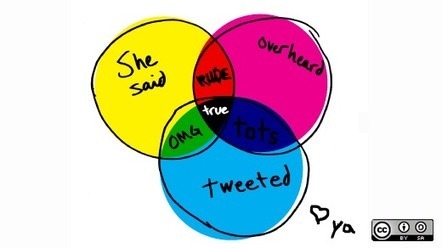
My hope is that we’ll put our energy into making critical thinking a central and essential part of classroom pedagogy. Via juandoming
Scoop.it!

Image via Wikipedia Paul Schoemaker is a rigorous thinker who is not afraid to buck conventional wisdom.
He believes that since mistakes are so valuable, people should learn from them. This observation leads Schoemaker to three implications for managers: read more...
Via juandoming
Scoop.it!

Les Luxembourgeois et Internet - Analyse de l'utilisation des technologies de l'information au Luxembourg
Ce petit malheur a engendré la coupure de la connexion Internet de 90 % de la population arménienne. Car cette dame s'était tout simplement attaqué à une connexion Internet. Heureusement, au Luxembourg, il est moins facile d'atteindre un tel câble avec une simple pelle, la connexion Internet est donc assurée 24h/24. Qui sont ces internautes et pourquoi certains décident-ils de rester hors ligne ?
L'année dernière, l'institut national de la statistique Statec s'est penché sur cette question. 1500 personnes, âgées entre 16 et 74 ans, ont été interrogées sur leur utilisation Internet...
Scoop.it!

Une association soutenue par la Confédération a édicté cinq mesures avec un but ultime: éviter que vous ne soyez une proie facile pour les virus et les truands informatiques.
Scoop.it!

Over the last several years our research on corporate leadership and HR has shown a dramatic trend: ===> successful businesses today are run by experts. <===
I don't mean experts at management, ===> but experts at the business itself. <===
Scoop.it!
Personal learning networks aren't about one social network platform.
Scoop.it!

We all need to learn and benefit from Advanced Life Skills because all life skills are not created equal. Basic life skills are simply not enough.
I am convinced that billions of people feel trapped in a life full of limits and frustrations because they have never been taught the simple skills that have the power to transform almost every aspect of their current situation.
As a result, a life of personal excellence seems like an impossible dream for most. We can easily understand why so many people feel that way when we consider the scarcity of living examples. Most people see very little evidence that a life of extraordinary quality is even possible.
Not all life skills are created equal
Read more: http://bit.ly/wiUFl2 Via Martin Gysler
Scoop.it!

Shock of the new
If we want to understand the modern way we think about so-called “information overload” the best place to start is the 1970 book Future Shock by author and futurist Alvin Toffler.
In it, he said future shock is, “the dizzying disorientation brought on by the premature arrival of the future. It may well be the most important disease of tomorrow”.
BBC Future description goes here... |
Scoop.it!

J’écrivais la semaine dernière un article sur l’application Facebook “Jobs For Me” qui permet à vos étudiants de trouver un stage ou un emploi via le célèbre réseau social Facebook, cette semaine c’est à son concurrent Twitter que je vais m’intéresser. Pour cela j’ai rencontré Sophie Figenwald, étudiante en école de commerce qui utilise Twitter de manière professionnelle suite à un atelier organisé dans son école. C’était il y a un an et ça a déjà porté ses fruits. Via Francois BOCQUET
Scoop.it!

Technology is not value-free. John Merrow explains how to turn kids — who are digital natives — into good digital citizens.
Schools today must provide opportunities for young people to create knowledge out of the swirling clouds of information that surround them 24/7. You went to school because that’s where the knowledge was stored. That was yesterday.
Think how different today’s world is. Today’s young people need guidance in sifting through the flood of information and turning it into knowledge.
They need to be able to formulate good questions — because computers have all the answers.
Scoop.it!
|
|
|
Scooped by
Gust MEES
March 18, 2012 7:21 PM
|
Scoop.it!

Whether you are a teacher, a parent, an aunt or an uncle, it is important to know that today's students are wildly different in some ways, from past generations.
|
|
Scooped by
Gust MEES
March 17, 2012 8:14 PM
|
Scoop.it!

At the core of Visible Thinking are practices that help make thinking visible: Thinking Routines loosely guide learners' thought processes and encourage active processing. They are short, easy-to-learn mini-strategies that extend and deepen students' thinking and become part of the fabric of everyday classroom life.
Thinking Ideals are easily accessible concepts capturing naturally occurring goals, strivings or interests that often propel our thinking. Four Ideals -- Understanding, Truth, Fairness and Creativity -- are presented as modules on this site.
There are associated routines for each ideal and within each module there are activities that help deepen students' concepts around the ideal.
|
|
Scooped by
Gust MEES
March 15, 2012 10:08 AM
|
Scoop.it!

Nombreux sont ceux qui ne connaissent même pas les limites et les définitions exactes du plagiat ou de la fraude. Voici des éléments qui vous permettront de vous appuyer sur des travaux antérieurs sans risquer de tomber dans l'illégalité.
|
|
Scooped by
Gust MEES
March 13, 2012 1:34 PM
|
Scoop.it!

5 modules identité numérique et professionnelle
Le module d’auto-formation sur l’identité numérique et professionnelle propose 5 séquences avec une progressivité réfléchie à base d’ebooks (en pdf) qui comprennent des exercices pratiques.
L’originalité de ce module est de présenter des solutions en ligne diversifiées avec une formalisation des objectifs, du projet et des moyens à engager (temps, ressources…)...
|
|
Scooped by
Gust MEES
March 11, 2012 4:10 PM
|
Scoop.it!

Google is not God, but the omnipresent search engine commands an unworldly level of trust from its followers.
If they’re naive at Googling, it’s because the ability to judge information is almost never taught in school. Under 2001′s No Child Left Behind Act, elementary and high schools focus on prepping their pupils for reading and math exams.
===> And by the time kids get to college, professors assume they already have this skill. <===
#criticalthinking
|
|
Scooped by
Gust MEES
March 9, 2012 12:09 PM
|
Scoop.it!

According to a Google advisory, the zero-day flaws related to universal cross-site scripting (UXSS) and bad history navigation.
===> UPDATE NOW! <===
**************#itsecurity #updates in a Topic called "21st Century Learning and Teaching"? YES, #itsecurity and #cybersecurity as well as #privacy are part of 21st Century Learning and Teaching!***************
|
|
Scooped by
Gust MEES
March 9, 2012 5:29 AM
|
Scoop.it!

Understanding, interpretation, and implementation of creativity.
|
|
Rescooped by
Gust MEES
from PEOPLE BUILDING
March 8, 2012 5:21 PM
|
Scoop.it!

Procrastination is a state that has complex origins. It may be due:
In the fear of success (more pressure thereafter); In the “pleasure” of having the pressure; To protect against everything and everyone…; The lack of confidence (failure); The lack of motivation (goal too far away or unclear); And many others.
Though it is, she rots our existence, blocking our way and be happy in life.
As a repented procrastinator, I know what I mean.
Today I found, fortunately, some very effective tools to avoid mostly resorting to this vicious subterfuge.
Why we are procrastinators?
The reasons are many and complex. Without going into the medical maze (yes, it can happen in extreme situations), I’m just going talk from the level “light”, which affects many people and that everyone should be able to manage itself...
Read more: http://martingysler.com/2012/03/08/procrastination-or-the-pleasure-to-do-it-tomorrow/
|
|
Rescooped by
Gust MEES
from The 21st Century
March 8, 2012 2:29 PM
|
Scoop.it!

This paper explores the use of Web 2.0 technologies for collaborative learning in a higher education context.