 Your new post is loading...

|
Scooped by
Gust MEES
December 30, 2016 9:35 AM
|
|
|
Scooped by
Gust MEES
December 26, 2016 12:35 PM
|
|
|
Rescooped by
Gust MEES
from E-Learning-Inclusivo (Mashup)
November 18, 2016 1:21 PM
|
Que doivent savoir les étudiants du 21e siècle ? A défaut d’avoir les ressources en interne, les universités peuvent nouer des partenariats. C’est ce que fait, par exemple, Paris 3 – Sorbonne nouvelle avec Talent Campus, un organisme de formation né dans le cadre des Investissements d’avenir et qui s’attache à développer les compétences sociales : esprit d’équipe, confiance en soi, leadership ou encore créativité. Savoir apprendre, savoir-faire, savoir-être : voilà les trois facettes de ce que j’appelle un « enseignement total », expression qui fait référence au concept d’ « éducation totale » développé par Nathalie Mons, Marie Duru-Bellat et Yannick Savina.
Cet enseignement dépasse le cadre des disciplines académiques pour se connecter et interagir davantage avec les autres acteurs de la société, notamment les entreprises. Ce modèle aujourd’hui est plutôt celui des pays du Nord et de la Grande-Bretagne.
La France, où traditionnellement les savoirs académiques priment, doit pleinement s’engager dans cette voie si elle veut former des citoyens éclairés, capables de vivre et de créer de la valeur dans notre société de la connaissance. Et c’est la mission de l’université du 21e siècle de montrer le chemin.
Learn more / En savoir plus / Mehr erfahren: https://gustmees.wordpress.com/2015/05/26/what-are-the-skills-needed-from-students-in-the-future/ https://gustmees.wordpress.com/2015/07/19/learning-path-for-professional-21st-century-learning-by-ict-practice/ https://gustmees.wordpress.com/2015/12/19/teaching-was-yesterday-today-is-coaching-the-learners-students-for-learning-to-learn/ https://gustmees.wordpress.com/2016/02/18/the-new-possibilities-to-learn-and-teach-with-ict/ https://gustmees.wordpress.com/2016/04/05/luxembourg-education-interviews-1-the-luxembourg-edu-system/
Via juandoming
|
|
Scooped by
Gust MEES
November 2, 2016 11:46 AM
|
|
|
Scooped by
Gust MEES
October 19, 2016 1:06 PM
|
|
|
Scooped by
Gust MEES
August 29, 2016 9:11 AM
|
|
|
Scooped by
Gust MEES
July 4, 2016 4:22 PM
|
WHICH Strategy could WE use for professional eLeadership and eSkills!? Well, giving pedagogical and andragocical (Adult Learning) courses since 2002 and being a Life-Long Learning person and interested (and experienced...) in resolving problems and finding NEW ways for BETTER Learning, here below my thoughts, ideas and strategy for a professional approach for #eLeadership…
|
|
Scooped by
Gust MEES
June 11, 2016 12:28 PM
|
Effective teachers for all classrooms? It’s time for teacherpreneurs
Education conversations around the globe are focused on how to recruit, evaluate, and develop effective teachers. And for good reason. A steady drip of empirical evidence has shown that teachers are the most crucial in-school factor in student learning.
But in many cases education policy leaders have fixated on firing bad teachers and recruiting better ones. They have paid far less attention to spreading the expertise of the many effective teachers already teaching—or to providing them with opportunities to lead without leaving their classrooms and profession.
The Teacherpreneur
Enter the teacherpreneur—who teaches students regularly but has the time, space, and reward to incubate and execute his or her own ideas. Imagine a public school teacher who has the respect (and income potential) of an endowed chair at a research university and whose pedagogical and policy expertise drives innovative, collaborative projects that spread effective teaching practices.
There are at least six sound reasons for this bold brand of teacher leadership:
Researchers have proven that students learn more when their teachers collaborate in deep and authentic ways;
Principals alone cannot address demands of 21st-century learning and accountability;
Top-performing nations invest in teachers as leaders;
The most effective teacher evaluation systems are driven by master teachers;
Teachers trust their teaching colleagues more than anyone else to help them improve their practice; and
Large percentages of teachers are interested in leading without leaving the classroom.
Learn more / En savoir plus / Mehr erfahren: http://www.scoop.it/t/21st-century-learning-and-teaching/?tag=Teacherpreneur https://gustmees.wordpress.com/2016/05/19/a-holistic-view-of-what-will-influence-education-in-the-future/
|
|
Scooped by
Gust MEES
May 24, 2016 10:58 AM
|
Sarcasm is the use of irony to mock or convey contempt. "The distinctive quality of sarcasm is present in the spoken word and manifested chiefly by vocal inflections". The sarcastic content of a statement will be dependent upon the context in which it appears.
|
|
Scooped by
Gust MEES
May 21, 2016 5:35 AM
|
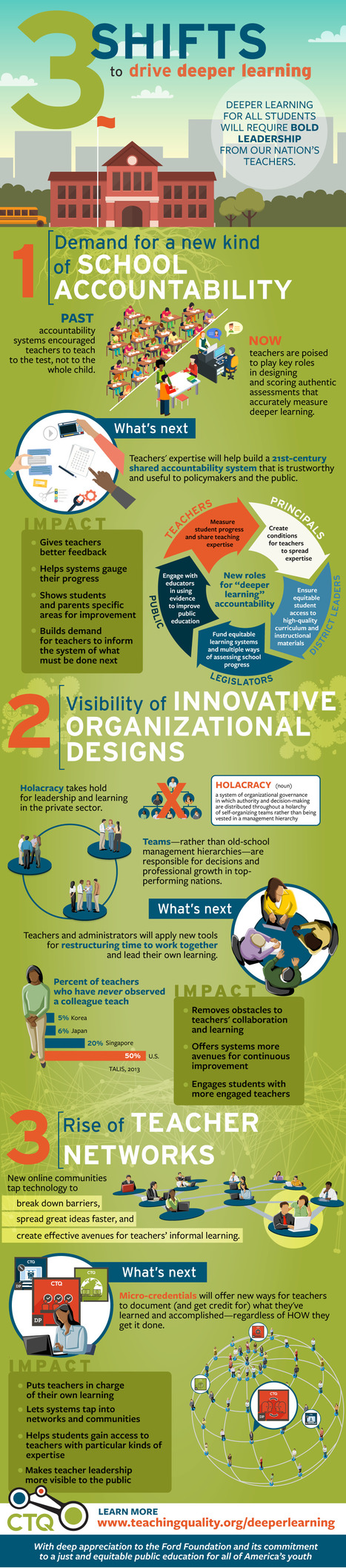
TEACHER LEADERSHIP & DEEPER LEARNING FOR ALL STUDENTS
In this new paper commissioned by the Ford Foundation, Barnett Berry makes the case for how a system of teacher leadership and learning can fuel deeper learning for all students.
Here is what the paper tackles:
examines current reforms’ limitations and notes some promising emergent examples, (like Social Justice Humanitas Academy in LAUSD); summarizes 30 years of research about how teachers learn and lead (also drawing on stories of teachers CTQ has worked with since our founding in 1998); identifies three promising shifts that could be leveraged to create an effective system of teacher leadership and learning; and
describes next steps that stakeholders (including policymakers, USDOE, state education leaders, superintendents, and others) can take to advance teacher leadership toward a more equitable public education system. The infographic below reveals 3 big changes we can leverage now to improve public education for all students. Learn more / En savoir plus / Mehr erfahren: http://www.scoop.it/t/21st-century-learning-and-teaching/?tag=LeaderShip http://www.scoop.it/t/21st-century-learning-and-teaching/?tag=Situational+Leadership+Theory
|
|
Scooped by
Gust MEES
April 21, 2016 6:20 PM
|
|
|
Scooped by
Gust MEES
April 17, 2016 3:58 PM
|
|
|
Scooped by
Gust MEES
April 17, 2016 3:37 PM
|
|
|
|
Scooped by
Gust MEES
December 26, 2016 12:43 PM
|
|
|
Scooped by
Gust MEES
November 23, 2016 2:33 PM
|
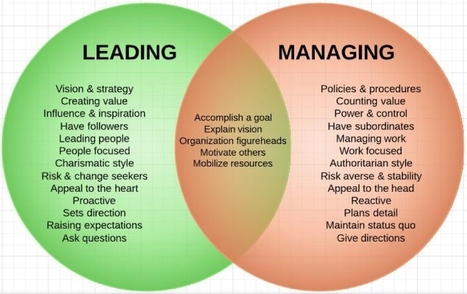
Leadership is not about stability, it is about growth. Leadership is about change for the better. While managers can fall into the trap of believing that strong management can improve a business, leaders know that nothing improves without something changing and they drive that change. Learn more / En savoir plus / Mehr erfahren: http://www.scoop.it/t/21st-century-learning-and-teaching/?tag=LeaderShip
|
|
Scooped by
Gust MEES
November 15, 2016 4:42 PM
|
|
|
Scooped by
Gust MEES
October 29, 2016 8:33 AM
|
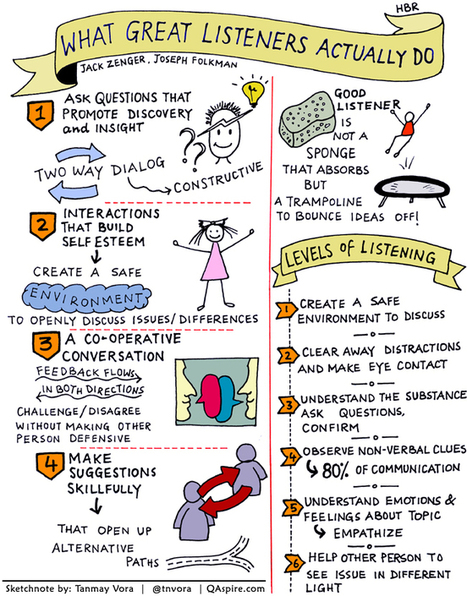
There is no leadership, personal or organizational, without listening. In fact, ability to truly listen (and not just hear) is the foundation of having a conversation, building trust, influencing others, resolving conflicts, driving your vision, building relationships, implementing change and... Learn more / En savoir plus / Mehr erfahren: http://www.scoop.it/t/21st-century-learning-and-teaching/?tag=listening
|
|
Scooped by
Gust MEES
October 12, 2016 6:49 PM
|
|
|
Scooped by
Gust MEES
July 6, 2016 12:28 PM
|
|
|
Scooped by
Gust MEES
June 28, 2016 4:05 PM
|
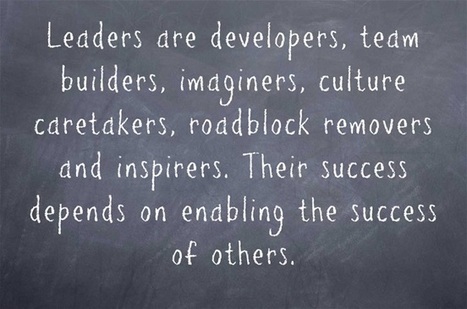
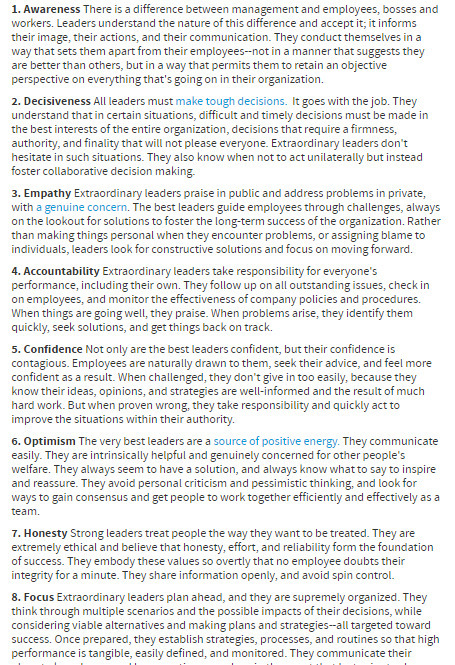
9. Inspiration Put it all together, and what emerges is a picture of the truly inspiring leader: someone who communicates clearly, concisely, and often, and by doing so motivates everyone to give his or her best all the time. They challenge their people by setting high but attainable standards and expectations, and then giving them the support, tools, training, and latitude to pursue those goals and become the best employees they can possibly be. Learn more / En savoir plus / Mehr erfahren: http://www.scoop.it/t/21st-century-learning-and-teaching/?tag=LeaderShip
|
|
Rescooped by
Gust MEES
from Supports for Leadership
June 1, 2016 3:08 PM
|
To Become a More Visionary Leader, Become Stronger at Visualization In our research with thousands of leaders, one skill stands out — by far — as the most common improvement area: their ability to sell a vision to employees. Over 50 percent of leaders we’ve assessed struggle to demonstrate this form of visionary leadership, a larger deficiency percentage than for any other leadership skill. Leaders are consistently unable to vividly paint a compelling picture of the future in a way that inspires others to follow them along a challenging route toward a new business reality. This is an improvement area for most leaders because it requires them to synthesize and clarify ambiguous, complex business concepts into a clear path forward.
Via Marc Wachtfogel, Ph.D., Dean J. Fusto, Mark E. Deschaine, PhD
|
|
Scooped by
Gust MEES
May 24, 2016 10:52 AM
|
Sarkasmus bezeichnet beißenden, bitteren Spott und Hohn, in der Literatur oft in Form der Satire oder - verschärft - der Polemik angewandte Form der Kritik an gesellschaftlichen Gegebenheiten unterschiedlicher Art. Sarkasmus ist ein latinisiertes griechisches Substantiv (σαρκασμός sarkasmós „die Zerfleischung, der beißende Spott", von altgriechisch sarkazein „sich das Maul zerreißen, zerfleischen, verhöhnen", von σάρξ sarx „das (rohe) Fleisch").
Da die Absicht eines Spottes nur dem Spötter selbst bekannt ist, ist eine Unterscheidung von außen äußerst schwierig. Den Begriffen gemeinsam ist die Tatsache, dass der Angreifer weniger Gegenangriffsfläche bietet, als wenn er sachlich vorgehen würde.
Spott ist häufig offener und eindeutiger als Sarkasmus; letzterer ist oft subtiler und doppeldeutig. Deshalb kann mancher Sarkasmus z. B. ein diktatorisches Regime kritisieren, ohne dass der Absender der sarkastischen Nachricht im Gefängnis landet.
Sarkasmus und Ironie[Bearbeiten | Quelltext bearbeiten]
Umgangssprachlich wird Sarkasmus oft als Form der Ironie betrachtet[6] oder Ironie als eine nette Variante und Sarkasmus demgegenüber als dem Angriff dienend aufgefasst, teilweise gar als Spott und Angriff streng von Ironie abgegrenzt.[7] Tatsächlich ist Ironie jedoch eine Technik, ein Mittel, etwas auszudrücken, während Sarkasmus eine bestimmte Absicht einer Aussage beschreibt, unabhängig von sprachlichen Mitteln, mit denen sie formuliert wurde. Ironie bezeichnet Aussagen, die als das Gegenteil des tatsächlich Gemeinten formuliert werden; dies kann zum Schutz des Sprechers verhüllend sein oder die Aussage verstärken. Sarkasmus ist bitterer, beißender Spott – unabhängig davon, wie das Gemeinte ausgedrückt wird, ob direkt oder indirekt mittels Ironie.
Für Arthur Schopenhauer ist Ironie objektiv. Sie verweist durch Über- oder Untertreibung auf die Kehrseite, wobei sie die Ianusnatur der Erscheinungen humorvoll gelten lässt. Sarkasmus dagegen ist einseitig; seine Fokussierung der Kehrseite zielt auf Vernichtung.
Learn more / En savoir plus / Mehr erfahren: http://www.scoop.it/t/21st-century-learning-and-teaching/?tag=Irony http://www.scoop.it/t/21st-century-learning-and-teaching/?tag=Rhetorik
|
|
Scooped by
Gust MEES
May 9, 2016 7:20 AM
|
Friedman clearly notes how Googlers have found that “the old basic skills are not enough,” the more important advantage is ability or capacity to “learn above” the basic skills. That means, the ability to ask big questions, see connections, draw parallels and distinctions, think originally and follow leads, and do it objectively, creatively and collaboratively. The reason this is absolutely essential to Google, and to all organizations that are shaping the new economy, is that innovation and learning to learn new-stuff-on-the-fly are key to their success, and innovation demands perceiving what was not there before and doing whatever you can to learn it.
That is why I think Google’s articulation of the ‘soft skills’ of leadership, innovation, humility, teamwork, and ownership is so right-on. Soft they may be, but these skills constitute a combination that is essential to the core work of innovation, which rarely happens in instantaneous individual breakthroughs but rather evolves through collaborative group endeavors in which personal adaptability is a necessity. Learn more / En savoir plus / Mehr erfahren: https://gustmees.wordpress.com/2015/07/19/learning-path-for-professional-21st-century-learning-by-ict-practice/
|
|
Scooped by
Gust MEES
April 19, 2016 12:41 PM
|
|
|
Scooped by
Gust MEES
April 17, 2016 3:52 PM
|
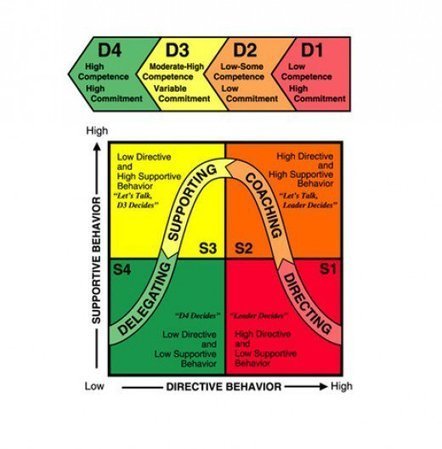
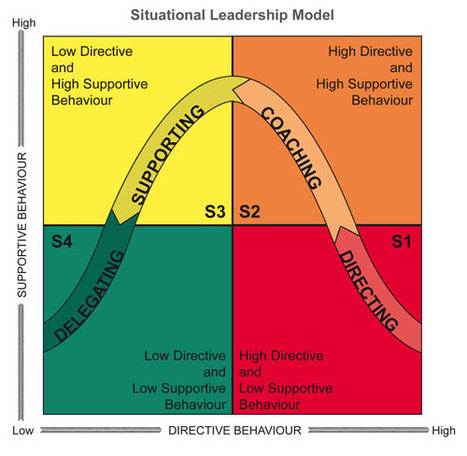
Kenneth Blanchard and Paul Hersey’s situational leadership model tells us that managers could use different leadership styles depending on the situation.
Traditionally the model allows you to analyse the situation that you’re in and then use the leadership style that is most appropriate. Also, your style is likely to change depending on the competences and commitment levels of your staff and so from person to person. You might lead the same person in one way in one situation and another way in a different situation.
The pair characterised leadership style in terms of the amount of direction and support that the leader needs to give to members of the team and created a simple matrix: Learn more / En savoir plus / Mehr erfahren: http://www.scoop.it/t/21st-century-learning-and-teaching/?tag=LeaderShip http://www.scoop.it/t/21st-century-learning-and-teaching/?tag=Situational+Leadership+Theory
|























Learn more / En savoir plus / Mehr erfahren:
http://www.scoop.it/t/21st-century-learning-and-teaching/?tag=Practice
http://www.scoop.it/t/21st-century-learning-and-teaching/?tag=Inquiry+Learning