 Your new post is loading...

|
Scooped by
Gust MEES
July 13, 2016 3:39 PM
|
Niantic Labs, partnering with Nintendo and Pokémon Co., released “Pokémon Go,” a free game for iPhones and Android phones. When you launch it, you see the game franchise’s world famous “pocket monsters” as if they existed in your backyard or bathtub. The point? To “catch ’em all,” as the kids say.
This is augmented reality, or AR, where your smartphone’s camera, GPS and position sensors tell the game what to display and where. It’s a digital world layered over the real one. Unlike virtual reality, which transports you to another universe, you play in your own.
Pikachu is the most well known Pokémon.
The technology isn’t new. Smartphones have had AR games for years, and even Nintendo previously released similar features for its 3DS hand-held device. This isn’t even especially good execution of AR. Which is why perhaps not even Nintendo predicted what happened next. Learn more / En savoir plus / Mehr erfahren: https://gustmees.wordpress.com/2014/11/25/digital-citizenship-social-media-and-privacy/ https://gustmees.wordpress.com/2014/03/05/often-asked-questions-are-there-cyber-security-dangers-with-apps-and-whats-about-privacy/ http://www.scoop.it/t/la-realite-augmentee-augmented-reality-ar
|
|
Scooped by
Gust MEES
July 12, 2016 7:11 AM
|
Das Lernhauskonzept ist ein Modell, das pädagogische, architektonische und organisatorische Strukturen miteinander verbindet. Eine Schule wird dabei in Unterschulen unterteilt, die über jeweils eigene Strukturen und Räume verfügen. Lehrer*innen arbeiten in Teams, die die Schüler*innen über längere Zeit begleiten.
|
|
Scooped by
Gust MEES
July 8, 2016 6:54 AM
|
Schüler in ihrer Eigenverantwortlichkeit und Selbstständigkeit zu fördern und voranzubringen ist den Lehrkräften an der Realschule am Europakanal ein großes Anliegen. Die Schule von einem Ort des Lehrens zu einem Ort des Lernens umzugestalten, an dem die Schüler, zwar angeleitet durch die Lehrkräfte, dennoch über ein erhebliches Maß an Freiheit hinsichtlich ihrer Wochenplanung verfügen, erfordert einerseits einen nicht unerheblichen Umbau der Strukturen und bedeutet andererseits eine Entwicklung des pädagogischen Selbstverständnisses der Kollegen hin zum Lernbegleiter und Lerncoach. In gewisser Weise kann von der Notwendigkeit einer Haltungsänderung dem Schüler gegenüber gesprochen werden.
Die EduZeit findet vier Mal pro Woche jahrgansstufenübergreifend statt. So kann der Schüler seinen Klassenverband verlassen und sich mit Mitschülern seiner Wahl bei einem Lehrer seiner Wahl einfinden, um seine Arbeitsaufträge zu bearbeiten. Der gewählte Lehrer muss nicht zwingend der entsprechende Fachlehrer zur ausgewählten Aufgabe sein. So kann die Mathematikaufgabe auch bei einem anderen Fachlehrer bearbeitet werden, sofern dessen Unterstützung nicht von Nöten ist. In der EduZeit ist ebenfalls die Möglichkeit gegeben, dass sich die Schüler auch gegenseitig unterstützen.
Jeder Fachlehrer stellt für die EduZeit entsprechende Aufgaben zur Verfügung, die in Phasenplänen festgehalten werden. Eine Phase umfasst in der Regel ungefähr 5 Wochen. Ein Drittel der Unterrichtszeit fließt also in die EduZeit, in der die Schüler, wie schon erwähnt, sowohl Fach, als auch Lehrer frei wählen können.
Dokumentiert wird die Anwesenheit des Schülers in der EduZeit in einem Planer, den der Schüler täglich mitzuführen hat. Die Aufsicht führenden Lehrkräfte stempeln die abgeleistete Zeit ab und haben die Möglichkeit den Erziehungsberechtigten, wenn nötig, zum Beispiel eine Mitteilung über die Arbeitshaltung des Schülers zu geben.
Auch die Termine für die Leistungsnachweise werden in den Phasenplänen festgehalten. Unangekündigte Leistungsnachweise gehören somit der Vergangenheit an. Learn more / En savoir plus / Mehr erfahren: http://www.scoop.it/t/21st-century-learning-and-teaching/?tag=Germany
|
|
Rescooped by
Gust MEES
from Learning & Mind & Brain
July 8, 2016 5:48 AM
|
|
|
Scooped by
Gust MEES
July 6, 2016 12:28 PM
|
|
|
Rescooped by
Gust MEES
from Technology and language learning
August 29, 2016 6:59 AM
|
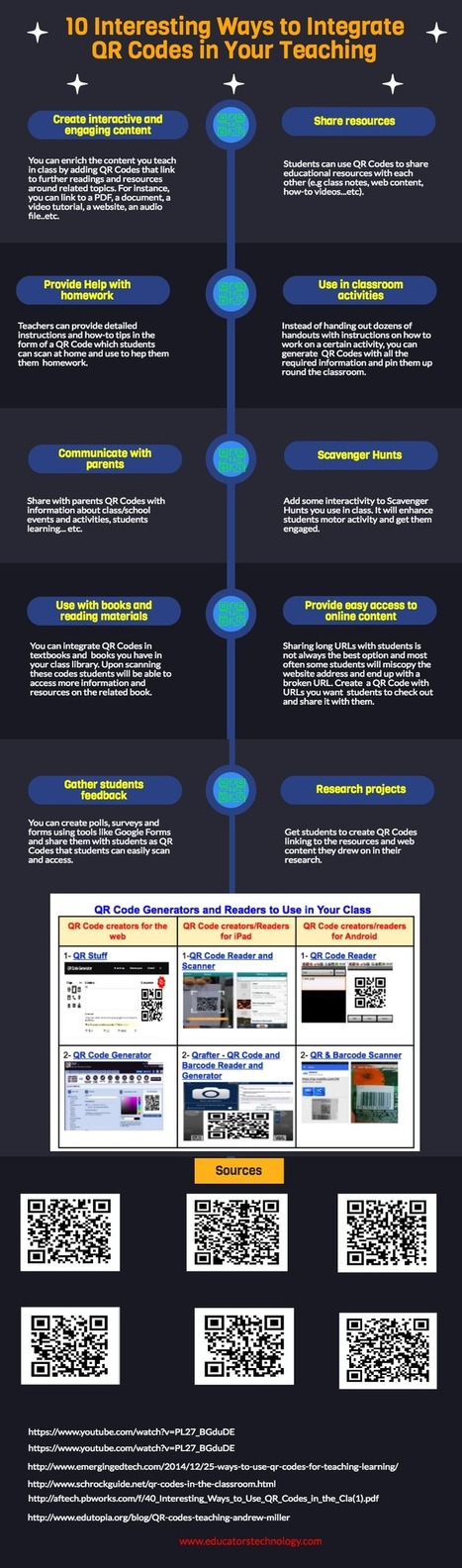
With the advance of mobile technologies, QR Code technologies open up a vast terrain for educational uses. There are several ways teachers can leverage the educational potential of QR Codes in their instruction. The visual below sums up 10 interesting examples of how you can use QR Codes with your students. We have also included some interesting resources and video tutorials to help better understand the whole concept of QR Codes in education. Check them out and share with your colleagues. Enjoy... Learn more / En savoir plus / Mehr erfahren: http://www.scoop.it/t/21st-century-learning-and-teaching/?tag=QR+Codes
Via Yuly Asencion
|
|
Scooped by
Gust MEES
July 5, 2016 9:19 AM
|
According to a recent study by Accenture, investments in fintech hit $5.3 billion in the first quarter of this year (having grown 75 percent in 2015, exceeding $22 billion). These are staggering figures for a still nascent industry, which can have a monumental impact on all sectors, from lending and investments to savings and payments.
Hitherto, most of the investments have occurred in the U.S. and Europe, with a marked exception this year when China’s Ant Financial completed a staggering $4.5 billion raise at a $60 billion valuation, making it one of the highest-valued private companies in the world.
This recent raise may draw to emerging markets attention from the world beyond London, New York and Silicon Valley, which importantly house more than 90 percent of the world’s under-30 population. Countries other than the U.S. and U.K. have collectively spawned a range of visibly successful companies in search (Yandex, Baidu), e-commerce (Alibaba, Rocket Internet’s portfolio) and media (Naspers) by mostly applying tried and tested Western strategies to the local know-how. Learn more / En savoir plus / Mehr erfahren: http://www.scoop.it/t/luxembourg-europe/?tag=Blockchain http://www.scoop.it/t/luxembourg-europe/?tag=Bitcoin http://www.scoop.it/t/21st-century-learning-and-teaching/?tag=blockchain http://www.scoop.it/t/21st-century-learning-and-teaching/?tag=Fintech
|
|
Scooped by
Gust MEES
July 5, 2016 8:23 AM
|
|
|
Scooped by
Gust MEES
July 4, 2016 4:22 PM
|
WHICH Strategy could WE use for professional eLeadership and eSkills!? Well, giving pedagogical and andragocical (Adult Learning) courses since 2002 and being a Life-Long Learning person and interested (and experienced...) in resolving problems and finding NEW ways for BETTER Learning, here below my thoughts, ideas and strategy for a professional approach for #eLeadership…
|
|
Scooped by
Gust MEES
July 2, 2016 7:02 PM
|
|
|
Scooped by
Gust MEES
July 2, 2016 6:46 PM
|
|
|
Rescooped by
Gust MEES
from Effective Education
June 30, 2016 9:31 AM
|
|
|
Scooped by
Gust MEES
June 29, 2016 7:40 AM
|
|
|
|
Scooped by
Gust MEES
July 13, 2016 3:13 PM
|
|
|
Scooped by
Gust MEES
July 8, 2016 5:54 PM
|
Ever dreamt of visiting a majestic château in France’s world-famous Loire Valley but can’t afford it? Well, now you can. The Loire Valley, which once housed France’s kings and nobility, attracts thousands of tourists a year. But, for many, a trip to France to see the fairytale former royal residences has long been an inaccessible dream. The castles that can now be viewed almost brick by brick with the new ‘Google Street View’ virtual tours include Sully-sur-Loire, Chambord and Cité Royale de Loches. Those who run these historic landmarks hope that the project will boost tourism to the charming and scenic “Valley of the Kings”.
|
|
Scooped by
Gust MEES
July 8, 2016 6:34 AM
|
Veröffentlicht am Donnerstag, 7. Juli 2016 um 19:13
(mig) - Ab der Rentrée 2016/17 ersetzt das neue Fach "Leben und Gesellschaft" den jetzigen Religions- und Moralunterricht im Secondaire. Im Fondamental wird das Fach erst 2017/18 eingeführt. Der Gesetzentwurf wurde am Donnerstag im Parlament mit den Stimmen der Mehrheitsparteien (32) und 28 Nein-Stimmen verabschiedet.
"Vie et société" ist ein Pflichtfach, bei dem sowohl weltanschauliche, philosophische als auch religiöse Sichtweisen auf neutrale Art behandelt werden sollen. Im Zentrum stehen sechs Lernfelder rund um den Zusammenhalt in einer multikulturellen Gesellschaft. Aufgabe des Fachs ist es, einen Zugang zur Pluralität an Werten, Kulturen, Weltanschauungen und Religionen zu ermöglichen und die jungen Menschen zu einer konstruktiven und kritischen Auseinandersetzung anzuregen. Learn more / En savoir plus / Mehr erfahren: http://www.scoop.it/t/luxembourg-europe/?tag=Education
|
|
Scooped by
Gust MEES
July 7, 2016 10:19 AM
|
|
|
Scooped by
Gust MEES
July 6, 2016 10:50 AM
|
|
|
Scooped by
Gust MEES
July 5, 2016 12:57 PM
|
Die Förderung von Selbstlernfähigkeiten als integriertes Konzept universitärer Lehre
Im Projekt "Selbstlernförderung als Grundlage" steht die Konzeption, Entwicklung und Umsetzung von Angeboten zur Unterstützung der Selbstlernfähigkeiten von Studierenden an der TU Kaiserslautern im Mittelpunkt. Anbieter dieses integrativen Maßnahmenpakets ist das Selbstlernzentrum der TU Kaiserslautern, das im Rahmen der Projektaktivitäten ebenfalls aufgebaut wird und sich als fachbereichsübergreifende Anlaufstelle für Studierende versteht.
Die Angebote des Selbstlernzentrums unterstützen Studierende der TU Kaiserslautern bei der Entwicklung ihrer Selbstlern- und Selbstführungskompetenzen, leisten einen Beitrag zur Erleichterung des Studieneinstiegs und zur Verbesserung der kontinuierlichen Studienorganisation. Um auf überfachlicher Ebene der Heterogenität der Studierenden gerecht zu werden, sollen Studierende dazu befähigt werden, ihre Selbstlernkompetenzen weiterzuentwickeln, ihren Studienalltag besser zu meistern, Lernprozesse zu reflektieren und ihre Lernstrategie zu optimieren. Learn more / En savoir plus / Mehr erfahren: https://gustmees.wordpress.com/2016/07/03/reflections-on-a-professional-strategy-for-eskills-eleadership/
|
|
Scooped by
Gust MEES
July 5, 2016 9:12 AM
|
Of course, before I share this with you, I also want to remind you that I am quick to embrace and celebrate an ecosystem of diverse schools. What I describe below is neither the best or only way to create an amazing school curriculum. Yet, I can write with confidence that this would certainly contribute to a rich, engaging and rewarding school experience; one that gives ample voice and choice to learners while challenging them to grow in character, competence, confidence, and purpose.
What is Curriculum?
The word “curriculum”, as best as I can tell, comes from the idea of a race course. It is a course of study, a pathway that leads to some destination. Yet, others simply define it in the broadest sense as everything that goes into a student’s learning experience in a formal education program. Traditionally, people thought of the curriculum in terms of content, assessments, resources (like books and other readings), teacher-guided lessons and learning experiences, and the like. Yet, more recently, much conversation about curriculum focuses upon standards, outcomes, resources, and assessments; the items that we frequently see in curriculum maps. Learn more / En savoir plus / Mehr erfahren: https://gustmees.wordpress.com/2016/07/03/reflections-on-a-professional-strategy-for-eskills-eleadership/
|
|
Scooped by
Gust MEES
July 4, 2016 5:55 PM
|
|
|
Scooped by
Gust MEES
July 3, 2016 6:33 PM
|
|
|
Scooped by
Gust MEES
July 2, 2016 6:52 PM
|
|
|
Rescooped by
Gust MEES
from E-Learning-Inclusivo (Mashup)
June 30, 2016 3:43 PM
|
|
|
Rescooped by
Gust MEES
from Future Ready School Libraries
June 29, 2016 10:53 AM
|
|


































Niantic Labs, partnering with Nintendo and Pokémon Co., released “Pokémon Go,” a free game for iPhones and Android phones. When you launch it, you see the game franchise’s world famous “pocket monsters” as if they existed in your backyard or bathtub. The point? To “catch ’em all,” as the kids say.
This is augmented reality, or AR, where your smartphone’s camera, GPS and position sensors tell the game what to display and where. It’s a digital world layered over the real one. Unlike virtual reality, which transports you to another universe, you play in your own.
Pikachu is the most well known Pokémon.
The technology isn’t new. Smartphones have had AR games for years, and even Nintendo previously released similar features for its 3DS hand-held device. This isn’t even especially good execution of AR. Which is why perhaps not even Nintendo predicted what happened next.
Learn more / En savoir plus / Mehr erfahren:
https://gustmees.wordpress.com/2014/11/25/digital-citizenship-social-media-and-privacy/
https://gustmees.wordpress.com/2014/03/05/often-asked-questions-are-there-cyber-security-dangers-with-apps-and-whats-about-privacy/
http://www.scoop.it/t/la-realite-augmentee-augmented-reality-ar