Your new post is loading...
To download, click on title or arrow above. File is a pdf with live links to cited documents. Selected/related links are below: Privatizing Schooling and Policy Making: The American Legislative Exchange Council [ALEC] and New Political and Discursive Strategies of Education Governance // Educational Policy http://epx.sagepub.com/content/early/2014/04/28/0895904814528794.abstract
Cashing In On Kids: 172 ALEC Education Bills Push Privatization in 2015 https://www.prwatch.org/news/2016/03/13054/cashing-kids-172-alec-education-bills-2015 How Online Companies Bought America’s Schools
https://www.thenation.com/article/how-online-learning-companies-bought-americas-schools/ The Profit Motive Behind Virtual Schools in Maine www.pressherald.com/2012/09/01/virtual-schools-in-maine_2012-09-02 K12Inc: California Virtual Academies’ Operator Exploits Charter, Charity Laws For Money, Records Show https://www.mercurynews.com/2016/04/17/k12-inc-california-virtual-academies-operator-exploits-charter-charity-laws-for-money-records-show/ Enrollment in California Public Versus Charter Schools https://www.cde.ca.gov/ds/sd/cb/ceffingertipfacts.asp Santa Clara County Office of Education Annual Charter School Databook https://www.sccoe.org/supoffice/charter-schools-office/Documents/2016-17%20Charter%20School%20Report%20Final.pdf Death By A Thousand Cuts: Racism, School Closures, and Public School Sabotage // https://www.j4jalliance.com/wp-content/uploads/2014/02/J4JReport-final_05_12_14.pdf IES National Center for Education Statistics: Percentage of Public School Students Enrolled in Charter Schools, By State (2014) https://nces.ed.gov/fastfacts/display.asp?id=30 Center for Media and Democracy Publishes List of [2,200]+ Closed Charter Schools (with Interactive Map) http://sco.lt/6KOm6z The Perfect Storm: Disenfranchised Communities [Video] https://vimeo.com/161523742 “School Closure Playbook” – [Video] https://vimeo.com/120338240 Charter School Closure Leaves Parents Scrambling For Alternatives http://www.sacbee.com/news/local/education/article199107149.html The Continuum of Structural Violence: Sustaining Exclusion Through School Closures http://sco.lt/9IcTKb KIPP Refuses Agreement To Abide By Conflict of Interest Law: Gets Approved By State Board of Education https://eduresearcher.com/2018/03/13/denykipp/ How Did The State Board of Education Vote on Controversial Charter School Petitions? https://eduresearcher.com/2018/09/07/how-will-state-board-of-education-vote-on-controversial-charter-school-petitions/ Separate and Unequal: The Problematic Segregation of Special Populations In Charter Schools Relative to Traditional Public Schools // Stanford Law and Policy Review http://nepc.colorado.edu/blog/are-charters-beacons Charter Schools, Civil Rights, and School Discipline: A Comprehensive Review: The Center for Civil Rights Remedies (UCLA) https://www.civilrightsproject.ucla.edu/resources/projects/center-for-civil-rights-remedies/school-to-prison-folder/federal-reports/charter-schools-civil-rights-and-school-discipline-a-comprehensive-review/losen-et-al-charter-school-discipline-review-2016.pdf Are California’s Charter Schools The New Separate But Equal “Schools of Excellence”, or Are They Worse Than Plessy? https://papers.ssrn.com/sol3/papers.cfm?abstract_id=3128802 How Privatization Increases Inequality: Section 5: Privatization Perpetuates Socioeconomic and Racial Segregation // In The Public Interest https://public.tableau.com/profile/civil.rights.project.at.ucla#!/vizhome/CostofCASuspensions/DistrictDash NAACP Resolution Calling for a Moratorium on the Expansion of Charter Schools [Original] https://eduresearcher.com/2016/10/21/naacp/ KIPP Refuses To Abide By Conflict of Interest Code; Gets Approved By State Board of Education: https://eduresearcher.com/2018/03/13/denykipp/ [Link no longer active – this was original document for State Legal Counsel’s opinion that a “charter school is subject to” government code 1090] https://cde.app.box.com/v/SBE2018MARCH/file/282675343163 Charter School Vulnerabilities to Waste, Fraud, and Abuse
http://populardemocracy.org/sites/default/files/Charter-School-Fraud_Report_2017 Rocketship Pushes Expansion Despite State Denials and Strong Community Opposition // https://eduresearcher.com/2016/03/09/rocketship-pushes/ John Danner (Co-Founder of Rocketship) Why Blended Schools Are “Whales” In The Ed Institutional Context Quote: “Schools like Rocketship will be a great way to test and validate products and we are happy to do it…” https://beyondschools2.blogspot.com/2012/ New Orleans Charter School Problems Exposed at NAACP Hearing https://eduresearcher.com/2017/04/29/nola-charter/ “Blended Learning: A Wise Giver’s Guide to Tech-Assisted Teaching” // Philanthropy Roundtable (formerly chaired by B. Devos) // http://www.philanthropyroundtable.org/file_uploads/Blended_Learning_Guidebook.pdf Breaking Point: The Cost of Charter Schools For Public School Districts https://www.inthepublicinterest.org/report-the-cost-of-charter-schools-for-public-school-districts/ Education School Dean: Urban School Reform Is Really About Land Development (Not Kids) // https://www.washingtonpost.com/news/answer-sheet/wp/2013/05/28/ed-school-dean-urban-school-reform-is-really-about-land-development-not-kids/?utm_term=.ef77a9f69fd5 Charter Schools, Race, and Urban Space: Where The Market Meets Grassroots Resistance // http://sco.lt/6vGDMf Spending Blind: The Failure of Policy Planning In California’s Charter School Funding // https://www.inthepublicinterest.org/wp-content/uploads/FINAL_ITPI_SpendingBlind_April2017.pdf A Comprehensive Guide To Charter School Closure http://sco.lt/80B85Z San Pablo Rocketship Appeal to State Board in Sacramento (Video with evidence of expanding gaps) https://www.youtube.com/watch?list=PLgIRGe0-q7Safim1TwdTNlcV7auIbigPr&v=uHpH63PsXKs Cybercharters Have An Overwhelmingly Negative Impact http://blogs.edweek.org/edweek/DigitalEducation/2015/10/CREDO_online_charters_study.html Virtual and Blended Learning Schools Continue to Struggle and Grow http://nepc.colorado.edu/newsletter/2016/04/virtual-schools-annual-2016 Red Flags Known and Overlooked With State Board Votes On San Jose Charter Schools // https://eduresearcher.com/2018/01/18/charter-red-flags/ How Will State Board of Education Vote on Controversial Charter School Petitions? // https://eduresearcher.com/2018/09/07/how-will-state-board-of-education-vote-on-controversial-charter-school-petitions/ Understanding Policies that Charter Operators Use for Financial Benefit https://nepc.colorado.edu/publication/charter-revenue New Report Uncovers Systematic Failure by California Charter Schools to Meet Local Control Obligations https://www.publicadvocates.org/uncategorized/22875/ KIPP subset of posts on Charter Schools & “Choice”: A Closer Look page: https://www.scoop.it/t/charter-choice-closer-look?q=kipp Rocketship subset of posts on Charter Schools & “Choice”: A Closer Look page // https://www.scoop.it/t/charter-choice-closer-look?q=rocketship For more with current updates, please see: http://bit.ly/chart_look
http://bit.ly/privatization_explained
http://bit.ly/naacp_resolution

|
Scooped by
Roxana Marachi, PhD
August 5, 2018 1:01 PM
|
From the National Education Policy Center "It is no secret. The news media is full of reports about problems with cyber schools. Some recent examples include:
• In January 2018, the nation’s largest virtual school, Electronic Classroom of Tomorrow (ECOT), closed. There was a subsequent failure to determine what happened to 2,300 of 11,400 students. The school shut down after the state of Ohio found that ECOT had overstated its enrollment by more than 9,000 students, resulting in a $60 million overpayment.
• The Akron Digital Academy quietly closed last month because it could not repay the state the $2.8 million it owed for failing to correctly track enrollment. Akron Public Schools dropped its sponsorship of the school in 2013 due to problems such as poor student performance.
• The state of New Mexico is in the process of shutting down the state’s largest virtual school, also for poor academic performance. An Education Week resource, updated through 2017, includes hundreds of news stories, state audits, and reports about online schools, many highly negative, dating back to the early 2000s. Some of the best and most updated information about these schools is provided in the NEPC’s Sixth Annual Report on Virtual Education, titled Full-Time Virtual and Blended Schools: Enrollment, Student Characteristics, and Performance. The report provides a census of the nation’s full-time virtual schools as well as institutions that blend online learning with face-to-face instruction. The report also includes student demographics, state performance ratings and, where available, analyses of school performance measures. Michigan public radio station WKAR mentioned the NEPC report in a piece about another study that found that a quarter of the 101,000 Michigan students enrolled in online classes did not pass a single one. In an interview with the outlet, Gary Miron, author of the Virtual Education report, said: “We need a moratorium right now; we have to stop. No more growth for the schools; no more schools. The schools that are performing extremely poorly, we have to take sound steps to dismantle them.” Ed tech-focused EdScoop devoted an article to the NEPC report’s findings, noting that: “While the average ratio in the nation’s public schools is 16 students per teacher, virtual schools reported having close to three times as many, and blended schools clocked in with twice as many.” In a piece about a rural school district that partnered with for-profit virtual education company K12 Inc., NBC News quoted the report’s finding that district-operated online schools tend to perform better than charter school versions. Yet the latter continue to dominate the sector. And despite the highly publicized problems with virtual schools, the sector continues to thrive. “It’s rather remarkable that virtual schools continue to grow even while study after study confirms that these schools are failing,” Miron told NEPC.
“Students are clearly being negatively impacted when they attend these schools, and revenues devoted to public school systems are being siphoned off to the private companies that dominate this sector.”...
For full post, see:
https://nepc.colorado.edu/publication/newsletter-virtual-schools-073118
|
|
Scooped by
Roxana Marachi, PhD
January 10, 2018 12:59 AM
|
By Tony Wan "Nothing should unite both critics and fans of education technology more than reports of companies making big money from shoddy products. But what about when the critic may also make a profit by betting that a company will tank because of its lackluster service and results?
At the Value Investing Congress in New York City on September 17, hedge fund manager Whitney Tilson of Kase Capital delivered a whammy of a case against online school provider, K12 Inc., with a 110-slide talk on "An Analysis of K12 (LRN) and Why It Is My Largest Short Position," shared on Business Insider. He said that K12 is his portfolio’s biggest short position. Tilson is a staunch and outspoken fan of education reform. He blogs regularly on education reform and circulates weekly newsletters championing charter schools, reform and edtech in general. He joined Teach for America in its early days and serves on the board of KIPP. And he invests. At last week’s meeting, Tilson argued that K12 Inc., the largest online K-12 education provider in the U.S., and manager of online charter schools in 33 states and D.C., is due for a fall. Although the company’s stock (ticker: LRN) has risen 70% since January 2012, Tilson says it’s “absurdly overvalued and sure to collapse.” Tilson’s analysis of why K12 is a poor investment briefly describes its financial numbers, then dives deeply into why it’s failing to deliver education value. On the numbers (slides 11-19): K12 says its revenue has grown 32% annually over the past decade and that projected earnings per share is expected to climb 32% over the next 12 months. Smoke and mirrors, contends Tilson. He notes that although net income and EBITDA (earnings before interest, taxes, depreciation and amortization) have climbed over the past two years, revenue growth is slowing. Profit margins (over the past two years) have been erratic. And other indicators--how long it takes K12 to get paid, its aggressive accounting practices, and so on--make Tilson jittery. Even more ominous are Tilson’s concerns about K12’s practices. Among them: (slide 8): - "K12's aggressive student recruitment has led to dismal academic results by students and sky-high dropout rates, in some cases more than 50% annually."
- "I have been looking for years and have not found a single K12 school that is free of scandal and posting even decent (much less good) academic results."
Through personal interviews, analysis of a class action suit and media coverage, Tilson has compiled a lengthy indictment of the quality of K12's service. He recounts stories from former employees (slides 21-25) who say the company follows a "growth-at-any-cost mentality" and "increasingly target[s] at-risk students that it knows are likely to fail." He has strong reservations against K12's publicized academic "successes" after poor results and "sky-high" dropout rates at its schools in Colorado, Pennsylvania and Tennessee (slides 33-59). These issues, along with other regulatory infractions, place K12 under intense scrutiny from state officials. Tilson notes that the company will not be opening schools in any new states next year (slide 81).
Following his presentation, Tilson wrote in an email that "K12 reminds me of the subprime mortgage lenders and for-profit colleges when they were flying high--and the ending will be similar I believe."... Full post is at the following page: https://www.edsurge.com/news/2013-09-21-why-investor-whitney-tilson-is-betting-against-k12
|
|
Scooped by
Roxana Marachi, PhD
January 15, 2017 10:25 AM
|
|
|
Scooped by
Roxana Marachi, PhD
December 28, 2016 1:41 PM
|
By Alan Singer "In the News: A number of news items in recent weeks show how powerful money-brokers work inside and outside the law in their war on public education in the United States.
(1) In the State of Washington, a State Supreme Court Judge up for reelection sided with a 6-to-3 court majority in a ruling that declared a state law directing tax dollars to independently run charter schools unconstitutional. To remake the court in their image hundreds of thousands of pro-charter Bill Gates and Paul Allen “Microsoft money” was donated to support his opponents campaign. Fortunately Washington voters rejected the charter judge, this time.
(2) Federal authorities charged seven leaders of the Platinum Partners hedge fund with fraud for operating what was alleged to be a “Ponzi scheme.” They kept the fund afloat by continually using money from new investors to pay off older investors who wanted out. Mark Nordlicht, founder and the chief investment officer for Platinum, also dabbles in operating low-cost religious schools that would benefit from the Trump-Amway DeVos voucher give-away
(3) The New York Times Business pages featured Bill Ackman of Pershing Square Holdings in an article they called “Hedge Fund Math: Heads or Tails, They Win.” It seems that even when his hedge fund performs poorly, Ackman always takes a profitable slice of the pie. According to the Los Angeles Times, Ackman’s Pershing Square Foundation has poured millions of dollars into promoting charter schools in their city. Ackman, through his foundation, is also a major donor to private schools and to Teach for America.
(4) Old friends at New York’s Success Academy Charter Network are under investigation by the city’s Comptroller for lax financial oversight, poor record keeping, understating administrative costs, and for billing the Department of Education for special education services they did not provide to students. The charter schools transferred money earmarked for the education of the students to the governing charter network and could not adequately account for what happened to $25 million worth of computers, desks, whiteboards, and other supplies.
(5) Carol Burris, Executive Director of the Network for Public Education, writing in the Washington Post, documented the salaries charter school magnets pat themselves. KIPP co-founder David Levin received a compensation package of nearly $475,000 from the KIPP Foundation in 2014. Co-founder Mike Feinberg received $219,596 from KIPP Inc., and another $221,461 from the KIPP Foundation. Success Academy’s Eva Moskowitz paid herself $600,000 in 2014 as the CEO of forty-one charter schools. The online for-profit charter company K12 paid its CEO $650,000 in salary plus a series of bonuses that brought his total compensation package to over a million dollars.
According to the National Center for Education Statistics the “total expenditures for public elementary and secondary schools in the United States amounted to $620 billion in 2012-13, or $12,296 per public school student.” If American schools were an independent country, they would have the 21st largest economy in the world. This is a very big financial pie, certainly big enough to make hedge fund managers drool.
The question is, how would hedge funds profit from the Trump-“Amway” DeVos voucher plan if school dollars follow each student?
The two biggest expenses in running a school are teacher salaries and benefits and the cost of building and maintaining school buildings. The key to making a profit is hiring low-paid poorly trained non-union transient teachers who follow scripted test-aligned lessons, finagling free space in existing schools so the public picks up the cost of the facility, and attracting public dollars. Let’s take a hypothetical small school in an average American community with a hundred students. Each of those kids is worth about $15,000, so the hundred students would be worth $1.5 million. Not a large amount for hedge funds, but not an insignificant amount for normal human beings.
The average beginning teacher’s salary in the United States is about $40,000 a year. With benefits figured at an additional 50% it would bring their cost to $60,000 per teacher. More experienced and better educated teachers cost significantly more. Average salary is about $60,000 a year and the benefits package would bring cost closer to $100,000 because it now includes higher pension payments. If our hypothetical school had five beginning teachers for their 100 kids, the cost for teachers would be about $300,000, but if they had a very experienced staff the cost would be closer $500,000. Hiring inexperienced transient teachers alone frees up $200,000 to pay corporate administrators and investors. But if our charter network operated ten small schools with a thousand students, its gross would be $15 million and the benefit of hiring inexperienced transient teachers alone would be $2 million. Now if our charter network operated a hundred small schools with ten thousand students we are starting to talk about real money. Its gross would be $150 million and the benefit of hiring inexperienced transient teachers alone would be $20 million. Michigan, Betsy DeVos’ home state, has 1.5 million children attending public elementary and secondary schools and spends about $11,000 per student. If charter networks operated all of Michigan’s schools, we are talking about $16.5 billion. Now that is real money! The charter network could stash away profits of $5.5 billion just my having high teacher turnover.
But that’s not the only way the hedge fund charter networks and private schools will make money. Inexperienced teachers need scripted lessons, staff development, and supervision, so the hedge fund schools can outsource these activities to subsidiary companies. They can also buy books, tests, supplies, computer software and hardware, and guidance services from their own companies and award maintenance contracts to themselves. This is how the great philanthropists that run the hedge funds can make money if they succeed in privatizing education in the United States."
For full post, see: http://www.huffingtonpost.com/alan-singer/how-hedge-funds-will-prof_b_13855900.html
|
|
Scooped by
Roxana Marachi, PhD
November 5, 2016 1:42 PM
|
"A Colorado cyber charter school with a 19 percent graduation rate. An Ohio cyber that inflated student attendance by nearly 500 percent. A Pennsylvania cyber founder who siphoned off $8 million in public money, including $300,000 to buy himself an airplane. A Hawaii cyber founder who hired her nephew as the athletic director – for a school with no sports teams. As part of an eight-month investigation into the poor academic performance and financial mismanagement of full-time online charter schools, Education Week reviewed hundreds of news stories and dozens of state audits and reports dating back to the early 2000s.
Together, these accounts raise a critical question: What would persuade state lawmakers to bring greater accountability to the nation’s troubled cyber charter sector? DISCLAIMER: In preparing the information included in this interactive map, the Education Week Library sought accounts from established news organizations and documents from state agencies that reported poor performance and/or mismanagement by full-time online charter schools. The list included here is representative, but not comprehensive.
Arizona
News Links: ● "Arizona online schools are rapidly expanding enrollment," Arizona Republic (12/10/2011)
● "Arizona nonprofit schools’ ties to for-profits raise flags," Arizona Republic (12/13/2011)
● "Arizona taxpayers fund firms to run online schools," Arizona Republic (12/13/2011)
● "Experts: Online schools in dire need of oversight," Arizona Republic (12/15/2011)
● "Brewer vetoes Arizona online-education bill," Arizona Republic (5/14/2012) State Audits & Reports: ● "Performance audit: Technology assisted project-based instruction program" (October 2007)
California News Links: ● "Cyber classrooms," San Diego Union-Tribune (11/10/2002)*
● "Virtual charter school network making a profit at the expense of California schoolchildren, study finds," East Bay Times (2/27/2015)
● "California’s attorney general is investigating the online charter school industry," Buzzfeed (11/2/2015)
● "California Virtual Academies: Is online charter school network cashing in on failure?," San Jose Mercury News (4/16/2016)
● "K12 Inc.: California Virtual Academies’ operator exploits charter, charity laws for money, records show," East Bay Times (4/18/2016)
● "K12 Inc: California Virtual Academies defend online charter schools as model of school choice," The Humboldt Beacon (4/19/2016)
● "California attorney general probe leads to $168.5 million settlement with for-profit online school operator," San Jose Mercury News (7/8/2016)
● "Online schools: Susan Bonilla shelves bill after interest groups water it down," San Jose Mercury News (8/30/2016) State Audits & Reports: ● "Settlement agreement and release, State of California v. K12 Inc." (7/8/2016) * This article is not publicly available online. Colorado News Links: ● "Online schools flunk audit," Denver Post (12/11/2006)
● "Oversight yet to catch up with Colorado’s burgeoning online schools," Denver Post (10/1/2011)
● "Online K-12 schools failing students but keeping tax dollars," I-News Network/Education News Colorado (10/2/2011)
● "Investigation finds lax oversight of online K-12 schools," I-News Network/Rocky Mountain PBS (10/2/2011)
● "Achievement drops when K-12 students switch to online schools," I-News Network/Education News Colorado (9/4/2013)
● "Online regulation bill quickly killed," Chalkbeat (3/16/2015) State Audits & Reports: ● "Report of the state auditor, online education, Colorado Department of Education, performance audit" (November 2006)
● "Online education reports," (2007-2014)
● "Summary report for online schools and programs," Submitted by Office of Blended and Online Learning of the Colorado Department of Education to the state board and state House and Senate’s education committees (June 2014) Florida News Links: ● "Bush, cabinet reject appeal by cyber high to reopen in Orange," Orlando Sentinel (8/14/2002)
● "Seminole pulls plug on cyber school," Orlando Sentinel (8/28/2002)
● "Mavericks’ high schools hope to profit from education – But at what cost?," New Times Broward-Palm Beach (12/29/2011)
● "PBC Charter school leader accused of steering money to his own company," Palm Beach Post (10/15/2015)
● "One Broward County charter school plans to close, another may be forced to shut down," Sun-Sentinel (3/14/2016)
● "Pinellas board appears ready to close three troubled charter schools," Tampa Bay Times (5/10/2016) Georgia News Links: ● "Odyssey School's charter renewed; State board gives approval for it and cyber partner," Atlanta Journal-Constitution (7/10/2009)
● "Cyberschool decision due; Commission weighs benefit for Georgia of more virtual classrooms," Atlanta Journal-Constitution (6/18/2010)
● "Georgia DOE blasts Georgia Cyber Academy, threatens to pull charter in report," Atlanta Journal-Constitution (11/20/2012)
● "State Department of Education praises Georgia Cyber Academy’s progress on special ed," Atlanta Journal-Constitution (12/4/2012)
● "Charter school prolonged a painful choice," Atlanta Journal-Constitution (12/18/2015)
● "Georgia’s largest online school paid millions, earns a D," Atlanta Journal-Constitution (7/24/2016)
● "Georgia lacks clear policy for counting online attendance," Atlanta Journal-Constitution (8/10/2016) State Audits & Reports: ● "Study of virtual school performance and impact," Conducted by Public Impact and the National Association of Charter School Authorizers, Commissioned by the State Charter Schools Commission of Georgia (2015)
● "Georgia virtual charter school report," Georgia Department of Audits and Accounts Performance Audit Division (2016) Hawaii News Links: ● "Charter school stands accused of nepotism," Honolulu Star-Advertiser (12/5/2010)
● "Exclusive: AG raids charter school, seizing records, computers," Hawaii News Now (12/17/2013)
● "No criminal charges filed against sisters," Honolulu Star-Advertiser (10/29/2015) Idaho News Links: ● "Virtual school bailout OK’d; Senate also says yes to changes for charter schools," Idaho Statesman (3/17/2004)*
● "A charter for conflict," Lewiston Morning Tribune (6/13/2004)
● "Education in uproar," Lewiston Morning Tribune (7/11/2004)
● "Idaho not tracking how online schools spend public money," Moscow-Pullman Daily News (4/6/2008)
● "Shawn Vestal: Idaho results show that in many cases, virtual education doesn’t deliver," Spokesman-Review (1/28/2016) State Audits & Reports: ● A descriptive analysis of Idaho virtual charter school student academic performance from 2004 to 2009," Idaho Department of Education / REL Northwest (January 2010) * This article is not publicly available online. Indiana News Links: ● "Star Watch: Cyberschools multiply, but scores fall short," Indianapolis Star (7/15/2012)
● "Rapid growth, rising debt mark Indiana Cyber Charter School," Evansville Courier & Press (6/4/2014)
● "Lawsuit: Virtual charter school owes $600K for services," Indianapolis Star (8/11/2014)
● "Virtual charter school shuttered over financial, management issues," Evansville Courier & Press (6/17/2015)
● "In danger of closure, virtual charter surprises state board by transferring students to sister school," Chalkbeat (9/7/2016) Maine News Links: ● "Those helping write virtual school policy positioned to profit from it," Portland Press Herald (9/1/2012)
● "Multinational giant set to run first virtual school in Maine," Portland Press Herald (3/15/2014)
● "Maine’s new virtual charter school sees 25% enrollment drop since opening," Portland Press Herald (1/6/2016) Massachusetts News Links: ● "Massachusetts Virtual Academy gets low marks for student progress," The Republican Newsroom/New England Center for Investigative Reporting (12/16/2012)
● "As state’s first virtual school grows, so do concerns," WBUR (10/1/2015) Michigan News Links: ● "Offering more choices?; House education committee holds hearing on online charter schools," Pioneer (1/27/2012)*
● "Three years later, jury still out on Michigan's cyber school expansion," Bridge Magazine (10/22/2015)
● "4 Grand Rapids schools, 2 charters make state list of low-performers," MLive (9/2/2016) * This article is not publicly available online. Minnesota News Links: ● "Arguments heard by education commissioner on BlueSky investigation," Pioneer Press (12/21/2011)
● "BlueSky online school rebounding after state effort to shut it down," Pioneer Press (4/27/2013) State Audits & Reports: ● "In the matter of the termination of the existing contract between BlueSky Online Charter School and Novation Education Opportunities," Minnesota Office of the Attorney General (February 2011) Nevada News Links: ● "Beacon Principal Praises Graduates for Overcoming Odds," Las Vegas Review Journal (6/13/2014)
● "Nevada panel weighs closure of several virtual schools, criticizes student performance," KSNV NBC Las Vegas (4/25/2016) New Mexico News Links: ● "2 Santa Fe charter schools rejected," Albuquerque Journal (9/21/2012)
● "Skandera OK’s virtual school," Albuquerque Journal (1/31/2013)
● "Bill bans firms from running public schools," Albuquerque Journal (2/13/2013)
● "Senator seeks AG’s opinion on whether Skandera actions stray from state law," Santa Fe New Mexican (3/20/2013)
● "State lawmakers take a closer look at virtual charter schools," Santa Fe New Mexican (9/16/2016) State Audits & Reports: ● "Virtual education and cyber learning: overview of 2012 through 2014 LESC interim reports," State of New Mexico Legislative Education Study Committee (6/25/2015)
● "Performance, cost, and governance of selected charter schools," New Mexico Public Education Department report to Legislative Finance Committee (1/18/2016) North Carolina News Links: ● "Virtual charter school seeks state response," Charlotte Observer (5/4/2012)
● "Two virtual charter schools on track for North Carolina," Charlotte Observer (12/17/2014)
● "NC virtual charter schools see high withdrawal rates," WUNC (1/7/2016)
● "NC virtual charter schools off to rough academic start," News & Observer (9/1/2016) State Audits & Reports: ● "Report to the North Carolina General Assembly: virtual charter school study," Public Schools of North Carolina, State Board of Education (4/15/2014) Ohio News Links: ● "Charter school owes state $48,000 for ineligible students," Associated Press (9/2/2003)*
● "Charter schools falling short on audits," Columbus Dispatch (7/26/2005)
● "Miscounted students; state owes $263,000 to online school," Columbus Dispatch (4/4/2006)
● "Online schools get millions in public support," Cleveland Plain Dealer/State Impact Ohio (9/30/2012)
● "Taxpayers’ $1.2 million propped up owner’s 2nd charter-school bust," Columbus Dispatch (11/19/2013)
● "E-school to repay Ohio for missing students," Columbus Dispatch (3/1/2016)
● "Online school enriches affiliated companies if not its students," New York Times (5/18/2016)
● "ECOT sues to block effort to track log-ins of students," Columbus Dispatch (7/8/2016)
● "State may force ECOT to pay back 60% of taxpayer funds," Columbus Dispatch (9/27/2016)
● "Eschools say they will appeal audits determining inflated attendance," Columbus Dispatch (10/4/2016) * This article is not publicly available online. Oklahoma News Links: ● "Virtual school says funding blocked," Tulsa World (8/13/2010)
● "University of Central Oklahoma pays $60K to exit charter deal," The Oklahoman (3/1/2011)
● "Millions in state aid go to online charter schools in Oklahoma," The Oklahoman (12/30/2013)
● "State moves to shut down virtual charter school," Oklahoma Watch (7/11/2016)
● "State says 3-year-old probe into virtual school still continues," Oklahoma Watch (7/14/2016) Oregon News Links: ● "Oregon virtual charter school faces loss of funds," Associated Press (9/6/2006)*
● "Lawmakers loosen admissions for online charter schools as state’s largest such school graduates biggest class," Oregonian (6/24/2011)
● "Gresham-Barlow academy gives students an online alternative to traditional school," Oregonian (2/1/2013)
● "Oregon's largest charter school miseducated student for years, graduated her unable to read or write," Oregonian (1/21/2013)
● "David Sarasohn: Virtual charter school uses smaller district for bigger money (Opinion)," Oregonian (9/12/2015) State Audits & Reports: ● "Online charter schools: policy issues," Oregon State Board of Education Policy Brief (August 2007) * This article is not publicly available online. Pennsylvania News Links: ● "Cyber-charter suit is a 'smear campaign,' founder says," Philadelphia Inquirer (9/7/2001)
● "Cyberschool is cautionary tale," The Morning Call (5/13/2002)
● "Zogby said to be in line for job at for-profit schools firm," Philadelphia Daily News (11/27/2002)
● "Court rules online school must close; Einstein Academy told to shut doors next month," Evening Sun (5/15/2003)*
● "Devon charter founder sues parents," Philadelphia Inquirer (2/3/2009)
● "Probe found no record of grant money," Philadelphia Inquirer (8/5/2009)
● "PA Auditor General: Taxpayers overcharged $365 million annually for charter schools," The Morning Call (6/21/2012)
● "Auditor General uses PA Cyber finances to illustrate need for change," Beaver County Times (12/7/2012)
● "Ex-workers claim operator of cyber charters played games with enrollment figures," WHYY/Newsworks (1/21/2013)
● "Rising Pa. cyber charter costs fuel push for statewide reform," WHYY/Newsworks (5/23/2013)
● "Feds: PA Cyber Charter School founder Trombetta schemed to steal $1 million," Pittsburgh Post-Gazette (8/24/2013)
● "Donations from ex-cyber school raise concerns," Pittsburgh Post-Gazette (9/1/2013)
● "Lawyers in Brown’s fraud case defend her multiple salaries," Philadelphia Inquirer (12/7/2013)
● "Ex-CEO of cyber school wants evidence thrown out in fraud case," Associated Press (6/5/2014)
● "After 3 years of fighting charges, PA Cyber founder admits tax fraud," Pittsburgh Post-Gazette (8/24/2016) State Audits & Reports: ● "Pennsylvania charter school accountability and transparency: time for a tune-up," Pennsylvania Department of the Auditor General (May 2014)
● "Charter and cyber charter education funding reform should save taxpayers $365 million annually," Pennsylvania Department of the Auditor General (6/20/2012)
● "The Commonwealth should revise its charter and cyber charter school funding mechanisms," Pennsylvania Department of the Auditor General (September 2010) * This article is not publicly available online. Tennessee News Links: ● "Tennessee legislative committee kills bill to close Tennessee Virtual Academy," The Commercial Appeal (2/12/2013)
● "Virtual school hits bottom, gets reprieve," The Tennessean (8/25/2013)*
● "Court: TN Virtual Academy can remain open," The Tennessean (6/12/2015)
● "Virtual academy improvement deadline unclear," WBIR (8/16/2016) State Audits & Reports: ● "Virtual education report," Tennessee Department of Education (2015)
● "Virtual schools in Tennessee," Tennessee Comptroller of the Treasury, Offices of Research and Education Accountability (March 2016) * This article is not publicly available online. Texas News Links: ● "3,500 students navigate virtual classrooms at 3 Texas public online schools," Dallas Morning News (11/7/2010)
● "Education Inc.," Texas Observer (9/6/2011)
● "Virtual schools; not so virtual loophole," Texas Observer (10/10/2011)
● "Virtual schools see numbers increase, along with questions," Amarillo Globe-News (6/7/2012) Utah News Links: ● "Private company could cash in on online charter school," Salt Lake Tribune (10/6/2007)
● "Utah charter schools under new performance scrutiny," Salt Lake Tribune (5/27/2013)
● "Audit finds poor oversight of Utah schools' online education," Salt Lake Tribune (2/27/2014)
● "Two Utah charter schools dumping vendor of online programs," Salt Lake Tribune (5/9/2014)
● "Highest, lowest-performing Title 1 schools in Utah identified," KSL.com (12/26/2014)
● "State announced high- and low-performing Title 1 schools," KSL.com (10/1/2015) State Audits & Reports: ● "Performance audit 2013-02, distance and online education programs in Utah schools," Utah State Board of Education (2/7/2014) View the full list of news stories Education Week collected. Please send additional accounts, reports, and responses that you believe merit inclusion to library@epe.org. Source: By Maya Riser-Kositsky, Benjamin Herold, and Arianna Prothero, Education Week | Design & Visualization: Sumi Bannerjee, Nina Goldman" For original post, see: http://www.edweek.org/ew/section/multimedia/cyber-charters-widespread-reports-of-trouble.html
|
|
Scooped by
Roxana Marachi, PhD
April 20, 2016 9:55 PM
|
By Jessica Calefati
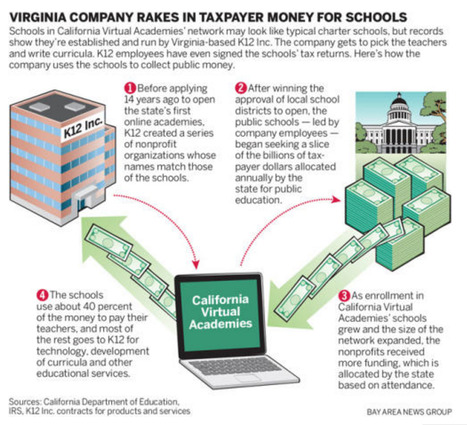
K12 Inc., California’s largest operator of virtual charters, rakes in taxpayer money as educational outcomes fall short. What our investigation found - Teachers employed by K12 Inc.'s charter schools may be asked to inflate attendance and enrollment records used to determine taxpayer funding.
- Fewer than half of the students who start the online high schools earn diplomas, and almost none of them are qualified to attend the state's public universities.
- K12's heavily marketed online model has helped the company reap more than $310 million in state funding over the past 12 years.
- Students who spend as little as one minute during a school day logged in to K12's school software may be counted as present in records used to calculate the amount of funding the schools get from the state.
- About half of the schools' students are not proficient in reading, and only a third are proficient in math -- levels that fall far below statewide averages.
- School districts that are supposed to oversee the company's schools have a strong financial incentive to turn a blind eye to problems: They get a cut of the academies' revenue, which largely comes from state coffers."
For full post, click on title above or here: http://www.mercurynews.com/education/ci_29777973 For part two of this series, please see: http://www.mercurynews.com/education/ci_29780959/k12-inc-california-virtual-academies-operator-exploits-charter?source=infinite-up
|
|
Scooped by
Roxana Marachi, PhD
March 14, 2016 3:27 PM
|
For full post, click on title above or here: http://www.truth-out.org/news/item/35144-cashing-in-on-kids-172-alec-education-bills-push-privatization-in-2015 By Brendan Fischer and Zachary Peters, PR Watch "ALEC's agenda would transform public education from an accountable institution that serves the public into one that serves private, for-profit interests. (Photo: School Money via Shutterstock; Edited: LW / TO)
Despite widespread public opposition to the corporate-driven education privatization agenda, at least 172 measures reflecting American Legislative Exchange Council (ALEC) model bills were introduced in 42 states in 2015, according to an analysis by the Center for Media and Democracy, publishers of ALECexposed.org and PRWatch.org. (A PDF version of this report may be downloaded here.) One of ALEC's biggest funders is Koch Industries and the Koch brothers' fortune. The Kochs have had a seat at the table - where the private sector votes as equals with legislators - on ALEC's education task force via their "grassroots" group Americans for Prosperity and their Freedom Partners group, which was described as the Kochs' "secret bank." The Kochs also have a voice on ALEC's Education Task Force through multiple state-based think tanks of the State Policy Network, ALEC's sister organization, which is funded by many of the same corporations and foundations and donor entities. ALEC's Education Task Force is also funded by the billionaire DeVos family, which bankrolls a privatization operation called "American Federation of Children," and by for-profit corporations like K12 Inc., which was founded by junk-bond king Michael Milliken. ALEC's education task force has pushed legislation for decades to privatize public schools, weaken teacher's unions, and lower teaching standards. ALEC's agenda would transform public education from a public and accountable institution that serves the public into one that serves private, for-profit interests. ALEC model bills divert taxpayer money from public to private schools through a variety of "voucher" and "tuition tax credit" programs. They promote unaccountable charter schools and shift power away from democratically elected local school boards."... **** ..."Other Koch-ALEC Educational Priorities in 2015 Other ALEC-influenced bills introduced in 2015 include legislation to: - Promote the creation of taxpayer-subsidized charter schools through the Next Generation Charter Schools Act, introduced in three states - Maryland, Utah, and West Virginia - which exempts charter schools from complying with the legal requirements that govern traditional public schools, such as teacher qualification standards. This legislation also creates an appointed, state-level charter school authorizing board, safeguarding charter schools from local accountability.
- Shield charter schools from democratic accountability through bills such as The Innovation Schools and School District Act, introduced in three states - Connecticut, Mississippi, and Texas. This legislation removes local accountability by giving state-level officials - rather than elected local school boards - chartering authority for schools that do not follow the legal obligations of public schools, including possibly waiving provisions of teacher collective bargaining agreements.
- Send taxpayer dollars to unaccountable, for-profit online school providers through the Virtual Schools Act, introduced in five states (Alabama, Illinois, Minnesota, Missouri, and Virginia), the Statewide Online Education Act, introduced in three states (Mississippi, South Carolina, and Virginia), and the Course Choice Program Act, introduced in five states (Alabama, Missouri, Oklahoma, Texas, and Wisconsin). These bills promote an education model where a single teacher remotely teaches a "class" of hundreds of isolated students working from home. The low overhead for virtual schools certainly raises company profits, but it is a model few educators think is appropriate for young children. Even the Walton Family Foundation, no friend to public schools, has documented the failure of online schools in 2015.
- Allow schools to revoke tenure for teachers through the Great Teachers and Leaders Act, introduced in three states - New Mexico, New York, and Oklahoma. This bill allows these schools to let go of teachers, despite seniority or contracted tenure, and purports to base these decisions on "performance," mostly measured through "student growth."
- Limit teacher tenure through the Career Ladder Opportunities Act, a version of which was enacted in Idaho, which modifies teaching contracts and pay scales to base them upon teaching "performance," potentially demonstrated in part by student test scores.
- Create mandated curriculum supporting ALEC's rhetoric about "federalism" in the Founding Principles Act, introduced or expanded in six states - Arkansas, Georgia, Michigan, New York, South Carolina, and Texas. This bill requires the teaching of a semester-long course on the "philosophical understandings" of America's founders that appears geared toward indoctrinating children with conservative views.
- Require the government to facilitate and fund sending students to any school in the state through The Open Enrollment Act, introduced or expanded in three states - Arkansas, Florida, and Rhode Island. These "open enrollment" programs are an alternative to voucher programs and have a similar fiscal impact on state education budgets.
Drivers of the School Privatization Agenda in ALEC Some of the interests funding ALEC and driving the effort to undermine universal public education include:
The Kochs' Americans for Prosperity (AFP) group. AFP has long been a member and funder of ALEC's education committee and has been active in promoting ALEC policies in the states, lobbying in favor of measures like vouchers in Wisconsin and holding rallies in Oklahoma to support the Special Needs Scholarship Act. AFP has also launched "issue ads" to support ALEC modeled school reforms.
Members of the State Policy Network (SPN) are also key drivers of the ALEC agenda in the states. SPN is a network of state-based "mini-Heritage Foundations" that provide academic cover and the appearance of local grassroots support for ALEC policies - even though the groups are working in a coordinated fashion. For example, SPN affiliates like Colorado's Independence Institute, Arizona's Goldwater Institute, Florida's James Madison Institute, and others are part of the ALEC Education Task Force. SPN was created to help ALEC's national agenda look local, as CMD has documented.
K12 Inc., the nation's largest provider of online charter schools, in which low-paid teachers manage as many as 250 students at a time and communicate with their pupils electronically. The corporation, co-founded by famed Wall Street junk bond king Michael Milliken, is on the ALEC Education Task Force and its lobbyist Lisa Gillis has Chaired ALEC's Special Needs Subcommittee. On top of other studies showing that full-time virtual schools are not appropriate for most children, the conservative Walton Family Foundation commissioned a study from Stanford University in 2015 which found that, over the course of a school year, students in virtual charters learned the equivalent of 180 fewer days in math and 72 fewer days in reading than their peers in traditional charter schools, on average. The 501(c)(4) American Federation for Children and its 501(c)(3) wing the Alliance for School Choice are key drivers of the school privatization agenda in ALEC. The groups were organized and are funded by the billionaire DeVos family (heirs to the Amway fortune); Richard DeVos has received the ALEC "Adam Smith Free Enterprise Award" and Betsy DeVos chairs AFC. AFC's top lobbyist at ALEC is disgraced former Wisconsin Assembly Speaker Scott Jensen, who was convicted of three felonies for misuse of his office for political purposes and banned from the state Capitol for five years (though the charges were later reversed and dropped as part of a plea deal).
The Milwaukee-based Bradley Foundation, one of the top school privatization funders in the country, has spent more than $31 million promoting "school choice" nationwide between 2001 and 2012. For decades, Bradley has also been a major ALEC funder bankrolling ALEC operations and key reports. The foundation has over $800 million in assets and has been headed for many years by Michael Grebe, Governor Scott Walker's longtime campaign co-chair (he is retiring in mid-2016)."... For full post, click on title above or here: http://www.truth-out.org/news/item/35144-cashing-in-on-kids-172-alec-education-bills-push-privatization-in-2015
|
|
Scooped by
Roxana Marachi, PhD
November 8, 2015 3:32 AM
|
By Donald Cohen
"Did you know that one of the fastest growing sectors of the charter school industry are ‘virtual’ charter schools, where K-12 students learn from home in front of their computers? No school buildings, no recess with friends, no shared learning. It’s true. The largest virtual charter company, a publicly traded corporation called K12, Inc., provides education to over 120,000 public school students across the country. Last year, they made more than $900 million in revenue, most of it taxpayer money earmarked for public education. But virtual charters are starting to pile up bad news and serious questions about their priorities.
A study released last week by the Center for Research on Education Outcomes (CREDO) found that students attending virtual charters learn significantly less in math and reading than similar students attending brick-and-mortar schools. So significantly less that the Washington Post’s Lyndsey Layton wrote, “In other words, when it comes to math, it’s as if the [online] students did not attend school at all.”
This week, news broke that California’s Attorney General is investigating the entire virtual charter industry. And for good reason. Earlier this year, we looked under the hood of California Virtual Academies (CAVA), the state’s largest provider of online public education, and what we found was clear: CAVA’s manager and primary vendor, a subsidiary of K12 Inc., has put their responsibility to maximize profits for shareholders above investing in educating children.
Virtual charters are starting to pile up bad news and serious questions about their priorities.
While the overall percentage of U.S. students who attend online schools is small, in some states—like California, where CAVA teachers are organizing to serve students and families, not corporations—online education has become yet another path towards the privatization of public education. Online charters are a significant issue in Pennsylvania’s ongoing budget standoff between legislative leaders and the governor, as the state has the second-highest online enrollment in the country.
An increasing number of charter schools are using ‘blended learning’ models, where students go to school but spend lots of time in front of keyboards and screens. A former executive of the charter school chain Rocketship—which is one of the largest users of online learning—called blended learning “stripped-down efficiency model.”
Along with a growing crowd, we have concerns about an overreliance on technology in the classroom, but fully online schools go too far. While high quality virtual charters can be useful for certain students, like actors, artists, or Olympic hopefuls, the majority of kids need teachers to interact with and classmates to socialize and study with. And a pro-charter think-tank (CREDO), California’s attorney general, and many others, including teachers, seem to agree.
To follow up our CAVA report, we’re going to be looking even harder at virtual charters. Let us know if companies like K12, Inc., are recruiting students in your community. We’d love to hear from you. Send us an email: info@inthepublicinterest.org"...
For full post, click on title here: http://www.inthepublicinterest.org/yes-virtual-charter-schools-exist-and-theyre-growing/
|
|
Scooped by
Roxana Marachi, PhD
February 27, 2015 1:51 AM
|
By Katy Murphy and Jessica Calefati // Mercury News "California schoolchildren studying at home through a growing network of for-profit online charter schools often lack functional computers and other materials they need to learn -- even as millions in state tax dollars flow to the schools' operator, according to a report released Thursday.
California Virtual Academy's high schools graduated just 36 percent of their students from 2011 to 2013 and had more dropouts than graduates, the report found."This is not what virtual education in California should look like," concludes the report by In the Public Interest, a Washington, D.C.-based research group that focuses on contracting and privatization.The troubling findings about the network's academic performance, resources and finances suggest that the company managing the 11 California schools -- Virginia-based K12 and its California subsidiary, K12 California -- is rewarding shareholders and executives at the expense of the 14,500 children enrolled in them from kindergarten through grade 12."...
For full post, click on title above or here: http://www.mercurynews.com/california/ci_27605967/virtual-charter-school-network-making-profit-at-expense For the In The Public Interest (organization website)
http://www.inthepublicinterest.org/ and pdf of report: http://www.inthepublicinterest.org/sites/default/files/Virtual_Public_Education_In_California.pdf _________________________________
For more background on K12 Corporation, ALEC, and legislative roots that paved the way for these profits: http://sco.lt/7ZUb3Z
|
|
Scooped by
Roxana Marachi, PhD
September 4, 2014 2:02 AM
|
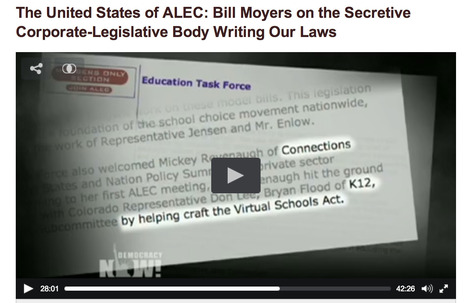
"Democracy Now! premieres "The United States of ALEC," a special report by legendary journalist Bill Moyers on how the secretive American Legislative Exchange Council has helped corporate America propose and even draft legislation for states across the country. ALEC brings together major U.S. corporations and right-wing legislators to craft and vote on "model" bills behind closed doors. It has come under increasing scrutiny for its role in promoting "stand your ground" gun laws, voter suppression bills, union-busting policies and other controversial legislation. Although billing itself as a "nonpartisan public-private partnership," ALEC is actually a national network of state politicians and powerful corporations principally concerned with increasing corporate profits without public scrutiny."... For full video and post, click on title, image above, or here: http://www.democracynow.org/2012/9/27/the_united_states_of_alec_bill Selected quotes / transcript from 27:11-29:19 on section related to Education:
“ALECS education agenda includes online schooling as well. Take a careful look and you’ll find a profit motive there too." “What you see is corporations that have a direct benefit, whose bottom line directly benefits from these bills, voting on these bills in the ALEC Task Force. And so corporations like Connections Academy, Corporations like K-12, they have a direct financial interest in advancing this agenda.” "Those corporations like Connections Academy and K-12 which specialize in online education can profit handsomely from laws that direct taxpayer money toward businesses like theirs. In 2011, both sat on ALEC’s Education Task Force. But the two companies didn’t just approve the model bill, they helped craft it. The proof is in one of Alec’s own documents. And there’s more to the story." “Thank you Mr. Speaker… House Bill 1030 has to do with the establishment of Virtual Public Schools.” “Last year, an online schooling bill based on the ALEC model turned up in another state where ALEC has a powerful influence, Tennessee. It was introduced in both the state Senate and House by ALEC members. The bill passed making private corporations eligible for public education. Then within weeks, the K-12 Corporation got what amounted to a no bid contract to provide online education to any Tennessee student from Kindergarten to the 8th grade. So, let’s review. The ALEC member corporations helped craft the bill, ALEC Legislators introduced it, and voted on it, and now there’s a state law on the books that enables one of those corporations to get state money. Game, Set, Match."... http://www.democracynow.org/2012/9/27/the_united_states_of_alec_bill For more on ALEC and its roots to school privatization, see:
http://www.scoop.it/t/charter-choice-closer-look?q=ALEC For more on K-12 Online Schools, check out: http://www.scoop.it/t/charter-choice-closer-look?q=K12
|
|
Scooped by
Roxana Marachi, PhD
July 14, 2014 3:07 PM
|
By PAUL BUCHHEIT "Free-market capitalists view education in terms of products and profits. The products, to them, are our children. The profits go to savvy businesspeople who use a "freedom to choose" rallying cry to convince parents that they're somehow being cheated by an equal-opportunity public school system.
Education reformers focus on privatization, public program cutbacks, and plenty of revenue-producing testing. There are at least five truths about education reform that suggest ignorance or delusion among its adherents.
1. Privatized Education Steals from the Poor, Gives to the Rich
Eva Moskowitz makes $72 per student as CEO of the private Success Academy in New York City.
Carmen Farina makes 19 cents per student as Chancellor of New York City Public Schools.
More salary shock: The salaries of eight executives of the K12 chain, which gets over 86 percent of its profits from the taxpayers, went from $10 million to over $21 million in one year.
A McKinsey report estimates that education can be a $1.1 trillion business in the United States. Forbes notes: "The charter school movement [is] quickly becoming a backdoor for corporate profit." The big-money people are ready to pounce, like Rupert Murdoch, who called K-12 "a $500 billion sector in the U.S. alone that is waiting desperately to be transformed."
Meanwhile, Head Start was recently hit with the worst cutbacks in its history. Arts funding overall is lower than ever, with a National Endowment for the Arts budget barely accounting for 2 percent of the National Science Foundation budget. Spending on K-12 public school students fell in 2011 for the first time since the Census Bureau began keeping records over three decades ago."....
For full post, click on title or image above.
|
|
Scooped by
Roxana Marachi, PhD
January 6, 2014 1:12 PM
|
Guest post by Darcy Bedortha (via Anthony Cody, EdWeekTeacher blog) - Jan. 6th, 2014
(Selected quote)..."Luis Huerta of NEPC and Teachers College, Columbia University cites K12 Inc.'s explicit strategy of targeting the least-supported population of students. He states that the corporation has an established practice of going after students who are "at risk" because of their tendency to not engage in school or expect much, if anything, from their educational experience, thereby creating a greater profit margin for K12 Inc. If a student is not active in school or demanding a quality education, he or she does not take as much of a teacher's time; fewer questions are asked, less work needs reviewing and less interaction is required. By targeting these students for enrollment, K12 Inc. is able to push a higher student to teacher ratio: fewer teachers equals less expense, more students equals more income, fewer expenses in conjunction with greater income equals greater profits. This is a core issue with for-profit education management organizations."
For full post, please read: http://blogs.edweek.org/teachers/living-in-dialogue/2014/01/15_months_in_virtual_charter_h.html
For more about how legislation was written to allow for the rapid proliferation of these schools, visit: http://sco.lt/4paE4H
|
|
|
Scooped by
Roxana Marachi, PhD
November 11, 2018 5:19 PM
|
To download, click on title or arrow above. File is a pdf with live links to cited documents. Selected/related links are below: Privatizing Schooling and Policy Making: The American Legislative Exchange Council [ALEC] and New Political and Discursive Strategies of Education Governance // Educational Policy http://epx.sagepub.com/content/early/2014/04/28/0895904814528794.abstract
Cashing In On Kids: 172 ALEC Education Bills Push Privatization in 2015 https://www.prwatch.org/news/2016/03/13054/cashing-kids-172-alec-education-bills-2015 How Online Companies Bought America’s Schools
https://www.thenation.com/article/how-online-learning-companies-bought-americas-schools/ The Profit Motive Behind Virtual Schools in Maine www.pressherald.com/2012/09/01/virtual-schools-in-maine_2012-09-02 K12Inc: California Virtual Academies’ Operator Exploits Charter, Charity Laws For Money, Records Show https://www.mercurynews.com/2016/04/17/k12-inc-california-virtual-academies-operator-exploits-charter-charity-laws-for-money-records-show/ Enrollment in California Public Versus Charter Schools https://www.cde.ca.gov/ds/sd/cb/ceffingertipfacts.asp Santa Clara County Office of Education Annual Charter School Databook https://www.sccoe.org/supoffice/charter-schools-office/Documents/2016-17%20Charter%20School%20Report%20Final.pdf Death By A Thousand Cuts: Racism, School Closures, and Public School Sabotage // https://www.j4jalliance.com/wp-content/uploads/2014/02/J4JReport-final_05_12_14.pdf IES National Center for Education Statistics: Percentage of Public School Students Enrolled in Charter Schools, By State (2014) https://nces.ed.gov/fastfacts/display.asp?id=30 Center for Media and Democracy Publishes List of [2,200]+ Closed Charter Schools (with Interactive Map) http://sco.lt/6KOm6z The Perfect Storm: Disenfranchised Communities [Video] https://vimeo.com/161523742 “School Closure Playbook” – [Video] https://vimeo.com/120338240 Charter School Closure Leaves Parents Scrambling For Alternatives http://www.sacbee.com/news/local/education/article199107149.html The Continuum of Structural Violence: Sustaining Exclusion Through School Closures http://sco.lt/9IcTKb KIPP Refuses Agreement To Abide By Conflict of Interest Law: Gets Approved By State Board of Education https://eduresearcher.com/2018/03/13/denykipp/ How Did The State Board of Education Vote on Controversial Charter School Petitions? https://eduresearcher.com/2018/09/07/how-will-state-board-of-education-vote-on-controversial-charter-school-petitions/ Separate and Unequal: The Problematic Segregation of Special Populations In Charter Schools Relative to Traditional Public Schools // Stanford Law and Policy Review http://nepc.colorado.edu/blog/are-charters-beacons Charter Schools, Civil Rights, and School Discipline: A Comprehensive Review: The Center for Civil Rights Remedies (UCLA) https://www.civilrightsproject.ucla.edu/resources/projects/center-for-civil-rights-remedies/school-to-prison-folder/federal-reports/charter-schools-civil-rights-and-school-discipline-a-comprehensive-review/losen-et-al-charter-school-discipline-review-2016.pdf Are California’s Charter Schools The New Separate But Equal “Schools of Excellence”, or Are They Worse Than Plessy? https://papers.ssrn.com/sol3/papers.cfm?abstract_id=3128802 How Privatization Increases Inequality: Section 5: Privatization Perpetuates Socioeconomic and Racial Segregation // In The Public Interest https://public.tableau.com/profile/civil.rights.project.at.ucla#!/vizhome/CostofCASuspensions/DistrictDash NAACP Resolution Calling for a Moratorium on the Expansion of Charter Schools [Original] https://eduresearcher.com/2016/10/21/naacp/ KIPP Refuses To Abide By Conflict of Interest Code; Gets Approved By State Board of Education: https://eduresearcher.com/2018/03/13/denykipp/ [Link no longer active – this was original document for State Legal Counsel’s opinion that a “charter school is subject to” government code 1090] https://cde.app.box.com/v/SBE2018MARCH/file/282675343163 Charter School Vulnerabilities to Waste, Fraud, and Abuse
http://populardemocracy.org/sites/default/files/Charter-School-Fraud_Report_2017 Rocketship Pushes Expansion Despite State Denials and Strong Community Opposition // https://eduresearcher.com/2016/03/09/rocketship-pushes/ John Danner (Co-Founder of Rocketship) Why Blended Schools Are “Whales” In The Ed Institutional Context Quote: “Schools like Rocketship will be a great way to test and validate products and we are happy to do it…” https://beyondschools2.blogspot.com/2012/ New Orleans Charter School Problems Exposed at NAACP Hearing https://eduresearcher.com/2017/04/29/nola-charter/ “Blended Learning: A Wise Giver’s Guide to Tech-Assisted Teaching” // Philanthropy Roundtable (formerly chaired by B. Devos) // http://www.philanthropyroundtable.org/file_uploads/Blended_Learning_Guidebook.pdf Breaking Point: The Cost of Charter Schools For Public School Districts https://www.inthepublicinterest.org/report-the-cost-of-charter-schools-for-public-school-districts/ Education School Dean: Urban School Reform Is Really About Land Development (Not Kids) // https://www.washingtonpost.com/news/answer-sheet/wp/2013/05/28/ed-school-dean-urban-school-reform-is-really-about-land-development-not-kids/?utm_term=.ef77a9f69fd5 Charter Schools, Race, and Urban Space: Where The Market Meets Grassroots Resistance // http://sco.lt/6vGDMf Spending Blind: The Failure of Policy Planning In California’s Charter School Funding // https://www.inthepublicinterest.org/wp-content/uploads/FINAL_ITPI_SpendingBlind_April2017.pdf A Comprehensive Guide To Charter School Closure http://sco.lt/80B85Z San Pablo Rocketship Appeal to State Board in Sacramento (Video with evidence of expanding gaps) https://www.youtube.com/watch?list=PLgIRGe0-q7Safim1TwdTNlcV7auIbigPr&v=uHpH63PsXKs Cybercharters Have An Overwhelmingly Negative Impact http://blogs.edweek.org/edweek/DigitalEducation/2015/10/CREDO_online_charters_study.html Virtual and Blended Learning Schools Continue to Struggle and Grow http://nepc.colorado.edu/newsletter/2016/04/virtual-schools-annual-2016 Red Flags Known and Overlooked With State Board Votes On San Jose Charter Schools // https://eduresearcher.com/2018/01/18/charter-red-flags/ How Will State Board of Education Vote on Controversial Charter School Petitions? // https://eduresearcher.com/2018/09/07/how-will-state-board-of-education-vote-on-controversial-charter-school-petitions/ Understanding Policies that Charter Operators Use for Financial Benefit https://nepc.colorado.edu/publication/charter-revenue New Report Uncovers Systematic Failure by California Charter Schools to Meet Local Control Obligations https://www.publicadvocates.org/uncategorized/22875/ KIPP subset of posts on Charter Schools & “Choice”: A Closer Look page: https://www.scoop.it/t/charter-choice-closer-look?q=kipp Rocketship subset of posts on Charter Schools & “Choice”: A Closer Look page // https://www.scoop.it/t/charter-choice-closer-look?q=rocketship For more with current updates, please see: http://bit.ly/chart_look
http://bit.ly/privatization_explained
http://bit.ly/naacp_resolution
|
|
Scooped by
Roxana Marachi, PhD
June 4, 2018 5:31 PM
|
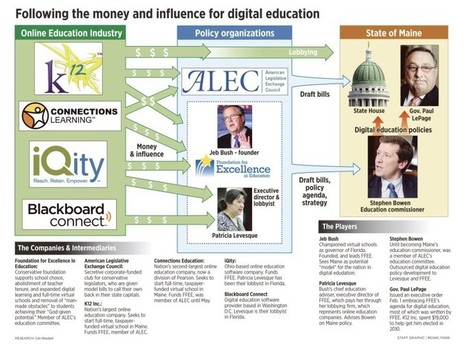
By Colin Woodard "Maine’s education commissioner had just returned to his Augusta office last October after a three-day trip to San Francisco where he attended a summit of conservative education reformers convened by former Florida Gov. Jeb Bush’s Foundation for Excellence in Education, which had paid for the trip. He’d heard presentations on the merits of full-time virtual public schools — ones without classrooms, playgrounds or in-person teachers — and watched as Bush unveiled the “first ever” report card praising the states that had given online schools the widest leeway. But what had Bowen especially enthusiastic was his meeting with Bush’s top education aide, Patricia Levesque, who runs the foundation but is paid through her private firm, which lobbies Florida officials on behalf of online education companies. Bowen was preparing an aggressive reform drive on initiatives intended to dramatically expand and deregulate online education in Maine, but he felt overwhelmed. “I have no ‘political’ staff who I can work with to move this stuff through the process,” he emailed her from his office.
Levesque replied not to worry; her staff in Florida would be happy to suggest policies, write laws and gubernatorial decrees, and develop strategies to ensure they were implemented.
“When you suggested there might be a way for us to get some policy help, it was all I could do not to jump for joy,” Bowen wrote Levesque from his office. “Let us help,” she responded.
So was a partnership formed between Maine’s top education official and a foundation entangled with the very companies that stand to make millions of dollars from the policies it advocates.
In the months that followed, according to more than 1,000 pages of emails obtained by a public records request, the commissioner would rely on the foundation to provide him with key portions of his education agenda. These included draft laws, the content of the administration’s digital education strategy and the text of Gov. Paul LePage’s Feb. 1 executive order on digital education. A Maine Sunday Telegram investigation found large portions of Maine’s digital education agenda are being guided behind the scenes by out-of-state companies that stand to capitalize on the changes, especially the nation’s two largest online education providers.
K12 Inc. of Herndon, Va., and Connections Education, the Baltimore-based subsidiary of education publishing giant Pearson, are both seeking to expand online offerings and to open full-time virtual charter schools in Maine, with taxpayers paying the tuition for the students who use the services. At stake is the future of thousands of Maine schoolchildren who would enroll in the full-time virtual schools and, if the companies had their way, the future of tens of thousands more who would be legally required to take online courses at their public high schools in order to receive their diplomas. The two companies have at times acted directly, spending tens of thousands of dollars lobbying lawmakers in Augusta and nurturing the creation of the supposedly independent boards for the proposed virtual schools they would operate and largely control."...
For full post, see: https://www.pressherald.com/2012/09/01/virtual-schools-in-maine_2012-09-02/
|
|
Scooped by
Roxana Marachi, PhD
June 3, 2017 6:58 PM
|
By Mary Bottari "The data is in and K12 Inc.'s brand of full-time public "cyber school" is garbage. Not surprising for an educational model kicked off with a $10 million investment from junk-bond king Michael Milken. Milken was the Wall Street financier who virtually invented junk-bonds -- high-risk securities that were used to leverage hostile buyouts in the "go-go" 1980s. Milken came to symbolize Wall Street excess, serving as inspiration for the Michael Douglas character Gordon Gekko in the 1987 movie Wall Street. Milken spent almost two years in a federal penitentiary for securities fraud. After he was released from prison, Milken set his sights on the $600 billion public education "market," forming new companies including Knowledge Universe and Knowledge Learning, parent company of the KinderCare child care chain. With his $10 million stake in K12 Inc., Milken aided one of his Vice Presidents and another junk dealer, Ron Packard, who specialized in mergers and acquisitions for Goldman Sachs back in the '80s. The duo prepped to exploit the public education sector, and boy, have they. His various educational ventures have made Milken one of the richest men in America, and Packard raked in over $16 million in compensation from 2008 to 2012 as CEO of K12 Inc. Almost all of that money came from U.S. taxpayers. Explosion of For-Profit "Virtual Schools" Linked to ALEC In recent years, there has been an explosion of full-time "virtual" charter schools paid for by the taxpayer. From 2008 to 2012, 157 bills passed in 39 states and territories (including the District of Columbia) that expand online schooling or modify existing regulations. Many of these bills are attributable to American Legislative Exchange Council (ALEC) politicians. ALEC approved a "model" Virtual Public Schools Act in 2005 at a time when both K12 Inc. and Connections Academy (the second largest for-profit) were corporate sponsors and helped craft the measure, according to ALEC's website at the time. Connections Academy quit ALEC under pressure, but K12 Inc. remains on the ALEC Education Task Force and helped sponsor the organization’s recent 40th anniversary shindig in Chicago. K12 Inc. and ALEC have pushed a national agenda to replace brick-and-mortar classrooms and hands-on teaching with computers and "distance learning." K12 Inc. operated 58 full-time virtual schools and enrolled close to 77,000 students in the 2010-2011 school year."... For full post, please see: http://www.truth-out.org/news/item/19204-cyber-schools-fleece-taxpayers-for-phantom-students-and-failing-grades
|
|
Scooped by
Roxana Marachi, PhD
January 14, 2017 9:11 PM
|
"By Brendan Fischer and Jonas Persson In 2007, Philly rolled out the red carpet for state legislators and lobbyists attending the annual "State and Nation" policy summit of the American Legislative Exchange Council. Pennsylvania legislators appropriated a whopping $50,000 of taxpayer money to help pay for the event, including $3,000 for cheesecake lollipops. The event apparently had a lasting impact as the ALEC agenda has continued to roll though the hallways of the state capitol in Harrisburg in the years since. After Governor Corbett took office in 2010, ALEC bill after ALEC bill was introduced and signed into law. To accomplish this feat a well-orchestrated cast of characters -- including politicians, state "think tanks" and advocacy organizations -- are singing from the same hymnal, and being bankrolled by the same interests. Behind the scenes, we find charter school magnates, ideological interests and deep-pocketed investors pumping millions into campaign coffers while playing the education "market" like a game of poker. With this report the Center for Media and Democracy puts a spotlight on some of the power players behind Corbett's dramatic moves to reshape state education policy for the benefit of corporate interests. A surprising number of these groups are reportedly under investigation by federal officials or have been charged with wrongdoing.
American Legislative Exchange Council: ALEC is an $8 million corporate "bill mill" that brings together politicians and corporate lobbyists behind closed doors to vote on "model" legislation for states. A storm of controversy over ALEC's role in spreading extreme gun laws, and voter suppression laws, resulted in over 90 corporations, such as Google, Wal-Mart, General Motors and General Electric, abandoning ALEC. According to ALEC's internal documents, at least 31 Pennsylvania legislators are still ALEC dues-paying members and many more appear to use the ALEC library of bills when shopping around for corporate education policy. Bills to institute school vouchers, take away local control for authorizing charter schools, expand tax credits to fund charter schools, or enact so-called "parent trigger legislation" can be traced back to ALEC and member groups like the American Federation of Children and the Cato Institute. Other ALEC bills include efforts to privatize pensions and attack unions and teachers. News reports indicate that ALEC may be under investigation by the IRS for illegal lobbying and violating its charitable, tax-exempt status.
Commonwealth Foundation: The Commonwealth Foundation for Public Policy Alternatives is a $1.5 million dollar right-wing think tank and advocacy group based in Harrisburg. For more than 25 years it has produced a steady stream of seemingly academic and "independent" reports and campaigns promoting school privatization and anti-union initiatives in line with the ALEC agenda. Commonwealth has not only been a member of ALEC, but also its sister organization the State Policy Network, an $84 million web of conservative think tanks across the country engaged in a concerted "attack against public sector rights and services in the key areas of education, healthcare, income tax, workers' compensation and the environment." According to the National Review, Commonwealth Foundation, like ALEC, is also under IRS investigation. Vahan Gureghian: Gureghian is the founder and CEO of a Pennsylvania charter school management company, and is a key power player promoting tax-funded charters. From 2006 to 2014, Vahan Gureghian, the operator of the Chester Community Charter School, has donated more than $1 million to conservative, pro-school voucher candidates running for state office in Pennsylvania, $250,000 this year. In the 2010 gubernatorial race, his $335,714 to Tom Corbett's campaign made him the governor's single largest donor. Gureghian was appointed to serve on Corbett's education committee and to co-chair his transition team. In 2011, an official state inquiry into possible cheating at Gureghian's school and others was underway, scores dropped dramatically -- by 30 percentage points -- at Chester Community Charter, but in the end the inquiry was closed by the Department of Education with no further action. Cyber School Firms: Cyber schools in Pennsylvania are not only failing to educate kids well, they have been mired in scandal. K12 Inc. executives doubled their compensation between 2012-2013 from $10 million to $20 million, and the company drew at least 14 percent of its revenue comes from the Agora Cyber School in Wayne, Pennsylvania -- yet Agora is failing to educate children, consistently failing federal and state measures of adequate yearly progress. Agora is still in operation due to its well-connected friends. Between 2007 and 2014, K12 Inc. spent close to $1 million lobbying the Pennsylvania legislature. Worse, in 2012 and 2013 Agora's founder was charged by the federal government with embezzling some $7 million from Agora and two other schools. Agora is not an isolated example; Nicholas Trombetta, founder and CEO of the biggest cyber school in the state -- Pennsylvania Cyber Charter School (not affiliated with K12 Inc.) -- was indicted in 2013 on eleven counts of fraud, bribery and tax conspiracy for swindling $8 million from kids.
American Federation for Children: The American Federation for Children (AFC) and its Pennsylvania affiliates, Students First PA and Students First PAC, are key players in the effort to elect Pennsylvania legislators sympathetic to the school privatization agenda. Chaired by Betsy DeVos, the billionaire wife of Amway heir Dick DeVos, AFC was created after another one of her pro-voucher organizations was fined $5.2 million for violating Ohio's campaign finance laws in 2006; they still haven't paid the fine. AFC's Pennsylvania affiliate, Students First PA, has spent $1.3 million on lobbying in Pennsylvania on "restructuring education institutions" between 2011 and 2014. Since 2010, the Students First PAC has spent $7.5 million electing school privatization candidates for Pennsylvania state office. Some of those funds were laundered through an array of other groups that spent in state legislative races in an apparent effort to disguise the origins of the funds. Susquehanna International Group: Three options traders are also fueling school privatization in the state as major contributors to Students First PAC and individual state politicians. Susquehanna International Group is an investment firm that bills itself as "one of the largest privately held financial institutions in the world." Specializing in derivatives and energy trading, the company has offices around the globe, over 1,500 employees, and boasts annual revenue of $1 billion and some $100 billion worth of assets under management. Joel Greenberg, Jeffrey Yass, and Arthur Dantchik are founding partners and have poured a record $6.5 million into Students First PAC ($750,000 this year), which masks their involvement by donating to other campaign finance vehicles. Common Cause/PA is concerned. "We have major concerns about large campaign donors and PACs laundering their contributions -- sometimes six figure contributions since there are no limits in PA -- through a series of contribution transactions designed to conceal the original benefactor." To find references for the above article and to read the full report, please see CMD's new report Power Players Behind the Corporate Takeover of Pennsylvania Schools and follow the conversation at #ALECexposed."... For original post, see: http://www.prwatch.org/news/2014/10/12632/power-players-behind-corporate-takeover-pennsylvania-schools
|
|
Scooped by
Roxana Marachi, PhD
December 14, 2016 8:03 PM
|
By Valerie Strauss
"Virginia-based K12 Inc. is the largest operator of for-profit charter schools in the country and is a national leader in running online full-time public schools in numerous states. The company, based in Herndon, has long been a target of critics who have questioned the quality of its schools as well as its spending and lobbying practices — and now, the company will face new questions, this time from stockholders. At a meeting scheduled for Thursday, shareholders are going to ask for a vote on whether the company should be required to publicly disclose details about its lobbying efforts in various states. The Arjuna Capital shareholder resolution asks that K12 prepare an annual report showing:
1. Company policy and procedures governing lobbying, both direct and indirect, and grass-roots lobbying communications.
2. Payments by K12 used for (a) direct or indirect lobbying or (b) grass-roots lobbying communications, in each case including the amount of the payment and the recipient.
3. K12’s membership in and payments to any tax-exempt organization that writes and endorses model legislation. 4. Description of the decision-making process and oversight by management and the board for making lobbying payments. At its annual meeting in December last year, investors voted down the company’s plan for executive pay based on a recommendation from Glass Lewis & Co., a governance advisory firm. Glass Lewis has endorsed the stockholder initiative being submitted on Dec. 15 at this year’s annual K12 meeting, as has proxy adviser firm Institutional Shareholder Services".... The new shareholder effort is being led by Bertis Downs, a public school advocate in Athens, Ga., who spent his career providing legal counsel and managing the rock group R.E.M., and who bought K12 stock a few years ago. Asked why he is taking this action, Downs said in an email: "My motivation in filing for this disclosure of K-12’s lobbying activities stems from my overall curiosity and interest as a parent and a shareholder in knowing more about what lobbying is done, whether through ALEC or directly, that leads to the so-called “education reform” laws being passed all over the country. How much does the company spend and how do they spend it and what results do they get for it? And is any of that good for meaningful teaching and learning in our schools? And is it good for the company and its shareholders?"
K12 is one of a number of education companies that have been attempting to exert influence on education policy in states. Their efforts come at a time when corporate school reformers have supported the expansion of online education for students from kindergarten through college. In Florida, for example, legislators passed a law requiring all students to take at least one online course to earn a high school diploma. Virtual schools as a whole are often cited for poor academic performance. A 2015 national study found that students in these schools who receive no instruction from an “in-person teacher” showed academic results in math equivalent of what would be expected if a student skipped 180 days of school. The deficiency in reading was reported to be the equivalent of 72 days of school. Virtual schools and their operators say that they often cater to students who struggle in traditional settings and that results should not be expected to be the same as traditional schools. Education Week said in a recent report: Despite more than a decade of state investigations, news media reports, and research that have documented startling failures and gross mismanagement in full-time online schools, the sector — dominated by two for-profit companies — continues to expand, spreading into new states and enrolling more students. Virtual charter schools, which collectively receive more than $1 billion in taxpayer money each year, are rarely shut down. One big supporter of virtual education is Betsy DeVos, the Michigan billionaire tapped by President-elect Donald Trump as his nominee for education secretary.
Her husband, Dick DeVos, listed on a financial disclosure form in 2006 that he and his wife owned K12 stock. The nonprofit organization she runs, the American Federation for Children, lists K12 on its website among organizations that support school choice. Enrollment at the schools K12 manages almost quadrupled from 2008 through 2015, according to Bloomberg, reaching more than 120,000, about one-third of students enrolled in full-time online schools. K12 — which receives most of its funding from public funds used to pay for the virtual schools to operate — “runs effective lobbying efforts in more than 20 states,” according to Education Week. That includes Indiana, where it spent, since 2007, nearly $1 million lobbying Indiana lawmakers and donating to their campaigns and political parties since 2007. A Mercury News investigation published in April revealed how California’s online charter schools — run by K12 — have “a dismal record of academic achievement” but have won more than $310 million in state funding over the past dozen years. In July, California’s attorney general announced that his office had reached a $168.5 million settlement with K12, and the 14 affiliated nonprofit schools known as the California Virtual Academies that it manages, over alleged violations of California’s false claims, false advertising and unfair competition laws. K12 is a member of the American Exchange Legislative Council, known as ALEC, a controversial group that advances model legislation about numerous issues, including at least 139 bills to promote private for-profit education models since 2013. K12’s stock price has gone up and down in recent years. According to Bloomberg News, “K12 shares have tumbled by two-thirds since reaching a near-record high in September 2013,” but it has rebounded some from its low. Natasha Lamb, managing partner at Arjuna Capital, said in a statement: “K12 would probably get failing marks on its results, but it absolutely flunks when it comes to transparency. K12 is dependent on taxpayer dollars, yet there is neither transparency nor accountability to taxpayers, students, or investors. The academic outcomes are troubling, and investor returns have suffered. Shareholders need to understand how K12 is using investor dollars to lobby for what appears to be a failing business model.”
The full text of the Arjuna Capital shareholder resolution is available online at http://arjuna-capital.com/wp-content/uploads/2016/12/K12-Lobbying-Proposal-2016.pdf."...
For original post, see: https://www.washingtonpost.com/news/answer-sheet/wp/2016/12/14/virtual-school-operator-k12-faces-challenge-from-stockholders-demanding-transparency/
|
|
Scooped by
Roxana Marachi, PhD
May 31, 2016 2:50 AM
|
By Jessica Calefati "SACRAMENTO -- A bipartisan group of lawmakers is calling for a state audit of a profitable but low-performing network of online charter schools following this newspaper's investigation of K12 Inc., the Virginia company at the heart of the operation. Published last month, the two-part series revealed that the Wall Street-traded company reaps tens of millions of dollars in state funding while graduating fewer than half of the students enrolled in its high schools. It also found that teachers at K12's California Virtual Academies have been asked to inflate attendance and enrollment records used to determine how much state funding the schools receive. Assembly members Phil Ting, D-San Francisco, and Catharine Baker, R-San Ramon, say an audit is needed because the Legislature takes allegations of misspent public money seriously -- and that any company profiting while students struggle deserves intense scrutiny. Lawmakers say its findings would likely set the stage for legislation aimed at addressing the problems at online schools. "This reporting raises serious questions that demand a more thorough investigation, which is why I will work with my colleagues to pursue an audit of for-profit charter schools and the mechanisms in place to hold them accountable," said Ting, who is joining with Assembly Speaker Anthony Rendon and other Assembly members to craft the audit request. Nationally, 70 percent of students enrolled in online charters attend schools managed by for-profit companies such as K12 and its leading competitor, Connections Academy, while 30 percent attend charters that are independent or run by nonprofits."... For full post, click here: http://www.mercurynews.com/education/ci_29957298/k12-inc-bay-area-lawmakers-call-audit-california
|
|
Scooped by
Roxana Marachi, PhD
April 19, 2016 2:34 AM
|
|
|
Scooped by
Roxana Marachi, PhD
December 12, 2015 11:45 PM
|
"California Virtual Academies (CAVA) is a network of 11 publicly funded charter K-12 schools in California. Researcher Chris Vickery recently contacted DataBreaches.net after he found a database with 58,694 of their students’ records leaking. In addition to a lot of personal information on the students that was all in plain text, the leaking data included some information on student disabilities and special education needs, services, and goals – again, all in plain text.
Here are redacted screencaps from two of the directories, just to give you an idea of what kind of information was vulnerable to access. The first screencap is from a case notes directory and has information about a therapy session with service provider:
Another directory contains special education profiles that contain the student’s date of birth, gender, ethnicity, grade, whether they have an I.E.P. (Individualized Education Program) and if so, what the goals are. There is also a section if the student has a 504 plan, and if so, what the reasons are for it. The profile also indicates whether the student is on a reduced fee or free lunch program. Social Security numbers do not appear to be included in this directory:
Yet another file, a spreadsheet, includes students’ full names, gender, birthday, school of attendance, grade, their Student Id, Special Education status, their teacher’s names, and their teacher(s)’ contact information. The matching of the student ID number to the full name has privacy implications for aggregating or matching other data.
According to CAVA’s web site, the students’ records are covered by FERPA. Employee Payroll Data Also Leaked The database also contains employee information on what Vickery estimated as approximately 17,000 employees: first and last names, email addresses, Social Security numbers, and payroll information – all in plain text. Curiously, encrypted passwords were immediately followed by the passwords in plain text:
CAVA’s Response
When contacted by Vickery about the exposure, CAVA responded promptly and ensured their database was secured. DataBreaches.net requested a statement from CAVA asking for how long these data were exposed, whether the data had been accessed by anyone other than Vickery, and whether they intended to notify parents of students and employees.
Jeff Kwitowski, a spokesperson for K12, CAVA’s education and technology provider, informs DataBreaches.net that CAVA’s database was on the server of a third party vendor who was responsible for it. Schools can contract with K12 for infosecurity services or independently contract with another provider. In this case, CAVA did not contract with K12 to manage and secure its database. According to Kwitowski, when Vickery contacted CAVA, CAVA immediately contacted K12, and although K12 was not responsible for the security of the database, K12‘s IT department immediately did their due diligence, confirmed the leak, and contacted the third party contractor to alert them. K12 IT personnel also investigated to determine whether any other schools they provide services to might also have databases at risk.
At the time of this posting, the unnamed contractor is reportedly auditing the system to identify any unauthorized IP addresses that may have gained access, and is also running additional security checks. It is not yet clear for how long the student and employees’ information may have been vulnerable, nor whether any other clients of the unnamed contractor may have been similarly affected. DataBreaches.net has submitted a public records request to CAVA for a copy of their contract with the third-party vendor responsible for securing their database.
“Data security is paramount,” Kwitowski tells DataBreaches.net. “K12and CAVA will continue to investigate, collect more information, and notify affected individuals as needed.”
This post will be updated as more information becomes available. Great thanks to Chris Vickery for alerting me to this leak."
For full post (including screenshot evidence), click on title above or here: http://www.databreaches.net/personal-and-sensitive-data-of-59000-charter-school-students-in-california-leaked-researcher/
|
|
Scooped by
Roxana Marachi, PhD
November 5, 2015 12:39 AM
|
"The expansion of Cyber Schools is the result of a nationwide lobbying effort, marketed through the State Policy Network (SPN) and its state affiliates (including the Mackinac Center), using language written by the American Legislative Exchange Council.
- (iNACOL is the trade association for K12 Inc and Connections (who operate the two Michigan cyber charter schools) and other virtual education companies.) “[iNACOL president Susan Patrick] visited SPN state groups and gave pep talks about how to sell the issue to lawmakers.” (Patrick spoke at the Mackinac Center sponsored Online Learning Revolution event at GVSU in November 2011.) How Online Learning Companies Bought America’s Schools, The Nation, December 5, 2011
- “ALEC, … coordinates a fifty-state strategy for right-wing policy. Special task forces composed of corporate lobbyists and state lawmakers write “template” legislation …Since 2005, ALEC has offered a template law called ‘The Virtual Public Schools Act’. Mickey Revenaugh, an executive at … Connections Learning, co-chairs the education policy–writing department of ALEC.” How Online Learning Companies Bought America’s Schools, The Nation, December 5, 2011
- “Jeb Bush campaigned vigorously in 2010 to expand such reforms … Bush’s Foundation for Excellence in Education is funded by online learning companies: K12 Inc., Pearson (which recently bought Connections Education), Apex Learning (a for-profit online education company launched by Microsoft co-founder Paul Allen), Microsoft and McGraw-Hill Education among others.” [His foundation hosts the yearly National Summit on Education Reform]. “Throughout the day, lawmakers mingled with education-technology lobbyists from leading firms, like Apex Learning and K12 Inc. [The program included a session] called “Don’t Let a Financial Crisis Go to Waste” How Online Learning Companies Bought America’s Schools, The Nation, December 5, 2011"...
For full post click on title above or here:
https://cyberschools.wordpress.com/history/
...for video documentation of the roots of ALEC legislation described above: http://sco.lt/7If281 ... for other ALEC-related charter school posts
http://www.scoop.it/t/charter-choice-closer-look?q=alec
and for full collection: http://bit.ly/chart_look
|
|
Scooped by
Roxana Marachi, PhD
November 14, 2014 12:09 AM
|
"Things aren't looking good for the publicly traded K12 Inc., which runs online charter schools in states around the country (Its Arizona Virtual Academy has more than 4,000 students). The schools are funded by taxpayer dollars, like all charter schools, so the corporation's profits and its CEO's $5 million salary come from taxpayer money it doesn't spend on its students' educations. K12 Inc.'s stock value has plummeted from $38 in September, 2013, to its current $12.60. The downward slide over the past few months has taken it into dangerous territory. Most stock analysts have revised their recommendations downward from Buy to Hold or Sell.
The notoriously poor education K12 Inc.'s schools provide isn't the issue, at least not directly. The problem is, the customer base hasn't grown sufficiently, stores are closing and new stores haven't opened as expected — I mean, the schools haven't picked up enough new students, some of K12 Inc.'s charters have severed ties with the corporation, and some states are balking at allowing schools to open. When you're running a for-profit school, students are customers and schools are stores, so it's really the same thing, which is the problem with for-profit education. (The best analysis of the problems with K12 Inc.'s education and its profit model comes from a wealthy hedge fund guy, Whitney Tilson.)
Can the corporation reverse its downhill slide? It's going to be tough. The brand is tarnished, and the stock market trend these days is up, not down. Unless investors think the stock has hit bottom and they can make a killing as it rises, things aren't looking good for K12 Inc."...
For full post, click on title above or here:
http://www.tucsonweekly.com/TheRange/archives/2014/11/13/for-profit-k12-inc-continues-its-stock-market-slide
Thanks to Mike Klonsky & Schooling in the Ownership Society for initial link: http://schoolingintheownershipsociety.blogspot.com/2014/11/k12-inc-stock-sinking-like-stone.html
(For more on the roots of K12Inc and ALEC legislation pushing online schools, check out this post)
|
|
Scooped by
Roxana Marachi, PhD
August 2, 2014 4:12 PM
|
BOULDER, CO (July 18, 2012) -- "A new report released today by the National Education Policy Center (NEPC) at the University of Colorado shows that students at K12 Inc., the nation’s largest virtual school company, are falling further behind in reading and math scores than students in brick-and-mortar schools. These virtual schools students are also less likely to remain at their schools for the full year, and the schools have low graduation rates. “Our in-depth look into K12 Inc. raises enormous red flags,” said NEPC Director Kevin Welner.
The report’s findings will be presented in Washington today to a national meeting of the American Association of School Administrators (AASA), where the report’s lead author, Dr. Gary Miron, is scheduled to debate Dr. Susan Patrick, president and CEO of the International Association for K–12 Online Learning. The report is titled, Understanding and Improving Full-Time Virtual Schools.
“Our findings are clear,” said Miron, an NEPC fellow, “Children who enroll in a K12 Inc. cyberschool, who receive full-time instruction in front of a computer instead of in a classroom with a live teacher and other students, are more likely to fall behind in reading and math. These children are also more likely to move between schools or leave school altogether – and the cyberschool is less likely to meet federal education standards.”
K12 Inc. schools generally operate on less public revenue, but they have considerable cost savings, says Miron. They devote minimal or no resources to facilities, operations, and transportation. These schools also have more students per teacher and pay less for teacher salaries and benefits than brick-and-mortar schools. “Computer-assisted learning has tremendous potential,” said Miron. “But at present, our research shows that virtual schools such as those operated by K12 Inc. are not working effectively. States should not grow full-time virtual schools until they have evidence of success. Most immediately, we need to better understand why the performance of these schools suffers and how it can be improved.”...
For full post, click on title above.
|
|
Scooped by
Roxana Marachi, PhD
April 20, 2014 5:27 PM
|
By Jon Swedian - Albuquerque Journal:
"ALBUQUERQUE, N.M. — A Farmington-based virtual charter school has broken state law by giving a for-profit company, an online curriculum provider, too much authority over the school’s operations, according to Attorney General Gary King. King issued an opinion April 1 stating that New Mexico Virtual Academy’s contract with K12 Inc. violates New Mexico’s charter school law by allowing the Delaware-based company to have input on budget, insurance and facility decisions. “K12′s administrative and managerial responsibilities under the agreement are significant …,” King wrote, noting the state’s charter school law doesn’t allow for-profit companies to manage charter schools...." For full post, click on title above or here:
http://www.abqjournal.com/381667/news/ag-charter-schools-contract-with-firm-illegal.html
|