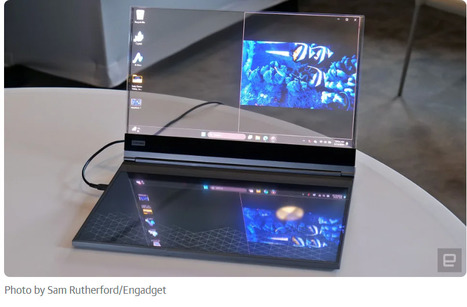
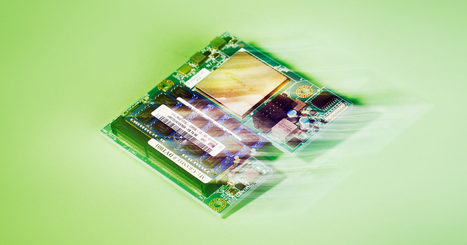
It’s not often you encounter a device that looks like it came straight out of a movie set. But Lenovo’s Project Crystal, supposedly the world’s first laptop with a transparent microLED display, is an example of sci-fi come to life.
Currently there are no plans to turn Project Crystal into a retail product. Instead Lenovo’s latest concept device was commissioned by its ThinkPad division to explore the potential of transparent microLED panels and AI integration. The most obvious use case would be sharing info somewhere, like a doctor’s office or a hotel desk. Instead of needing to flip a screen around, you could simply reverse the display via software, allowing anyone on the other side to see it while getting an in-depth explanation.
It’s not often you encounter a device that looks like it came straight out of a movie set. But Lenovo’s Project Crystal, supposedly the world’s first laptop with a transparent microLED display, is an example of sci-fi come to life.
Currently there are no plans to turn Project Crystal into a retail product. Instead Lenovo’s latest concept device was commissioned by its ThinkPad division to explore the potential of transparent microLED panels and AI integration. The most obvious use case would be sharing info somewhere, like a doctor’s office or a hotel desk. Instead of needing to flip a screen around, you could simply reverse the display via software, allowing anyone on the other side to see it while getting an in-depth explanation.
Russian hackers and cybercrime forums are notorious for exploiting critical infrastructure. Last month, Hackread.com exclusively reported that a Russian-speaking threat actor was selling access to a US military satellite. Now, researchers have identified macOS malware being sold for $60,000.
Russian hackers and cybercrime forums are notorious for exploiting critical infrastructure. Last month, Hackread.com exclusively reported that a Russian-speaking threat actor was selling access to a US military satellite. Now, researchers have identified macOS malware being sold for $60,000.
The NATO Cyber Security Centre (NCSC) has completed its test run of secure communication flows that could withstand attackers using quantum computing.
Konrad Wrona, principal scientist at the NCSC, told ZDNet that it is becoming increasingly important to create protection schemes against current and future threats.
"Securing NATO's communications for the quantum era is paramount to our ability to operate effectively without fear of interception," Wrona said.
"The trial started in March 2021. The trial was completed in early 2022. Quantum computing is becoming more and more affordable, scalable and practical. The threat of 'harvest now, decrypt later' is one all organizations, including NATO, are preparing to respond to.
The NATO Cyber Security Centre (NCSC) has completed its test run of secure communication flows that could withstand attackers using quantum computing.
Konrad Wrona, principal scientist at the NCSC, told ZDNet that it is becoming increasingly important to create protection schemes against current and future threats.
"Securing NATO's communications for the quantum era is paramount to our ability to operate effectively without fear of interception," Wrona said.
"The trial started in March 2021. The trial was completed in early 2022. Quantum computing is becoming more and more affordable, scalable and practical. The threat of 'harvest now, decrypt later' is one all organizations, including NATO, are preparing to respond to.
Now a team of Google researchers has published a proposal for a radical redesign that throws out the ranking approach and replaces it with a single large AI language model—a future version of BERT or GPT-3. The idea is that instead of searching for information in a vast list of web pages, users would ask questions and have a language model trained on those pages answer them directly. The approach could change not only how search engines work, but how we interact with them.
Now a team of Google researchers has published a proposal for a radical redesign that throws out the ranking approach and replaces it with a single large AI language model—a future version of BERT or GPT-3. The idea is that instead of searching for information in a vast list of web pages, users would ask questions and have a language model trained on those pages answer them directly. The approach could change not only how search engines work, but how we interact with them.
As a huge proponent for media literacy for over a decade, I’m struggling with the ways in which I missed the mark. The reality is that my assumptions and beliefs do not align with most Americans. Because of my privilege as a scholar, I get to see how expert knowledge and information is produced and have a deep respect for the strengths and limitations of scientific inquiry. Surrounded by journalists and people working to distribute information, I get to see how incentives shape information production and dissemination and the fault lines of that process. I believe that information intermediaries are important, that honed expertise matters, and that no one can ever be fully informed. As a result, I have long believed that we have to outsource certain matters and to trust others to do right by us as individuals and society as a whole. This is what it means to live in a democracy, but, more importantly, it’s what it means to live in a society.
In response to the disclosure of vulnerabilities in Tor's design, researchers at MIT have created Riffle, a system that allegedly provides better security and uses bandwidth more efficiently.
In response to the disclosure of vulnerabilities in Tor's design, researchers at MIT have created Riffle, a system that allegedly provides better security and uses bandwidth more efficiently.
Après le web qui a révolutionné notre façon de communiquer et de consommer, la mobilité qui a permis d'y avoir accès partout ou presque : les objets connectés sont la troisième révolution numérique.
Cette nouvelle technologie de rupture pourrait mener a une transformation fondamentale de notre expérience de l'objet, une expérience qui marque l'évolution de la culture humaine. les objets connectes deviendront intelligents, voir vivants, et seront envisagé plutôt comme des services et non comme des objets individuels. De quoi aura l'air un futur envisagé par ce paradigme innovant d'objet en réseau ? Et nos objets d'art? Comment ceci transformera notre expérience des objets d'art, et nos objets d'arts?
14h00 - Séance inaugurale et présentation de l'initiative. Olga Kisseleva, Tsila Hassine. 14h30 - Qu'est l'internet des objets entre art et marche ? Rafi Haladjian, Julien Levesque. 15h30 - La pensée de l'objet connecté. Stephen Wright, Albertine Meunier 16h30 - Objet d'art - service d'art ? Naziha Mestaoui, Emmanuel Mahé
Comite scientifique : Olga Kisseleva, artiste et chercheur, Université Paris 1 Panthéon-Sorbonne - CNRS / Tsila Hassine, artiste et doctorante, Université Paris 1 Panthéon-Sorbonne / Marta Ponsa, responsable du service « projets artistiques et action culturelle » Centre d 'art contemporain Jeu de Paume / Margherita Balzerani, Directrice de l'Institut des Métiers d'Art et du Patrimoine / Julie Miguirditchian, commissaire d'exposition / Isabelle Arvers, commissaire d'exposition et chercheur, Université libre de Bruxelles
Want to type fast (or document a meeting in text?), Cite documents in a better way, or translate any document -all in a few steps? Google Docs has been getti...
Here’s a chart that’s a little disturbing: The interactive graphic above, created by biotechnologist David Taylor and appearing first on his data-visualization blog, illustrates how common and deadly various types of cancer are. Each pie chart represents an organ (matched for color) and is sized according to the incidence of...
Seven of the ten most important factors in SEO ranking now come from social media.
An updated study from Searchmetrics has revealed just how important social media signals are to a strong SEO ranking, with well-positioned URLs almost always having a high number of likes, shares, tweets and +1s.
Searchmetrics have documented their findings in this infographic, which takes a closer look at what well-positioned web pages on Google have in common, and what distinguishes them from pages that are lower-ranked.
A recent study by Searchmetrics has revealed just how important social media signals are to a strong SEO ranking and then produced the results as this really nice infographic.
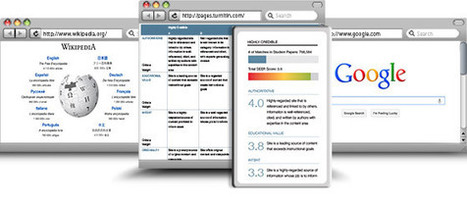
Educators are well aware of the shortcomings of relying on crowd-sourced content for authoritative information, yet the fact that Wikipedia continues to reign supreme as a top match in Turnitin suggests that students don't see things the same way. In short, what constitutes "research" for students today has come to mean "Googling."
I worked on a writing assignment regarding the cost of accessing publicly funded research articles when I was at the Banff Science Communications Program. One of the instructors told me that this issue had been covered quite extensively, so I did some research - and yes indeed, the issue was well-discussed in US and UK (mostly through the science sections of the New York Times and the Guardians), but there were very few mentions of it in Canada. This article reminds me how disappointed I was (and continue to be). Is there anything we can do to change the situation?
"The Globe and Mail doesn’t have a science section. Neither does the National Post. Add to this the fact that there are no dedicated Canadian science magazines for the general public, and it starts to become obvious why Canadians rarely hear about groundbreaking science research done across the country."
MIT Technology Review’s What’s Next series looks across industries, trends, and technologies to give you a first look at the future. You can read the rest of our series here.
This time last year we did something reckless. In an industry where nothing stands still, we had a go at predicting the future.
MIT Technology Review’s What’s Next series looks across industries, trends, and technologies to give you a first look at the future. You can read the rest of our series here.
This time last year we did something reckless. In an industry where nothing stands still, we had a go at predicting the future.
The tech world, Burger explained, was moving into a new orbit. In the future, a few giant Internet companies would operate a few giant Internet services so complex and so different from what came before that these companies would have to build a whole new architecture to run them. They would create not just the software driving these services, but the hardware, including servers and networking gear. Project Catapult would equip all of Microsoft’s servers—millions of them—with specialized chips that the company could reprogram for particular tasks.
The web is a little fucked up right now. Governments are spying on civilians, some block specific websites, and companies like Amazon have a stranglehold on the cloud services business. But what if we could create a decentralized web, with more privacy, less government control, and less corporate influence?
The web is a little fucked up right now. Governments are spying on civilians, some block specific websites, and companies like Amazon have a stranglehold on the cloud services business. But what if we could create a decentralized web, with more privacy, less government control, and less corporate influence?
There is a technology revolution – a revolution inspired by nature, built upon collaboration, self-assembly and disruptive innovation.
.
The Wyss Institute is crossing boundaries and disrupting the status quo to pioneer new technologies, new devices, and new therapeutics that harness the power of life itself. There is a technology revolution and it is happening at the Wyss Institute.
A new report from the Pew Research Center's Internet & American Life Project finds that online video is growing. 78% of online adults watch or download videos online, up from 69% in 2009, and the share of internet users who upload or post video online has doubled from 14% in 2009 to 31% today. Kristen Purcell, report author, explains these findings and the reasons behind them.
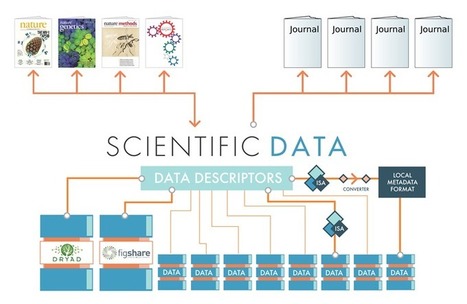
"Scientific Data to complement and promote public data repositories
Scientific Data will be a forum for publications about datasets, but will not be a repository for primary datasets. Primary data associated with Data Descriptors will be stored in one or more external data repositories. Why this distinction?
This strategy helps us draw some clear lines around the goals of Scientific Data. By ensuring that the primary datasets are stored in external systems, we make it crystal clear that our goal is to help authors publish content that promotes the scientific value and reusability of their datasets, not to control access to data. We feel that this is a progressive strategy that will help promote collaboration and data consolidation, rather than fragmentation"
This is an example of providing access to data & content. It presents a forum for authors to develop collaboration and data sharing rather than fragmenting research or keeping it embargoed. One result of such activities will be more rapid and wider dissemination of research to improve the knowledge base available to the scientific communities.
Presentation slides for my webinar on the 11 May (2013) to students from an Online Course in Research methodology for PhD scholars at the Shreemati Nathibai Dam
This is a great resource for anyone looking to get their research out there. Some great links and tools are provided. Thanks to Zaid Ali Alsagoff for the presentation and to Anna Waits for scooping!
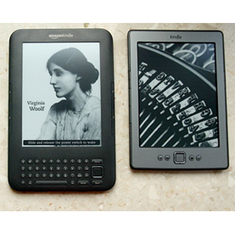
E-readers and tablets are becoming more popular as such technologies improve, but research suggests that reading on paper still boasts unique advantages
To get content containing either thought or leadership enter:
To get content containing both thought and leadership enter:
To get content containing the expression thought leadership enter:
You can enter several keywords and you can refine them whenever you want. Our suggestion engine uses more signals but entering a few keywords here will rapidly give you great content to curate.


 Your new post is loading...












![Reseach Shows Social Media Hugely Important in SEO Ranking [INFOGRAPHIC] | information analyst | Scoop.it](https://img.scoop.it/TmJ6w0OSa2m_Nt_HnnH4ljl72eJkfbmt4t8yenImKBVvK0kTmF0xjctABnaLJIm9)
















It’s not often you encounter a device that looks like it came straight out of a movie set. But Lenovo’s Project Crystal, supposedly the world’s first laptop with a transparent microLED display, is an example of sci-fi come to life.
Currently there are no plans to turn Project Crystal into a retail product. Instead Lenovo’s latest concept device was commissioned by its ThinkPad division to explore the potential of transparent microLED panels and AI integration. The most obvious use case would be sharing info somewhere, like a doctor’s office or a hotel desk. Instead of needing to flip a screen around, you could simply reverse the display via software, allowing anyone on the other side to see it while getting an in-depth explanation.
Learn more / En savoir plus / Mehr erfahren:
https://www.scoop.it/topic/21st-century-innovative-technologies-and-developments/?&tag=Research