Your new post is loading...

|
Scooped by
Jim Lerman
March 9, 2017 11:54 AM
|
Blog schedules are relentless—they don't care if you're feeling motivated, tired, or completely burnt out. If you can't keep up the pace, you miss deadlines. Or, in my case, you pull 12-16 hour days to pick up the slack, leaving you exhausted and unproductive come the next day, and thus the cycle repeats.
Thankfully, there's a better way to write.
Last year, I reorganized my workflow and started automating what I could, which led to a 375% increase in output in my writing and the ability to consistently produce content I'm proud of.
|
|
Scooped by
Jim Lerman
March 6, 2017 7:43 PM
|
In this episode, I’m going to share my writing process that has evolved over the years by borrowing secrets from great writers, including novelists, non-fiction authors, editors, screenwriters, copywriters, bloggers and more.
|
|
Rescooped by
Jim Lerman
from Feed the Writer
March 5, 2017 8:32 PM
|
Publishing student writing does not mean posting their assignment on a blog. Learn how to publish student writing and showcase it to the world to read.
Via Sarah McElrath
|
|
Rescooped by
Jim Lerman
from Feed the Writer
March 5, 2017 8:31 PM
|
We’ve created a comprehensive list of 120 of the best websites for writers in 2016. No more searching aimlessly around the internet.
Via Sarah McElrath
|
|
Rescooped by
Jim Lerman
from Into the Driver's Seat
March 3, 2017 1:41 PM
|
"Of all the resources we publish on The Learning Network, perhaps it’s our vast collection of writing prompts that is our most widely used resource for teaching and learning with The Times.
"This list of 401 prompts (available here in PDF) is now our third iteration of what originally started as 200 prompts for argumentative writing, and it’s intended as a companion resource to help teachers and students participate in our annual Student Editorial Contest. (In 2017, the dates for entering are March 2 to April 4.)"
|
|
Rescooped by
Jim Lerman
from Into the Driver's Seat
March 2, 2017 8:21 AM
|
"In terms of digital story telling, I have created a page to house all of the videos I recently created as a YouTube playlist and as the basis for an online course. The videos introduce vector graphic creation, digital story telling, the tools necessary to take it deeper, animations and the use of multiple slides to take the process further than Apple ever intended! "It also contains a classroom resource and a link to a workshop session on the same subject along with more session pages (many still under construction) covering an entire conference with Mac/iOS, Google for Edu, Coding and MakerSpace/Design Thinking strands."
|
|
Rescooped by
Jim Lerman
from Into the Driver's Seat
February 27, 2017 4:50 PM
|
Abstract
This study is an analysis of the curriculum used to teach writing at one US high school in which outcomes for students were extremely strong. The study surfaces what was different in the approach used from what is typically understood and promoted as best practice in the teaching of writing. It does so in order to surface what elements of writing instruction are fruitful for further research. Findings identify an approach to teaching writing called progressive mastery through deliberate practice. This article articulates the five elements that constitute this approach (understanding the final product, breaking down its critical elements, creating a hierarchy among the elements, layering and progression of elements, and gradual release of scaffolds), as well as the ways they work in concert to bring about improved student writing and thinking
|
|
Scooped by
Jim Lerman
February 26, 2017 8:22 PM
|
Although threats and detection software have some impact, the best way to prevent plagiarism is to teach students how to avoid it in the first place Jim Lerman's insight: A 32-minute podcast by the great Jennifer Gonzalez
|
|
Rescooped by
Jim Lerman
from Cool School Ideas
February 26, 2017 8:12 PM
|
It is no secret that in my classroom we try to keep it real. Once the authenticity is gone from the work my students and I do together, my students know it. They can tell when something is done because “we have to,” like state- and districtwide tests. When we read, we do so as real readers. When we write, we do so as real writers. When we research it is no different. To get students thinking about how writers use research in their own writing process, I began with a story that is rife with researchable topics: Verdi, by Janell Cannon. As a quick aside, Verdi is a playful and plucky young python who doesn’t want to grow up to be big, boring, and green.
Via Cindy Riley Klages
|
|
Rescooped by
Jim Lerman
from Into the Driver's Seat
February 25, 2017 11:33 AM
|
|
|
Rescooped by
Jim Lerman
from Into the Driver's Seat
February 24, 2017 10:11 AM
|
The Art of Storytelling is a section of Pixar in a Box that teaches students about four elements universal to good storytelling. The Art of Storytelling is comprised of six instructional videos and four lesson activities for students. The videos and activities can be shared through Google Classroom
Via John Evans, Jim Lerman
|
|
Scooped by
Jim Lerman
February 20, 2017 10:55 PM
|
One of the best ways to ensure you stick with a daily writing habit is to have plenty of prompts on hand. Teens thrive when they are given boundaries with generous margins. The twenty writing prompts in this free printable March writing prompt calendar provide the perfect amount of structure to stimulate your high schooler while allowing for plenty of creative expression!
The calendar is not dated, so you can use it year after year whenever you need writing inspiration for your middle school or high school student. Each week features five different categories of prompts so your tween or teen isn’t stuck in a rut of only expository or only persuasive topics.
|
|
Scooped by
Jim Lerman
February 20, 2017 10:46 PM
|
Jennifer Burgin (@MrsJBurgin) teaches amazing 2nd graders at Oakridge Elementary in Arlington, Virginia. She was named Oakridge Teacher of the Year and Arlington Public Schools Teacher of the Year in 2016.
Too many teachers are working too hard to teach writing. When the teacher is “queen of the classroom” and has to do everything (review, give feedback, find mistakes) it either burns out the teacher or frustrates the students.
Today’s show will help teachers solve this problem by learning the fundamentals of facilitating peer review that works. Starting at the beginning with simple steps and moving towards a full peer review classroom, Jennifer talks with Vicki Davis on 10MT today about how her classroom changed when she started using peer review.
She also shares her biggest mistakes and frustrations and how teachers can avoid them. Finally, she talks about how every teacher can start using peer review today.
|
|
|
Scooped by
Jim Lerman
March 7, 2017 8:28 AM
|
From some of the experts in our midst comes a host of powerful and effective writing exercises that will get students thinking critically and creatively.
|
|
Rescooped by
Jim Lerman
from Feed the Writer
March 5, 2017 8:33 PM
|
A story arc is the chain on which the pearls, or scenes, of your novel are strung. The story arc--or narrative arc--is the same thing as "plot."
Via Penelope, Sarah McElrath
|
|
Rescooped by
Jim Lerman
from Feed the Writer
March 5, 2017 8:32 PM
|
Rather than bombard teens with fancy pens and motivational reading, direct them to a comfort zone: the Internet. These sites are great resources for future storytellers.
Via Sarah McElrath
|
|
Rescooped by
Jim Lerman
from Into the Driver's Seat
March 4, 2017 1:09 AM
|
via The Scout Report "Khan Academy has teamed up with Pixar to create this interactive lesson about the Art of Storytelling. In this Pixar in a Box lesson, young writers get to hear the perspectives of numerous Pixar storyboard artists as they explain their creative processes and their personal favorite stories. These videos are accompanied by four activities designed to get youth to reflect on and discuss different aspects of storytelling, including memory. In the opening video, film director Pete Docter provides an especially helpful reflection on what it really means to "write what you know." Other clips urge students to consider their favorite films or the different storytelling elements that appear in their favorite films. Youth are also encouraged to ask their own What if? questions in regards to their favorite films, fostering creativity. This Khan Academy collection could make a strong addition to an elementary school language arts class or an enrichment class. As of this write up, this series includes one complete tutorial; additional tutorials on storytelling are coming soon."
|
|
Rescooped by
Jim Lerman
from Cultivating Creativity
March 3, 2017 11:58 AM
|
50 Of The Best Writing Apps For The iPad by Ashley McCann The best writing apps for iPad, like any concept of ‘best,’ is subjective and further based on need and circumstance. Are you a poet drafting when inspiration strikes? A student taking notes and writing essays?
Via Mika Auramo
|
|
Rescooped by
Jim Lerman
from Into the Driver's Seat
February 27, 2017 8:22 AM
|
|
|
Rescooped by
Jim Lerman
from Into the Driver's Seat
February 26, 2017 8:16 PM
|
In today’s collection we are sharing with you some very good digital storytelling apps to use with kids and young learners. These are particularly ideal for enhancing kids literacy skills. You can have kids work either in pairs or alone on creative projects that involve composing personal stories (imaginary or real). The apps provide them with a number of interesting features to help them make their stories engaging and informative. They can record their own voice for narration, use pictures, characters and images and backgrounds to bring life to their stories. And when they are done they can easily share it with the whole class and get feedback from their peers.
|
|
Rescooped by
Jim Lerman
from Digital Delights
February 26, 2017 3:57 PM
|
The increasingly widespread use of social software (e.g., Wikis, Google Docs) in second language (L2) settings has brought a renewed attention to collaborative writing. Although the current methodological approaches to examining collaborative writing are valuable to understand L2 students’ interactional patterns or perceived experiences, they can be insufficient to capture the quantity and quality of writing in networked online environments. Recently, the evolution of techniques for analyzing big data has transformed many areas of life, from information search to marketing. However, the use of data and text mining for understanding writing processes in language learning contexts is largely underexplored. In this article, we synthesize the current methodological approaches to researching collaborative writing and discuss how new text mining tools can enhance research capacity. These advanced methods can help researchers to elucidate collaboration processes by analyzing user behaviors (e.g., amount of editing, participation equality) and their link to writing outcomes across large numbers of exemplars. We introduce key research examples to illustrate this potential and discuss the implications of integrating the tools for L2 collaborative writing research and pedagogy.
Via Ana Cristina Pratas
|
|
Rescooped by
Jim Lerman
from iPads, MakerEd and More in Education
February 24, 2017 10:12 AM
|
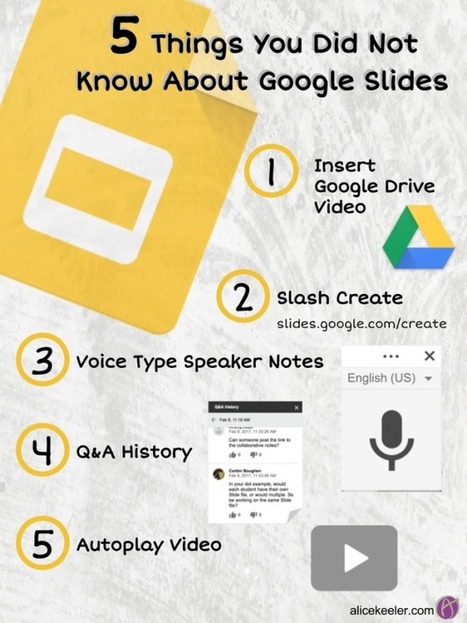
This is a little cheating as some of these features are new so you could not have known!! Google Slides is one of my favorites. I use it to have students GIVE ME information rather than get information. Truly transformative for teaching.
Via John Evans
|
|
Scooped by
Jim Lerman
February 20, 2017 10:56 PM
|
One of the best ways to ensure you stick with a daily writing habit is to have plenty of prompts on hand. Kids thrive when they are given boundaries with generous margins. The twenty writing prompts in this free printable March writing prompt calendar provide the perfect amount of structure to stimulate your young writer while allowing for plenty of imagination!
Example writing prompts from the March calendar
If you fell from the sky with a parachute, where would you hope to land? Why?
If you could lift and bring home one heavy object, what would it be? What would you do with it?
Who was your favorite coach, teacher, scout leader, or Sunday school teacher? Why?
Describe something you would do if you knew you couldn’t possibly fail.
Many kids have a special blanket or stuffed animal they can’t sleep without. Did/Do you?
The calendar is not dated, so you can use it year after year whenever you need writing inspiration for your elementary students in grades 3-8.
|
|
Scooped by
Jim Lerman
February 20, 2017 10:47 PM
|
Teachers want their students to create, but don’t want to fight with clunky technology. Listening skills and learning can be improved with podcasting. Today’s show will help you understand one of the simplest technologies to use in the classroom: podcasting. Podcasting sparks imagination, creativity, and builds listening skills. Just about any teacher with a smartphone and an internet connection can have their students podcasting quickly!
In this episode, Tom Daccord and I discuss how to using podcasting in the classroom. Welcome to episode 298 of the Every Classroom Matters podcast.
Listen to the Audio
BAM Radio Network | iTunes
In this episode, you’ll learn:
How is podcasting being used in the classroom?
How can students publish podcasts for the world?
What kind of impact can podcasting have on learning?
How can you use podcasts to improve listening skills?
|