


Ana Christina Pratas describes 4 interesting web platforms designed to facilitate publishing work in different formats:
Carbonmade
Booktype
Magnt
Youblisher
-JL

 Your new post is loading...
 Scoop.it! Ana Christina Pratas describes 4 interesting web platforms designed to facilitate publishing work in different formats: Carbonmade Booktype Magnt Youblisher
-JL 
No comment yet.
Sign up to comment
Scoop.it!

Mark Gleeson's reflections on the phenomenon of Adora Svitak, now 14 years old. At the age of 7, Adora was documented to have written 250,000 words as author of a number of books.
Gleeson details key factors he believes contribute to her success and, potentially, to most students:
1. Early support, genuine interest in the child's passions and communicating one's own passions by parents and teachers.
2. Technology plays its part. Don't fear it, embrace it.
3. Develop these qualities in all children: imagination, courage, curiosity, exploration, accceptance and learning from criticism, desire to better one's performance
Scoop.it!
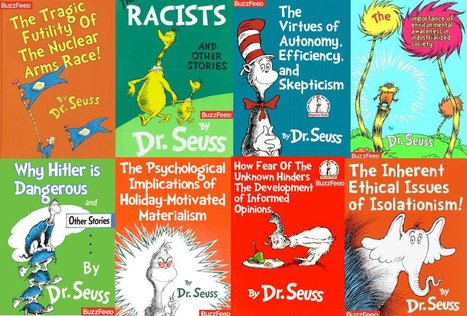
"Before his career as a beloved children's author, Dr. Seuss was a political cartoonist. These 'fake' titles capture an allegorical reading of Dr. Seuss that at time is not so subtle (The Butter Battle Book and the Lorax are the most obvious IMHO). THis link takes you to the Special Collections of UCSD with houses the archive on Dr. Seuss' political cartoons. "
This is amazing news to me. -JL Via Seth Dixon
Scoop.it!
The Best Websites For K-12 Writing Instruction/Reinforc
|

|
Rescooped by
Jim Lerman
from Contemporary Literacies
March 12, 2012 11:41 PM
|
Scoop.it!

"Across the globe youth are growing up with digital and interactive media technologies as an integral part of their lives. This generation of learners, often called the 'Net-Generation, spends a great deal of free time engaging in online literacy-related activities such as instant messaging, gaming, surfing, and publishing on the web. Such media and technology-literate students can pose special challenges for educators who grew up with and value more print-based forms of literacy.
However, because these youth often find digital literacy activities to be more engaging than the print-based ones associated with classrooms, it seems important for us, as literacy educators and researchers, to take an in-depth look at some of these media and activities that young people find so engaging.
One such activity that warrants a closer look is online fanfiction—that is, fan-authored texts stemming from popular culture and media such as books, music, movies, and video games. While paper-based fanfiction has been around for years (Jenkins, 1992), in recent decades, fans have started "meeting" in online spaces to publish, share, and critique each other's texts...."
|
|
Scooped by
Jim Lerman
March 12, 2012 1:29 AM
|
Scoop.it!

By Liana Heitin
Overall, the Story Pirates programs aim to inspire kids to use their imaginations and to write. "If there's anything we can give kids, it's that it's worth putting your ideas on paper," says McNerney, who is the program's full-time associate artistic director. "That's an essential skill that bleeds into so many other life skills."
During classroom workshops, the group's performers and "teaching artists"—who have both teaching and acting experience—use games, chants, and puppets to create a safe space for students to express their most outlandish ideas. Over four classroom sessions, they instruct kids in the elements of storytelling, using curriculum created around that particular grade's state standards.
|
|
Scooped by
Jim Lerman
March 9, 2012 5:29 PM
|
Scoop.it!

As teacher Elizabeth Schlessman watched her upper elementary students learn about mosses by close observation and inquiry, she wondered: Could you do the same when studying punctuation? Getting beyond the stultifying application of rules, she guided her students to see the verbal patterns into which punctuation fits.
|
|
Scooped by
Jim Lerman
March 7, 2012 7:57 PM
|
Scoop.it!

One-stop shopping for all manner of information resources. Designed for reporters, but of great value to students and adults to find important and useful information quickly. -JL
|
|
Scooped by
Jim Lerman
March 7, 2012 7:35 PM
|
Scoop.it!

My Story is the simplest story maker and book creator in the App Store. Children can draw, use photos, record voice, type, and then send their finished creations to family and friends on the iPad. Cost: $1.99
|
|
Scooped by
Jim Lerman
March 7, 2012 1:59 PM
|
Scoop.it!

Contains graphic language.
Filmmaker Andrew Stanton ("Toy Story," "WALL-E") shares what he knows about storytelling -- starting at the end and working back to the beginning. Andrew Stanton has made you laugh and cry. The writer behind the three "Toy Story" movies and the writer/director of "WALL-E," he releases his new film, "John Carter," in March. Recorded at Feg. 2012 TED Conference.
|
|
Rescooped by
Jim Lerman
from Into the Driver's Seat
March 6, 2012 6:12 PM
|
Scoop.it!

“A person’s a person, no matter how small.” “There is no one alive who is youer than you.” “Oh the places you’ll go!” Who doesn’t remember a Dr. Seuss line from one of his many delightful children’s books? For decades, parents have been reading Theodor “Ted” Geisel—more commonly known to book and rhyming word lovers as Dr. Seuss—to their children. Dr. Seuss, whose birthdate is believed to be March 2, 1904, has touched the lives of millions of children and adults worldwide. Not bad for someone who dropped out of college and whose Dr. title was honorary.
Seuss was his middle name. And for decades, people have been pronouncing his name incorrectly. The correct pronunciation is “Zoice” not “Soose,” according to the author’s official website, Seussville.com.
|
|
Scooped by
Jim Lerman
March 6, 2012 5:55 PM
|
Scoop.it!

By Marsha Ratzel
I wanted my 6th graders to write in science class. My goal was to inspire them to demonstrate their understanding of the properties of minerals as well as the elements of good writing. I realized it would be no easy task. After all, minerals are not a topic high on the interest list of any 12-year-old I know.
Yet I found myself in a computer lab full of students who were happily typing their hearts out, writing about minerals. And later, I commented on one well-written essay after another. Was I surprised? Yes. Was I satisfied? Absolutely. All my scheming had paid off.
Let me tell you how my students and I did it.
|
|
Scooped by
Jim Lerman
March 5, 2012 12:11 AM
|
Scoop.it!

Voice Lessons: Here's an archive of lesson plans designed to teach voice in writing!
|
|
Rescooped by
Jim Lerman
from Edumathingy
March 21, 2012 8:03 PM
|
Scoop.it!

Story Shakers is the revolutionary online teaching tool that is shaking up Literacy teaching. Try our homepage storyboard to see how it works - just touch the dice!
Story Shakers gives you thousands of different options for storyboards in a range of writing genres including stories, non-chronological reports, instructions and newspapers.
|
|
Scooped by
Jim Lerman
March 19, 2012 6:30 PM
|
Scoop.it!

By Jaime R. Wood
“You may say I’m a dreamer, but I’m not the only one.” John Lennon is right. From the time I was a small girl, people have told me that I’m idealistic, which always came across as a nice way of calling me naïve. But when it comes to teaching, I am one of Lennon’s dreamers. I really do believe that education should have meaning, and I believe students should, at least on occasion, feel the excitement of epiphany in a classroom setting.
"Just the other day, one of my college-level writing classes experienced just that. We sat together in a conference room that had been reserved for our fish bowl discussion around this question “Is college necessary to be successful?” and for a time I felt like we were a group of ancient Roman philosophers analyzing the important questions of life.
"You might be thinking that this was a tricky question that I came up with to get my students to think critically about why they’re there or to persuade them to reflect on what an education means to them, but you’d be wrong. I didn’t devise this activity at all. Sure, I reserved the room, but the students did everything else. All I had to do was give them permission."
|
|
Scooped by
Jim Lerman
March 13, 2012 12:09 AM
|
Scoop.it!

By Jennifer Demski
During what might have in the distant past been called "quiet time" in Arlene Anderson's fourth-grade classroom, many of her students are glued to their netbooks. The intense, enthusiastic focus and the hushed chatter amongst the students are all about high scores and strategy. But the students aren't playing video games. Instead, they're revising and editing their writing assignments within a web-based application that instantly assesses their writing skills and suggests ways to improve their work before turning the assignments in to their teacher. "For students, the software is an amazing self-motivator for writing, editing, and reviewing their writing," explains Anderson. "They're constantly working at learning the skills that will raise their scores."
The software and netbooks are part of the Saugus Union School District's (CA) Student Writing Achievement Through Technology Enhanced Collaboration (SWATTEC) initiative, one of a number of similar tech-supported initiatives that encourage writing across the curriculum. At the same time, the Saugus initiative is helping to prove that schools can see improvement in student achievement and engagement by harnessing 21st century tools to enhance writing skills.
Via Gregg Festa
|
|
Scooped by
Jim Lerman
March 13, 2012 12:00 AM
|
Scoop.it!

These writing handbooks contain a wealth of instructional strategies, lessons, and assessment rubrics. Teachers of students from fourth through eighth grades and in high school will find them invaluable in teaching the writing strategies and applications found in the California English-Language Content Standards.
|
|
Scooped by
Jim Lerman
March 12, 2012 2:18 PM
|
Scoop.it!

Writing to learn is more than just putting words on the page for someone else to read. The focus has to be on what the writer gets out of the process of writing -- not just the reader. The process of writing to learn clarifies perspectives and crystallizes jewels of personal beliefs. The final product of the writing to learn process is a summation of the thinking and learning that occurred. Writing to learn crosses all content areas. For example, writing about the process of an experiment; what the student hoped to learn, the analysis and what was learned from the conclusion, is all writing to learn. Writing about the experience of solving a difficult mathematical problem, or making connections to disparate historical events can also be writing to learn.
|
|
Scooped by
Jim Lerman
March 11, 2012 6:05 PM
|
Scoop.it!

The “tortured writer” has been Woody Allen-ized into a kind of embarrassing caricature. We picture him in a bare studio apartment, hunched over at a collapsing, secondhand card table, surrounded by crumpled up pieces of paper and possibly clutching at his furrowed brow. Alternatively, he is horribly out of place at some cocktail party, raving at bemused, wine-sipping guests about “society” or “the muse” or “the process.”
We laugh at the tortured writer for the same reason we laugh at most of the things we laugh at – because she makes us uneasy. In her monkish devotion to craft, she seems threateningly at odds with the sort of ironic resignation that the modern world seems to demand. How else is an intelligent person to deal with the Roman coliseum of Western Culture without jumping out of a window?
|
|
Scooped by
Jim Lerman
March 8, 2012 4:11 PM
|
Scoop.it!
Description from SmartBrief on EdTech
Writing-focused initiatives are supported by one-to-one technology programs in one California school district and one Colorado district. Fourth-grade students in Saugus, Calif., are using Web-based software accessible on their netbooks to help improve their writing skills. In Littleton, Colo., a technology-based writing initiative that began with fifth-grade students has been expanded to students throughout the district.
|
|
Scooped by
Jim Lerman
March 7, 2012 7:49 PM
|
Scoop.it!

The National Writing Project's 30 Ideas for Teaching Writing offers successful strategies contributed by experienced writing project teachers. Since NWP does not promote a single approach to teaching writing, readers will benefit from a variety of eclectic, classroom-tested techniques.
Few sources available today offer writing teachers such succinct, practice-based help—which is one reason why 30 Ideas for Teaching Writing was the winner of the Association of Education Publishers 2005 Distinguished Achievement Award for Instructional Materials.
These ideas originated as full-length articles in NWP publications (a link to the full article accompanies each idea below).
|
|
Scooped by
Jim Lerman
March 7, 2012 6:49 PM
|
Scoop.it!

A whole new world of magic animals, brave young princes and evil witches has come to light with the discovery of 500 new fairytales, which were locked away in an archive in Regensburg, Germany for over 150 years. The tales are part of a collection of myths, legends and fairytales, gathered by the local historian Franz Xaver von Schönwerth (1810–1886) in the Bavarian region of Oberpfalz at about the same time as the Grimm brothers were collecting the fairytales that have since charmed adults and children around the world.
|
|
Rescooped by
Jim Lerman
from Into the Driver's Seat
March 6, 2012 11:36 PM
|
Scoop.it!

WorldFuturist.net, a Web site for future-focused kids aged 8-18, is seeking submissions in the following categories: future predictions, future scenarios, utopian visions, alternative lifestyles, science fiction, science fiction book reviews, science fiction video game reviews, science fiction movie reviews, science and technology news reports, scifi drawings, and futuristic videos according to the site's creator, FUTURIST magazine blogger and IEET managing director Hank Pellissier.
WorldFuturist.net is also looking for regular contributors aged 13-18 who want to be columnists, critics, and news reporters on topics ranging from Neanderthal studies to black holes.
All material published by WorldFuturist.net will include the author's name, photo, and biography. WorldFuturist.net is sponsored by the California registered non-profit, The Kids' Co-op, Inc. Official launch is April 15, 2012. Directors include Gabriel Rothblatt, Nikki Olson, and Hank Pellissier.
To submit material or make inquiries, contact hankpellissier(at)yahoo.com
Source: IEET on Facebook
|
|
Rescooped by
Jim Lerman
from Into the Driver's Seat
March 6, 2012 6:06 PM
|
Scoop.it!

The recent success of the film 'The Artist' seems to have created a lot of interest in silent black and white movies again. These kinds of movies are great for using with students as the visual aspect makes the context very clear and they show how video can communicate without language and focus students on the non verbal aspects of communication.
Now you can create your own silent movies using the Artistifier and any clip that you can find on YouTube.
|
|
Scooped by
Jim Lerman
March 5, 2012 12:12 AM
|
Scoop.it!

Sample papers for grades 1 - 12. Dozens of samples!





