


Oxford Saïd Business School threw its weight behind gender equality in business last week. The leading MBA provider is campaigning to make financial inclusion for women a global imperative.

 Your new post is loading...
 Scoop.it! Oxford Saïd Business School threw its weight behind gender equality in business last week. The leading MBA provider is campaigning to make financial inclusion for women a global imperative. 
No comment yet.
Sign up to comment
Scoop.it!
From
www

The African Development Bank (AfDB) President, Donald Kaberuka, and Mrs. Graça Machel, Founder of New Faces, New Voices (NFNV) on Friday in Nairobi,...
KRII-KROTOASA RESEARCH-INTENSIVE INSTITUTE 's insight:
Tunis / Nairobi, 20 March 2010 – The African Development Bank (AfDB) President, Donald Kaberuka, and Mrs. Graça Machel, Founder of New Faces, New Voices (NFNV) on Friday in Nairobi, jointly launched the first “African Women’s Economic Summit” to ensure the inclusion of women in decisions that are shaping the global financial system.
During the opening session, Kenya’s Prime Minister, Raila Odinga and Central Bank Governor, Njuguna Ndung’u expressed their strong support to African Women’s Economic Empowerment in view of women’s positive role in tackling the continent’s development challenges.
Mr. Odinga said: “if you empower a woman, you empower a whole family and a nation”. They agreed that recovering from the financial crisis; the financial leaders should take the advantage to include more women.
Some 160 African and global decision-makers in the financial and political sectors, policy-makers, regulators, commercial banks, and prominent women entrepreneurs attended the ceremony.
The AfDB President stated that he was “proud to be meeting here in a country which also has one of the most impressive innovations in the financial sector- in which women leaders play a key role, with the Central Bank’s support”.
However, he acknowledged that “women access to financial services so critical for the growth of any economic endeavor remains problematic”. He stressed the need “to cross the bridge together to break the barriers holding back so much a force for good in the world of finance”.
The African Women Business Initiative, launched by the AfDB Private Sector Operations, is an example of how financial stakeholders could best serve half of the African continent, how more women get up the corporate ladder.
Scoop.it!
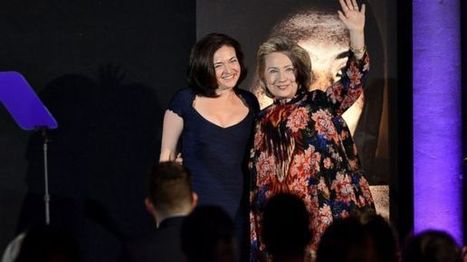
(Credit: Shahar Azran/Getty Images) Last night, I attended a gala dinner for Women for Women International (WfWI) hosted by and honoring two of the most powerful women in America -Facebook COO and WfWI Board Member Sheryl Sandberg and former Secretary of State Hillary Rodham Clinton.
WfWI works with socially excluded women in eight countries where war and conflict have devastated lives and communities. Their mission is to empower victims of war-based rape and torture to rebuild their lives and their communities. “The best way to save a child’s life is to empower the mother,” said WfWI CEO Afshan Khan in…
KRII-KROTOASA RESEARCH-INTENSIVE INSTITUTE 's insight:
Khan said Clinton was chosen as WWFI’s honoree for her “incredible work” in championing women’s rights and “empowering women to build and transform societies.” Sandberg, according to Khan, has been “a very strong … and an engaged supporter for years.”
Sandberg, who is on the board of The Walt Disney Co., ABC’s parent company, presented Clinton with the “Champion of Peace Award.” Matching the evening’s theme of Stronger Women, Stronger Nations, Clinton emphasized the impact of advancing the rights of women and girls around the world.
“You cannot have real peace and security if you marginalize and exclude women,” said Clinton. “You cannot have decent, just societies if you abuse women. You cannot move on a path to democracy and open economies if you isolate and marginalize half the population. For some that was self-evident, others have had their eyes opened over the past 20 years.”
WfWI’s message to help women help themselves and their communities dovetails with Sandberg’s own nonprofit movement, “LeanIn.org,” which promotes women and girl in leadership. Sandberg talked about starting her career in development at the World Bank, where there was an old saying, “When you give money to men, they spend it on whiskey and themselves…when you give to women, they spend it on their children.”
She said, “If women and girls everywhere were treated as equal to men in rights, dignity and opportunity, we would see political and economic progress everywhere.” In an interview with ABC News last March, Sandberg expressed her hope that Hillary Clinton would run for the highest office in U.S. government again. In that interview Sandberg said she hoped her 4-year old daughter would one day not ask her why all the past U.S. presidents are male.
Read More: Facebook’s Sheryl Sandberg Says Women Must Learn to “Lean In” “I believe if we had half our companies and half our countries run by women, and half our homes run by men, things would be better,” she said. “We know our companies would be more productive. If you use the full talents of the population, you’re more productive. We know our homes would be happier.”
Clinton reaffirmed the benefits of empowering women. “By helping women in some of the most dire circumstances…you are not only helping them, you’re helping communities and countries – helping make our world more prosperous, more peaceful.” Supporting women and girls is not just a “nice thing to do, it supports global economies,” she concluded.
According to Khan, WfWI focuses on recruiting women on the community level by identifying the most vulnerable households. “Women who enroll in our one-year program learn job skills and receive business training so they can earn a living. They come to understand their rights and how to fight for those rights in their homes, their communities and their nations. They learn how to become leaders,” said Khan.
Scoop.it!

The National Council of Jewish Women North Shore Section held a panel event, “Leading the Way: Jewish Women’s Voices in Politics."
KRII-KROTOASA RESEARCH-INTENSIVE INSTITUTE 's insight:
The National Council of Jewish Women North Shore Section held a panel event, “Leading the Way: Jewish Women’s Voices in Politics,” on May 7 at Glencoe North Shore Congregation Israel. The driving point of the discussion was ways to empower Jewish women to become better policy advocates and to consider running for elected office.
Planning committee members included Diane Moore, Cynthia Plouche, Alison Bloom, Karen Dillon, Barbara Slutsky, Carol Spielman and Dana Gordon, all of Highland Park; Rachel Ferber and Ronna Ash, both of Glencoe; Barbara Novick of Morton Grove and Donna Fishman of Northbrook.
Speakers included Highland Park Mayor Nancy Rotering, Amy Zisook, Marjie Sandlow, all of Highland Park, Marilyn Glazer and Shelley Sutker-Dermer, both of Skokie and Rebecca Sive of Chicago
Scoop.it!

The late Shaikh Zayed bin Sultan Al Nahyan stressed that women comprise half of the society, and that no country wanting to develop can do without one half.
KRII-KROTOASA RESEARCH-INTENSIVE INSTITUTE 's insight:
Shaikha Fatima bint Mubarak, Chairwoman of the General Women’s Union and the Family Development Foundation and President of the Supreme Council for Motherhood and Childhood, has said that the President His Highness Shaikh Khalifa bin Zayed Al Nahyan is continuing the march of the late Shaikh Zayed bin Sultan Al Nahyan in supporting the empowerment of the UAE’s women.
In an interview given to Nation Shield Journal, she confirmed that the late Shaikh Zayed bin Sultan Al Nahyan, with his wise vision, was not only a strong supporter of women, but also their stoic defender against any injustice. He stressed that women comprise of half of the society, and that no country wanting to develop, can do without one half.
The following is Shaikha Fatima’s interview in full: Q. “Your Highness accompanied the late Shaikh Zayed bin Sultan Al Nahyan on many occasions - what was the Founding Father’s vision of the UAE women and of their role in progress, development of the nation?” A. “I was associated with the great Founding Father of the nation, the late Shaikh Zayed bin Sultan Al Nahyan, during various stages of the establishment and building of the UAE. I witnessed the difficulties and the hardships that he faced and overcame them through his insight, wisdom and patience. I saw his feelings, struggle, strength of will in the face of difficulties, and his dedication and sincerity in building the State of the Union.
He felt this was the way for the nation to progress and ensure happiness and a decent life for citizens. I was there for the days of joy and saw the happiness on his face at every achievement that helped to promote the march of the Union.
Shaikh Zayed was not only a strong supporter of women, but also their defender against injustice. He believed that women are half the society, that no country which wants to build itself can do so without the contribution of both halves. Women’s participation in community service and development is essential.
He urged women to learn and encouraged them to work in positions that are commensurated with progress for them and the nation. He encouraged and supported me without limits for the advancement of women, encouraged them to learn, and envisioned structures and organisations to be established that deal with women’s issues and rights.
His ambitious aspirations have come true. Now women have become ministers, members of the Federal National Council, engineers, physicians, diplomats, lawyers, judges, prosecutors, professors, lecturers, officers, pilots in air defence, investors, businesswomen, and hold other positions in which they have proved their capacity and efficiency in work and creativity, side by side with their male counterparts.
Scoop.it!
KRII-KROTOASA RESEARCH-INTENSIVE INSTITUTE 's insight:
Stories related to women and girls globally generally tend to get so little mainstream coverage in the media that it's too easy to remain blissfully unaware of their status.
March 8, International Women's Day, lets the world stop and consider women's condition past and present -- both to celebrate the economic, political and social strides women have certainly made globally, but also to remind us of the enormous inequities that remain to be addressed.
Around the world, girls and women continue to lack economic opportunity and adequate health care and education. They are pushed into early marriage and suffer sexual violence and many forms of oppression and discrimination.
The global community is increasingly aware that educating girls and women helps the whole of humanity, with women's empowerment linked to the alleviation of a host of serious problems facing the world such as poverty, war and the environment. As Hillary Clinton said at the UN Fourth World Conference on Women in Beijing in 1995, "human rights are women's rights ... and women's rights are human rights."
Women -- and men -- must come together and take a strong stand for our own rights and those of our global sisters. (To get informed and involved, you can visit this list where we feature some of the amazing organizations working on behalf of women's global causes.)
Scoop.it!
From
linkis
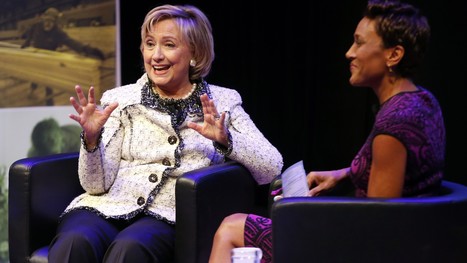
During an hour-long conversation with Robin Roberts, Clinton's most telling remarks about American women and work came in the form of an off-hand anecdote about promoting female staffers.
KRII-KROTOASA RESEARCH-INTENSIVE INSTITUTE 's insight:
At Philanthropy New York‘s 35th annual meeting at the Ford Foundation in New York, the crowd waited eagerly to hear Hillary Rodham Clinton speak with Good Morning America co-anchor Robin Roberts on the topic of full participation in society for women and girls around the world.
It’s a topic that’s long been on Clinton’s short-list of priorities, and her appearance yesterday functioned in part to boost awareness of the Clinton Foundation’s No Ceilings initiative, launched to revisit promises made at the 1995 UN Fourth World Conference on Women in Beijing, address where progress has been made, and where gaps still must be addressed.
During the hour-long conversation with Roberts, Clinton touched on pressing issues for women, such as the recent kidnapping of nearly 300 Nigerian schoolgirls by Boko Haram, a situation she called “a perfect storm of all the issues concerning those of us who follow women and girls around the world.”
She discussed African villages that hum with women at work that goes unmeasured by economists and the “vestigial remnants of a prior era” and “unwelcoming atmosphere” that still stymies women looking to enter STEM and other male-dominated fields.
Scoop.it!
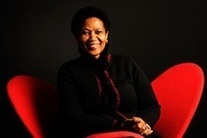
The current issue of the Economist recognizes that the dramatic change in labor force participation of women is one of the most important transformations in the economic and social worlds during the past generation. I will discuss the main forces behind this change, and also consider whether the United States needs additional public policies to accommodate women at work. Several crucial changes have contributed to transforming the position of women. Perhaps the most fundamental during the past half century were technological advances, such as the computer, and the shift in richer countries away from manufacturing and toward services. These developments...
KRII-KROTOASA RESEARCH-INTENSIVE INSTITUTE 's insight:
Although women still lag by a lot in their representation in the top managerial positions, they have greatly narrowed the gap between their full time earnings and that of men. Wives earn more than their husbands in perhaps 30% of all American families with two earners, and that percentage continues to grow.
American women are starting new businesses at a much faster rate than they did in the past, and the number of female heads of large companies, although small in number, has been growing.
Although the United States has instituted various policies to help working women, unlike Sweden and other Scandinavian countries it does not provide extensive public subsidies to childcare, does not have a system of legislated paid leaves to women that allow them to care for newborn children, and does not guarantee that they can get their jobs back when they return to work.
Yet, contrary to many claims, I believe that the less interventionist American approach may not have impeded, and may even have encouraged, women’s’ progress in the labor force....
Scoop.it!
A Nonprofit Media Initiative Founded by Maria Shriver
KRII-KROTOASA RESEARCH-INTENSIVE INSTITUTE 's insight:
Released January 12th, 2014
Scoop.it!
From
www
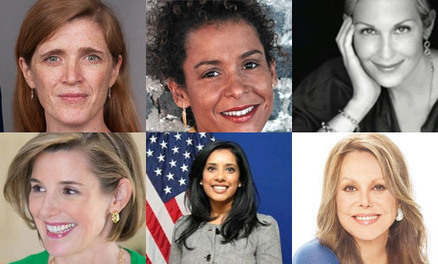
Join 92Y and women’s leadership and lifestyle expert Claudia Chan for the S.H.E. Summit, a two day event that can transform your life.
KRII-KROTOASA RESEARCH-INTENSIVE INSTITUTE 's insight:
Don't miss the 2014 women's conference that can propel you to get everything you want in work and life!
Claudia Chan and 92nd Street Y are thrilled to present the 3rd annual S.H.E. Summit on June 5-6, 2014. Convening 60+ remarkable thought leaders, partners igniting change and thousands of influential women (YOU)—S.H.E. Summit is a global conversation and celebration of female potential and possibility that is accessible and relevant to women everywhere.
BUY TICKETS to the transformational live event! Attend either June 5 or June 6 for $149 or attend both days for $249! (Click on the buttons on the right to purchase, or call 212.415.5500.)
1-Day & 2-Day Tickets include an $80+value SHE Swag Bag and so much more:Access up to 20 program sessions covering women's leadership, career, innovation, tech, self care, confidence, wealth management, motherhood, social good, science and more!
Gain stories, strategies and solutions from 60+ Extraordinary Speakers & Experts to help you lead your optimal career and lifestyleNetwork with passionate, like-minded women to build your personal and professional network Stay refreshed with complimentary snacks and bevvies sponsored by Sakara Life, Luna Bar, Lifeway Kefir and more
Discover and connect with amazing brands, companies and initiatives in our S.H.E. Marketplace, including healthy-skin treatments by Dermalogica skin bar and special offers from BOBS from Skechers, One Medical and more Enjoy an early evening cocktail reception with surprise cocktails sponsored by FrangelicoGo home with a fabulous S.H.E. swag bag worth over $80 sponsored by Dermalogica 20
Program Sessions Include:[CAREER] Reimagining the Career Journey to Success[LEADERSHIP] Fireside Chats with Sallie Krawcheck and Marlo Thomas[LEADERSHIP] Where Are the Women? A Look at Industries: Sports, Finance, Tech, Media & Beyond[MOTHERHOOD]
The New Vocabulary: Fulfillment & Integration Over “Having It All”[ENTREPRENEURSHIP] Women Business Owners: How to Go from Start to Scale?[SOCIAL GOOD] Invest in Girls. Change the World[PERSONAL FINANCE] Women & Wealth: Managing Money, Making Meaning
Scoop.it!
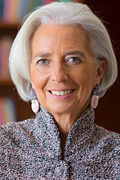
Strategic organizations are beginning to realize that capitalizing on the talents of women is a business imperative. Many European business leaders know that the proportion of women in leadership does not reflect the number of women entering their companies.
KRII-KROTOASA RESEARCH-INTENSIVE INSTITUTE 's insight:
Catalyst and The Conference Board Europe partnered for this study of the perceptions and attitudes of top-level women and men executives in large corporations and professional firms across 20 countries in Europe. This study replicates the methodology of three studies of women in leadership in the United States, Canada, and the U.K. The study's findings showed, among other things:
Barriers to women’s advancement are remarkably similar across Europe.Women report that stereotypes and preconceptions about women’s roles and abilities are the No. 1 barrier to advancement, closely followed by lack of role models, lack of general management experience, commitment to family and personal responsibilities, and lack of mentoring.Men do not seem to see the same barriers to women’s advancement as the women.
Contrary to common wisdom, the women want to reach the top—one-third of the European women respondents and one-quarter of the men aspire to senior most leadership.Many of the women in the study have ascended the career ladder while managing personal responsibilities: 75 percent are married, 73 percent of those married have full-time working partners, and 63 percent have children.
Sponsors: Accenture, BP p.l.c., IBM Europe; Sponsored by Deloitte Touche Tohmatsu, Ford of Europe, General Motors Europe, Goldman Sachs, Pfizer Inc, Royal Dutch Shell, UBS Warburg; with assistance from Ernst & Young, ExxonMobil Foundation, General Electric, ING, Novo Nordisk, Rabobank Nederland
Scoop.it!
KRII-KROTOASA RESEARCH-INTENSIVE INSTITUTE 's insight:
Worldwide Guide to Women in Leadership CURRENT WOMAN LEADERS
Scoop.it!
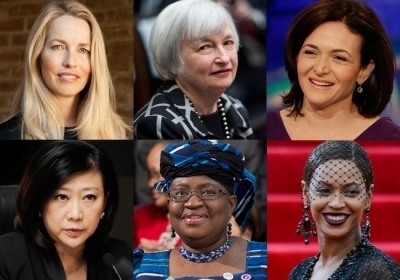
Our definitive annual guide of the 100 extraordinary icons, game changers and ceiling crashers who are asserting themselves on the world stage. Eighteen newcomers join the list this year, which is based on dollars and impact.
KRII-KROTOASA RESEARCH-INTENSIVE INSTITUTE 's insight:
Continue »
|
Scoop.it!
HuffPost Live is a live-streaming network that attempts to create the most social video experience possible. Viewers are invited to join discussions live as on-air guests. Topics range from politics to pop culture.
Scoop.it!

Amid what he characterised as renewed grabs for Africa's resources, former United Nations Secretary-General Kofi Annan has said that women's empowerment remains crucial for Africa's development and must be prioritised as the continent moves forward.
KRII-KROTOASA RESEARCH-INTENSIVE INSTITUTE 's insight:
Annan currently chairs the Africa Progress Panel and was speaking at the Johannesburg launch of the Panel's latest progress report entitled, "From Agenda to Action: Turning Resources into Results for People," which identifies gender inequality as a major barrier to Africa's development.
Formed in 2007 after the Gleneagles G8 Summit, the panel was originally formed to monitor international commitments made to Africa at the summit, but also works to assess the continent's progress in areas such as governance, economic development and progress made in achieving the Millennium Development Goals.
"Too many Africans remain poor, and women and girls remain the worst off - they are still treated like second-class citizens in many of our countries," Annan said.
The report highlights that although women produce up to 80% of all basic food products in sub-Saharan Africa, they continue to face cultural, economic, educational and legal barriers to economic empowerment.
And while countries like Rwanda, South And Lesotho have made considerable gains in ensuring gender parity in local and national government, women continue to be under-represented in politics.
Hitting close to home
For fellow panellist and governor of the Bank of Botswana Linah Mohohlo, the report's findings hit close to home. "In Botswana, several years ago you had to be very nice to your husband if you wanted to borrow money. Even me, with my position in finance, would have to be nice," she said Mohohlo.
According to the Organisation for Economic Co-operation and Development (OECD) Atlas of Gender and Development, while Botswana recently enacted changes to support greater gender equality, women who choose to marry under traditional law, or "in common property," still have limited ownership rights and access to credit absent of their husbands.
However, the OECD's Social Institutions and Gender Index notes that women in the country are increasingly opting to marry under different legal frameworks in order to maintain their rights...
Scoop.it!
KRII-KROTOASA RESEARCH-INTENSIVE INSTITUTE 's insight:
“When you think of women in technology, who comes to mind? Facebook’s Sheryl Sandberg? HP’s Meg Whitman? Google’s Susan Wojcicki?
Yes, me too. But I also think of Martha Kerubo, an orphan from rural Kenya, who recently graduated from high school, acquired some basic technical skills, and is carving out a life for herself through online BPO work. Like those mentioned above, Martha is a bright, determined woman with great inner strength who sees and seizes the potential of technology. While Martha isn’t on Forbes’s list of the world’s most powerful, she is a very powerful woman in her own right.” Google also celebrated the day with another of their famous doodles to show solidarity with the women of the world on the day.
Scoop.it!
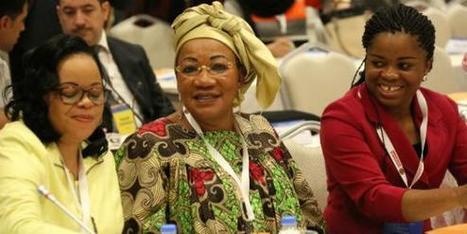
Today's Zaman Women's empowerment key for development, İstanbul summit concludes Today's Zaman The participants of the summit underlined the importance of equality between women and men and proposed gender equality before the law, in the workplace...
KRII-KROTOASA RESEARCH-INTENSIVE INSTITUTE 's insight:
An international summit in İstanbul, with women's perspectives on the United Nation's post-2015 Development Agenda as its focus, has called for women's empowerment as a condition for sustainable development.

Evelyn Chima's curator insight,
June 3, 2014 5:10 AM
There is need to also need to work on the barriers to women empowerment. I suggest there is need to improve on knowledge of women on various areas that affect their lives for them to participate and make important decisions
Scoop.it!

Photo Credit: Joe Molieri/Bread for the World The Millennium Development Goals (MDGs) taught us that clear goals and coordinated, committed leadership can go a long...
KRII-KROTOASA RESEARCH-INTENSIVE INSTITUTE 's insight:
The Millennium Development Goals (MDGs) taught us that clear goals and coordinated, committed leadership can go a long way in driving human progress. They also solidified the notion of interconnectedness—that human issues should not be considered or addressed in isolation from one another. We’ve rediscovered that truth in the cross-cutting benefits of women’s empowerment in the developing world. When women are more empowered, economies improve, education levels rise -- and hunger, undernutrition, and poverty decline.
But women’s empowerment isn’t as easy to capture as specific statistics such as how many children attend primary school or how many households have access to clean water. How will we know which “empowerment” strategies are succeeding so that we can scale them up? In an effort to capture holistically how women fare from one country to another, women’s empowerment indices—composed of dozens of indicators—have been devised by the UN Development Programme and the World Economic Forum.
The United Nations Statistical Division recently released a minimum set of indicators needed to get an accurate picture of starting points and progress. This “minimum” list has 52 indicators in five categories. The U.N. “statistics people” also took the next step: considering how much data is available on a sampling of these indicators. The findings show that we still have a long way to go toward reliable, consistent data on women’s empowerment.
Scoop.it!
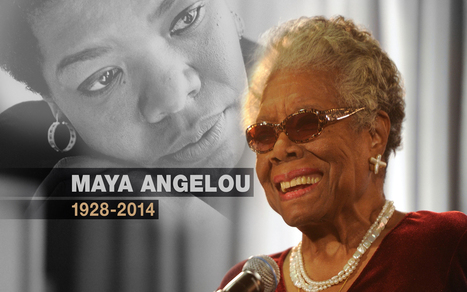
Ali Velshi talks about Maya Angelou's work in promoting financial literacy
KRII-KROTOASA RESEARCH-INTENSIVE INSTITUTE 's insight:
Ali Velshi got to know Maya Angelou personally during the financial crisis. She told him she watched him on TV and felt his explanations of the crisis helped her understand it and feel safer. This led her to bring Ali on her radio show several times to discuss money.
He remembers accepting an invitation to a garden party at Angelou’s North Carolina home, the finest Southern party he ever attended. Personally greeting everyone, she made her guests, including Ali, feel like they were the only ones in the world. That was part of her power. Maya Angelou's early life was a struggle - she faced sexual abuse as a child, and racism as an adult. But she was a pioneer from the beginning.
At the age of 16, in awe of the uniforms and the caps and the little gizmos attached to their belts that gave change, Maya Angelou became San Francisco’s first woman streetcar conductor. She knew the best way to avoid the worst life had to offer was political and economic empowerment.
She understood financial literacy is a big part of empowerment. Talking about money with Maya Angelou, on her radio show, allowed Ali to reach a different audience and speak about finance in the most accessible way he’d ever known.
He remembers Angelou telling him, what he did mattered and helped people. She was about as removed from Ali’s world as anyone, yet she included herself in it, and she included Ali in hers.
Scoop.it!
KRII-KROTOASA RESEARCH-INTENSIVE INSTITUTE 's insight:
International perspective on Issues in Gender, Science and Economic Development
The gender issues in science and economic development have two major dimensions: economic opportunities for women and abilities of women. The focus of this study is on economic opportunities for women from a global perspective.
While there are significant increases in the female labor force participation rates in almost all countries, the proportion of female professional and technical workers remains much smaller. Using data from fifty countries with high human development index, we find that high index of achievement in education and high per capita incomes are important factors that contribute to the growth of professional and technical women workers.
Gender empowerment index alone does not guarantee increased participation of women in science and technology.
Scoop.it!
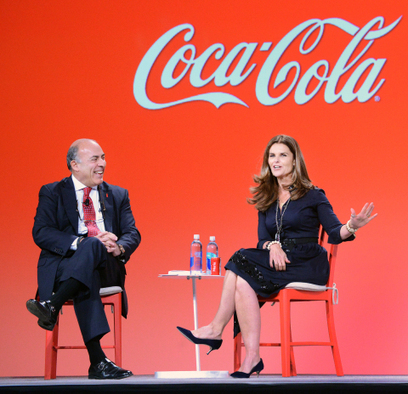
Photo Advisory From The Coca-Cola Company: Muhtar Kent Discusses
KRII-KROTOASA RESEARCH-INTENSIVE INSTITUTE 's insight:
The Shriver Report and Coca-Cola's 5by20 women's economic empowerment initiative at The Coca-Cola Company 2014 Annual Shareholders Meeting is Available on Business Wire's Website and AP PhotoExpress.
Scoop.it!
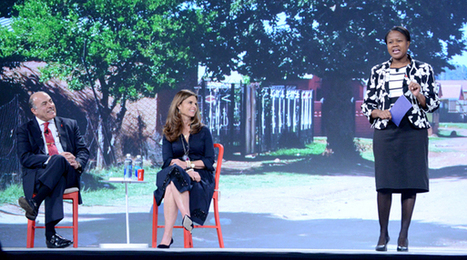
Award-winning journalist Maria Shriver and Malehlohonolo Moleko, a bakery and shop owner from South Africa, discussed women's empowerment at
KRII-KROTOASA RESEARCH-INTENSIVE INSTITUTE 's insight:
ATLANTA -- A pair of special guests took the stage Wednesday at Coke’s annual meeting of shareowners to explore an issue very important to the company’s business and society at large: women’s economic empowerment.
Award-winning journalist Maria Shriver discussed the findings of the latest Shriver Report -- A Woman's Nation Pushes Back From the Brink -- which highlights the under-reported 42 million working women in the U.S. who are on the verge of poverty and the 28 million children who depend on them.
During a conversation with Coca-ColaChairman and CEO Muhtar Kent, Shriver said empowering women in the U.S. -- many of whom are living paycheck to paycheck and juggling the roles of breadwinner, mom and caregiver to aging parents -- will require collaborative solutions from government, business and women themselves.
For example, women -- who make up half of the U.S. workforce and 70 percent of minimum wage earners -- must learn how to manage a budget and prioritize education over family planning. “Women today are not working for what I call ‘fun’ money,” Shriver said. “They’re working for money that makes a life-or-death difference in their family homes. Educating and empowering them is good for your business."
Shriver said men -- who are sharing parenting and caregiving duties today more than ever -- are a critical part of the equation, too. She applauded Kent and Coke for taking steps to empower women both inside and outside the company’s walls.
“To empower women doesn’t mean to disempower men,” said Shriver, who has two sons and four brothers. “I’ve learned that what women need is what men need.”
Scoop.it!
Women in many parts of the world do not have basic financial services or financial literacy, making it very hard for them to be free and plan for their future. Everywhere, women are denied access to the capital necessary to run businesses that could feed or educate their children and benefit communities. Even in the wealthy nations, women are disadvantaged in their dealings with the financial system, including access to meaningful work in the finance sector. All these keep women from being fully equal citizens in the world and its economy, as well as having effects on basic living standa ...
Scoop.it!
KRII-KROTOASA RESEARCH-INTENSIVE INSTITUTE 's insight:
Equality between women and men is enshrined in the EU Treaties and the EU Charter of Fundamental Rights as a fundamental principle of the European Union (EU). Ensuring gender equality is one of the EU's main objectives and tasks. It is also a necessary condition for the achievement of the objectives of the Europe 2020 strategy – the EU’s growth strategy, which leans on knowledge, competences and innovation. Despite significant progress during the last decades thanks to regulatory pressure, gender inequalities persist in leadership positions and the pace of change is slow in many Member States. In response, the European Commission has reaffirmed its commitment to work to improve the situation by making gender equality in decision-making one of the five priority areas in both the Women’s Charter and the Strategy for Equality between Women and Men (2010-2015).
Women are particularly outnumbered by men in leadership positions in the corporate sector and this has been the focus of intense public debate initiated by the European Commission at EU level and in a number of Member States. Indeed, the under- utilisation of the skills of highly qualified and experienced women constitutes a loss of economic growth potential. Research from various countries suggests that companies with a higher representation of women at the most senior levels deliver stronger organisational and financial performance as well as better corporate governance. Moreover, the lack of women in leadership positions means that female talent is being underused, human capital wasted and the quality of appointments to the highest positions may be compromised.
Scoop.it!
KRII-KROTOASA RESEARCH-INTENSIVE INSTITUTE 's insight:
The election of a new European Parliament this month and the subsequent appointment of a new European leadership present an opportunity to improve gender representation in EU leadership positions. Europe could certainly benefit from a more diverse political elite. At one level, female representation in leadership positions may not appear to be that much of a problem in Europe. After all, Germany has a female chancellor, eight women now sit in the newest Italian cabinet, and nine female commissioners are at the helm of the European Commission. The first high representative for foreign and security policy is a woman. And female members constituted 35.8 percent of the European Parliament, higher than in any European member state. However, only 29 percent of European companies have at least two women on their executive committees. And when looking at the institutions surrounding governments and public administration, such as think tanks and public policy institutes, there are no binding provisions for equal gender representation. Men still generally dominate public policy debates and discussions, particularly in the areas of foreign and security policy. In part, the problem lies with how policy topics are framed. It does not take a radical feminist theorist to tease out the gendered nature of the terms “hard power” and “soft power,” and the implicit hierarchy assumed between the two. Hard security and statecraft feature at the highest levels of think tank and policy events more frequently than a host of other “soft” topics such as public health, climate change, energy security, urban policy, international aid, cultural diplomacy, and education. It is no coincidence that these topics tend also to feature more female perspectives.
|







MBA Careers: Oxford Saïd Business School Joins Call For Financial Inclusion For Women Oxford Saïd Business School threw its weight behind gender equality in business last week. The leading MBA provider is campaigning to make financial inclusion for women a global imperative.
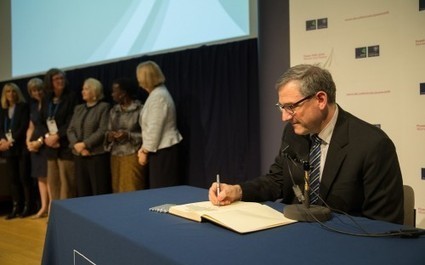
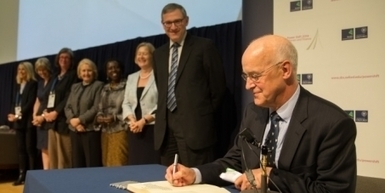
Professor Peter Tufano, Dean of Saïd Business School, signing the petition last week
Oxford Saïd Business School became the latest MBA provider to call for financial inclusion for women last week.
Professor Peter Tufano, Dean of Saïd Business School, and Professor Andrew Hamilton, Vice-Chancellor of the University of Oxford, were among the first signatories to a petition to world leaders to make financial inclusion for women a global imperative, and to include it in the post-2015 Millennium Development Goals.
The petition was launched at Power Shift: The Oxford Forum on Women in the World Economy, at Saïd Business School. The launch was live-streamed on the Knowledge Gateway for Women’s Economic Empowerment, and the petition was signed by the conference participants – a range of leading academics, investors, financial institutions, advisers and entrepreneurs.
The petition says: “We, the undersigned, call on the Open Working Group on Sustainable Development Goals, in the articulation of the Post-2015 Development Framework, to emphasise women's economic empowerment, particularly with regard to increasing women’s access to financial services, improving their financial capability, and increasing their access to skilled jobs including leadership positions in the financial sector.”
The full petition will be delivered in person to the UN in New York on 9 June 2014.