Content curation trends
185.9K views | +0 today
Your new post is loading...
Scooped by Guillaume Decugis
March 26, 2012 12:46 PM
Scoop.it!

Is Curation the missing stack of the News-as-Data-Platform Model? (Vote)

Is Curation the missing stack of the News-as-Data-Platform Model? (Vote) | Content curation trends | Scoop.it

We've suggested this topic for a panel or a talk at the next Online News Association conference. 


As we see the Publishing and Tech worlds overlap more and more, an interesting way to look at the future of Media is to take an engineering angle. You'll find a summary below and by clicking to the Reddit page of the ONA, you'll be able to vote and comment.


"The Web has killed the integrated newspaper model where the same company did everything from writing to publishing and from editing to distribution. To survive in the open internet, media companies need to become platforms that interoperate with others, forming what engineers call stacks when they build something on top of another. One of the stacks that seems obvious in that model is the sharing stack, whether you call it Facebook or Twitter. With the exploding growth of platforms like Tumblr or Pinterest, we're also discovering the importance of a new layer: the curation stack, which as it democratizes, can make everyone a publisher. Are journalists, the historical news curators, ready to embrace that change?"

No comment yet.
Scooped by Guillaume Decugis
March 15, 2012 6:55 PM
Scoop.it!

Re-envisioning Modern Pedagogy: Educators as Curators

Re-envisioning Modern Pedagogy: Educators as Curators | Content curation trends | Scoop.it

Corinne Weisgerber (an Associate Prof. of Communication at St. Edward's University that we were lucky to interview recently) gave this presentation at SXSWedu on March 6, 2012. It's of course targetting educators - natural-born curators. But a lot of what's in that presentation is generic enough so it's interesting to read.


Corinne comes back on 8 steps that she defined as essential for curators and describes how they intereact together to form a complete cycle.


It's also interesting to note how good a fit there is betwwen curation and education; something we've felt for quite some time at Scoop.it by seeing a lot of educators using the platform.

Debbie Morrison's comment, March 17, 2012 11:37 AM
Inspirational! Loved this post! Corinne's presentation describes what online education is all about! Thanks JennyP for sharing!
Scooped by Guillaume Decugis
March 14, 2012 1:54 PM
Scoop.it!

I’m not a “curator” – Marco Arment on linking and the curator code

I’m not a “curator” – Marco Arment on linking and the curator code | Content curation trends | Scoop.it

I've just published Matt Langer's rant agains the curator code which opens up interesting questions but this is another must-read on the whole curator code debate; this time by Instapaper founder Marco Arment - someone I've read many interesting pieces from and who's been an amazing entrepreneur building a great App in the new Content space.


Marco says the curator code is tackling the wrong problem when it comes to curation, link sharing or whatever you want to call it.


By the way, we're still investigating what the Curators Code means for Scoop.it users and how to deal with it. So please send us feedback if you have ideas on it.


On the previous posts, I've listed some of the questions that we have but let me repost them here too: "Is the curator code redundant with the Web's fundamentals such as the hyperlink? Does it add complexity for readers? Will it make sense if only a minority use it?"


The other observation I'm starting to make is that this makes 2 posts by smart people that I would consider curators (at least part of their time) and that have reacted to Maria's initiative by saying they didn't want to be called a curator because of that. So another question is "will the curator code bring standardization or will it devide people who are great at discovering and sharing content?".


Love to hear your thoughts!

No comment yet.
Rescooped by Guillaume Decugis from Ideas That Matter From SXSW '13
March 13, 2012 11:47 AM
Scoop.it!

Wanna be a Super Hero? Be a curator ! Steve Rosenbaum's favorite trend at SxSWi 2012

If you've followed curation as a trend, you've heard of Steve Rosenbaum. His book Curation Nation was instrumental last year in making curation and curators emerge as a trend and as an important group.


As Steve puts it, curators are the Web's super heroes.


But as Steve says, it's just starting and this is juts the beginning. And from what we can see in Austin this year, he's darn right!


Eric Moran's curator insight, January 10, 2013 2:28 PM

Steves point about curating the noise out there and streamiling content is the wave of the future. Steve does a great job explaining the importance of content curation. Great piece and great examples. Have a look.

Eric Moran's curator insight, January 10, 2013 2:31 PM

Steves point about curating the noise out there and streamiling content is the wave of the future. Steve does a great job explaining the importance of content curation. Great piece and great examples. Have a look.

Scooped by axelletess
March 12, 2012 12:35 PM
Scoop.it!

Networked Knowledge and Combinatorial Creativity

Networked Knowledge and Combinatorial Creativity | Content curation trends | Scoop.it

Much of Buddhist philosophy centers around this same idea, this balance between what’s being phrased as “intention” and “attention” – our intentional curiosity about knowledge and growth, and our choice of where to focus our awareness, what to pay attention to.

So that, I think, is the role of information curators: They are our curiosity sherpas, who lead us to things we didn’t know we were interested in until we, well, until we are. Until we pay attention to them — because someone whose taste and opinion we trust points us to them, and we integrate them with our existing pool of resources, and they become a part of our networked knowledge and another LEGO piece in our combinatorial creativity.

So if information discovery plays such a central role in how we fuel our creativity and thus in our creative output, then information discovery is a form of creative labor in and of itself.


An absolute must read, from Maria Popova, master curator. Curation is not only a necessity to make sense of the web, it is the path to explore your own creativity :


How we choose to pay attention, and relate to information and each other shapes who we become, shapes our creative destiny


Truly inspiring. 

No comment yet.
Rescooped by Guillaume Decugis from Ideas That Matter From SXSW '13
March 11, 2012 11:02 AM
Scoop.it!

The Curators and the Curated

See also the sketchnote at : http://blog.fueledbycoffee.com/tagged/sxswcurate

No comment yet.
Rescooped by Guillaume Decugis from Ideas That Matter From SXSW '13
March 10, 2012 11:23 AM
Scoop.it!

The New York Times joins Mozilla and Knight Foundation to drive open innovation in news

The New York Times joins Mozilla and Knight Foundation to drive open innovation in news | Content curation trends | Scoop.it
The New York Times and three other leading global news organizations are joining Knight-Mozilla OpenNews, a partnership aimed at driving open source innovation in news.

This could be an emblematic announcement for the future of publishing. Technology and Media coming closer is an interesting trend and one that shows some in the Media industry understand their future is in embracing technology; not fighting it.
No comment yet.
Scooped by Guillaume Decugis
March 6, 2012 12:51 PM
Scoop.it!

What are the key differences between Squidoo / Hubpages and the new wave of curation startups?

What are the key differences between Squidoo / Hubpages and the new wave of curation startups? | Content curation trends | Scoop.it

I was asked to answer this question on Quora and maybe it seems obvious to you. My short answer is that the key difference is Creation vs Curation. 


But I've elaborated on what I suspect the other differences are, in particular when in comes to incentives and motivations of users.


How do you think about that? Have you been using Squidoo or HubPages? How would you describe the difference with Scoop.it?

Guillaume Decugis's comment, March 8, 2012 11:12 PM
Ah! Ok ;-)

Yes, I agree that curation can be a form of creation too. I think the difference comes from the initial impulse:
- on Scoop.it I add thoughts to existing content: I'm reacting to it
- on Squiddo, I feel the drive is very different, coming from knowing something and writing about it

There can be other drivers, like on Quora for instance answering to an open question.

Curation and creation are mixed. I feel the essence of curation such as on Scoop.it is that creation doesn't occur ex-nihilo but in relation to existing, valuable content.

Does it make sense?
Otir's comment, March 8, 2012 11:17 PM
Complete sense! I loved this conversation!
Thanks so much.
Marc Rougier's comment, March 14, 2012 3:04 PM
I think there is also creation in the organization of content: curating two different posts on the same topic, side by side, adds a perspective. Where I'm going to: in curation, the creation is the whole (the sum of content), not the single item.

Organization MAKES sense.
Scooped by axelletess
March 5, 2012 5:34 PM
Scoop.it!

Engagement in the Age of the Interest Graph

Engagement in the Age of the Interest Graph | Content curation trends | Scoop.it

Recently, I had more fun going to a yoga retreat than to a dinner with many of my old friends in my hometown. Don’t get me wrong, I love my friends, they know me, I can be myself with them, but they don’t always allow me to express all the dimensions of my personality. I have so many different passions that my friends can’t care about all of them: I am a yogi, veggie, geek. Guess what? I m not the only one but many in my entourage are not and don’t want to hear about it.

Two weeks ago, I was in this yoga retreat in the middle of NAPA. I was intimated and a bit scared to find the time pretty long because I did not know anybody there. The NAPA, my yoga mat and 20 complete strangers…

…and I had a blast. Why? Because the connection was instantaneous. We love yoga, and we had hours of conversation to share. We live in San Francisco and talk about our favorite aspects of life there during long dinners.

After 48 hours, I did not only have new friends. I had met people with whom I could share a dimension of myself and some of my passions. It was a new group I felt a part of, initiated solely because of our interests.

Thinking about the adventure, I started to notice something so interesting on Scoop.it.

No comment yet.
Scooped by axelletess
February 28, 2012 12:05 PM
Scoop.it!

Use Content Curation To Build Readers’ Trust

Use Content Curation To Build Readers’ Trust | Content curation trends | Scoop.it

"The Content Marketing Institute recently published a good definition on their blog of what a content curator does:

A content curator assembles a quality collection of third-party and original content that is of keen interest to a particular audience, selects the best content for presentation, adds commentary valuable to the audience and publishes to the audience’s preferred channels. Content curation tools use technology to facilitate these steps"


Good definition !


The hardest on the Internet is to get attention.

Trust is the strongest basis of a relationship and a powerful way to catch everyone's eyes. There is information everywhere, but I do believe internet users are looking for knowledge. 

No comment yet.
Scooped by axelletess
February 23, 2012 3:04 PM
Scoop.it!

The Truth About Content

The Truth About Content | Content curation trends | Scoop.it


Great Blog post from Christopher Butler on the importance of  content that matters as a valuable marketing strategy : 


"there are instances in which written content marketing works quite well. At the product end of the business spectrum, those manufactured for businesses, rather than consumers, are typically heavily researched by buyers—who make active use of search engines to do so—before purchase. Case studies, white papers, blog posts, and other articles can satisfy the researcher’s need for sharable, decision-reinforcing information, especially if they are enabling a buying decision that will ultimately be made by someone else. And obviously, the same dynamic exists within any “knowledge industry” service. For professionals in design, advertising, marketing, public relations, law, or finance, the essential intangibility of their expertise must be carefully described in-depth in diverse ways to qualify the specific nature of what they do and for whom they are best suited to do it (...)


Congratulations, you just became a publisher. Who is your editor? "


Christopher mentions the need to respect a process as any publisher will do. Without compromise with the qualities of content you share, if you have great platform to help you doing so without spending hours on it, it's even better.... 

No comment yet.
Scooped by Guillaume Decugis
February 18, 2012 10:35 AM
Scoop.it!

Content and the New Marketing Equation by Brian Solis

Content and the New Marketing Equation by Brian Solis | Content curation trends | Scoop.it
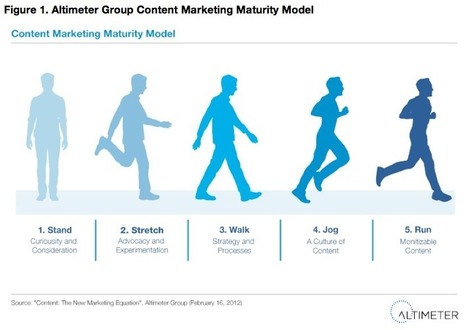
This is an interesting recap by Brian Solis of the stakes and challenges of companies with regards to content marketing. This is based on a report by the Altimeter Group, Brian's firm, produced by Rebecca Lieb.

He makes a lot of interesting observations, starting from the one that social media 1.0 is dead and that effective strategies need to recognize that you're not dealing with a simple audience anymore but an audience with an audience with an audience.

The report also defines 5 maturity stages for content marketing. Which one is yours?
No comment yet.
Scooped by Guillaume Decugis
February 14, 2012 3:03 PM
Scoop.it!

Can Brands Become Money-Making Publishers Themselves?

Can Brands Become Money-Making Publishers Themselves? | Content curation trends | Scoop.it

"Major brands are slowly discovering that e-commerce may not be the only revenue stream the digital world has to offer them."


Andy Nibley wrote this guest post on Wired.com; he's the CEO of Yieldex.


His take is that major retailers have such a big trafic they're now starting to make money not just by selling products but by selling ads to other retailers orbrands: "So here’s a fresh example of the internet’s law of unintended consequences: Corporations who never had an interest in publishing may find that there is money to be made by sharing their customers with other brands."


The rationale being  that ad margins can be higher than retail margins.


What I feel this all means is that, in our noisy Web, catching the consumer attention becomes the greatest asset of all.

No comment yet.
Scooped by Guillaume Decugis
March 20, 2012 10:39 AM
Scoop.it!

If you have news, it will be aggregated and/or curated

If you have news, it will be aggregated and/or curated | Content curation trends | Scoop.it

"One thing that becomes clear from the latest Pew report on the state of media is just how big a role aggregators -- both human and machine-powered -- are playing in news consumption." comments Mathew Ingram on GigaOm.


He goes on to analyze what this means for the business models of media outlets that weren't built around the assumption that as high as 30% of their trafic would come from news agregators or human curators.


I'd love the study to make a better difference between news readers such as Flipboard or Zite, agregation sites such as the Huffington Post and the work of human curators on platform such as Scoop.it. But it's great to have a measure of the huge impact curation already has.


NB: the whole report is available here.

No comment yet.
Scooped by axelletess
March 15, 2012 12:05 PM
Scoop.it!

LinkedIn Industry Trends: Winners and Losers During the Great Recession

LinkedIn Industry Trends: Winners and Losers During the Great Recession | Content curation trends | Scoop.it

What I find very interesting in this graph is this phenomenom :


The fastest-growing industries include renewables (+49.2%), internet (+24.6%), online publishing (+24.3%), and e-learning (+15.9%). Fastest-shrinking industries were newspapers (-28.4%), retail (-15.5%), building materials (-14.2%), and automotive (-12.8%)


Newspapers are struggling but online publishing is booming. A whole area is shifting and as usual in this time of big transition, the ones that understand the opportunity and embrace with passion the change will be the winner.


Who wants to be a publisher and particpate to one of the most interesting innovation in the information industry? 


No comment yet.
Scooped by Guillaume Decugis
March 14, 2012 1:32 PM
Scoop.it!

Stop Calling it Curation

Stop Calling it Curation | Content curation trends | Scoop.it

"Imagine, if you will, a world in which Richard Seaver or Robert Gottlieb had stomped their feet and huffed and puffed every time John Leonard forgot to give them their proper “↬”. Or rather, as I joked on Twitter over the weekend about the new “Curator’s Code,” if Goethe had lived long enough to chide Mann for writing about Faust and giving a “ᔥ” to Marlowe but forgetting to give a “↬” to Goethe."


This rant by Matt Langer is very interesting to read. Whether you agree with him or not.


Maria Popova introduced the Curator Code last week, right before SxSWi where she participated in a very exciting panel. While some have immediately felt it was a great idea, it's interesting to look at the reactions of others.


Is the curator code redundant with the Web's fundamentals such as the hyperlink? Does it add complexity for readers? Will it make sense if only a minority use it? 


Those are good questions to consider.

No comment yet.
Scooped by Guillaume Decugis
March 12, 2012 2:11 PM
Scoop.it!

The Curator's Guide to the Galaxy - Atlantic Mobile

The Curator's Guide to the Galaxy - Atlantic Mobile | Content curation trends | Scoop.it
This is an interesting analysis on the Atlantic on the Curator Code that Maria Popova introduced last week.

Let's conquer the Galaxy!
No comment yet.
Rescooped by Guillaume Decugis from Ideas That Matter From SXSW '13
March 11, 2012 6:48 PM
Scoop.it!

Curation: Corinne Weisgerber's favorite trend at SxSWi 2012

Corinne Weisgerber teaches Communication & Social Media at St.Edward'sUniversity in Austin, Texas. She gave a very interesting presentation on curation last year that you can find here: http://bit.ly/twxznS


We asked her what she saw coming for this year and she felt Curation, more than ever, was the major trend she saw emerging at SxSWi this year.

No comment yet.
Scooped by Guillaume Decugis
March 10, 2012 4:54 PM
Scoop.it!

A Curator Code to recognize curators' authorship

A Curator Code to recognize curators' authorship | Content curation trends | Scoop.it
Yesterday, Maria Popova (@brainpicker), one of the Web's prominent curators proposed the idea of a curator code.

As she's said before, curation is a form of authorship and should be recognized as such.

Hence the need for this code to improve the way we attribute content.
Robin Good's comment, March 11, 2012 5:24 AM
Hello Guillaume, as I wrote in my short piece about Curator's Code, you and Maria should get together and see if there is a simple way to make the two bookmarklets work together, as for now they don't. Have you tried?
Guillaume Decugis's comment, March 11, 2012 9:48 AM
Hi Robin. I just talked to her yesterday on that matter in Austin. We're going to have a look at it. Keep you posted!
Scooped by Guillaume Decugis
March 7, 2012 7:10 PM
Scoop.it!

Curated Discussions: the next step for Twitter co-founders

Curated Discussions: the next step for Twitter co-founders | Content curation trends | Scoop.it

"Obvious Corporation, the new endeavor of Twitter founders Biz Stone, Evan Williams and Jason Goldman, has today announced its second project. It’s called Branch."


Ths site isn't live yet but the idea that old-style forums could use some curation, taking into account participants' expertise is definitely interesting.


If Curation is to beat Noise on the Web, forums and comment threads certainly have some.

No comment yet.
Scooped by axelletess
March 5, 2012 8:38 PM
Scoop.it!

TED Becomes a Publishing Platform

TED Becomes a Publishing Platform | Content curation trends | Scoop.it

"TED has become a publisher (curating content and disseminating it) and a publishing platform (a format designed to attract and disseminate more content). The platform is akin to other new forms of publishing such as blogs or tweets. A TED talk is something that can be described and that gives it informational power.

TED could have done the traditional publishing thing — put up walls and sold exclusivity. Instead, it has chosen to embrace the notion that information has the most value when it is shared widely. Perhaps traditional publishers of other forms of media should take note"


 TED is now one of the most powerful and visible brand in the world. Not only because they produce qualitative content, but curate, select and spread ideas they believe in widely.


Pretty inspiring. And convincing.

So, who wants to be a publisher ?

No comment yet.
Scooped by axelletess
March 1, 2012 9:26 PM
Scoop.it!

Facebook: Brands Are People..and that's why they have to become publishers

Facebook: Brands Are People..and that's why they have to become publishers | Content curation trends | Scoop.it

Yesterday at New York’s fMC, the Facebook Marketing Conference, the company echoed that very sentiment as it argued that following brands on Facebook is no different than following friends and family. Introducing a suite of new advertising tools--enhanced brand Pages, premium offers, mobile ad placements--the social network reasoned that users would appreciate the additional avenues advertisers now have to reach them, because advertisers share "quality" content. "

Our main objective is to make sure that over time, the advertising is as good as the content you would receive from your friends or family," said Carolyn Everson, Facebook’s VP of global marketing solutions. "It’s very similar to your own Facebook experience. There are certain friends that you probably love getting updates from--they are witty and interesting--and that’s really what we’re trying to do with brands: Stop thinking about brands over here and people over here, but actually [think of] brands as people


Facebook is definitely trying to push brands to use the social network to create more engagement, as it seems more and more difficult on the crowded platform. But we know now that content is king and context is god. Nothing is more powerful than publishing your content where you have a chance to be heard. 


Being a publisher not only give you control on what you share but from where you share it. How to get more visibility than that? 


Because the more visible brand on Facebook will always stay facebook itself.  


No comment yet.
Rescooped by Guillaume Decugis from Content Curation World
February 25, 2012 3:22 PM
Scoop.it!

Aggregation and curation: two concepts that explain a lot about digital change

Aggregation and curation: two concepts that explain a lot about digital change | Content curation trends | Scoop.it
This is a Mike Shatzkin article published in 2009 that I discovered through Robin Good.

"Every time I read a story about why newspapers are failing that doesn’t mention the role of aggregation and curation in their troubles, it reminds me that something very fundamental is being missed, even by very sophisticated observers." he starts.

Having been an actor of the digital disruption in the music business, the comparison of publishing with the music industry (and subsequently of the newspaper with the 12/15 song album) is dear to my heart.

The Music Industry lost a lot of time and effort blaming piracy while not realizing albums had stopped making sense and that they had opportunities around curating playlists or compilations that they didn't exploit.

Likewise, the opportunity to create new relevant media through curation has never been that big.

by Guillaume Decugis
Via Robin Good
No comment yet.
Scooped by axelletess
February 23, 2012 2:12 PM
Scoop.it!

Fashion Brands Say Publications Are a Good Investment

Fashion Brands Say Publications Are a Good Investment | Content curation trends | Scoop.it

This publication approach “indirectly gives texture to a brand, creates a feeling, an environment,” said Johan Lindeberg, the brand’s creative director and the founder of the clothing brand J. Lindeberg


Fashion Brands were the first to understand the value of good content and the power of being your own publisher to engage your audience and promote your brand in a more meaninful way. The opportunity exists for many others industries...

No comment yet.
Rescooped by Guillaume Decugis from Is the iPad a revolution?
February 12, 2012 3:38 PM
Scoop.it!

Four Mistakes Publishers Make When Bringing Content to Tablets

Four Mistakes Publishers Make When Bringing Content to Tablets | Content curation trends | Scoop.it

This is a guest post on TechCrunch.com from Mitch Lazard, the CEO of mobile news reader Taptu. As such he has an interesting experience dealing with media publisher but interestingly he's been working for one himself: CNN.

The way some Media publishers embrace she iPad and new technologies is all wrong, he says, as they miss some of the critical things to have a successful strategy in the mobile/social world where content evolves today. Even if this is seen with a mobile focus, a lot of what he writes is generic and relevant beyond the mobile opportunity. Interestingly he highlights the role of curators as news DJ and as a force some Media Publishers tend to underestimate.

No comment yet.
✖

Get a demo of Scoop.it Enterprise

Learn how content curation can help your company.
* Mandatory fields