Your new post is loading...

|
Scooped by
Nicolas Weil
December 7, 2011 6:13 PM
|
Avid continues to enhance the landmark asset management capabilities of Interplay MAM by adding several new features, including: - ICPS (Interplay Common Playback Service)—Web-based media player lets users view, annotate, add metadata, log, and create shot lists with any cataloged media from any location with greater precision and speed. Compatible with Mac OS and Windows PCs. - Graphical Workflow Management—Enables quicker, error-free workflow design and modification, simple drag-and-drop capabilities, and visual workflow monitoring to support more flexible workflow orchestration. - MAM-Production Integration— Transparent media and metadata exchange between Interplay MAM and Interplay Production—the industry’s most powerful media and production asset management systems—allows customers to unify and coordinate production groups across their media enterprise.
|
|
Scooped by
Nicolas Weil
December 5, 2011 6:10 PM
|
The recurring rumors about Apple entering the TV set business are at fever pitch, with no less than former Apple President Jean-Louis Gassée recently jumping into the fray and joining the it-will-likely-happen bandwagon. Gassée and I have been arguing about the idea of an Apple TV since 2008, when I was among the first to blog about the idea. Gassée had taken the position that since TVs are upgraded every five years on average, and computers every two years on average, melding the two would not make sense. The computer would make the TV obsolete too early. Now, Gassée is usually right about Apple predictions, so what's changed? In short, the TV set is on its way to becoming little more than a monitor that simply displays what's on handheld devices. Think about it: to be interactive, a TV no longer needs a computer built into it.
|
|
Scooped by
Nicolas Weil
December 5, 2011 4:13 PM
|
The popularity of mobile devices is pushing most of online video projects to adapt their services to mobile applications (e.g., tablets or smart phones). In the context of many online video services needing video content protection (for example, to offer content libraries from the major Western movie studios), implementing of DRM features in a mobile video player is becoming a critical task. As always, you have a set of solutions and platforms to choose from. Recently, we wrote of DRM features in iOS. Now, it’s high time to talk about Android DRM.
|
|
Scooped by
Nicolas Weil
December 4, 2011 4:46 PM
|
Audible Magic, a leader in automated content recognition (ACR) technologies and services, today announced that it will introduce a new live television identification and synchronization service at the Consumer Electronics Show (CES) this coming January 10-13 in Las Vegas. The new service capitalizes on Audible Magic's patented digital-fingerprint ACR technology to identify TV content even if it is live, never-before-seen, reality-based material. For content owners, broadcasters, programmers, and other application providers, this service also offers several significant new opportunities. With it, for example, they can now add content-aware intelligence to smart, connected device applications on televisions, mobile devices, and set-top boxes. In addition, they can use the intelligence they acquire to create and support new forms of social engagement, advertising recognition and response, and audience measurement.
|
|
Scooped by
Nicolas Weil
December 3, 2011 12:08 PM
|
The Second Screen Ecosystem
|
|
Scooped by
Nicolas Weil
December 3, 2011 11:19 AM
|
Being long interested in HTML5 (and all that other stuff) I sometimes think about it's future, especially regarding it's commercial use. Once, I've got a particular evil vision about possible (video) DRM implementation using HTML5 goodness. We can argue whether the whole DRM concept is a good or a bad thing. It is though inevitable for commercial content to come to the HTML5 world. Here, probably, should I rant about music/movies industry being stagnant, old-fashioned and closed-minded. I won't, there's plenty of examples in the aforementioned Wikipedia article. Folks are really vocal. In this (and probably one future) post I'm going to loudly think about the technical side of this problem.
|
|
Scooped by
Nicolas Weil
December 3, 2011 11:11 AM
|
|
|
Scooped by
Nicolas Weil
December 3, 2011 10:51 AM
|
|
|
Scooped by
Nicolas Weil
December 3, 2011 5:01 AM
|
The EBU's 67th General Assembly in Geneva opened with the announcement that 24 members have agreed to collaborate to unlock the full potential of Hybrid TV for a European rollout of the technology in 2012, writes David Fox. Hybrid or Connected TV combines traditional viewing with internet and smart device applications to enhance what viewers can watch on their TV. The group will cooperate in exchanging best practices and support each another to push through a fast, comprehensive rollout of hybrid TV, on the understanding that only high quality, creative content will enable hybrid technology to fulfil its potential and only a flexible, cross-border approach will create the necessary impetus. In signing up to the Hybrid TV project, these EBU Members make a commitment both to open standards, like HbbTV, MHP and MHEG5, and to delivering a compelling new experience to their audiences.
|
|
Scooped by
Nicolas Weil
December 2, 2011 2:55 PM
|
2012MMSys has announced the selected papers that will be presentend next year. The list is quite impressive and provides numerous R&D insights on how DASH and HTTP streaming in general can be optimized. Let's book our seats for great topics like : - Shaping HTTP adaptive streams for a better user experience - QDASH: A QoE-aware DASH system - Adaptive Scalable Video Streaming in Wireless Networks - Synchronized Delivery of Multimedia Content over Uncoordinated Broadcast Broadband Networks - Quality Selection for Dynamic Adaptive Streaming over HTTP with Scalable Video Coding - Dynamic Adaptive Streaming over HTTP Dataset
|
|
Scooped by
Nicolas Weil
December 1, 2011 5:40 PM
|
There’s a lot of skepticism about the success potential of UltraViolet, a new cloud based digital distribution format designed to make digital rights management work across devices. That’s because people hate DRM, but also because the standard currently lacks support from Amazon and iTunes, the two biggest digital video sellers and renters. I wanted the real story on where UltraViolet is going, so I sat down with the Tim Dodd, VP and GM of Neustar Media, developers of the technology that powers UltraViolet. Watch here on TCTV as he defends UltraViolet, explains how it works on iOS devices without support from iTunes, and claims that there’s still a future in physical media.
|
|
Scooped by
Nicolas Weil
November 30, 2011 3:25 PM
|
|
|
Scooped by
Nicolas Weil
November 28, 2011 4:46 PM
|
With YouView just around the corner there should be a sharp focus on hybrid broadcast broadband (HBB) services in the UK next year, and if the marketing is anything like as successful as it was with Freeview then the concept of on-demand content on TV, and backwards facing EPGs, should become well understood by many more consumers. But YouView is far from being the only game in town and it could even face competition from the existing free-to-air (FTA) platforms in terms of attracting those viewers who primarily just want some catch-up TV content or even some specialist linear channels on their living room set. It is widely expected that the ISPs behind the YouView project, TalkTalk and BT, will provide set-top boxes to their broadband customers, which is a logical extension of the model BT already uses to bundle BT Vision (hybrid Freeview DTT and IPTV) with existing services. And while YouView could represent a good value alternative to Pay TV, or provide a toe in the water for free-to-air homes that want some additional content, it still has to force its way into a market that is well catered for in terms of the primary service on offer: free-to-air linear TV.
|
|
|
Scooped by
Nicolas Weil
December 5, 2011 6:14 PM
|
Adaptive Streaming VLC 1.2 should support, at least partially: - HTTP live streaming, aka HLS, in both live and VOD mode; - MPEG DASH, aka Dynamic Adaptive Streaming over HTTP, in at least 2 profiles. Those are still under heavy work, help is welcome.
|
|
Scooped by
Nicolas Weil
December 5, 2011 5:46 PM
|
The DVB has allied with the 3D@Home Consortium to encourage the development of standards for 3DTV. The move will also ensure that knowledge about 3D viewing is shared and that the bodies’ work is complementary. Commenting on the liaison is David Wood, chair of DVB’s Commercial Module on 3DTV: “3D@Home is an important organisation for 3DTV. They have many areas of interest, including the study of ‘human factors’ associated with 3DTV viewing that we are hoping to learn from. For our part, our work developing delivery specifications for 3DTV, will be helpful for 3D@home.” The 3D@Home Consortium was formed in 2008 with the mission to speed the commercialisation of 3D into homes worldwide and provide the best possible viewing experience by facilitating the development of standards, roadmaps and education for the entire 3D industry - from content, hardware and software providers to consumers.
|
|
Scooped by
Nicolas Weil
December 5, 2011 4:10 PM
|
Over the last few years, the multimedia technology has been growing exponentially. Twenty years ago, the analog over-the-air broadcast was the top experience available. Now, online video services make an increasing impact on the TV industry. You will find useful DRM technologies overview in this article (I hope). It was published in the latest issue of Russian magazine Telesputnik. //Great DRM introduction and technical walkthrough!
|
|
Scooped by
Nicolas Weil
December 3, 2011 12:35 PM
|
During this webinar, FIMS activities were presented in details inc. a reminder on the open conditions to be a member, an introduction to the project working procedures, the FIMS 1.0 specification demonstrated at NAB and IBC 2011, as well as future plans. Presentations have been given by the project Chairs and managers: Giorgio Dimino – RAI, John Footen – Cognizant, Paul Gardiner – Sony, Brad Gilmer – AMWA and Jean-Pierre Evain - EBU.
|
|
Scooped by
Nicolas Weil
December 3, 2011 12:01 PM
|
We’ve been able to play video in the browser without a plugin for a couple of years now, and whilst there are still some codec annoyances, things appear to have settled down on the video front. The next step is adding resources to the video to make it more accessible and provide more options to the viewer. We currently have no means to provide information about what’s happening or being said in the video, which means the video isn’t very accessible and the user can’t easily navigate to a particular section of the video. Thankfully, there’s a new format specification in the works called WebVTT (Web Video Text Tracks). As of now, it’s only in the WHATWG spec, but the recently established W3C Web Media Text Tracks Community Group should introduce a WebVTT spec to the W3C soon.
|
|
Scooped by
Nicolas Weil
December 3, 2011 11:18 AM
|
Let's say you (or someone else) have resolved all previously mentioned issues. You've got yourself a half-working DRM implementation for your HTML5 video player. Now, where to start?
|
|
Scooped by
Nicolas Weil
December 3, 2011 11:04 AM
|
|
|
Scooped by
Nicolas Weil
December 3, 2011 10:41 AM
|
The paper “A VLC Media Player Plugin enabling Dynamic Adaptive Streaming over HTTP” will be presented at the ACM Multimedia 2011 Open Source Competition in Scottsdale. Here you can find a preview of the poster that will be presented on Tuesday.
|
|
Scooped by
Nicolas Weil
December 3, 2011 2:32 AM
|
I’ve been meaning to explain this acronym for a while, and a recent announcement from the DLNA (who create some of the standards that are supposed to make home streaming simpler) is probably as good a reason as any. Regular readers will recall that I’ve seen various recorders over recent months that have fairly advanced functionality, allowing you to record programmes on the hard disk and then watch it over the home network, and predicted we’ll see more of them. For example, last year’s Panasonic FreeviewHD recorder could do the trick, and it’s due to come to the Humax FreeviewHD boxes too. But, right now, it’s a little limited, because of content control issues – that’s the rules that say, for instance, that some material broadcast on FreeviewHD can only be copied to disc once.
Among other things, the looming arrival of the Interoperable Master Format (IMF) is illustrating that the digital media industry is now capable of moving "nimbly and quickly" to create technical standards to address and evolve the ways that it packages, moves, and protects precious content in the form of digital assets in a world where the technology used to do all that, and the very industry itself, is fundamentally changing at a startling rate. Unlike the DCI spec, IMF is not built of wholly new parts. Wherever possible, the file package will consist of existing pieces combined together in an MXF-flavored wrapper. This should, Chang hopes, make it easier for businesses across the industry to adapt without huge infrastructure changes in most cases as IMF comes to fruition.
"With IMF, we are using existing standards—a form of MXF (called MXF OP1A/AS-02) to wrap the files, and parts of the Digital Cinema format and other formats that many manufacturers already use," says Annie Chang, Disney's VP of Post-Production Technology and chairwoman of the SMPTE IMF work group. "So, hopefully, there is not much of a learning curve. We hope that most of the big companies involved in the process won't be caught unaware, and will be able to make firmware or software upgrades to their systems in order to support IMF. Hopefully, companies will not have to buy all new equipment in order to use IMF.
Via Richard Kastelein
|
|
Scooped by
Nicolas Weil
November 30, 2011 4:09 PM
|
Ensequence and Civolution today announce an automatic content recognition (ACR) product integration to enable the synchronization of TV content with interactive content on connected devices including tablets and smartphones. The integrated solution consisting of Civolution’s watermarking technology and Ensequence’s iTV Manager platform identifies what viewers are watching on their televisions or PCs and enables programmers and content publishers to create, manage and deliver immersive two-screen experiences for TV shows and commercials. Civolution’s VideoSync - 2nd Screen product allows for the automatic identification of the TV channel being watched and the content being played. Upon identification, it enables accurate time synchronization between content played on a TV set and supplementary content on a portable device such as a tablet or smartphone. The Ensequence iTV Manager platform enables the creation of the interactive content and handles the timely and synchronous delivery of the content to trigger real-time interactivity. The watermarking technology used for ACR handles distribution delays seamlessly and also supports time-shifted viewing.
|
|
Scooped by
Nicolas Weil
November 29, 2011 4:55 PM
|
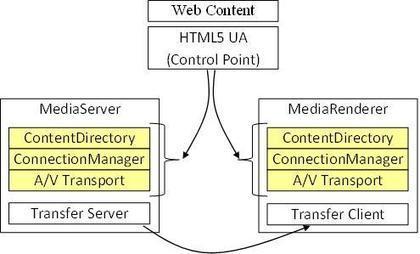
This document describes how an HTML5 UA can fulfill the role of the User Interace (UI) application in a UPnP architecture by mapping existing HTML5 APIs to equivalent UPnP functions. New HTML5 APIs are proposed where required. HTML5 and UPnP Integration Overview UPnP [UPnP] defines a peer-to-peer network architecture providing applications with standards-based connectivity to devices and services in a local area network. An HTML5 [HTML5] UA can implement UPnP functions, thereby enabling Web applications to access home network services. This specification describes the HTML5 UA functions required for it to act as an application in a UPnP network.
|