Your new post is loading...

|
Scooped by
Nicolas Weil
February 22, 2012 2:24 AM
|
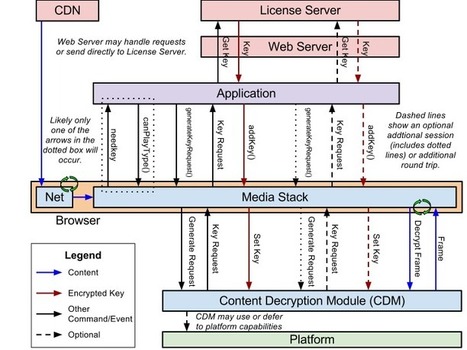
This proposal extends HTMLMediaElement to enable playback of protected content. The proposed API supports use cases ranging from simple clear key decryption to high value video (given an appropriate user agent implementation). License/key exchange is controlled by the application, facilitating the development of robust playback applications supporting a range of content decryption and protection technologies. No "DRM" is added to the HTML5 specification, and only simple clear key decryption is required as a common baseline.
|
|
Scooped by
Nicolas Weil
February 11, 2012 5:48 PM
|
IBM-Research Tokyo recently partnered with the Carl and Ruth Shapiro Family National Center for Accessible Media (NCAM) at WGBH to research ways to deliver online audio descriptions via text-to-speech (TTS) methods, rather than using human recordings.
IBM and NCAM explored two approaches which exploit new HTML5 media elements-- video, audio and track-- as well as Javascript: - Writing and time-stamping a description script, then delivering the descriptions as hidden text in real time in such a way that a user's screen reader will read them aloud. The descriptions remain otherwise invisible and inaudible to non-screen-reader users. - Writing and time-stamping descriptions, then recording them using TTS technology. At the time of playback, each description is individually retrieved and played aloud at intervals corresponding to the time-stamped script.
|
|
Scooped by
Nicolas Weil
January 21, 2012 4:37 AM
|
Mozilla is drafting a proposal for a new Web standard called MediaStream Processing that introduces JavaScript APIs for manipulating audio and video streams in real time. The specification is still at an early stage of development, but Mozilla has already started working on an implementation for testing purposes.
Mozilla's Robert O'Callahan, the author of the MediaStream Processing API proposal draft, released experimental Firefox builds that include MediaStream Processing support. He has also published a set of demos (note: you need to run the experimental build to see the demos) that illustrate some of the functionality defined by the specification.
The demos show how the APIs can be used to perform tasks like rendering a visualization of a video's audio track in a Canvas element while the video is playing. It also shows how the APIs can be used for mixing tasks, like implementing a cross-fade between two audio streams, dynamically adjusting the volume of a video, and programmatically generating audio streams.
|
|
Scooped by
Nicolas Weil
January 8, 2012 3:10 PM
|
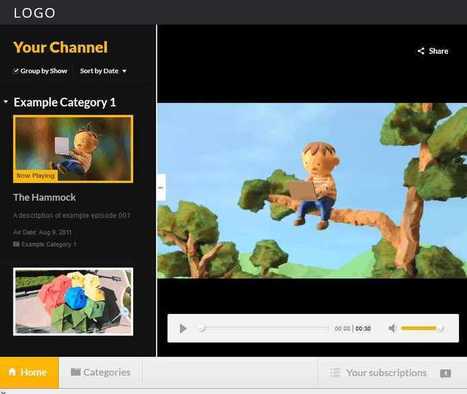
Perhaps Google isn't all bad these days! A new open source HTML5 video player is yours for the download. As well as being a good showcase app it is also practically useful. It is the architectural core of the new 60 Minutes and RedBull.tv apps available in the Chrome Web Store.
As well as being a basic video player, the app allows the user to add their own content, be it a single episode or a playlist. A Category page also allows the user to build up a catalog of things they would like to watch. The user interface is fairly polished and you can try it out at The Video Player Sample.
The key features of the app are (according to the Google Code Blog): - A beautiful video watching experience, including a full screen view - Ability to subscribe to shows, watch episodes, create play lists - Support for multiple video formats depending on what the user’s browser supports (including WebM, Ogg, MP4, and even a Flash fallback) - A Categories page with an overview of the different shows/categories available in the app - Notifications of new episodes (when the app is installed via the Chrome Web Store) - Built in support for sharing to Google+, Twitter and Facebook - To ensure easy customization, all source files, including the Photoshop PSD’s, are included
|
|
Scooped by
Nicolas Weil
January 5, 2012 3:34 PM
|
Shaun the Sheep, An HTML5 Video Experiment
Watch Shaun and his friends' antics in clips from "An Ill Wind", "Snowed In", "The Big Chase", and "Twos Company" through an interactive experiment created with hardware-accelerated HTML5 video, 3D CSS Transforms, and WebM. Use the controls to expand and shrink the video, rotate the scene, bring up a rotating carousel of videos, turn on puddle reflection, and navigate between videos in a snap.
HTML5 and CSS make these advanced functionalities (and more!) a part of the modern web standard, and allow developers and artists to create immersive, imaginative experiences for everyone to enjoy.
Requirements:Windows Vista/Mac OS X 10.6 or above, Google Chrome
|
|
Scooped by
Nicolas Weil
January 1, 2012 4:25 PM
|
There has been a lot of attention focused on enhancements for HTML5 videos recently. Here is an updated list of changes you can expect to see, as well as find out what is currently planned.
Available now in Firefox - Added visual feedback when the HTML5 Media stalled event is dispatched - Clicking on the video surface will toggle between play and pause - The seekable attribute returns the ranges of the media that are currently available for seeking to. - The played attribute enables script to see what regions of the media has been played - Seeking in media is now accurate to the nearest microsecond
...
|
|
Scooped by
Nicolas Weil
December 15, 2011 5:01 PM
|
If you produce streaming video in the worship market and have your ear to the ground, you may be experiencing sensory overload right now. HTML5 is being promoted as a panacea for all plug-in-related woes; Adobe threw the mobile market into turmoil by ceasing development of the Flash Player, and there’s a new standard called DASH that supposedly will create a unified approach for adaptive streaming to all connected devices. Seems like getting that sermon out over the Internet has gotten a lot more complicated. Well, maybe not. In this article I’ll describe what’s actually happening with HTML5, Flash, and DASH, and make some suggestions as to how to incorporate these changes into your video-related technology plans.
|
|
Scooped by
Nicolas Weil
December 3, 2011 12:01 PM
|
We’ve been able to play video in the browser without a plugin for a couple of years now, and whilst there are still some codec annoyances, things appear to have settled down on the video front. The next step is adding resources to the video to make it more accessible and provide more options to the viewer. We currently have no means to provide information about what’s happening or being said in the video, which means the video isn’t very accessible and the user can’t easily navigate to a particular section of the video. Thankfully, there’s a new format specification in the works called WebVTT (Web Video Text Tracks). As of now, it’s only in the WHATWG spec, but the recently established W3C Web Media Text Tracks Community Group should introduce a WebVTT spec to the W3C soon.
|
|
Scooped by
Nicolas Weil
December 3, 2011 11:18 AM
|
Let's say you (or someone else) have resolved all previously mentioned issues. You've got yourself a half-working DRM implementation for your HTML5 video player. Now, where to start?
|
|
Scooped by
Nicolas Weil
November 22, 2011 6:02 PM
|
Adobe reversed course on its Flash strategy after a recent round of layoffs and restructuring, concluding that HTML5 is the future of rich Internet content on mobile devices. Adobe now says it doesn’t intend to develop new mobile ports of its Flash player browser plugin, though existing implementations will continue to be maintained. Adobe’s withdrawal from the mobile browser space means that HTML5 is now the path forward for developers who want to reach everyone and deliver an experience that works across all screens. The strengths and limitations of existing standards will now have significant implications for content creators who want to deliver video content on the post-flash Web. Author Ryan Paul goes through : - Strengths and weaknesses of HTML5 video - Can DRM be made to play nice with open standards? - Netflix stands behind DASH - DASH and DRM - What next?
|
|
Scooped by
Nicolas Weil
November 10, 2011 3:17 PM
|
Pritham Shetty : "We are focusing our efforts on the experiences our customers are actively building, and reducing our focus on areas that are not widely used but require significant resources. This enables us to focus on unsolved problems, like standardized dynamic streaming and DRM for HTML5, that are holding back reach and monetization across devices." This is what Adobe will support: 1. Desktop: Flash Player as a browser plug-in 2. Mobile Browser: Flash Player 11.1 will be available on Android and Blackberry. Adobe is committed to creating great tools and technologies for HTML5 experiences and server-side technologies to deliver HTML5 video (Ex. FMS 4.5 streaming to iOS). 3. Mobile Apps: Flash based apps packaged with AIR which can be distributed via all of the major app stores, including Apple’s App Store, Android Market, Amazon’s App Store etc. 4. TV apps: Ability to embed Flash video in native HTML apps as well as Flash based apps packaged with AIR This is what Adobe will not support: 1. Future versions of Flash as a mobile browser plug-in. Increasingly, mobile OS manufacturers are excluding browser plug-ins, limiting our ability to use Flash to solve mobile browser fragmentation 2. Browsing on a TV. We believe the apps, not browsing to a website, will be the primary way viewers access premium video and games on TVs and peripherals. Specifically, we will not ensure that, for example, 10 year-old websites will render flawlessly on TVs because most people are not browsing 10 year-old websites on TVs.
|
|
Rescooped by
Nicolas Weil
from Video Technologies
October 20, 2011 3:47 PM
|
Fantastic overview of HTML5 video developments and forthcomings. Overview of OVC 2011 conference dedicated to open media development.
Via DENIVIP Media
|
|
Scooped by
Nicolas Weil
August 12, 2011 5:18 AM
|
Los Angeles production house Halo-8 Entertainment is banking on nonlinear storytelling with its upcoming delivery platform EtherFilms, which will give viewers greater control over how movies and other media unfold. For example, the interactive transmedia platform might serve up an extended version of a particularly fascinating interview or let the viewer dive into a comic book mentioned in a documentary. Anchored in the principle that programming should be oriented around content rather than format, HTML5-based EtherFilms will integrate multimedia from past and future Halo-8 motion comics and documentaries like Grant Morrison: Talking With Gods. “That means jumping from an animated film to the digital comic that tells a character’s origin or extending an interview in a documentary, or even jumping to a different documentary altogether for further insight on a topic”...
|
|
|
Scooped by
Nicolas Weil
February 15, 2012 3:25 PM
|
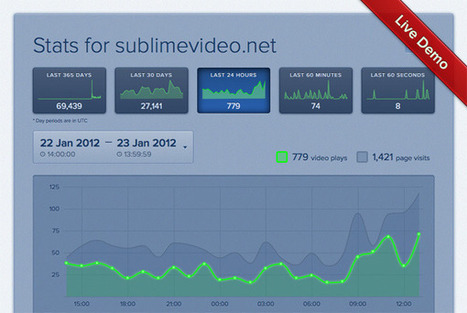
Jilion SA, a Swiss company that offers the SublimeVideo HTML5 video player, has created a live demo to show off its real-time statistics feature. The company introduced real-time stats in a November, 2011, update.
Viewing the demo requires a browser that supports HTML5. The stats feature, however, can pull data from any device, whether desktop or mobile running HTML5 or Flash. The live demo shows stats for the SublimeVideo.net site.
|
|
Scooped by
Nicolas Weil
February 6, 2012 5:37 PM
|
Meztura webKeyer is a software + hardware solution that makes it possible to overlay HTML5/Javascript, Flash and Silverlight content on top of High Definition or Standard Definition video signals.
In other words, the system is able to overlay on top of On-air video any Web page or Web application respecting the transparency values (alpha channel) defined therein.
The rendering engine of the system, based on the WebKit project, ensures speed and compatibility with present and future standards (HTML5, Javascript, WebSockets, ...) as well as Flash and Silverlight.
Video Capture Card: Black Magic Decklink Studio or Decklink Extreme 3D
|
|
Scooped by
Nicolas Weil
January 12, 2012 12:38 AM
|
In a decade or so down the line, experts looking back likely will say that 2012 was the year cable operators and the rest of the telecommunications industry pivoted from basic “get it out there” multiscreen platforms to those that work with a far higher level of precision and efficiency.
That’s the plan, at least. What happens remains to be seen. What is clear is that the industry is poised to take several important steps beyond the “one off” catch-as-catch-can approach that has dominated to date. “The year 2011 saw most — if not all — the major service providers world-wide investigating adaptive streaming, ranging from lab investigations to highly publicized deployments,” wrote Yuval Fisher, chief technology officer of RGB Networks in response to emailed questions. “The market has matured quickly, with operators’ expectations quickly rising from the initial ‘help me just see how this works’ to ‘I need high video quality, high-availability equipment.’”
|
|
Scooped by
Nicolas Weil
January 5, 2012 3:52 PM
|
ACCESS, a global provider of advanced software technologies to the mobile, beyond-PC and digital TV markets, today announced the availability of NetFront Browser NX 2.0 DTV Profile, an advanced new WebKit-based HTML5 browser that features extremely efficient memory usage, high stability, high portability and comprehensive support for DTV and IPTV standards including HbbTV, BBC iPlayer, major video-on-demand (VoD) services in Japan and CE-HTML.
Key features - HTML5 support - Audio/Video tag, Canvas 2D, Web Workers, Web Storage, WebSocket and WebGL - CSS3 support, CSS3 3D Transforms, Transitions and Animations - HbbTV, BBC iPlayer
|
|
Scooped by
Nicolas Weil
January 3, 2012 3:33 PM
|
LeanBack Player is a Javascript based HTML5 Media Player UI that uses build-in HTML5 <video> and <audio> element functionality of standard browsers, platforms and devices. It's very easy to integrate, it's skinnable by using CSS, it's independent of any other javascript libraries and it's adaptable by using extensions.
Until recently, the only way to embed video in web pages was using third-party plugins like Silverlight, Flash and QuickTime. HTML5 has made it easier to include multimedia in your web pages without any plugins, by just using the <video> element. However support for video and audio file formats varies across browsers. HTML5 capable browsers support different video formats.
Via Ludovic Bostral
|
|
Scooped by
Nicolas Weil
December 8, 2011 11:08 PM
|
Trying to free the web of proprietary plugins is a noble goal to which we are committed. But it would be dishonest to strip people of the interactivity they have gotten used to, if we have no acceptable solution to offer them in exchange. Technology such as Flash can evolve very quickly. With the recent announcement of Flash being discontinued on mobile devices (as a plugin, but still present in Air applications), I don’t think anybody saw the seamless quality transition feature coming. I certainly didn’t. Yet, it is so very easy to come up with a new cool feature when you are on your own, not having to reach consensus with a big group of companies having sometimes misaligned interests. How long until such a feature hits HTML5 audio and video? From where we are standing, it feels like forever. The W3C Audio Working group is experiencing difficulties. Scarce meetings (if any), decisions being made internally by companies disregarding the opinions of the working group, unwillingness to let individual developers express themselves… In the end, if no big company is interested in the same feature as you, individual developer, what can you do? For the time being, not much.
|
|
Scooped by
Nicolas Weil
December 3, 2011 11:19 AM
|
Being long interested in HTML5 (and all that other stuff) I sometimes think about it's future, especially regarding it's commercial use. Once, I've got a particular evil vision about possible (video) DRM implementation using HTML5 goodness. We can argue whether the whole DRM concept is a good or a bad thing. It is though inevitable for commercial content to come to the HTML5 world. Here, probably, should I rant about music/movies industry being stagnant, old-fashioned and closed-minded. I won't, there's plenty of examples in the aforementioned Wikipedia article. Folks are really vocal. In this (and probably one future) post I'm going to loudly think about the technical side of this problem.
|
|
Scooped by
Nicolas Weil
November 29, 2011 4:55 PM
|
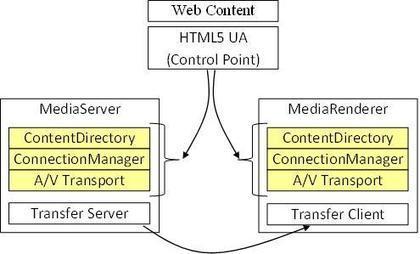
This document describes how an HTML5 UA can fulfill the role of the User Interace (UI) application in a UPnP architecture by mapping existing HTML5 APIs to equivalent UPnP functions. New HTML5 APIs are proposed where required. HTML5 and UPnP Integration Overview UPnP [UPnP] defines a peer-to-peer network architecture providing applications with standards-based connectivity to devices and services in a local area network. An HTML5 [HTML5] UA can implement UPnP functions, thereby enabling Web applications to access home network services. This specification describes the HTML5 UA functions required for it to act as an application in a UPnP network.
|
|
Scooped by
Nicolas Weil
November 10, 2011 3:45 PM
|
Video on the web has always been a bit disappointing. After all, it’s pretty much just like television, only smaller. Unlike the rest of the web, video is just as much a passive experience in your browser as it is anywhere else.
Mozilla would like to change that. The company’s effort to bring a more interactive video experience to the web is known as Popcorn.js and it recently reached 1.0 status. If you’d like to play around with Popcorn, head on over to the Mozilla site and download a copy. Popcorn uses HTML5 video features and at the moment works best in Firefox and Chrome.
At its core, Popcorn is about making HTML5 web video into something more than just another television.
|
|
Scooped by
Nicolas Weil
October 23, 2011 2:59 AM
|
One of the most popular features of modern Flash players is the ability to adapt the bitrate of the streamed video to the available bandwidth, also called HTTP adaptive streaming. HTML5 browsers (with the notable exception of Safari, which supports Live Streaming) do not yet suport this feature because it has not been standardised yet in a codec-independent manner. ISO/MPEG have developed the DASH specification, which may be applied in a codec-independent manner and therefore be a good option for HTML5. While there are several solutions for HTTP adaptive streaming of MPEG video, none has been released for WebM, nor a standard set that works across media formats. Experiments have been run in several frameworks for WebM to see how it can work in comparison to MPEG. This session gives the developers an opportunity to report on their experiences and to discuss how to move forward for standardisation across browsers and codecs.
|
|
Scooped by
Nicolas Weil
August 12, 2011 7:10 AM
|
At first glance, video captioning might not seem like a huge deal. Maybe it might appeal to you if you need to meet accessibility requirements in your workplace, or you're just doing it to be nice to people with hearing difficulties. You're pretty far from the mark though. Yes, accessibility is an important driver for video captioning on the web. But it's about much more than ‘deaf people’ (and you should be providing quality captioning for them anyway!) In addition to important accessibility benefits, captioning your video can allow automatically generated transcripts, text search-ability within videos (imagine what will be possible once Google supports crawling WebVTT!), chapter markers and powerful metadata capability, and much more! You could provide a track of time-specific comments on the video (the same way SoundCloud allows commenting on specific parts of audio) or even a live twitter feed on your video (similar in style to the ABC'S Q&A program.) “Alright!”, you say. “I'm convinced. How does HTML5 allow me to caption my video?” For a while, there wasn't an easy way to do it. Guys like Bruce Lawson were coming up with creative ways (if a little hacky) to implement support, in lieu of a proper standard. Now, however, there's a really nice way to provide support - the HTML5 <track> element and its associated JavaScript API. There's a slight catch though. No currently shipping browser supports either of these features/standards. They will soon - Webkit has support in development, and Firefox can now parse the <track> element (but can't do anything with it yet.) But you want to caption your HTML5 video now. And for that, you need Captionator.js.
|