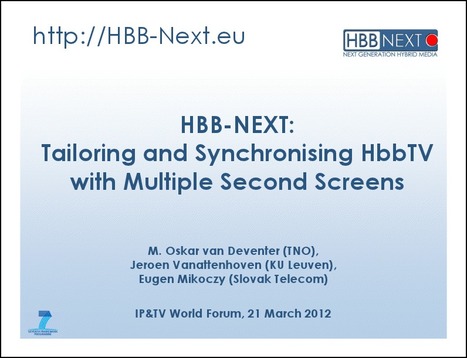
Intellect, the UK’s trade body for the high technology sector, today launched its preferred way for aligning the UK with Hbbtv, the hybrid TV standard emerging dominant in Europe, for consultation with broadcasters. In this way, hybrid television could work seamlessly alongside the UK’s Freeview HD platform, for example, just as it is developing in France, Italy, Germany and many other countries in Europe.
Today sees:
- the release of a specification enabling deployed HbbtV capability on devices, within the UK DTT system - the announcement of test stream made available and hosted by Intellect - a beginning of a process of consultation and discussion with broadcasters and other stakeholders.
Already reaching maturity in Germany, HbbTV is not only set for rollout across Europe but also in other parts of the world, says Adrian Pennington.
Despite some criticism from certain quarters, HbbTV has been accepted by Europe’s national broadcasters as a de-facto standard with interest spreading to commercial operators and to other parts of the globe on the back of new DRM and adaptive streaming capabilities. With estimates of 60 million HbbTV compliant TV sets in Western Europe by 2014, HbbTV appears to have settled as a ‘must have’ industry standard. Almost every European country has endorsed and/or adopted the standard, and the remaining countries are trialling HbbTV or have near-term plans to deploy it.
Support of multiple DRM with a common encryption will allow service providers to provide secure streaming to HbbTV 1.5 sets, and is a major step in making CTVs useful devices for pay- TV services and VoD. However, warns Jean-Marc Racine, managing partner, Farncombe, retail devices are not pay-TV devices, and the control and maintenance of the security of the device will be a challenge. “The industry has to take it into account and integrate it in its operating mode. This is not yet the case, and HbbTV and the device manufacturers integrating it with DRMs or Ultraviolet are facing similar challenges that will need to be addressed,” he says.
Smart TV Alliance, an open-standards based app development platform that will allow developers to create one version of their software to run on TV sets from Sharp, LG and TPV, has been officially launched today.
Sharp, LG Electronics and TPV - a company that owns Philips' TV bussiness - are the current members of the alliance. The members' ambition is align on technology that will allow app developers to create apps and run them on all supported Smart TV Alliance platforms.
Smart TV Alliance utilizes open solutions technology and apps can be developed using open standard (HTML5) systems. A common SDK has been released using HTML5, CE-HTML and HbbTV.
The IRT (Institut für Rundfunktechnik) will use ANGA Cable 2012 to highlight its HbbTV Test Harness, which enables and simplifies HbbTV conformance testing of set-top boxes and integrated digital televisions (iDTV). Receiver manufacturers and network operators can easily integrate the testing environment into their custom hardware testing procedure in order to validate all the use cases of the Test Suite. The IRT says the process is efficient and reliable.
With HbbTV Test Harness, the test results are automatically generated for the test reports. They are captured as screen shots by a digital video camera controlled by the HbbTV Test Harness. The HbbTV Test Harness enables receiver manufacturers and network operators to test TV devices against the standard functionalities of the so-called Test Suite of the HbbTV consortium. There are tests to ensure the proper functionality of the ‘Red Button’, for opening HTML pages and ensuring the flawless navigation of HbbTV applications by users, for example.
With estimates of 60 million HbbTV compliant TV sets in Western Europe by 2014, HbbTV is becoming the dominant standard for interactive, hybrid and OTT delivery in Europe. It’s a success story unmatched by previous pan-European interactive TV initiatives.
Huge impetus was given to rollout late last year when 20 EBU members including RAI (Italy); RTVE (Spain); YLE (Finland); RTBF (Belgium) and NRK (Norway) agreed to deploy HbbTV services in 2012 and to establish a common market for hybrid television applications.
EBU Director General Ingrid Deltenre said; “Underlying this co-operation is the shared conviction that only high quality creative content can breathe life into the promise of hybrid technology – and only a flexible, cross-border approach will make it happen quickly.”
NorDig has specified common API for interactive services for advanced IRDs (Integrated Receiver and Decoder), now referred to ashybridIRDs (previously referred to as Enhanced or Interactive IRDs). From now NorDig hybrid IRDs will be based on theHybrid Broadcast Broadband TV (HbbTV) and succeeding DVB MHP as NorDig previous chosen API. The HbbTV aims to harmonise the classical broadcast (terrestrial, cable and satellite) and broadband delivery of entertainment to the end consumer through connected IRDs.
NorDig is specifying a common platform for Digital Television to be used within the Nordic region (Denmark, Finland, Iceland, Norway and Sweden) and Éire. NorDig’s minimum requirements for HbbTV implementation is initially placed as separate addendum to NorDig Unified IRD specification (v2.2.1 and) v2.3 and is based it on the HbbTV version 1.1.1. NorDig’s HbbTV requirements is however planned to included into main NorDig Unified IRD specification in the next release of the specification.
The Hybrid Broadcast Broadband TV (HbbTV) consortium has reacted quickly to the growing momentum behind the recently published MPEG-DASH HTTP adaptive streaming standard by incorporating it within the latest version of its specification.
The consortium believes that, with the HTTP adaptive streaming support, it now has all the key ingredients for deployment of hybrid TV services combining broadcast with web content and interactive services. This is significant not just because it enables broadcasters to deliver content at higher quality over the Internet as part of hybrid services based on HbbTV, but also because it increases options for content protection. MPEG-DASH uses the Common Encryption Scheme (CENC) specifying standard encryption and key mapping methods that can be used by one or more Digital Rights Management (DRM) systems.
It operates with a common format for the encryption related metadata necessary to decrypt the protected streams, therefore enabling content to be encrypted just once for handling in principle by any DRM. This support for multiple DRMs is a key requirement for multi-screen services deployed to a variety of device platforms that may have different protection mechanisms for content.
Ligada iSuite consists of a highly automated test harness and test suite covering HbbTV, OIPF, DRM and DASH adaptive streaming. The company is engaging with a number of hybrid platform operators to provide interoperability, functional and security tests.
Digital TV Labs can offer existing extensive HbbTV 1.1 and 1.5 test suites including DASH adaptive streaming, as well as specific operator test case authoring, allowing users to build their own test suites. The company offers an outsourced test service in the UK and Hong Kong for receiver manufacturers, and in addition provides test servers covering prevalent DRM systems.
The EBU's 67th General Assembly in Geneva opened with the announcement that 24 members have agreed to collaborate to unlock the full potential of Hybrid TV for a European rollout of the technology in 2012, writes David Fox.
Hybrid or Connected TV combines traditional viewing with internet and smart device applications to enhance what viewers can watch on their TV. The group will cooperate in exchanging best practices and support each another to push through a fast, comprehensive rollout of hybrid TV, on the understanding that only high quality, creative content will enable hybrid technology to fulfil its potential and only a flexible, cross-border approach will create the necessary impetus.
In signing up to the Hybrid TV project, these EBU Members make a commitment both to open standards, like HbbTV, MHP and MHEG5, and to delivering a compelling new experience to their audiences.
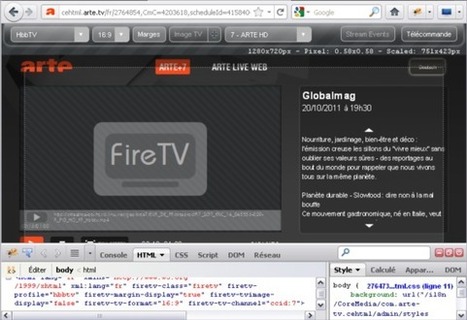
FireHbbTV integrates with Firefox to help you develop HbbTV (http://www.hbbtv.org/) compliant applications.
You can then benefit of strong development tools associated with your favourite browser. Most commonly used HbbTV API are injected on-the-fly on the web page once you activate the plugin support for a given site. Moreover, FireHbbTv provides you with usefull tools such as resize, aspect-ratio switch, safe-area margin display and keyboard navigation miming TV remote control capabilities.
J’ai eu l’occasion d’intervenir dans un débat mercredi 19 octobre 2011 au Sénat portant sur les “Libertés sous le règne de l’Internet” organisé par la Fondation Robert Schumann et le Center for European Studies. [...]
La seconde table ronde où j’intervenais rassemblait trois opérateurs télécom français [...] et portait sur le web 3.0 et les télévisions connectées et sur les migrations de valeur intervenant dans l’univers télécoms, Internet et télévision numérique.
[...] Mon propos faisait le lien entre la stratégie actuelle des acteurs français et par extension européens, celle des grandes sociétés américaines et asiatiques, et les enjeux de libertés : liberté d’expression, liberté d’accès aux contenus et libertés d’entreprendre. Il se terminait par une proposition permettant d’éviter à l’industrie européenne de la télévision de tomber sous le contrôle des géants américains et asiatiques et de d’étendre les libertés citées où l’on part de très bas pour ce qui est de la télévision.
Le point clé de cette piste est de prôner un collaboration plus intense de l’industrie et des régulateurs pour standardiser les plateformes de la TV connectée.
Momentum behind the HbbTV hybrid standard designed to unify broadcast and broadband services behind a common user interface is gathering pace in Europe outside the UK with trials or deployments by several major public broadcasters. Even in the UK, HbbTV is gaining some ground, having been adopted there by the Digital TV Group (DTG), responsible for digital terrestrial broadcasting, in the 7th edition of its D-Book. This defines the interoperability specification for UK digital terrestrial television, and by endorsing HbbTV, the DTG has created some confusion since the country appeared to be adopting an alternative platform, YouView. This is a consortium backed by the BBC, ITV, Channel Four, Channel Five, BT, TalkTalk and Arqiva, aiming to launch its proposed hybrid broadcast and broadband platform in February 2012. As provider of the UK’s terrestrial infrastructure, Arqiva now appears to have a foot in both the YouView and HbbTV camps, so the future course of UK hybrid DTT services is unclear.
Outside the UK, though, Europe is rallying behind HbbTV, with NPO (the Dutch public broadcasting organization) conducting HbbTV trials on the Canal Digital satellite DTH platform and on the Ziggo cable networks, according to Dutch magazine Totaal TV. The Canal Digital trials are kicking off with Sony Bravia connected TV sets that have built-in satellite tuners as well as HbbTV support. Other leading CE manufacturers, including Philips and Samsung, plan to pile into the burgeoning Dutch hybrid market with HbbTV enabled TVs by the end of the year. The services will include an HbbTV “red button” that will enable interactive services combining linear and Internet content to be unified within personalized EPGs.
The Digital TV Group (DTG) has given its approval to HbbTV-based connected TV hybrid products and services as part of the 7th edition of the ‘D-Book, the detailed interoperability specification for UK digital terrestrial television.
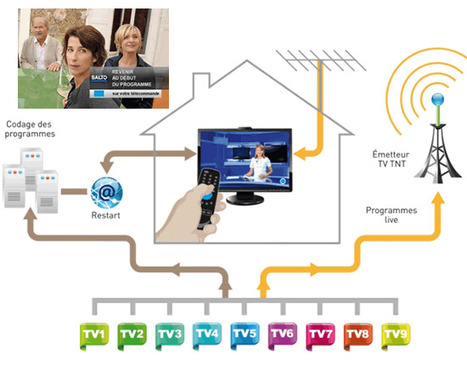
As part of its digital development, French PSB group France Télévisions is enriching its connected TV offer with the launch of the Salto DTT HbbTV service and enhancement of Pluzz VOD.
Based on a technological solution from TDF, Salto allows viewers to watch prime time live programming airing after 20:00 from the very beginning, even when started. Like time shifting functionalities, it is designed to give greater control to a live TV feed. Returning back to the live session is also possible.
The attached schema files have been developed by the HbbTV Association to capture test case requirements, to document the development and approval process for each test case, and to enable implementation of test cases using a HbbTV conformant test harness. These schema are published to enable other groups to use the same schema for development of their own test cases in a way that will maximise interoperability of implementations.
Farncombe and Digital TV Labs have announced the launch of a TNT 2.0 test suite for manufacturers launching connected TV devices based on the latest version of the HbbTV 1.5 standard.
As prime contractor, Farncombe has focused on DRM testing, while Digital TV Labs designed the suite of tools to certify HTTP adaptive streaming based on the recently published MPEG-DASH specification. The TNT 2.0 test suites will also enable the validation of Marlin and Microsoft PlayReady DRMs.
Farncombe will offer the DRM test suite alongside its popular security audits, allowing connected TV manufacturers’ DRM implementations to be reviewed to ensure compliance with robustness obligations and an objective set of minimum security requirements.
Digital TV labs CEO, Keith Potter said: “The DASH adaptive streaming specified in HbbTV 1.5 is an important step in improving the perceived quality of video presentation on busy or slow internet connections. We are now able to license the full TNT 2.0 test suite, in conjunction with Ligada iSuite to provide full HbbTV 1.5 support to our clients.”
This is a HbbTV testsuite and is designed for testing HbbTV implementations.
The testsuite is inofficial and incomplete, but still contains a lot ofimportant tests. Please note that the HbbTV consortium currently is workingon an official testsuite, but as this takes longer than expected, thisproject is designed to be a first step towards that goal.
ALi Corporation today announced that its hybrid broadcast broadband TV (HbbTV) supported STB platform is ready for mass production.
The adoption of HbbTV is spreading in Europe. It is already implemented in retail STBs, connected TVs and other devices such as game players from many leading TV and STB manufacturers. To create an optimal HbbTV experience, ALi and Opera offer a friendly interface to browse web content on TVs for traditional remote controls or their companion devices, as well as robust rendering engines for television with TV rendering (TVR) technology, supporting features such as adapting internet pages to suit TV screens, anti-flicker filtering, picture-in-picture viewing, etc. ALi has pre-ported Opera to its new STB SoC solution, optimizing the Opera Devices Software Development Kit (SDK) for specific middleware, which reduces time to market and development costs.
The Opera Devices SDK uses the most recent version of Opera's rendering engine, Opera Presto, which powers the latest Opera desktop and mobile browsers. The latest version incorporates improvements in CSS, DOM and JavaScript modules. Moreover, the Opera browser uses hardware acceleration, using DirectFB to speed up rendering and animations, providing smoother web browsing experience on hardware limited devices.
The HbbTV (Hybrid Broadcast Broadband TV) consortium has announced the publication of version 1.5 of its hybrid TV specification. Building on existing standards and web technologies, the HbbTV specification provides the features and functionality required to deliver feature rich broadcast and internet TV services.
Version 1.5 of the HbbTV specification notably introduces support for HTTP adaptive streaming based on the recently published MPEG-DASH specification, improving the perceived quality of video presentation on busy or slow Internet connections. It also enables content providers to protect DASH delivered content with potentially multiple DRM technologies based on the MPEG CENC specification, improving efficiency in markets where more than one DRM technology will be used. Version 1.5 significantly enhances access to broadcast TV schedule information, enabling operators to produce full seven-day electronic programme guides as HbbTV applications that can be deployed across all HbbTV receivers to provide a consistent user experience. The latest advances are based on activity within the HD Forum in France as part of the development of the TNT 2.0 specification
In this research paper, Jean-Claude Dufourd, Stéphane Thomas and Cyril Concolato have explored the different issues raised by the recording and on-demand playback of broadcast HbbTV services containing interactive applications. They proposed a set of HbbTV native tools for the base of the system, DASH tools for adding random access to MPEG-2 TS in the user recording case, and also adding HTTP streaming in catch-up systems. They proposed guidelines to application developers and small extensions to HbbTV. They described possible implementations based on MPEG-2 TS and discussed an alternative based on ISOBMFF.
Future work includes the implementation of a recording functionality in their in-progress open source HbbTV player, the checking of recording guidelines in their HbbTV application validation software, proposing the extensions described above for standardization in the next version of HbbTV, and exploring the playback of HbbTV services on non-HbbTV devices such as mobiles and tablets in the context of convergence in the home.
With YouView just around the corner there should be a sharp focus on hybrid broadcast broadband (HBB) services in the UK next year, and if the marketing is anything like as successful as it was with Freeview then the concept of on-demand content on TV, and backwards facing EPGs, should become well understood by many more consumers. But YouView is far from being the only game in town and it could even face competition from the existing free-to-air (FTA) platforms in terms of attracting those viewers who primarily just want some catch-up TV content or even some specialist linear channels on their living room set.
It is widely expected that the ISPs behind the YouView project, TalkTalk and BT, will provide set-top boxes to their broadband customers, which is a logical extension of the model BT already uses to bundle BT Vision (hybrid Freeview DTT and IPTV) with existing services. And while YouView could represent a good value alternative to Pay TV, or provide a toe in the water for free-to-air homes that want some additional content, it still has to force its way into a market that is well catered for in terms of the primary service on offer: free-to-air linear TV.
Do not expect rationalisation of standards and anything close to a pan-European, let alone a global specification for hybrid broadcast broadband (HBB). That was the message from a panel of experts at the OTT TV World Summit on Wednesday. Anthony Smith-Chaigneau, Chairman of the DVB-GEM Commercial Module, which determines what the DVB interactive TV standard needs to deliver for the market, suggested the problem is not a technical one but a human one. “There are plenty of standards but nobody is choosing them,” he said. “Everyone is fighting each other and following their own path.”
Many people in the DTV industry have only a basic understanding of DSM-CC, and sometimes not even that. For MHP and OCAP developers, it's a technology that you need to know something about. It's not necessary to know all of the details, but a general idea of what goes on and why is essential to building applications that work well and load quickly.
The detailed parts of this tutorial are contained in separate sections, and are really only for people who are implementing MHP or OCAP receivers, or head-end systems that need to build object carousels for those receivers: other readers should not need to stray from the main page of this tutorial into the more technical discussions of specific parts of DSM-CC.
To get content containing either thought or leadership enter:
To get content containing both thought and leadership enter:
To get content containing the expression thought leadership enter:
You can enter several keywords and you can refine them whenever you want. Our suggestion engine uses more signals but entering a few keywords here will rapidly give you great content to curate.


 Your new post is loading...








![Digital TV Labs Offers Interoperability Testing For OTT, Hybrid And HbbTV Operators including OIPF, DRM and DASH [PR] | Video Breakthroughs | Scoop.it](https://img.scoop.it/-d-oBejMhfoiSonvRLCgajl72eJkfbmt4t8yenImKBVvK0kTmF0xjctABnaLJIm9)





![ALi supports Opera in its HbbTV STB platform [PR] | Video Breakthroughs | Scoop.it](https://img.scoop.it/IEzLGtQlb1Kg-mP_3AhFxzl72eJkfbmt4t8yenImKBVvK0kTmF0xjctABnaLJIm9)