


Future Technology
Mercedes Benz Future Truck Technology | Future Technology Innovation.
Credit Himanshu Kumar
Via TechinBiz

 Your new post is loading...
 Scoop.it! Future Technology Via TechinBiz 
No comment yet.
Sign up to comment
Scoop.it!

Arizona groundbreaking serves as a crucial stop as EV truck maker drives toward its ambitious goals.
Richard Platt's insight:
The EV truck market is heating up with numerous automakers including a host of hungry youngsters Rivian, Lordstown, Tesla and Bollinger each fighting for position. However, with an eye on capturing the lion’s share of the electric truck market, Nikola Corp. recently broke ground on its 1 million-square-foot manufacturing facility in Coolidge, Arizona. "This has been an incredible journey for Nikola Corp. We started in our basement six years ago and now we are kicking off this 1 million-square-foot manufacturing facility," said Trevor Milton, Nikola founder and executive chairman. Located off U.S. Highway 87 at east Houser Rd and Vail Rd, the future 4.0 designed facility will incorporate the latest technology to increase connectivity 24/7 throughout the building and equipment to optimize overall energy, productivity and quality. After an 18-month national site search of various locations around the United States, led by Tom Stringer at BDO and Saint Holdings, Nikola selected Coolidge for its outstanding industrial infrastructure within the region. The decision was also further solidified by the tireless support of the state, county and city, as well as the breadth of talent, year-round sunshine conducive to renewable energy, and the infrastructure available to scale with the ambitious plans and growth trajectory Nikola has set forth.
Scoop.it!

Next year's Mercedes EQS electric luxury sedan will be one of the longest range EVs on the market, the first real thorn in Tesla's side.
Richard Platt's insight:
We recently experienced the Mercedes-Benz EQS, and even though it’s not perfect and can only muster around 186 miles / 300 km real world range, the idea of a batter-powered Mercedes really started to make sense. However, range won’t be an issue with the brand’s future EVs, since it just announced that its EQS flagship electric sedan will go further than 435 miles or 700 km on one charge. That will make it one of the longest range EVs ever made and it will also be among (if not) the most luxurious. That’s how much Mercedes said the EQS concept was able to muster and we’re impressed and intrigued that the production model matches it. The manufacturer will even build the battery packs itself, at its Stuttgart-Untertürkheim facility. The information was made public by Daimler boss Ola Källenius at the Daimler Annual Meeting. Regarding the EQS, which is due to be launched next year, he said it will mark ‘ a new era for Mercedes in terms of electrification. The EQS will set standards. More than 700 kilometers of driving range according to WLTP. With the EQS, the way we think about cars is changing. It is the first fully electric luxury sedan from Mercedes-Benz based on an all electric architecture. This opens up entirely new possibilities – from the position of the batteries to the car’s design. ‘ It has to be said that the 435 miles / 700 km claimed range will be a bit lower in the U.S. where cars are tested according to the EPA test cycle, not WLTP. At the same time, Mercedes hasn’t announced the exact number and it will be more than 435 miles / 700 km, so we’ll have to wait and see. The EQS will be the first non-Tesla EV to challenge (and possibly even surpass) the Model S Long Range Plus whose claimed EPA range is 402 miles / 647 km which has a 100 kWh battery pack.
Scoop.it!

From
phys

Providing clean water to soldiers in the field and citizens around the world is essential, and yet one of the world's greatest challenges. Now a new super-wicking and super-light-absorbing aluminum material developed with Army funding could change that.
Richard Platt's insight:
Providing clean water to soldiers in the field and citizens around the world is essential, and yet one of the world's greatest challenges. Now a new super-wicking and super-light-absorbing aluminum material developed with Army funding could change that. With funding from the Army Research Office, an element of the U.S. Army Combat Capabilities Development Command's Army Research Laboratory, researchers at the University of Rochester have developed a new aluminum panel that more efficiently concentrates solar energy to evaporate and purify contaminated water. "The Army and its warfighters run on water, so there is particular interest in basic materials research that could lead to advanced technologies for generating drinking water," said Dr. Evan Runnerstrom, program manager at ARO. "The combined super-wicking and light-absorbing properties of these aluminum surfaces may enable passive or low-power water purification to better sustain the warfighter in the field." The researchers developed a laser processing technology that turns regular aluminum pitch black, making it highly absorptive, as well as super-wicking (it wicks water uphill against gravity). They then applied this super absorptive and super-wicking aluminum for this solar water purification. The technology featured in Nature Sustainability, uses a burst of femtosecond (ultrashort) laser pulses to etch the surface of a normal sheet of aluminum. When the aluminum panel is dipped in water at an angle facing the sun, it draws a thin film of water upwards over the metal's surface. At the same time, the blackened surface retains nearly 100-percent of the energy it absorbs from the sun to quickly heat the water. Finally, the wicking surface structures change the inter-molecular bonds of the water, increasing the efficiency of the evaporation process even further.
Scoop.it!

From
www
Getting to net-zero carbon emissions will require rapid, radical innovation, a new report says.
Richard Platt's insight:
Global warming can often feel overwhelming, given its political, social, and economic complexities. From a purely engineering perspective, though, it is surprisingly simple. There is a clear goal and a bounded set of technological tools to achieve it — just the kind of problem engineers like to solve. The clear goal is net-zero global greenhouse gas emissions by 2050, a target around which much of the world is coalescing. Reaching global net-zero is necessary to stabilize the atmosphere at any temperature. Otherwise, it continues warming. “The difference between one and a half degrees, two degrees, and two and a half degrees [of warming] is functionally just the amount of time you have to achieve net zero,” says Julio Friedmann, an energy researcher at the Center for Global Energy Policy at Columbia University. Failing to reach net zero means failing to stabilize the atmosphere. The term “net-zero emissions” means that for every ton of carbon released from the geosphere into the atmosphere (through mining, drilling, and burning of fossil fuels), one ton must be returned from the atmosphere to the geosphere, either through natural means like absorption in oceans, soil, and plants, or through industrial carbon capture and sequestration. Getting to net zero means reducing emissions as much as humanly possible and burying enough carbon to account for emissions that can’t be eliminated.
Scoop.it!

Lithium-based batteries play a central role in the world of technology, but producing them is complicated and they have been the cause of fires.
Richard Platt's insight:
Lithium-ion batteries play a central role in the world of technology, powering everything from smartphones to smart cars, and now one of the people who helped commercialize them says he has a way to cut mass production costs by 90 percent and significantly improve their safety. Hideaki Horie, formerly of Nissan Motor Co., founded Tokyo-based APB Corp. in 2018 to make “all-polymer batteries” (hence the company name). Earlier this year the company received backing from a group of firms including general contractor Obayashi Corp., industrial equipment manufacturer Yokogawa Electric Corp. and carbon fiber maker Teijin Ltd. “The problem with making lithium batteries now is that it’s device manufacturing, like semiconductors,” Horie said in an interview. “Our goal is to make it more like steel production.” The making of a cell, the basic unit within every battery, is a complicated process requiring “cleanroom” conditions — with airlocks to control moisture, constant air filtering and exacting precision to prevent contamination of highly reactive materials. The setup can be so expensive that just a handful of top players, like South Korea’s LG Chem Ltd., China’s CATL and Japan’s Panasonic Corp., can spend billions of dollars building a suitable factory.
Scoop.it!

Electric vehicle makers hope to roll out super long-lasting batteries. That raises interesting questions about resources, performance—and a battery's second act.
Richard Platt's insight:
Electric vehicles (EVs) have a clear environmental advantage over their gas-guzzling counterparts, but when it comes to longevity, the two are in a dead heat. Two hundred thousand miles is considered a good, long run for a car built today, regardless of whether it’s powered by a lithium battery or an internal combustion engine. But if a flurry of recent reports are to be believed, EVs may soon surge ahead in this long-distance competition—not by mere thousands of miles, but by 800,000. Recently, multiple EV battery makers have announced the imminent arrival of “million-mile” batteries, power packs that supposedly have enough juice to be driven to the moon and back twice. In May, a top executive at General Motors said the company was “almost there” on development of a million-mile battery; in June, Chinese battery maker Contemporary Amperex Technology Co. Ltd. (CATL) told Bloomberg it was ready to produce batteries that last 1.24 million miles. For months, rumors have swirled that Tesla will soon roll out a million-mile battery on its own. Its 2019 Impact Report, released in early June, certainly reinforced that impression when it emphasized the environmental advantages of a “future Tesla vehicle with a million mile battery.” But what does the million-mile battery revolution actually mean? According to experts in battery storage technology and the EV market, claims of new batteries that will last a million miles don’t tell us much on their own. How these batteries can be used is going to depend, first and foremost, on how they perform and degrade over their so-called “million-mile” lifespan. Several experts pointed out that true million-mile batteries are likely to outlast whatever cars they’re built for, meaning their arrival could dramatically impact both second-use markets and battery recycling. “What they’re talking about with million-mile batteries is not so much that an average consumer would put a million miles on the clock,” said Simon Lambert, a co-lead investigator at the Recycling of Lithium-Ion Batteries project (ReLiB) at the UK’s Faraday Institution, “but that you’d potentially be able to use the battery multiple times, either in vehicular energy storage or grid-connected stuff.” Most EV batteries on the road today—nearly all of which are lithium-ion batteries employing one of several different chemistries—are warrantied to last 8 to 10 years or 100,000 miles. Some automakers guarantee that the battery will retain at least 70 percent of its original capacity over that period, meaning the car’s range—the distance it can drive before needing to be charged—won’t degrade by more than 30 percent. In practice, early data suggests today’s EV batteries often last considerably longer with less degradation, said James Frith, an energy storage analyst for BloombergNEF, an clean energy research firm. Tesla’s recent impact report, Frith notes, claims that Model S and X batteries lose less than 20 percent of their original charge capacity after being driven 200,000 miles. A Nissan executive, meanwhile, recently estimated that a Nissan Leaf battery will last about 22 years based on battery degradation data the company is collecting on EVs sold in Europe, according to Automotive News. “We’re only just getting to the point where we’ve had EVs on the road for 10 years, and we can really see how well those claims of battery life last,” Frith said. “But in general, we see EVs do tend to perform quite well.”
Scoop.it!

Projects will serve customers in Arkansas, Louisiana, and Oklahoma, saving them approximately US$3 billion over 30 years.
Richard Platt's insight:
The Public Utility Commission of Texas recently denied approval of Southwestern Electric Power Co.'s (SWEPCO) plan to add 309 MW of wind energy to serve Texas customers. However, American Electric Power (AEP) has received the other regulatory approvals needed to acquire the entire planned 1485 MW of North Central wind generation. The AEP is investing approximately US$2 billion to bring new renewable energy to Public Service Co. of Oklahoma (PSO) customers and SWEPCO customers in Arkansas and Louisiana. "We are disappointed that our SWEPCO customers in Texas will not be able to benefit from the low-cost wind energy the North Central projects will provide," said Nicholas K. Akins, AEP chairman, president, and chief executive officer. "The regulatory approvals we have received in Arkansas, Louisiana, Oklahoma, and at the Federal Energy Regulatory Commission (FERC) will allow us to move ahead with the North Central wind projects at full scale, saving our customers in those states approximately US$3 billion over the next 30 years. As we transition to a clean energy future, our investment in the North Central wind projects supports economic and business development in our communities and will help our customers meet their renewable energy goals."
Scoop.it!

Powered by 190-kW hydrogen fuel cell system, Xcient Fuel Cell can travel approximately 400 km on a single charge.
Richard Platt's insight:
Powered by 190-kW hydrogen fuel cell system, Xcient Fuel Cell can travel approximately 400 km on a single charge. Hyundai Motor Company has shipped the first 10 units of the Hyundai Xcient Fuel Cell, the world’s first mass-produced fuel cell heavy-duty truck, to Switzerland. The company plans to ship a total of 50 Xcient Fuel Cells to Switzerland this year, with handover to commercial fleet customers starting in September. Hyundai plans to roll out a total of 1,600 Xcient Fuel Cell trucks by 2025, reflecting the company’s environmental commitment and technological prowess as it works toward reducing carbon emissions through zero-emission solutions. “Xcient Fuel Cell is a present-day reality, not as a mere future drawing board project. By putting this groundbreaking vehicle on the road now, Hyundai marks a significant milestone in the history of commercial vehicles and the development of hydrogen society," said In Cheol Lee, Executive Vice President and Head of Commercial Vehicle Division at Hyundai Motor. “Building a comprehensive hydrogen ecosystem, where critical transportation needs are met by vehicles like Xcient Fuel Cell, will lead to a paradigm shift that removes automobile emissions from the environmental equation." (Also read: Hyundai's hydrogen-powered truck is a concept that unpacks future of mobility) “Having introduced the world’s first mass-produced fuel-cell electric passenger vehicle, the ix35, and the second-generation fuel cell electric vehicle, the NEXO, Hyundai is now leveraging decades of experience, world-leading fuel-cell technology, and mass-production capability to advance hydrogen in the commercial vehicle sector with the Xcient Fuel Cell," he added. Xcient is powered by a 190-kW hydrogen fuel cell system with dual 95-kW fuel cell stacks. Seven large hydrogen tanks offer a combined storage capacity of around 32.09 kg of hydrogen. The driving range per charge for Xcient Fuel Cell is about 400km, which was developed with an optimal balance between the specific requirements from the potential commercial fleet customers and the charging infrastructure in Switzerland. Refuelling time for each truck takes approximately 8~20 minutes. Fuel cell technology is particularly well-suited to commercial shipping and logistics due to long ranges and short refuelling times. The dual-mounted fuel cell system provides enough energy to drive the heavy-duty trucks up and down the mountainous terrain in the region. Hyundai Motor is developing a long-distance tractor unit capable of traveling 1,000 kilometres on a single charge equipped with an enhanced fuel cell system with high durability and power, aimed at global markets including North America and Europe. In addition to the Xcient Fuel Cell trucks, Hyundai is also the manufacturer of Nexo, its second-generation hydrogen-powered SUV. By 2025, the company aims to sell 670,000 electric vehicles annually, including 110,000 FCEVs. In December 2018, Hyundai Motor Group announced its long-term roadmap, “Fuel Cell Vision 2030", and reaffirmed its commitment to accelerate the development of a hydrogen society by leveraging its global leadership in fuel cell technologies. As part of this plan, Hyundai Motor Group aims to secure a 700,000-unit-a-year capacity of fuel cell systems for automobiles as well as vessels, rail cars, drones and power generators by 2030.
Scoop.it!

Sydney, the largest city in Australia, has signed a power purchase agreement that allows it to source all of its electricity from renewables.
Richard Platt's insight:
As of July 1, 2020, Sydney, the largest city in Australia, will power all its operations — street lights, sports facilities, buildings, and the historic Town Hall — with 100% renewable energy from local sources. The clean energy transition, made possible by a power purchase agreement put together by Flow Power, is worth $60 million and is projected to save the city more than a half million dollars on its electricity bills every year for the next 10 years. Sydney began working to reduce its carbon footprint in 2016 when it adopted a plan to cut its carbon emissions 70% by 2030. The city calculates this latest power purchase agreement will help it reach that goal 6 years earlier than planned. It also worked hard to make sure the sources of the renewable energy it uses were all local to the area, providing economic development and job growth opportunities for people living in surrounding communities. Two Solar Farms & One Wind Farm: The PPA will use electricity from three sources — 2 solar farms and one wind farm. Three-quarters of it will be provided by the Sapphire Wind Farm near Inverell. It is the largest wind farm in New South Wales with a capacity of 270 MW generated by 75 turbines that stand 200 meters high. The reason wind is such a big part of the package is that the majority of the electricity the city consumes goes to power its 23,000 street lights. Sydney has converted about 6,000 of them to LEDs recently and has plans to convert another 12,000 soon. “The process of buying energy from a generator when its output matches your demand is known as load matching. For example, if you use most of your electricity at night, like we do, you choose to buy more wind power than solar power. It’s not just a good idea financially — if every large energy buyer practiced load matching, our electricity grid would become much more stable and sustainable,” the city says. Even though the wind blows at night when the city uses most of its electricity, Sydney is also sourcing renewable energy from two solar farms, one of which is a 3 MW community solar installation. The Shoalhaven project is being developed by Flow Power in partnership with local community group Repower Shoalhaven, a not for profit volunteer community enterprise that develops community solar projects. “When we decided to pursue a 100% renewable electricity deal, we knew we wanted to help grow the renewables sector in NSW as well. We didn’t want to simply buy renewable electricity that was already being produced. So we worked with our broker to make sure we were supporting new projects,” the city says. “We ended up partnering with a community energy group that needed help to get a project off the ground. Repower Shoalhaven could not have become operational without our investment. By partnering with this project, we’re stimulating the market and helping the renewables sector grow.”
Scoop.it!

From
thehill
The fossil fuel economy, which motored happily through one century, is quickly running out of steam. Momentum is growing for renewable energy.
Richard Platt's insight:
Coal suffered a historic drop in usage last year. Buyers paid producers as much as $37 per barrel of crude oil in April. The price of plastics has fallen by roughly half over the last four years. The fossil fuel economy, which motored happily through one century, is quickly running out of steam. Gas, once considered a viable option to bridge the transition from “dirty” fossil fuels — such as coal and oil — to renewable energy, is now more likely to serve as the end of the fossil fuel era rather than the beginning of the renewable energy age. Originally hailed as a boon both for U.S. exporters and Asian economies, liquefied natural gas (LNG) prices have hit a 10-year low. Texas energy companies have found it’s cheaper to burn $750 million worth of gas than to try selling it. Also, the company that pioneered gas fracking, Chesapeake Energy Corp., filed for bankruptcy protection earlier this week. Neither the oil nor gas industry’s woes are new. But the coronavirus pandemic, which is expected to shave roughly $8 trillion from the U.S. economy over the next decade, has thrown the troubles of the energy industry into high relief, forcing companies and investors to face reality and turn toward renewables. Evidence that renewable energy and storage sectors reached a milestone was clear this May: a record-low solar tariff of $13.50 per megawatt-hour (MWh) was awarded in Abu Dhabi, which is 13 percent below the previous global record; the New Mexico Public Regulation Commission approved 100 megawatts of solar generation and 50 megawatts of dispatchable battery storage for $30 per MWh; California awarded seven projects totaling 770MW of battery storage; two mega-renewable hydrogen projects worth a total of $5 billion were reported in China; and more. Through the middle of June, U.S. wind turbines, solar panels and dams had produced more electricity than coal on 90 separate days, demolishing the previous year’s record. Momentum for renewables continued through June, when utilities in Arizona, Colorado and Florida announced plans to close coal-fired plants and replace them with renewable sources, without using any gas-fired plants as a “bridge” fuel. While a recovery from the worst economic downturn since the Great Depression is to be encouraged, it is unlikely that energy demand will return to pre-pandemic levels for years. Slumping demand means low prices for fossil fuels, and low prices make it challenging for producers to generate profits from mining coal or drilling oil and gas wells. Renewables also are more likely to benefit from federal policy, even with an ardent coal supporter in the White House. Should Congress enact more stimulus legislation in 2021, it’s possible that measures may be similar to the 2009 economic stimulus package that included $90 billion in clean energy investments and tax incentives.
Scoop.it!

Richard Platt's insight:
In a report outlining how the world can phase out the most polluting fuel while powering an economic recovery from the coronavirus pandemic, a group of experts said coal had reached a financial "tipping point" making it uncompetitive in most markets. The authors estimate that a third of the global coal fleet is already more costly to run than it is to build new renewable power solutions, including battery storage. That figure is set to rise to 73 percent of the fleet by 2025, said the analysis, which also found that replacing the entire coal fleet with clean energy could be done at a net saving to the global economy as soon as 2022. "A faster transition from coal to clean energy is within our grasp, and we show how to engineer that transition in ways that will save money for electricity customers around the world while aiding a just transition for workers and communities," said Paul Bodnar, managing director of the Rocky Mountain think tank which co-produced the research. The 2015 Paris climate deal enjoins nations to limit global warming to well below 2 degrees Celsius (3.6 Farenheit) above pre-industrial temperatures through sweeping emissions cuts.
Scoop.it!

Siloed program efforts, programs structures hold back a more coordinated approach to bundling solar, storage and EE.
Richard Platt's insight:
In February 2020 the ACEEE released a report outlining the benefits of integrated energy efficiency (EE) with solar and storage. According to the report, EE improvements prior to installation of solar and storage have the dual benefit of reducing the sizing needs of systems to support loads while freeing up capital (from bill savings) to help finance these systems. Other benefits are better management of mismatched supply and demand (which is common when peak demand occurs when the sun goes down), and the ability to enhance clean energy portfolios for the purpose of deferring traditional infrastructure investments in distribution, transmission, and generation. According research completed in 2019 by the Rocky Mountain Institute, 90% of proposed gas-fired power plant construction through 2025 is more costly than equivalent clean energy portfolios consisting of distributed solar, storage and energy efficiency. Further, the economics to operate fossil fuel powered generation is expected to decline significantly, resulting in a higher risk of stranded assets. There is plenty of indication that utilities are embracing solar plus storage. United States Energy Information Association (EIA) data shows that solar and wind generation sites paired with energy storage had grown from 19 to 53 between 2016 and 2019, with another 56 planned installations to come online by 2023. High profile sites such as those in Nantucket Island (National Grid) and Santa Barbara (Southern California Edison) have received national coverage.
|
Scoop.it!

Ducati seems to be doing everything it can to elbow its way into the electric bicycle market, now unveiling three new designs for folding electric bicycles. Ducati unveils new folding electric bikes The newest electric vehicles to join the Ducati family come in the form of a trio of folding e-bikes, each with their own […]
Richard Platt's insight:
The newest electric vehicles to join the Ducati family come in the form of a trio of folding e-bikes, each with their own unique designs. The move comes just one week after Ducati made headlines by unveiling a new urban-oriented electric trekking bicycle. The Ducati Scrambler urban trekking bike was designed to tackle both urban riding and light trail duty, and the same could likely be said for some of Ducati’s new designs. The three new models also cover a range of riding possibilities from urban commuting to off-road shenanigans.
Scoop.it!

Two major breakthroughs in solar cell technology could vastly improve the way energy is harvested from the sun. The two studies, published in Nature Energy and Nature Photonics, will transform the efficiency and significantly reduce the cost of producing solar cells, scientists say. The first breakthrough involves “upconverting” low energy, non-visible light into high energy
Richard Platt's insight:
Two major breakthroughs in solar cell technology could vastly improve the way energy is harvested from the sun. The two studies, published in Nature Energy and Nature Photonics, will transform the efficiency and significantly reduce the cost of producing solar cells, scientists say. The first breakthrough involves “upconverting” low energy, non-visible light into high energy light in order to generate more electricity from the same amount of sunlight. Researchers at RMIT University and UNSW University in Australia and the University of Kentucky in the US discovered that oxygen could be used to transfer low energy light into molecules that can be converted into electricity. “The energy from the sun is not just visible light. The spectrum is broad, including infrared light which gives us heat and ultraviolet light which can burn our skin,” said Professor Tim Schmidt from UNSW Sydney. “Most solar cells... are made from silicon, which cannot respond to light less energetic than the near infrared. This means that some parts of the light spectrum are going unused by many of our current devices and technologies.” The technique involves using tiny semiconductors known as quantum dots to absorb the low energy light and turn it into visible light to capture the energy.
Scoop.it!

Aurora, the autonomous vehicle technology startup backed by Amazon, is expanding into Texas as it aims to accelerate the development of self-driving trucks. The company said it plans to test commercial routes in the Dallas-Fort Worth Area with a mix of Fiat Chrysler Pacifica minivans and Class 8 trucks. A small fleet of Pacificas will […]
Richard Platt's insight:
Aurora, the autonomous vehicle technology startup backed by Amazon, is expanding into Texas as it aims to accelerate the development of self-driving trucks. The company said it plans to test commercial routes in the Dallas-Fort Worth Area with a mix of Fiat Chrysler Pacifica minivans and Class 8 trucks. A small fleet of Pacificas will arrive first. The trucks will be on the road in Texas by the end of the year, according to the company. Aurora’s Texas office, which will staff about two dozen people, will be mostly comprised of new hires. Aurora said it’s hiring for a variety of roles, including technicians, team leads, truck drivers and vehicle operators. Aurora is developing a full-stack solution for self-driving vehicles, which it calls the “Driver.” Since it launched in 2017, the startup has said its self-driving stack — the combined suite of software and hardware that provides the brains for an AV — could be applied to any vehicle. However, Aurora’s partnerships and public comments in those first two years centered on robotaxis, not logistics. That started to change last year. In October 2019, Aurora wrote a blog post prioritizing the development of autonomous trucks over cars. In recent months, the company’s co-founders have talked more openly about making trucks a priority. “While the Driver will ultimately move both people and goods, our first commercial product will be in trucking — where the market is largest today, the unit economics are best, and the level of service requirements is most accommodating,” the company wrote in a blog post Monday. While the unit economics were a driving factor, the company says its acquisition of lidar company Blackmore and the integration of that tech in its self-driving stack has made the shift to trucks possible. Aurora has said its FirstLight Lidar gives it a crucial competitive advantage in high-speed self-driving.
Scoop.it!

Chevrolet is developing its first full-size electric pickup. It will arrive with over 400 miles of driving range, but little else is known about it.
Richard Platt's insight:
General Motors confirmed one of the 20 electric cars it plans to release by 2023 will be a full-size Chevrolet pickup. It quietly announced the model in the 179-page 2019 sustainability report it published this month. Chevrolet pledged its yet-unnamed pickup will offer over 400 miles of driving range on a charge, but it chose not to disclose additional details about the truck. It could be marketed as a greener alternative to the Silverado, or it could arrive as a standalone model. GMC has other pickups and SUVs in the pipeline, and we're betting they will all share at least some components under the sheetmetal. GMC's much-hyped Hummer will be offered as a pickup and as an SUV. And, in the same report, Cadillac sketched out plans for a full-size, three-row luxury SUV that builds on the Escalade's DNA. All of these models will have roughly the same footprint, so some structural components will be likely shared in the same way that the Sierra, the Silverado, and the Escalade are built on the same basic architecture. Moving beyond trucks, Chevrolet also confirmed it will release a midsize electric crossover and the smaller, Bolt-based model it announced several months ago. GMC will initially settle for the two variants of the Hummer as its only electric options, while Cadillac's Escalade-like model will be joined by the Lyriq, what it described as a "globally-sized three-row SUV," an XT4-sized model, and the Celestiq. As previously reported, the latter is an ultra-luxurious flagship model that will be assembled by hand in extremely limited numbers. Cadillac predicts it will manufacture 1.2 vehicles daily. Insiders have hinted the sedan may carry a base price of over $200,000, a figure which would make it the most expensive regular-production car manufactured in the United States. Finally, Buick will release two electric models. One is described as an SUV with more conventional crossover proportions, while the other is a crossover with "more expressive proportions." Most of the aforementioned electric vehicles will be powered by the Ultium battery technology that GMC is busily developing. All told, the company is allocating about $20 billion of its capital and engineering resources to bringing the 20-plus electric cars it promised to the market in a timely manner. This massive push partially explains why the guillotine is falling on some of its less popular models, like the Impala and the Sonic.
Scoop.it!

Hydrogen stocks have been on a tear recently. Investors are betting that hydrogen will power trucks and planes.
Richard Platt's insight:
Summary:
It seems like every ten years there's another speculative mania about alternative energy. In the '90s and early '00s, there were solar panels. That one ended badly, with Chinese competition crushing many US darlings. Then there were electric cars. Most of them also failed, but Tesla turned out great, possibly due to it leveraging silicon valley techniques to things like battery packs (and of course, Mr. Musk). There was also a fuel cell mania six years ago. Right now, fuel cells are getting a second wind, under the name of the hydrogen economy. In the past year, Ballard Power Systems (BLDP) has quintupled; McPhy Energy has gone up 5.5 times. And of course, every millennial investor knows about Nicola Corp. The purpose of this article is to explain the hydrogen economy and to explain how I am investing in it. This will be longer than my typical article, and it's in two sections. The first will cover the general situation, and the next will go into my specific trade. The article will be somewhat technical, so a little chemistry background will help. The great unsolved problem in sustainable energy is storage. The technology exists to produce great amounts of power by intermittent sources like solar and wind. But without a way to store the energy, there is a mismatch between when the power is produced and when it is needed. This is one of the virtues of battery electric vehicles (BEV); they can be recharged overnight when normal demand is low. Another way of storing energy is using hydrogen. Here green power is used to produce hydrogen. The hydrogen is then shipped and stored in various well-known ways. Finally, it can be used to provide power via fuel cells or heat engines. The exhaust is just water. This cycle has some big upsides. First, the original power can be produced by fully non-polluting methods, both CO2 and conventional pollutants. Second, some of the processes use existing infrastructure. For example, existing natural gas pipelines can be repurposed for hydrogen. Third, it's possible to decentralize some of the systems for greater efficiency. Think of a truck stop connected to a solar array that produces its hydrogen onsite. Fourth, if the hydrogen is used in a vehicle, fueling time and range will be similar to gasoline. Fifth, hydrogen can be stored virtually indefinitely, as compressed gas, a liquid, as NH3 or as a hydride. Finally, this is not a mature technology. There is more development possible, so the eventual numbers can look much better than today.
Scoop.it!

Tesla has quietly cut the price of the Model Y by $3,000, and it's giving Performance buyers an upgrade package as standard.
Richard Platt's insight:
Tesla just gave would-be Model Y buyers an unexpected treat: a sudden price drop. Electrek has discovered that Tesla lowered the cost of a Long Range AWD variant by $3,000 to $49,990 before taxes and incentives. The electric crossover still isn’t a trivial purchase at that price, but it might be easier to justify if the earlier price was just a little too hard to swallow. There are perks if you’re willing to spend more, too. The Performance trim (priced at $59,990) now includes the previously optional Performance Package as standard. That nets you a higher 155MPH top speed, 21-inch wheels, upgraded brakes, a lowered suspension and aluminum alloy pedals. You will take a hit in range due to those wheels, down from 316 miles on the Long Range to 291 miles, but this saves you money if you were already set on getting a maxed-out Model Y. We’ve asked Tesla for comment. A cut like this makes sense, though. Tesla has a habit of reducing prices as production and economies of scale improve, and the COVID-19 pandemic has had a disastrous effect on car sales — even if EVs represent a rare bright spot. Cuts like this, as well as earlier price drops for the Model S and Model X, could keep Model Y sales humming even as the pandemic continues and the car’s initial novelty wears off.
Scoop.it!
Richard Platt's insight:
We are in the age of electric vehicles but when we think of them all that ever comes to mind is cars. Electric vehicles go beyond just road transportation. While it may take some time to have electric ones that actually fly or sail, concept designs like Kiwa show us that the design innovation for them has already begun! Isaac Burrough, a designer from New Zealand, has created a 110 meters long superyacht concept that uses current and future sustainable technologies to maximize the impact. Kiwa is named after the Māori guardian of the ocean which is a fitting name given that its goal is to help the planet through its energy-saving features and sleek design. A yacht that will look sophisticated whether cruising the Mediterranean or the arctic,” says the designer. Kiwa’s narrow, low-volume to length hull ensures motor-efficiency from the ground up. The yacht also features 200 square meters of solar panels that power the everyday activities, crew usage as well as the hotel load. Along with lowering fuel consumption it also uses a hybrid propulsion system that allows it to select an electric-only mode when the yacht wants to enter remote zones – this promotes sustainable traveling as it cuts out the pollution and also lets guests enjoy al fresco dining without the generator noise! Looking to incorporate the best that engineering has to offer, its electric capacity is expected to extend from several hours to unlimited as solar and battery technologies advance enabling emission-free motoring.
Scoop.it!

'This looks like confirmation that commodities like energy are undervalued'
Richard Platt's insight:
Warren Buffett finally found his next crisis-era deal. His Berkshire Hathaway Inc., which has stayed relatively quiet during the tumult of the coronavirus pandemic, broke its silence at the end of a holiday weekend with its biggest acquisition in more than four years. The US$9.7 billion deal for Dominion Energy Inc.’s natural gas pipeline and storage assets signalled to the market that Buffett is willing to pounce despite his cautious tone in May about the pandemic, according to David Kass, a professor of finance at the University of Maryland’s Robert H. Smith School of Business. “He’s willing to make investments now, of a fairly sizable amount,” Kass said. “It’s very positive that he’s sending a signal for the right deal at the right price, US$10 billion or more, ‘We’re ready to go, we’re ready to invest.’” Buffett, who has crafted Berkshire into a conglomerate valued at US$434 billion, built his reputation as an investor able to swoop in during volatile markets to strike unique and complicated deals in past crises. After being stymied on the acquisition front during the recent bull market for stocks, Buffett still wasn’t striking any deals during the initial stages of the pandemic and even dumped his stakes in the major U.S. airlines. His inability to make a major acquisition recently has drawn scrutiny from his critics who have argued that Buffett has lost his ability to pull off the game-changing transactions that helped vault Berkshire into the ranks of the most valuable U.S. public companies. Now, the deal to buy substantially all of Dominion Energy’s natural gas transmission and storage assets for US$4 billion, along with the assumption of US$5.7 billion in debt, shows that Buffett is willing to put his money to work, Kass said. “We are very proud to be adding such a great portfolio of natural gas assets to our already strong energy business,” Buffett, who is chief executive officer and chairman of Omaha, Nebraska-based Berkshire Hathaway, said in a statement Sunday. “I’m inspired to see that, given that he’s bearish, he’s still willing to make acquisitions where he thinks it makes sense and where it meets Berkshire’s hurdle points,” said Darren Pollock, a portfolio manager at Cheviot Value Management, which invests in Berkshire shares. Buffett has considered its energy business one of the “lead dogs” of Berkshire’s non-insurance operations alongside its railroad. Berkshire’s purchase expands its hold in the sector, adding more infrastructure to handle natural gas to its already sprawling energy operations across states such as Nevada and Iowa. Berkshire also struck the deal at a low point in the market. Natural gas futures in the U.S. dropped last month to their lowest point in 25 years and have recovered just slightly since then.
Scoop.it!
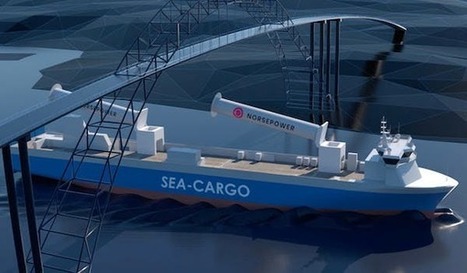
Wind power comes back to the shipping industry, with spinning "sails" that can duck under low bridges and power lines, too.
Richard Platt's insight:
Just when you think you’ve seen everything, along comes the Finnish company Norsepower with an idea whose time has come: tiltable sails. And why? Well, the dream of powering cargo ships the old fashioned way is nice enough, but getting those sails to dip under bridges and snap back up again is a whole ‘nother can of worms. Wind power comes back to the shipping industry, but these “sails” are different than any others Wind Power That Tilts! - So, Norsepower. This company made a little splash on the CleanTechnica radar back in 2017, when we were looking at kite-based wind power technology and then something about “spinning sails” caught our eye. Then, last October we were taking stock of a wind power renaissance in the cargo ship area when all of a sudden Norsepower popped up again, this time in connection with the leading energy and marine operations firm Wärtsilä: “Another important development occurred earlier this week, when Finland’s Wärtsilä and Norsepower announced a new mashup aimed at scaling up the adoption of wind power in commercial seagoing operations. “The new agreement will help Wärtsilä promote projects using Norsepower’s Rotor Sail technology. In turn, Norsepower will have access to Wärtsilä’s high tech global service network.” Interesting! As of last year, though, Rotor Sails had been installed on only three vessels in five years, so it’s about time for Norsepower to pick up the pace — and it looks like they’re doing just that, only now it tilts. The word “sail” is used loosely in this context. Norsepower’s Rotor Sails look nothing like sails or, for that matter, wind turbines. As a matter of fact, they look like smokestacks, only with no smoke. Tiltable Wind Power For The Green Cargo Ship Of The Future — & What Is A Ro-Ro? However, if all goes according to plan, the installation could lead to bigger things. The aim is to demonstrate how Norsepower’s wind power technology can be retrofitted onto existing ships (SC Connector is a twenty-something, btw) and tailored to fit specific circumstances, which in this case would mean conditions in the North Sea. If our friends over at Vessel Tracker are correct, as of this moment the SC Connector is right in the neighborhood. She is heading to the port of Sunndalsøra in Norway at a speed of 13.4 knots and should get there by Thursday evening if you would like to go down and say hello. As for Ro-Ro, SC Connector is something called a Ro-Ro, which is cargospeak for ships that specialize in roll-on/roll-off goods such as cars and the like. How Does It Work? The SC Connector was selected for the first-of-its-kind installation because the Rotor Sail optimizes wind conditions in the North Sea, and the ship’s route takes it under power lines as well as several bridges. The two sails are each 35 meters high and 5 meters wide, so there will be a lot of tilting going on. However, Norsepower’s use of lightweight, composite cylinder materials should ease some of the mechanical burden on the operation. As for what the Rotor Sail is, Norsepower explains that it is a “modernised version of the Flettner rotor, a spinning cylinder that uses the Magnus effect to harness wind power to thrust a ship.” That’s literally what it is: a vertical cylinder that spins. Unlike a conventional sail or wind turbine it needs a power input, which makes it spin. That need for juice may seem somewhat counter-intuitive, but the Magnus effect enables Flettner rotors to create thrust, which more than offsets the energy they consume.
Scoop.it!

From
abc7
You might find this new car's shape instantly familiar as the modern Mini Cooper, but it is a little different, as it runs purely on electricity.
Richard Platt's insight:
You might find this new car's shape instantly familiar as the modern Mini Cooper, but it is a little different, as it runs purely on electricity. It's the new Mini SE, an all-electric plug-in version of the conventional Mini Cooper. Somewhat easy to spot via clever emblems that look like a power plug combined with the letter E, the Mini SE is the brand's first EV available to the general public for purchase. It has a back seat, though not a huge one. Pretty much anyone can get one, and it's one of the most affordable EVs in showrooms today. As for range? Well, that number won't top any comparison charts. Today, there are a number of EVs on the market with a driving range of over 200 miles, for under $40,000 before tax incentives. The Mini SE? Well, it's around $30,000 before tax incentives, and range is around 100 miles. The EPA says 110 miles officially, though that number can drop if you do things like use the air conditioner or drive at freeway speeds a lot.
Scoop.it!

Pacific Gas & Electric has emerged from a contentious bankruptcy saga that began after its long-neglected electrical grid ignited wildfires i
Richard Platt's insight:
Pacific Gas & Electric has emerged from a contentious bankruptcy saga that began after its long-neglected electrical grid ignited wildfires in California that killed more than 100 people. The nation’s largest utility announced Wednesday it emerged from Chapter 11 bankruptcy and paid $5.4 billion in initial funds and 22.19% of its stock into a trust for victims of wildfires caused by its outdated equipment. “This is an important milestone, but our work is far from over,” Bill Smith, PG&E PCG, +4.65% interim chief executive officer, said in a statement. “Our emergence from Chapter 11 marks just the beginning of PG&E’s next era — as a fundamentally improved company and the safe, reliable utility that our customers, communities and California deserve.” A federal judge last month approved a $58 billion plan for the company to emerged from bankruptcy by June 30, the deadline that the company had to meet to qualify for coverage from a $21 billion wildfire insurance fund created by California last year. U.S. Bankruptcy Judge Dennis Montali’s decision cleared the way for PG&E to pay $25.5 billion for losses from devastating fires in 2017 and 2018. Dozens of lawsuits were settled during the ordeal, with $13.5 billion earmarked for more than 80,000 people who lost family, homes, businesses and other property in the fires. The company plans to find a new CEO to replace Bill Johnson, who stepped down June 30 after just 14 months on the job. It has overhauled its board of directors, including 11 members who were just recently appointed. PG&E also has committed to slicing up its sprawling territory into regional units to be more responsive to the different needs of the 16 million people who rely on it for power. Financing the plan requires PG&E to nearly double its debt, saddling the company with a burden its critics fear will make it more difficult to raise the estimated $40 billion for improvements that the utility still needs to make to its electrical grid. This marks the second time in 16 years that PG&E has navigated a complex bankruptcy case that has raised questions about how it should operate in the future. The last time the company emerged from bankruptcy, in 2004, electricity rates soared and management focused even more on boosting profits instead of upgrading its power supply.
Scoop.it!

DOE to invest up to US$100 million over five years in two new DOE National Laboratory-led consortia.
Richard Platt's insight:
The U.S. Department of Energy (DOE) recently announced its intention to invest up to US$100 million over five years in two new DOE National Laboratory-led consortia to advance hydrogen and fuel cell technologies research and development (R&D). This funding is subject to appropriations. "Hydrogen and fuel cell technologies have the potential to enable resilience, energy security, and economic growth across multiple sectors," said Undersecretary of Energy Mark W. Menezes. "Through these ambitious new initiatives, the Trump administration continues its commitment to all of the above energy solutions, providing a wide variety of clean energy options for both power generation and transportation." One consortium will conduct R&D to achieve large-scale, affordable electrolyzers, which use electricity to split water into hydrogen and oxygen, and can be powered by various energy sources, including natural gas, nuclear, and renewables. This R&D will complement and help support large industry deployment by enabling more durable, efficient, and low-cost electrolyzers. The other consortium will conduct R&D to accelerate development of fuel cells for heavy-duty vehicle applications, including long-haul trucks. This initiative will set a five-year goal to prove the ability to have a fully competitive heavy-duty fuel cell truck that can meet all of the durability, cost, and performance requirements of the trucking industry. Daniel R Simmons, the DOE's assistant secretary for energy efficiency and renewable energy, gave a preview of this announcement during his remarks at the International Partnership for Hydrogen and Fuel Cells in the Economy (IPHE) Global Hydrogen Forum, where he represented the United States as the IPHE chair. "We have made tremendous technological progress on fuel cells, electrolyzers, and fundamental materials, but hydrogen infrastructure remains a critical barrier we are committed to overcome,” said Simmons. "Through these new consortia, the National Labs, industry, and academia will work together to improve the cost, durability, and distribution of these technologies in order to realize their full potential."
|






Mercedes Benz Future Truck Technology