A small French company called CILAS has been testing its laser system, downing a number of different drones flying at more than 30 mph and up to 3,300 feet away. It marks the first time in Europe that drones were downed by laser. Lasers like this have an advantage when it comes to swatting pesky drones out of the sky: they will fry up and burn whatever they have hit. But the beam will go no further, causing no collateral damage. They are very precise, have a long range, and are extremely fast. Tanguy Mulliez, manager of the innovation and products department at CILAS, which specializes in lasers, tells Popular Science: “It’s like the beam of a flashlight. It stops at whatever object it hits first.” “the great advantage of a laser system is that it can also be used for other missions,” such as neutralizing explosives, destroying electronics, taking out light sensors, and jamming cameras by blinding them. The system is called the HELMA-P, which stands for High-energy Laser for Multiple Application – Power. “These demonstrations made a real impact on the military and they’ve come back with a lot of questions that we’re working on, both for France and other clients,” .
The military’s new gadget works by amplifying existing light, either from the moon, stars or sources on the ground. The device senses tiny amounts of photons reflected off seemingly dark objects. Then, the photons pass over an internal surface engineered to convert light into electrons. The electrons are amplified by striking a quarter-sized glass plate that has millions of tiny holes in it. Then, they pass a screen coated with phosphor, a fluorescent substance, to create an image. Traditionally, a green phosphor is used, which is why green-hued night-vision imagery is well-known. But Elbit’s latest device uses white phosphor, producing black-and-white images, which officers say creates more contrast and greater clarity at night. “Generally, when you think of night goggles, you think of ambient green light, which is helpful, but this is an improvement on that and allows for better accuracy,” The Army’s latest goggles include an outline mode, which creates glowing white outlines. There’s an augmented reality overlay that can display navigation instructions and maps. The goggles can also connect wirelessly to others in the platoon, so if a soldier spots something, they can mark that object in cyberspace and have it show up on other people’s binoculars.
Drone flights generally aren’t remarkable, but this one was for a simple reason—the entire time the Hybrid Tiger was in the sky, it drew power from two distinct systems: solar panels in the wings, and a compact hydrogen fuel cell in the body. The flight marked a major milestone for the program from the US Naval Research Laboratory, a sign that the drone is at least half as capable as intended. Hybrid Tiger’s successful day in the air started November 18, 2020, although the Navy announced the success in mid-April. “The flight was effectively a performance test in worst-case conditions: temperatures falling below zero degrees Celsius, winds gusting to 20 knots, and relatively little solar energy as we approached the solar solstice Dec. 21,” said Richard Stroman, a mechanical engineer from the NRL Chemistry Division, in a release. “Despite all of that, Hybrid Tiger performed well.” A typical long-endurance drone, such as an MQ-9 Reaper, stays aloft for hours and hours by burning hundreds of gallons of jet fuel to power an engine, which in turn drives the Reaper’s pusher propeller. Noise from this engine gives the Reaper its distinctive loud buzz, a sound that is conspicuously absent from the Hybrid Tiger.
Earlier today, the United States Army announced that it will work with Microsoft on the production phase of the Integrated Visual Augmentation System (IVAS) program as it moves from rapid prototyping to production and rapid fielding. The IVAS headset, based on HoloLens and augmented by Microsoft Azure cloud services, delivers a platform that wil
Yesterday the United States Army announced that it will work with Microsoft on the production phase of the Integrated Visual Augmentation System (IVAS) program as it moves from rapid prototyping to production and rapid fielding. The IVAS headset, based on HoloLens and augmented by Microsoft Azure cloud services, delivers a platform that will keep Soldiers safer and make them more effective. The program delivers enhanced situational awareness, enabling information sharing and decision-making in a variety of scenarios. Microsoft has worked closely with the U.S. Army over the past two years, and together we pioneered Soldier Centered Design to enable rapid prototyping for a product to provide Soldiers with the tools and capabilities necessary to achieve their mission. (from the MSFT blog) "We appreciate the partnership with the U.S. Army, and are thankful for their continued trust in transitioning IVAS from rapid prototyping to rapid fielding. We look forward to building on this successful partnership with the men and women of the U.S. Army Close Combat Force."
Battery Technology in Silicon Valley is about to commercialize revolutionary technology that will enable huge breakthroughs in the battle against global warming. Credit Bloomberg Quicktake
Battery Technology Silicon Valley is about to commercialize revolutionary technology that will enable huge breakthroughs in the battle against global[...] Battery Technology Silicon Valley is about to commercialize revolutionary technology that will enable huge breakthroughs in the battle against global warming. Credit Bloomberg Quicktake
Future Unmanned Aircraft System This video discusses in detail the Airpower Teaming System developed by Boeing for the RAAF (Royal Australian Air Force), also known as The Loyal Wingman.
Future Unmanned Aircraft System This video discusses in detail the Airpower Teaming System developed by Boeing for RAAF, also known[...]Future Unmanned Aircraft System This video discusses in detail the Airpower Teaming System developed by Boeing for RAAF, also known as The Loyal Wingman. Credit Unveiling Reality
Tesla's valuation is 5 times that of Volkswagen because the market has concluded that, as the auto industry goes electric, Tesla will not only lead the industry, but dominate it.
When a company commands a valuation many times that of its rivals, despite having a meager fraction of those rivals’ sales, it usually means one thing: The market expects the upstart to eat the incumbents’ lunches as it grows into a dominant powerhouse. Widespread belief that electric vehicles (”EVs”) are destined to replace the internal combustion engine (“ICE”), combined with a highly publicized role in the creation of the global EV market, have convinced many within the investment community, media industry, and general public that Tesla is such a company. * - Tesla's valuation is 5X that of Volkswagen because the market has concluded that, as the auto industry goes electric, Tesla will not only lead the industry, but dominate it. The idea that Tesla will hold unprecedented sway in the auto market may sound appealing to some, but it is fundamentally flawed. In reality, Tesla has no unassailable advantage in the EV space, a fact other automakers have begun to prove with the introduction of their own competitive EV offerings. * - Competitors are already hounding Tesla at every turn; in every major market – China, Europe, the US – rival offerings are eating into Tesla's market share and even surpassing it.
The U.S. Marine Corps is looking to equip its infantry units with a man-portable, swarming loitering munition that experts say is part of its shift toward countering China with a light and deadly seaborne infantry force. The so-called “Organic Precision Fires - Infantry Light” program is seeking ground-launched drones that can be deployed with no more than two people, have a range of up to 20 kilometers, loiter for 90 minutes, swarm, be jam resistant and be able to take out enemy troops and materiel, according to a November request for information. Special operations forces have used small loitering munition drones in combat for some time, said Bryan Clark, a retired submarine officer and senior fellow at The Hudson Institute, pointing to the AeroVironment Switchblade system. But the swarming effect is something that would take the system a step further, he added. “The swarming idea would be, ‘How do I overwhelm the enemy’s defenses and cut off lines of escape,’” Clark explained. “If I’m a Marine unit, I’m generally going after a group of people, not just one or two guys the way SOF might be. But the idea here is to cause an area effect. You want to overwhelm defenses or cause explosions over a wider area to try and herd your adversary or cut off lines of retreat. “You might create a blast pattern or detonate in some kind of order that herds your adversary into an area that you want to be a kill box. So, swarming for the Marine Corps would be about driving your enemy’s behavior in ways advantageous to yourself.” Marines might also be able to use a swarm as a decoy and try to get the adversary to look for the unit in the wrong locations. “You are looking for weapon systems that can maximize the effectiveness of finding and eliminating a target while minimizing the logistical burden on the unit,” he said. “And you want to maximize the range and any intelligence that system can deliver to you. If I have a man-portable unmanned system that I can launch with a camera, it’s small in size so its detectability is reduced, it can send that information back to the unit and it can also hit a target with great precision: That’s an awesome capability to have.” The swarming capability makes it even more lethal, Wood said, because the drones can communicate with each other to maximize the effectiveness of the strike by attacking from different axes. Both Clark and Wood agreed that this isn’t a science fiction project but technology that exists today, which means it could be available much more quickly than a typical long-duration DoD acquisition program. “It’s another indicator of the Marine Corps looking for current technologies that can allow small units to operate autonomously with a low logistical burden,”.
QuantumScape Chief Executive Officer Jagdeep Singh discusses how his company is developing multi-layered solid state lithium batteries for electric vehicles, which are safer and more efficient than current EV batteries
QuantumScape Chief Executive Officer Jagdeep Singh discusses how his company is developing multi-layered solid state lithium batteries for electric vehicles, which are safer and more efficient than current EV batteries.
Elon Musk’s Space Exploration Technologies Corp. launches a Falcon 9 rocket from Cape Canaveral, Florida. and deploys 60 Starlink satellites into orbit early Tuesday morning
Elon Musk’s Space Exploration Technologies Corp. launches a Falcon 9 rocket from Cape Canaveral, Florida. and deploys 60 Starlink satellites into orbit early Tuesday morning.
Hyundai is teasing the first interior photos of the Ioniq 5 ahead of its world premiere on February 23rd. It’s Hyundai’s first car to utilize the E-GMP platform allowing for a spacious and customizable interior.
Hyundai is teasing the first interior photos of the Ioniq 5 ahead of its world premiere on February 23rd. It’s Hyundai’s first EV to utilize the Electric-Global Modular Platform (E-GMP) — the same platform that Apple is said to have been interested in for its oft-rumored self-driving car. E-GMP’s flat battery and long wheelbase allows for a more spacious and customizable interior for both passengers and cargo.
The big design flourish teased today is a sliding center console inside the Ioniq 5. The so-called “Universal Island” moves out of the way so that the driver or passengers can easily enter and exit either side of the car when parked in a narrow spot, for example. Hyundai says that the driver and front-passenger seats are equipped with leg rests to relax while the vehicle recharges. The seats can also be repositioned so that adults in the front can care for pets and children seated in the rear. Hyundai notes that the Ioniq 5’s interior will be clad with eco-conscious materials. The Ioniq 5 appears to have Tesla’s Camp Mode in its sights with a feature that effectively turns the car into a rolling generator with 3.5 kW of Vehicle to Load (V2L) power. That’s enough juice to power beefy 110V/220V appliances like a full-sized oven, treadmill, or five giant speakers, as Hyundai’s already teased. Teslas can’t do that without hacking an inverter into the circuitry and possibly voiding your warranty. The Ioniq is fitted with V2L outlets on the inside and outside of the car.
First-time filings for unemployment insurance were expected to total 760,000 last week, according to economists surveyed by Dow Jones. CNBC's Steve Liesman reports.
In court in Norway, Tesla was found guilty of throttling charging speed and battery capacity through a software update. Unless it appeals, Tesla is going to have to pay $16,000 to each of the thousands of owners affected in the country. The fine could be even more significant as other similar legal efforts are on the way in other countries. According to Norway’s Nettavisen, Tesla didn’t respond to the lawsuit and the 30 owners behind the case were automatically awarded 136,000 kroner (~$16,000 USD) each in compensation unless Tesla appeals to the case, which it has a few weeks to do. There could be over 10,000 Tesla owners affected by the update in Norway alone, which could make the fine quite pricey for the automaker, but more importantly, it could also set the tone for several other similar lawsuits, including one in the US.
Tesla received a new patent last week for “estimating object properties using visual image data.” Elon Musk estimated that Tesla would release a version of FSD (Full Self Driving) Beta in April. At the time, he also mentioned that Tesla was going for pure vision and suggested that it would not even use radar sensors in the future.
“According to their patent, this invention aims to address the increasing cost and complexity of vision sensors for mass-market autonomous vehicles. This method enables a vehicle to detect and interpret the distance to its surroundings using the vehicle’s image data and machine learning,” explained law firm Founders Legal to Teslarati. Tesla’s patent describes an invention using two neural networks to gauge the distances of objects using only image data. The first neural network can determine the distance of objects from images captured by the cameras around a vehicle. The other neural network creates training material in the form of annotated images for the first neural network.
In the end, Shaw makes it clear that there are certainly savings to be had by switching to an EV. However, he also says that a crossover like the Model Y is expensive, and compared to a similarly equipped gas car, you're probably not going to see an overall savings over a short period of time. Perhaps that will change over time, and it's different for each person. Over the longer term, for example, owning an EV for 5 years, you may start to really see the savings add up.
Singapore has built a floating solar power station off its coast in the Johor Strait. The complex with 13,000 panels was completed in January 2021 as part of the land-scarce city state's push to harness more solar energy and lower greenhouse gas emissions. Singapore’s per capita carbon dioxide (CO2) emission rates are among the highest in Asia.
The Tesla Model Y, Mustang Mach-E, Hyundai Ioniq 5, & VW ID.4 are all fantastic for different reasons. This video may help you decide which one suits you.
There are four all-electric crossovers but which one is best for you? The Tesla Model Y, Ford Mustang Mach-E, Volkswagen ID.4, and Hyundai Ioniq 5 are all fantastic electric crossover – at least based on what we know so far – but for different reasons. Each one may satisfy different car shoppers' priorities. The YouTube video may help you decide which one best suits you. There's the Tesla Model X, Audi e-tron and Jaguar I-Pace, but are all quite expensive. The Hyundai Kona Electric and Kia Niro EV are both solid options for electric crossover shoppers, but are simply electrified versions of gas-powered platforms. The Tesla Model Y has become quite popular, but it has multiple competitors. Ford's Mustang Mach-E, which is more similar to the Model Y than any other vehicle thanks to its sleek styling and stellar performance. The Volkswagen ID.4 as far as we understand is not a performance SUV like the Model Y and Mach-E, but it has a lot to offer, especially for shoppers focusing on comfort, practicality, space, and interior quality. The Hyundai Ioniq 5 is the latest competitor to be unveiled, so not much information is available. However, if the all-electric CUV comes to market offering everything Hyundai suggests it will, it stands to be a home run for the segment.
Future Unmanned Aircraft System conducts a roundup of the contenders to replace the U.S. Army’s RQ7 Shadow drone, shown here conducting flight tests and maneuvers Feb. 25-26, 2021, at Leyte West Airfield, Fort Benning, Georgia. Credit Vertical Magazine
Future Unmanned Aircraft System Check out some of the contenders to replace the U.S. Army’s RQ7 Shadow drone, shown here[...]Future Unmanned Aircraft System Check out some of the contenders to replace the U.S. Army's RQ7 Shadow drone, shown here conducting flight tests and maneuvers Feb. 25-26, 2021, at Leyte West Airfield, Fort Benning, Georgia. Credit Vertical Magazine
Intel Corp’s Mobileye, maker of self-driving technologies, has set up a strategic collaboration with two French-based firms to jointly develop and deploy commercial autonomous shuttles for public transportation services in Europe in 2023 and then globally. The agreement is with France’s Transdev Autonomous Transport System (ATS), part of the Transdev Group, a private-sector public-transport operator, and the Lohr Group, a maker of car-transport and other vehicles. The companies will integrate Mobileye’s self-driving system into the i-Cristal electric shuttle, manufactured by Lohr Group, with plans to integrate it into public transportation services powered by fleets of self-driving shuttles across the globe, starting in Europe. A pilot for the testing of the shuttles will start next year in France, the companies said in a statement on Thursday, with commercial services, the deployment of self-driving shuttles in public transportation networks, expected a year later in Europe.
The FAA plans to order stepped-up inspections of Pratt & Whitney PW4000 engines like the one the failed on a United Airlines Boeing 777-200 near Denver on Feb. 20.
The U.S. National Transportation Safety Board confirmed late Feb. 21 that two fractured fan blades are among the damage found in its probe of a catastrophic engine failure which forced a United Airlines Boeing 777-200 to return to Denver International Airport on Feb. 20 shortly after takeoff. Meanwhile, the FAA was finalizing an emergency inspection order targeting the blades, and Boeing is calling for operators not to operate affected aircraft until the new protocols are in place. Boeing said operators of PW4000-powered 777s should keep them out of service until the U.S. agency acts. "While the [National Transportation Safety Board, or NTSB] investigation is ongoing, we recommended suspending operations of the 69 in-service and 59 in-storage 777s powered by Pratt & Whitney 4000-112 engines until the FAA identifies the appropriate inspection protocol,” the manufacturer said late Feb. 21. Boeing’s statement came after the only U.S. operator, United Airlines, pulled its 24 affected aircraft from service, and Japan’s regulator ordered its airlines to ground them. Japan's Ministry of Land, Infrastructure, Transport and Tourism ordered all PW4000-powered 777s flown by its country's airlines grounded until further notice.
1st, it shattered. then, it took a nosedive onto the highway. You’d expect Sentry Mode and Teslacam to protect your EV against vandals and unfair accident claims, but Julie McCuen learned these video recording features also help customers against Tesla itself. After the right rear window in her 2019 Model 3 SR+ shattered spontaneously and fell out of the car onto the middle of a freeway, Teslacam was her only resource to get Tesla to repair her vehicle under warranty. If the story seems familiar, that’s because it is. We have been covering spontaneous glass-shattering in Model 3 units since March 2020, and most of them have happened on the right rear window. However, this is the first case in which the problem occurred at highspeed. McCuen received a “sound alert" about the problem, so to speak. The video above seems to start when she received the "warning." You can see McCuen trying to change lanes and a Kia Sorento to the right suddenly slows down. The SUV is forced to make a brisk maneuver to avoid the shattered window on the ground. It dropped on the asphalt as a single piece because it had window film..Service from Tesla - “I have been there three times now. All three times were bad experiences. After the second time, my husband and I said we would never go there again. Still, this incident happened a few miles from there so they were the closest location to get to safely. There was still broken glass in the window sill even after most of it fell out.”Her prior visits to the Service Center were due to a persistent humming noise that still has not sorted out. McCuen replaced the rubber window trim close to the A-pillar. That solved the issue for some days, but the problem came back.
GM unveiled a refreshed Chevy Bolt electric hatchback and a brand new Bolt EUV, essentially a compact SUV. Both vehicles get around 250 miles of range and will sell for under $35,000.
The GM's Chevy Bolt is quickly becoming obsolete and sales have been anemic since the release of the Tesla Model 3 in 2018, which has dominated the EV market worldwide. The Bolt’s compact hatchback size is not what most US buyers are looking for, adding a recent recall of 2017-2019 model year Bolts related to a flawed battery certainly hasn’t helped GM’s image problems with the EV. However General Motors unveiled two new versions of the Bolt on Sunday: an updated Bolt EV hatchback with longer range and new high-tech features, and the brand new Bolt EUV — essentially a compact SUV — with more legroom room and less range than the Bolt EV. Due out this summer, the refreshed Bolt EV will sell for $31,995 — or about $5,000 less than the current model year Bolt EV. A limited-edition “Launch” version, with unique wheels, special badging, and an illuminated charge port, will be available for $43,495. 1st introduced in 2016, the Chevy Bolt was intended to be GMs’ first stab at a mass-market, purely battery-electric vehicle with 200-plus miles of range and an affordable price tag. . Both the Bolt EV and Bolt EUV will be built on GM’s BEV2 platform, which is distinct from the new “Ultium” battery pack announced in early 2020.
To get content containing either thought or leadership enter:
To get content containing both thought and leadership enter:
To get content containing the expression thought leadership enter:
You can enter several keywords and you can refine them whenever you want. Our suggestion engine uses more signals but entering a few keywords here will rapidly give you great content to curate.


 Your new post is loading...


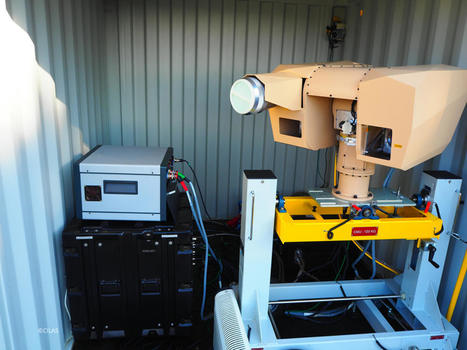













A small French company called CILAS has been testing its laser system, downing a number of different drones flying at more than 30 mph and up to 3,300 feet away. It marks the first time in Europe that drones were downed by laser. Lasers like this have an advantage when it comes to swatting pesky drones out of the sky: they will fry up and burn whatever they have hit. But the beam will go no further, causing no collateral damage. They are very precise, have a long range, and are extremely fast. Tanguy Mulliez, manager of the innovation and products department at CILAS, which specializes in lasers, tells Popular Science: “It’s like the beam of a flashlight. It stops at whatever object it hits first.” “the great advantage of a laser system is that it can also be used for other missions,” such as neutralizing explosives, destroying electronics, taking out light sensors, and jamming cameras by blinding them. The system is called the HELMA-P, which stands for High-energy Laser for Multiple Application – Power. “These demonstrations made a real impact on the military and they’ve come back with a lot of questions that we’re working on, both for France and other clients,” .