


Oculus CEO Brendan Iribe outlines why the company is wholly focused on virtual reality, and how its technological cousin won't factor in for a long time
Via siobhan-o-flynn, Mark E. Deschaine, PhD

 Your new post is loading...
 Scoop.it! Oculus CEO Brendan Iribe outlines why the company is wholly focused on virtual reality, and how its technological cousin won't factor in for a long time Via siobhan-o-flynn, Mark E. Deschaine, PhD
Richard Platt's insight:
Oculus CEO Brendan Iribe, who outlined the reasons for keeping the realities divergent. In short? Augmented reality isn't advanced enough yet to match what Oculus can do with immersive VR, and they don't expect it to be for a long time yet. "It is a different market because it's a different user experience," Iribe says. "You see the real world and [rendered models will] appear holographic for a long time, because matching the lighting of the real world through the glasses is incredibly difficult. You have an incredible perceptual system that can detect when things aren't quite right." While that's a problem Microsoft may have to address with its own upcoming AR project, Hololens, Iribe thinks the industry may see a half-way point hybridising VR and AR. 
Scoop.it!

The San Jose City Council approved a pilot program that allows the San Jose Police Department to use a drone.
Richard Platt's insight:
After much debate and discussion, San Jose City Council members voted on the implementation of a one-year police drone pilot program. "The drone needs to go up, it can save lives, it can make the officers more safe. It's not about surveilling the public, it's about giving us another tool that we can use on the street," Sgt. Paul Kelly from the San Jose Police Officers' Association said. San Jose police acquired the $7,000 drone as part of a federal grant last year, but it's been grounded ever since, pending approval from the city. - "It will not be used for surveillance, it does not have telephoto lenses, it does not have infrared lenses, it does not have any types of weapons or anything disruptive," Larry Ames from the San Jose Neighborhoods Commission leader who also say the drone won't be able to record any video and will also be prohibited from flying at night. Furthermore, the drone would only be used in specific circumstances, such as an active shooting scenario or dealing with an explosive device, but community groups have raised concerns. "The rules can be bendable, and it could very much become a slippery slope," Raj Jayadev from Silicon Valley Debug said. Jayadev says privacy and civil liberties are at stake. He explained, "The use of new technology is one experimental, it's the reason why drones have been challenged in cities and counties, and jurisdictions all across the country." The pilot program still needs approval from the Federal Aviation Administration. The earliest the drone could go up would likely be 2017.
Scoop.it!

A research team from Arizona State University has created a flexible and stretchable battery, which it hopes could power future smartwatches and wearables. The idea for the battery came from kirigami, similar to origami, but involves cutting as well as folding, according to Embedded Computer Design. The design means the batteries can stretch 150 percent…
Richard Platt's insight:
Not the 1st time that I've reported on this specific technology, but in an attempt to capture greater understanding of its value - The battery in the demo only has a capacity of 80 mAh, but the team said in it's Scientific Reports article, if it was scaled up to the size of the wristband, it could achieve about 700 mAh. and the density of the battery is similar to the lithium-ion batteries found in current smartwatches and phones. That could more than double the battery capacity of the original Samsung Gear 2, and more than triple the Apple Watch's. - Battery life is a constant problem in wearables, and some of the biggest names like NASA and Microsoft are trying to address it. Whether it's changing the way wearables use power, or how much power they have, this problem is hard to ignore. When this issue is solved, it's safe to say the wearable industry will quickly and completely change for the better.
Scoop.it!

A report by the Department of Homeland Security says the growing availability of drones in the U.S. increases the chances of one being used to carry out a terrorist attack or commit a crime. CBS News correspondent Jeff Pegues reports.
Richard Platt's insight:
Expect restrictions on drones moving forward
Scoop.it!

Nokia has taken a firm stride in VR territory with the introduction of Ozo, a VR camera designed for professional content makers, Via Timo Ilomäki
Richard Platt's insight:
There is more work to be done on this VR platform from Nokia, with the capture quality and playback issues noted, the success or failure of Ozo will be equally decided by whether or not the camera can find adoption among professional VR filmmakers (the real market it is shooting for).
Scoop.it!

From
angel

Browse 225 Virtual Reality startups, 1,044 Virtual Reality angel investors, and 52 startup jobs in Virtual Reality. Via Timo Ilomäki
Richard Platt's insight:
Of the 225 VR startups most were started in 2015, with an average $4M valuation. It is clear to say that Virtual Reality is going to be a big thing, now these companies just need to figure out what their Minimum Winning Game is, that is not a typo I definitely do not mean Minimum Viable Products.
Scoop.it!

The Oculus Rift virtual reality (VR) device was one of the biggest success stories of Kickstarter in recent years. Via Timo Ilomäki
Richard Platt's insight:
The phone’s is used to great effect – two halves of the screen are used that appear as a 3D image when viewing the display through the lenses. It’s amazing stuff but of course there are still some limitations – resolution and lag is good but it’s important to remember that all this is running off a smartphone that wasn’t designed for virtual reality. So right now, even though virtual reality as offered by the Gear VR is an impressive and extremely immersive experience, it’s still not really quite there yet – future devices like the Rift will no doubt improve upon the inherent design limitations and offer more powerful hardware. Games: Most people seem to agree that at least as far as consumers are concerned, games and apps are one of its most promising areas. Samsung already offers a decent selection of games and other ‘experiences’, and the choices on offer are growing steadily. While viewing the Gear VR user interface, there is a Home menu, a Library of existing titles and the store. Recent apps appear on the home screen, and all previous downloads appear in the Library. Moving around between the menus is also fairly intuitive – just move your head and just press on the touchpad. It works so well that you don’t actually need to remove the Note while using the device (as you’d expect).
Scoop.it!
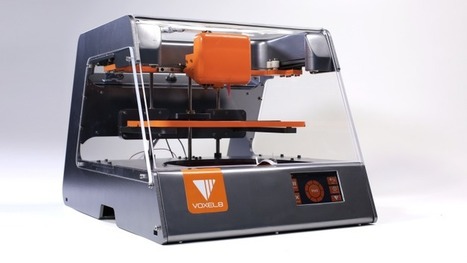
Voxel8, the startup behind the first multi-material 3D electronics printer, has raised $12 million to bring its printers to the desks of engineers and..
Richard Platt's insight:
The result of a decade of patented research by co-founder and Harvard Professor Jennifer Lewis, Voxel8 printers are able to print fully functional electronics by incorporating materials such as conductive inks, flexible silicones and high-strength epoxies. The majority of 3D printers today are built with FDM technology, co-founder Dan Oliver explains, which creates single-material plastic objects by pushing a solid plastic filament through heat. “Instead of printing a plastic part that’s useful as a prototype, or useful as jewelry or art, Voxel8 really enables the printing of functional parts that have electronics embedded in them,” says ARCH managing director Clint Bybee. “This is really the first time that this capability has been brought to market.” - This technology enables you as the entrepreneur to create low cost electronics and test that prototype for an IoT or wearable device, assuming of course you know what you're doing. Expect to see more in this space.
Scoop.it!

Winged Vertical Takeoff Drone Via TechinBiz
Richard Platt's insight:
New venture between Sony and ZMP to deploy drones, not a mass consumer product for the time being. Still in development but is definitely a direction that Sony is exploring for some kind of B2B applications, not yet defined.
Scoop.it!

Virtual reality has the potential to change the world, but you'll need to understand the radical new technology before you embrace it.
Richard Platt's insight:
One of the most important insights about this technology is how the user interfaces and interacts via many tools from a keypad, mouse, keyboard, game controller or via motion sensors (like Kinect). All you really need to know is this: Gamepads work, but hand-tracking is your best bet. That’s the only one you’re likely to buy anyway, at least for right now, so there’s no need to worry yourself with the Kinect or an omnidirectional treadmill - The latter two are either too kluge or expensive and don't work well enough, to repeat again, for the moment, that is until some smarty pants engineer figures out how to make the motion control approach work better/ more fluid and accurate in responding to what you want to do in the VR domain you find yourself in. Once that happens gaming, and VR gaming will go to whole new level, that will be a game worth playing.
Scoop.it!

Technology that can wirelessly power our devices on the go could change our world. Imagine never having to plug in your cell phone again, or technology that..
Richard Platt's insight:
Energous’ WattUp is a wireless charger for electronic devices. It can charge your cell phone and other battery-enabled devices on the go using something that is already abundantly flowing all around us – radio waves. - There are several companies approaching this same problem in different ways. Nikola Labs presented at TechCrunch Disrupt a couple years back with the same idea – turning radio frequency signals into battery power. Energous told us that their tech could be ready for the consumer market possibly this next year. - See video for how it works.
Scoop.it!

These gadgets will push VR onto the next level...... Links Prior VRhttps://www.yeitechnology.com/priovr Cyberith Virtualizer http://cyberith.com/ Stem System... Via Timo Ilomäki
Richard Platt's insight:
Interesting video on new VR products
Scoop.it!

A new program will set up five qualified teams with a grant and a pair of HoloLens development kits.
Richard Platt's insight:
Now that is what I call incentivizing the market - MSFT put out a request for proposals Monday seeking projects that will help “to better understand the role and possible applications for holographic computing in society.” Microsoft will pick “approximately 5 proposals and give the researchers behind them a grant of up to $100,000 and two HoloLens development kits. In particular, Microsoft said it’s interested in seeing its technology used for things like data visualization, new forms of collaboration, interactive art and new teaching tools. - Microsoft expects its funding will serve as a seed for a larger project. Researchers are encouraged to show a plan for acquiring additional funding from other sources to push the project forward. - this is the same strategy that Intel and Samsung as well as Quirky have used in their open innovation platforms for IoT devices and other innovations by outsiders.
|
Scoop.it!

A two-shipping container house in the woods features a composting toilet, solar power and lots of camo decor.
Richard Platt's insight:
The two-bedroom, one-bath house features a composting toilet to save water and makes use of both photovoltaic panels and solar hot water heaters to reduce energy demands. The home is partially buried into a hill in the back, which helps moderate interior temperatures while a wood-fired stove provides heating. Although we’d certainly have liked to see a skylight or two for more daylighting, the resident’s hunting trophies are at least adequately lit. Vintage and antique furniture pieces pair nicely with the camo decor, creating unified redneck aesthetic.
Scoop.it!

The secret to cheaper, more efficient solar power may lie in the unassuming wings of the butterfly.
Richard Platt's insight:
Butterflies’ ability to fly on cloudy days is limited by the energy the insects can get from the sun. But the Cabbage White butterfly is able to take off sooner than other types of butterflies even on cloudy days. Researchers discovered this is because the Cabbage White positions its wings in order to concentrate sunlight onto its thorax and speed up the “charging” process. - Taking a cue from this information, the researchers were able to create a new, lightweight material that can be positioned in a v-shape to concentrate sunlight on solar panels. And in so doing, they increased solar output by nearly 50%. TRIZ Biomimicry in engineering is not new. However, this truly multidisciplinary research shows pathways to develop low cost solar power that have not been done before,” said Professor Tapas Mallick, lead author of the research. - Crucially, by replicating this 'wing-like' structure, the power-to-weight ratio of the overall solar energy structure is increased 17-fold, making it vastly more efficient. The research by the team from both the Environment and Sustainability Institute (ESI) and the Centre for Ecology and Conservation, based at the University of Exeter's Penryn Campus in Cornwall, is published in the leading scientific journal, Scientific Reports.
Scoop.it!

Elon Musk revealed there have been more than 100,000 reservations (roughly worth $1 billion) of Tesla batteries, which have sold out through 2016. The batteries
Richard Platt's insight:
Demand for Tesla Energy’s revolutionary battery “has been crazy,” according to the company’s founder and CEO Elon Musk. Yesterday, in a second quarter earnings call, Musk revealed there have been more than 100,000 reservations (roughly worth $1 billion) of the rechargeable lithium-ion batteries, which have sold out through 2016. As Musk boasted during his call, “You can basically, in principle, shut down half of the world’s power plants if you had stationary storage.” The Tesla Powerwall offers homes and small businesses the means to use and store energy generated from residential solar panels or when utility rates are low. The larger Powerpack (for large businesses and utilities) allows battery owners to store excess energy on site, or as Forbes contributor Jeff McMahon explained in a report, the “batteries allow utilities to store energy when demand is low and use it when demand is high, without turning on more power plants.” With the battery, utilities no longer need to build power plants to meet peak demand, McMahon added. - “The fundamental economics of cost are always true, meaning there’s always a cost advantage of system-wide implementation of stationary storage because of high peak to trough of electricity usage,” Musk said. The energy stored by Tesla’s batteries doesn’t necessarily have to come from renewables, Musk pointed out. “It seems like people link this too much to renewable energy,” he said. “Of course we are great believers in renewable energy, but that is not the gating function for stationary storage.”
Scoop.it!

There is no VR revolution without an affordable way for people to experience presence so they can travel to other worlds. Via Timo Ilomäki
Richard Platt's insight:
(1) MAGIC LEAP: Investment: $542 million led by Google in October 2014, following $50 million in February 2014. (2) MATTERPORT: Investment: $30 million raised in June 2015, $56 million to date. (3) RAZER: Investment: $50m in 2011, “undisclosed figure” from Intel Capital. (4) JAUNT: Investment: $35m over three rounds, including a $27.5M series B in 2014. (5) IMPROBABLE: Investment: $20 million added in March 2015 by the same people that helped Oculus. (6) WEVR: Investment: An investor’s release in July 2015 indicates Vive-maker HTC is buying a 15 percent stake for $10 million, bringing the total to $18.6 million over 7 rounds. (7) HIGH FIDELITY: Investment: $17.5 million over four rounds, $11 million raised in series B in February. (8) NOD LABS: Investment: $16 million in total, $13.5 million series A in June. (9) ALTSPACEVR: Investment: $15.7 million over three rounds, $10.3 million series A in July. (10) VIRTUIX: Investment: $7.5 million over four rounds, with $1.1 million in Kickstarter backing. (11) NEXTVR: Investment: $5 million raised in July 2014. (12) RELOAD STUDIOS: Investment: $2 million raised in June 2015. (13) WORLDVIZ: Investment: “Multi-million” dollar investment from Intel in April 2015 as well as a $1 million seed round in 2014.
Scoop.it!

AltspaceVR, the virtual reality communication platform, has announced it’s to receive an additional $10M of funds to help accelerate the company’s product development. AltspaceVR Via Timo Ilomäki
Richard Platt's insight:
AltspaceVR is a social communications platform which allows networked VR participants to meet, share, present and talk in virtual reality. Founded in 2013, the company has ridden the wave of VR’s growth and now plans to expand its team as it sets its sights on delivering a final product.
Scoop.it!

Near the end of the opening keynote at Google's I/O developer conference, the company announced something called "Jump." And while it may have sounded like Jump was just a camera rig the company b... Via Timo Ilomäki
Richard Platt's insight:
VR content isn't impossible to come by these days, but it's still not what you would call easily accessible. It's also not very easy to create — even professional filmmakers are still using hacked-together rigs like what I saw being used at the NBA All-Star game earlier this year. And if Google really wants to push VR into places like the classroom, making it more accessible for consumers is key. Last year's release of Cardboard really helped establish an entry point for virtual reality, but until now it hasn't been surrounded by the kind of ecosystem that could really let it take off.
Scoop.it!

With some of their core businesses not doing well, you'd think Sony would want to hunker down and focus its resources on getting those in tip-top shape first. Instead, the Japanese tech giant is sp...
Richard Platt's insight:
More on the Sony / ZMP collaboration with Aerosense - interesting. "This isn't the first time Sony and ZMP worked together. Early this year, Sony injected a good deal of money into ZMP's coffers, buying a very small stake in the latter. The purpose? To help further ZMP's R&D into self-driving cars. Making its motto "Robot of Everything" (like the "Internet of Everything"), ZMP wants to use robotics to make lives not only easier but also fun. Presumably, drones with image capture capabilities are part of that vision. Like before, Sony and ZMP will bring complementary skills and expertise to Aerosense. While Sony itself has some robotics experience, ZMP's is more in depth and covers even automotive technology. This, however, will be ZMP's first foray into open skies. Sony, on the other hand, has years, even decades, of work on imaging technologies. But more than that, Sony will also bring some telecommunications network know-how, as Aerosense will also provide cloud-based data processing services. - Sony and ZMP plan to launch Aerosense's first services, whatever they may be, by early 2016. Although Sony's imaging tech is definitely useful for UAVs, diving head on into a dedicated drone business is probably a huge leap. Sony says that it does tie into its expansion beyond devices and into the Internet of Things market, where its venture with Aerosense will help sharpen its cloud services chops.
Scoop.it!

From
heavy
Some HMDs are out now, some are on pre-order, but all of these VR headsets promise to turn sci-fi dreams into reality. Via Timo Ilomäki
Richard Platt's insight:
VR has the promise to improve every aspect of technology, whether in the medical field, education, or in gaming, and with all of the emerging developers approaching this tech from their own perspective, virtual reality should be a fully realized technology by the end of 2016. Though these 10 headsets’ availability vary from out now to pre-order forthcoming, they have proven through tech demos and press releases alike that they are indeed the HMDs to watch for. From big hitters like Oculus Rift, to VR with a cause like Razer OSVR, the best of the best are about to go big.
Scoop.it!

The drone industry is celebrating what some are calling its "Kitty Hawk moment." CBS News correspondent Chip Reid reports on one of the first federally approved health care-related deliveries by drone.
Richard Platt's insight:
Awesome use case validation of the application and use of drones, addressing a real problem. Real time delivery of important / vital medicines to the point of use.
Scoop.it!

“In five years, we may all be laughing at our "low" resolution QuadHD smartphone displays.Samsung is developing an 11K "super-resolution" display with an absolutely insane pixel density of 2,250 ppi (pixels per inch), according to ET News.” Via Jesús Hernández
Richard Platt's insight:
Samsung is developing an 11K "super-resolution" display with an absolutely insane pixel density of 2,250 ppi (pixels per inch), Based on a 16:9 aspect ratio, an 11K display with that pixel density would measure 5.74 inches diagonal, with a resolution of 11,264 х 6,336. The screen will also reportedly display content in 3D. "Because 11K is able to show screen colors in detail, it is able to show 3D-effect," the report says, which seems to imply the screen will be able to produce 3D images that won't require special glasses. - Development reportedly began last month on June 1. Samsung Display won't be working on development of the 11K display alone — it's collaborating with the South Korean government, which has invested $26.5 million in the project, and 13 other companies to produce the display within five years.
Scoop.it!

Neymar Jr. is a well-oiled marketing machine. Not only is the Brazilian footballer a Nike brand icon, but you can also find him on the cover of video games like...
Richard Platt's insight:
The Nike virtual reality experience, introduced this week, lets people step into none other than Neymar's shoes. You can feel what it's like to have defenders flying toward your feet, dribble the ball and, of course, score a goal -- all things the Brazil and Barcelona player is familiar with. To get the full effect in VR, you'll need to have a Google Cardboard headset, though the video can also be enjoyed using YouTube's 360-degree feature. Because traditional commercials simply aren't enough anymore, the sportswear giant is trying something different to promote its Hypervenom Phantom II soccer boots: VR.
Scoop.it!
Richard Platt's insight:
The project involves the Azura prototype, built by Northwest Energy Innovations. Azura is a 45 ton machine that moves with the swells of the waves capturing their complex motion in 360 degrees, making it more efficient than other wave generators that only capture a particular movement in the waves (like up and down, or side to side). Azura was deployed last month, and will run for a full year, monitored by many different research groups, including the University of Hawaii, who independently verified that the generators were working and supplying power to the grid. If all goes well, an even larger version of the device will go into the ocean in 2017. Though this is the first, there are a lot more wave energy projects in the works. The Department of Energy (DOE) notes that over 50 percent of the population in the United States lives within 50 miles of the coast, making waves (and their energy) an easily accessible renewable energy option.
|







Effective VR means constructing a "new" environmental experience independent of "reality." (Truly we need better words to differentiate these things). AR overlays reality and reality isn't controllable so it will continually be a noncooperative participant in the creation of presence and immersive experience. Successful AR installations needs a shift in conceptualization of what it can do and the purpose of juxtaposing information over reality. Is it integrative or does it provide a portal for experience? Is immersion really the goal? #mediapsych
He says. "It won't show you video [via external cameras] because that won't be comfortable, but it'll scan in local space."
It seems to me like some techs already starts to emerge allowing just that (http://www.ximmerse.com/#!stero-camera/c1k4c) but I guess he knows what is talking about right :)
"You see the real world and [rendered models will] appear holographic for a long time, because matching the lighting of the real world through the glasses is incredibly difficult. You have an incredible perceptual system that can detect when things aren't quite right."