HANDJET® EBS-260 - http://handjet.com - film presents the new mobile printer (reference film by the manufacturer). The first printer of this type in th
The patent, filed under Apple's acquisition Metaio, refers to technology in which points of interest viewed through a smartphone can be enhanced with AR. The technology could have application on say, guided tours, recognizing buildings and adding in information to further inform users. German AR-specialist Metaio was acquired by Apple in 2015, and has been linked to the Silicon Valley giant's upcoming release of ARKit, a set of tools based on existing hardware designed to help app builders easily introduce AR into their work. Apple CEO Tim Cook is famously enthusiastic about AR, which he described as a "core technology" in an interview with the Independent in February 2017. "I regard it as a big idea like the smartphone," he added.
Now with the Model 3, which starts at $35,000, Tesla is releasing a vehicle that could truly move the needle on electric car adoption. The sedan is a critical step in CEO Elon Musk's vision of accelerating the world's transition to sustainable energy.
"This is a great day for Tesla," Musk told reporters Friday. "It was never our goal just to make expensive cars. We wanted to make cars everyone could buy."
A team of engineers at MIT is working on a smaller computer chip that can be installed in a drone the size of a bottle cap, yet can take images and navigate the device with a minimum of power.
Using simulations from recorded drone data as well as motion-control flights, the team was able to produce a chip that conserves power by eliminating outside memory storage and processing data in such a way that it can erase any stored information the instant it's no longer needed. The result is a chip that could process 20 images a minute as it orients the drone in space, while consuming only 2 watts of power and two megabytes of memory. The MIT team is currently working on improved algorithms and an application-specific integrated circuit that could one day get power consumption down to a matter of hundreds of milliwatts. Ultimately, the team hopes the technology will lead to Karaman says is "the smallest intelligent drone that can fly on its own." Such a chip could one day be used to make insect-sized drones for search-and-rescue missions as well as other applications.
Self-driving police vehicles are set to hit Dubai -- but don't expect to catch a ride in one. This autonomous police car is tiny.
Continuing a Smart Dubai initiative, which saw Dubai Police introduce a humanoid robot officer last month, the force has signed an agreement with Singaporean company OTSAW Digital to introduce so-called "autonomous outdoor security robot" O-R3 by the end of 2017. OTSAW touts the O-R3 as the world's first ground-aerial outdoor security robot.
As I found while playing with Blocks at Google’s Mountain View campus last week, the app’s barrier to entry is delightfully low. Like Tilt Brush, Google’s fantastic 3D VR painting app, Blocks’ user interface relies on the motion-sensing controllers of either an HTC Vive or Oculus Rift. (Mobile users, you’re out of luck for now.) Atop the left controller, Google overlays a palette of tools for creating and manipulating a small handful of simple 3D shapes (think spheres, cubes, and cones), which one selects from and implements with the right controller. After a brief tutorial, a VR virgin can confidently design a decent snowman in about 90 seconds: Select a few spheres from your palette, arrange and color them accordingly, and use the remaining time to add eyes (some small, black cubes), a mouth (more cubes) and a nose (orange cone). Voila: Frosty.
With so many drones filling the sky, the federal government will now require every drone to be registered. Drone owners will have to give their name, email address and mailing address, and pay a $5 fee. Kris Van Cleave reports.
Apple Inc. supplier LG Display Co. will spend more than 10 trillion won ($8.7 billion) on building a new plant and expanding production of a newer type of display that can be used to cut power use, make thinner devices and show brighter colors. Shares rose.
More on the move by Apple to go to OLED technology, and how LG Display is gearing up to support, making quite the serious investment. Given this commitment by LG we can likely expect to see more of these types of advanced displays in the future. The real benefit thereof on the other hand of OLED tech on the small screen seems like a bit of a stretch though (at least to me), but if people can be convinced that it is a better technology that they just must have, then it is likely to take off.
As previously pointed out in our analysis of Samsung's technology development roadmap for display technology (based on TRIZ methods). Apple plans to switch to OLED displays for iPhones starting in 2018, according to Japanese website Nikkei. The report claims Apple has notified its suppliers about its future plans, with LG Display already planning capacity upgrades for high-volume OLED display production. LG Display and Samsung Electronics will likely share a large portion of the OLED panel production for future iPhones, according to the report. Apple's shift to OLED displays could have "major implications" for Apple's current LCD display suppliers Sharp and Japan Display, the latter of which relies on Apple for 30% of its business. Samsung's popular Galaxy-branded smartphones are equipped with AMOLED displays, as is the Apple Watch, but iPhones have always had LCD displays since the original model launched over eight years ago.OLED displays can provide sharper images and brighter colors compared to LCD displays, but generally have a shorter lifespan and higher manufacturing costs. Apple has reportedly been "consulting with display makers" about OLED technology to eliminate potential drawbacks.KGI Securities analyst Ming-Chi Kuo believes that Apple is unlikely to adopt AMOLED displays for iPhones for at least three years, claiming that its main supplier Foxconn is preparing to invest in advanced TFT-LCD production lines in China for mass production in 2018.
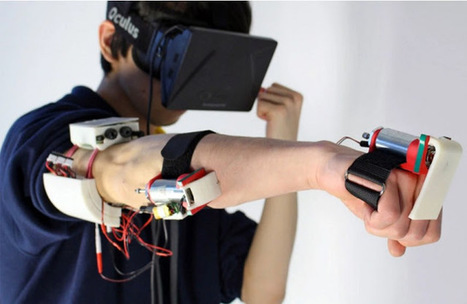
The folks at German's Hasso Plattner Institute Human-Computer Interaction (HCI) labs have created working models of a device known as Impacto that allows you and your opponent to feel the impact of punches in your faces and other things, just the way it is in real life, when gaming in virtual reality. Impacto is embedded in a band and uses HCI's special software with a virtual reality headset to produce the feeling. The Impactor device can be worn on the different parts of the body such as on your leg or arm so you could carryout maneuvers like kicking. According to the team, Impacto is a device designed to render the haptic sensation of hitting or being hit in virtual reality. The key idea that allows the small and light impacto device to simulate a strong hit is that it decomposes the stimulus: it renders the tactile aspect of being hit by tapping the skin using a solenoid; it adds impact to the hit by thrusting the user's arm backwards using electrical muscle stimulation.
Once a place to professionally network, LinkedIn has evolved into a vehicle for marketing execs to weigh in on the hottest industry topics du jour in blog posts, self-promote and even dish out advice on entrepreneurship in their status updates. "LinkedIn has become far more cluttered with these marketing gurus recently than it used to be," said Eric Schiffer, CEO of reputation management firm Reputation Management Consultants. "The presupposition is that it makes you appear more credible in business."
While the efficiency on construction sites has been stagnant in the last 20 to 30 years, manufacturing efficiency has increased significantly due to robotics and technology. Construction Robotics created SAM to solve that problem. SAM requires a human partner to smooth over the works, but the heavy lifting is left to the bot. The robot can lay bricks at least three times faster than humans – and it never gets tired or makes mistakes. VICE News went to a construction site in Virginia to see SAM at work.
Lockheed Martin Corp (LMT.N) was awarded a $3.7 billion interim payment for fifty F-35 jet fighters that are earmarked for non-U.S. customers, the Pentagon said on Friday.
Lockheed Martin Corp was awarded a $3.7 billion interim payment for fifty F-35 jet fighters that are earmarked for non-U.S. customers, the Pentagon said on Friday. Lockheed was (already) awarded an interim payment on 7 July of $5.6 billion to help finance construction of the 11th batch of 141 F-35 jets for the U.S. military. The F-35 Program office said the Department of Defense would continue to negotiate the 11th low rate initial production contract with Lockheed Martin and expected an agreement by the end of 2017. - In February, the Pentagon agreed to a deal for the tenth batch of the fighter aircraft and agreed to pay below $95 million per F-35A model jet for the first time, compared with $102 million in the previous purchase, which was the lowest price up until that point. The Pentagon expects to buy 2,457 jets.
In 1995, Charlie Munger gave a speech about how the human mind tricks itself into making poor decisions. This is an abridged and animated version of tha
This is a very interesting, instructive and useful video, definitely recommended viewing for decision makers in companies - In 1995, Charlie Munger gave a speech about how the human mind tricks itself into making poor decisions. This is an abridged and animated version of that speech.
From retail to e-tail, is Cyber Monday the new Black Friday? Indoor malls have been in decline ever since consumers discovered online shopping, and man
While seemingly unrelated, but isn't we now see what and why the mall in the US has been in decline, it is the rise of the experience based economy. Interesting
VR is a very important type of techology. It has failed for decades and only now does it have a chance of taking off. If consumers experience mediocre virtual reality experiences like they do with the Google Cardboard or frustrating experiences with the Gear VR, they may not give the technology a chance when it is perfected. Hopefully, the upcoming Oculus Rift can correct at least some of the ills of the Gear VR and bring virtual reality to the mainstream. More development work needed for VR to become something we want or even need.
Read the full article: http://wp.me/p3aqRt-9Zh At 9.3 pounds, Nokia's Ozo VR camera is impressively compact. Not only can the device be handheld if need be, ...
The Gear VR web browser beta is now available on the Oculus Store and includes support for voice commands and has an on-screen keyboard. It also supports both 360-degree and 3D video streaming, and any HTML5 video. The browser has a “Gaze Mode” that will let you choose menus by simply looking at them. No tapping on the touchpad or controller necessary. You can also import and manage your bookmarks, the company says. It’s a really important step for the consumerization of virtual reality, as most people head to a web browser for entertainment and information before they ever think about hitting up Netflix or any app store. Or even the TV. The questions that I get the most about VR is “can I do this?” or “can I do that?” The most mentioned this or that? Internet browsing. The voice search, provided by Google, is pretty handy for searching for things. There are a few sites to get started with in your default bookmarks, Yahoo, Google, Facebook and YouTube with a tab for more recommended sites once you start browsing a bunch. The “Gaze Mode” is actually quite handy, and if you look at a specific item for a second or so, it’ll “click” the link for you automatically. This however can get annoying if you’re trying to read something with a bunch of hyperlinks…you might kick off a page you didn’t want to.The browsing window is a little small and I’m not sure if you’re able to resize it. Sure, there’s a “zoom” feature, but I’d rather the window take up more real estate in my field of vision. The YouTube support is an outstanding addition to the Gear VR experience, especially for 360 degree videos. So there you have it, even though this probably should have launched with the Gear VR. Either way, Samsung isn’t having any problems selling them.
While it’s no surprise that the presence of virtual reality is weaving its way into many sectors of tech, we’re still left waiting to find out how it’ll unfold when it comes to Apple. Google, Samsung, Sony, and Facebook have all shared their VR plans, but Apple is remaining silent. Well, mostly silent anyway. Yesterday, Apple confirmed…
Google, Samsung, Sony, and Facebook have all shared their VR plans, but Apple is remaining silent. Well, mostly silent anyway. Yesterday, Apple confirmed to TechCrunch that it had purchased Swiss startup Faceshift, which develops motion-capture technology. Prior to Apple's acquisition, Faceshift focused on producing motion-capture solutions primarily for gaming and film applications. Most notably, the startup has done work for little film called Star Wars. Faceshift’s tech integrated with cameras capable of capturing and deciphering depth in a space, then used the visual information picked up by the camera to influence the appearances, actions and facial expressions of digital objects like avatars and animated characters. So, what does Apple want with Faceshift? In typical Apple fashion, it gave a stock non-answer when asked about how it plans to use Faceshift.For now, it’s anyone’s guess how Faceshift might factor into Apple’s plans for the future. But it almost certainly didn’t acquire Faceshift without some seriously sophisticated plans for motion capture and facial mapping technology. And, like always, we’ll be waiting for Apple to read us in.
Remote-controlled aircraft larger than 9 ounces would have to be registered with the Federal Aviation Administration under recommendations described Monday by the leaders of a drone task force.
Remote-controlled aircraft larger than 9 ounces — the kind owned by hundreds of thousands of hobbyists — would have to be registered with the Federal Aviation Administration under recommendations described Monday by the leaders of a drone task force. If the FAA adopts the recommendations, drone owners would have to register their names and physical addresses, but would not have to pay a fee. Each aircraft would be marked with a unique number, though not necessarily the serial number, to identify the owner. The registry marks the latest balancing act for federal regulators who are trying to keep the skies safe as drones increasingly share the airspace with passenger planes. Commercial drones, for purposes like aerial photography or utility inspections, are already registered when operators get special permission to fly from FAA. The proposed registry would help authorities track down hobbyists if a drone collides with another aircraft, flies too high or encroaches on an airport. But Roger Duffell, of Loganville, Ga., said as a licensed pilot who also registered a commercial drone, he supported registration. He also urged that drones be programmed to return home automatically if they fly out of range of their remote pilot. “The trick is going to be getting Pandora back in the box, by stopping the future sale or importation of non-compliant” drones, he said. “As a pilot, I have a vested interest in keeping the (national airspace) safe!” Dave Vos, co-chairman of the task force as leader of Project Wing at Google X, which is developing delivery drones, said the task force didn't make any recommendations about "geofencing," or software that would restrict where drones fly.
To get content containing either thought or leadership enter:
To get content containing both thought and leadership enter:
To get content containing the expression thought leadership enter:
You can enter several keywords and you can refine them whenever you want. Our suggestion engine uses more signals but entering a few keywords here will rapidly give you great content to curate.


 Your new post is loading...


 Scoop.it!













'Brikawood' is shaped into boards and spacers that interlock to make building a house easy and fast.