


If the Bauhaus may be said to have been the ultimate decantation chamber for early 20th-century modernity, it didn’t just emerge from Gropius’s head after World War I as a full-fledged idea.

 Your new post is loading...
 Scoop.it! If the Bauhaus may be said to have been the ultimate decantation chamber for early 20th-century modernity, it didn’t just emerge from Gropius’s head after World War I as a full-fledged idea. 
Scoop.it!

Architects: Kengo Kuma & Associates
Scoop.it!

Architects: Kengo Kuma & Associates
Scoop.it!

Top: Educational Building In Mozambique / Bergen School of Architecture Students. Middle: School Library Gando / Kere Architecture. Bottom: How many times in the last year have you heard 3d printing mentioned? What about double-skinned curtain walls or “smart” buildings? High-tech materials almost always seem to dominate the conversation – at least in architectural circles. But using the latest invention in material technology usually does not make a building “innovative.” More often than not, it just makes it expensive and flashy. Low-tech materials like lumber, stone and brick, on the other hand, are often overlooked, even though the use of local and locally produced materials offers the lowest possible carbon footprint. And while these common materials may seem boring, with a bit of imagination and technical skill, an architect can transform these materials into something fresh. With that in mind, check out three truly innovative projects which use low-tech materials in different and exciting ways.
Scoop.it!

the issam fares institute for public policy and international affairs, at the american university of beirut, is currently under construction.
Scoop.it!
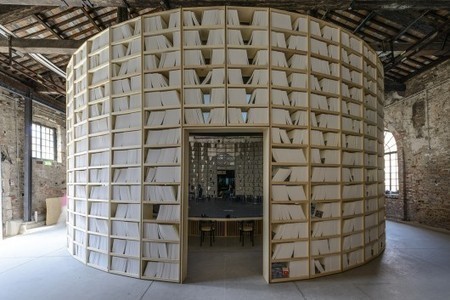
Inside France’s “Modernity, Promise or Menace?” – Special Mention Winner at the Venice Biennale 2014
© Luc Boegly / Pavillon français pour l'Institut français et le Ministère de la Culture et de la Communication This year's French Pavilion stood out
Scoop.it!

Developing countries have the highest demand for steel-reinforced concrete, but often do not have the means to produce the steel to meet that demand. Rather than put themselves at the mercy of a global market dominated by developed countries, Singapore’s Future Cities Laboratory suggests an alternative to this manufactured rarity: bamboo. Abundant, sustainable, and extremely resilient, bamboo has potential in the future to become an ideal replacement in places where steel cannot easily be produced.
Scoop.it!

A team lead by Arup has developed a method of designing and 3D Printing steel joints which will significantly reduce the time and cost needed to make complex nodes in tensile structures. Their research is being touted as “a whole new direction for the use of additive manufacturing” which provides a way of taking 3D printing “firmly into the realm of real-world, hard hat construction.” Aside from creating more elegant components which express the forces within each individual joint - as you can see in the above photo – the innovation could potentially reduce costs, cut waste and slash the carbon footprint of the construction sector.
Scoop.it!

Rem Koolhaas's excellent Biennale sets new sensibilities against old, and maps out Italy's history of grandeur and brutality, says Rowan Moore
association concert urbain's insight:
via @fil_urbain Rowan Moore has written the most insightful, brilliant review/analysis of Rem Koolhaas Arch biennale in venice
Scoop.it!

An expert on the Middle Eastern construction industry has said that architects working inQatar are worried about the future of their projects, following the allegations sparked by a Sunday Times report last week of corruption during the country’s 2022 World Cup bid. With many people calling for Qatar to be stripped of the event or for the bidding process to be re-run, there is a chance that Qatar might have to pull the plug on many of its major projects.
Scoop.it!

This shell-like concrete structure with triangular slices is an auditorium designed by Valentiny HVP Architects for a music festival in Trancoso, Brazil.
Scoop.it!

The awards ceremony for the 14th International Architecture Exhibition have just wrapped and the results are in! Rem Koolhaas, the director of the Biennale, Paolo Baratta, president of the Biennale, and the jury presented the awards for Lifetime Achievement and International Participations. The jury recognized that the Biennale was a tremendous opportunity to produce and share knowledge about modernity — especially praising its role in uncovering and dissecting new areas of influence in the architecture world. The Golden Lion for Best National Participation went to Korea for “Crow’s Eye View: The Korean Peninsula” The jury cited Korea’s “extraordinary achievement of presenting a new and rich body of knowledge of arch and urbanism in a highly charged political situation.” Chile received the Silver Lion for a National Participation for “Monolith Controversies”. The jury said, “Focusing on one essential element of modern architecture – a prefabricated concrete wall- it critically highlights the role of elements of architecture in different ideological and political contexts.” The Silver Lion for best research project in the Monditalia section went to Andrés Jaque/Office for Political Innovation for “Sales Oddity. Milano 2 and the Politics of Direct-to-home TV Urbanism.” The three Special Mentions to National Participations went to Canada – Arctic Adaptations: Nunavut at 15 France – Modernity: promise or menace? Russia – Fair Enough: Russia’s Past Our Present The jury also assigned three Special Mentions to research projects in the Monditaliasection
Scoop.it!

Logements de fonction EDF à Ivry-sur-Seine (94), 2014 - Atelier de Montrouge. Classés à l'Inventaire supplémentaire des monuments historiques, ces immeubles inoccupés depuis 15 ans seront rénovés dans le cadre du programme d'urbanisme Ivry-Confluences.
association concert urbain's insight:
|
Scoop.it!

Épingles sur le thème Brazilian architecture sélectionnées par le membre Dezeen magazine
Scoop.it!

Architects: Kengo Kuma & Associates
Scoop.it!

rchitects: Bjarne Mastenbroek and Dick Van Gameren
Scoop.it!

The skyline of Chicago can be seen as the timeline of skyscraper history, which started in 1885 with the Home Insurance Building. The new Aqua Tower by Studio Gang is a highlight along this timeline, not just because of its height (250m tall) but also because of its sculptural condition. The design was inspired by the striated limestone outcroppings common in the Great Lakes area (see photo below). But this sinuous shape is not just a mere formal gesture, but it is also a strategy to extend the views and maximize solar shading. And by looking at the plans we see a rational structure, true to the Mies legacy in the city. I discovered Studio Gang in a lecture by Jeanne Gang at the 2009 AIA Convention, and I was impressed by her work. You can see our previous coverage of Studio Gang projects in ArchDaily, such as the Bengt Sjostrom Starlight Theatre. Location: 200 North Columbus Drive, Chicago, IL, USA Products in this project
Scoop.it!

The project, by the architect Bruno Fioretti Marquez, is featured as a Bauhaus reinterpretation not reconstructed in Dessau after WW2.
Scoop.it!

In Radical Cities, Justin McGuirk travels across Latin America in search of the people and ideas shaping the way cities are evolving: “after decades of social and political failure, a new generation has revitalised architecture and urban design in order to address persistent poverty and inequality. Together, these activists, pragmatists and social idealists are performing bold experiments that the rest of the world may learn from.” The following is an excerpt from Radical Cities on PREVI – the great, but all-but-forgotten experimental housing project in Lima that counted James Stirling and Aldo van Eyck among its contributors.
Scoop.it!
Bahrain Pavilion. Image © Andrea Avezzù, Courtesy of la Biennale di Venezia Your virtual tour of the Venice Biennale has arrived! Check out each of
Scoop.it!

What once seemed like a fad in landscape architecture has become a new facade standard: the vertical garden. Whether to add greenery to an area otherwise bound by lack of space or to create a stunning living work of art for a hotel or museum, these plant-covered walls are as impressive as they are eco-friendly. Join us on a sublime tour of some of the world's most enthralling and sprawling vines: House In Travessa Do Patrocínio by Luís Rebelo de Andrade, Tiago Rebelo de Andrade, and Manuel Cachão Tojal Another example of creating room for a green space in an urban area, this green wall in Lisbon was built to add a garden where there would not have been room for traditional planting. Jardín Vertical Hotel Santo Domingo by Lumiartecnia ...
Scoop.it!

Courtesy of http://blog.newx.com/ The International Union of Architects (UIA) has announced that it will award its Gold Medal to the Chinese born
Scoop.it!

Tadao Ando has added an auditorium with a curving concrete interior to François Pinault's Palazzo Grassi contemporary arts centre in Venice, Italy.
Scoop.it!

Bernardes + Jacobsen Arquitetura groups buildings under an undulating roof to create the Museu de Arte do Rio art museum and school in Rio.
Scoop.it!

The city’s inhabitants are aware of their real needs, driven by the inevitable, they transform their city under a new order: The Moral Modulor. He embodies the human potential to understand urgency and inscribe it in space. He adds, to the order established by human dimensions, the moral dimension that necessity recovers. Urgency provides for the individual a foundational alibi. Every sexual or physiological impulse, every birth and even death, will provoke the appearance of new walls, columns, stairways, new windows or plumbing and electrical systems.
|





History of western-european architecture blog.
worth to be seen!