
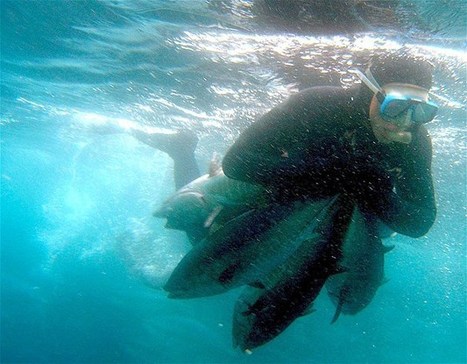
Photos of the mass production of the Earth's natural resources


|
Scooped by
Adrian Bahan (MNPS)
onto Unit V Agricultural Land Usage February 2, 2015 3:08 PM
|
 Scoop.it!
Photos of the mass production of the Earth's natural resources

 Your new post is loading...
Scoop.it!

The future of the nations will depend on the manner of how they feed themselves, wrote the French epicurean Jean Anthelme Brillat-Savarin in 1826. Almost 200 years later, how nations feed themselves has gotten a lot more complicated. That’s particularly true in the US, where food insecurity coexists with an obesity crisis, where fast food is everywhere and farmer’s markets are spreading, where foodies have never had more power and McDonald’s has never had more locations, and where the possibility of a barbecue-based civil war is always near. So here are 40 maps, charts, and graphs that show where our food comes from and how we eat it, with some drinking thrown in for good measure.
Scoop.it!

USDA National Agricultural Statistics Service Information. NASS publications cover a wide range of subjects, from traditional crops, such as corn and wheat, to specialties, such as mushrooms and flowers; from calves born to hogs slaughtered; from agricultural prices to land in farms. The agency has the distinction of being known as The Fact Finders of U.S. Agriculture due to the abundance of information we produce. The National Agricultural Statistics Service's mission is to serve the United States, its agriculture, and its rural communities by providing meaningful, accurate, and objective statistical information and services.
Scoop.it!
"In this Feed the Future video, narrator Matt Damon discusses the importance of increasing food production around the world and notes the importance of equipping women with the right tools, training, and technology to see as much as a 30 percent increase in food production. To feed our growing population we need to increase food production by 70 percent before 2050. Women make up the majority of the agricultural workforce in many areas of the world."

Lauren Quincy's curator insight,
March 19, 2015 4:50 PM
Unit 5: Agriculture, Food Production and Rural Land Use
This video is about how women make up the majority of the agricultural workforce and that giving them access to land, water, markets, and technology could increase food production by 30%. This in return would help boost the economy. Places such as Kenya have given women the same resources as men and have seen a 22% increase in crop production. In Brazil, programs targeting women in agriculture have helped cut the population in extreme poverty by half and malnutrition by 73%. This video encourages people around the world to help give women the resources they need in order to increase the food production and economy.
This relates to unit 5 because it deals with agriculture and particularly women's roles in agriculture. This video explains how increased resources can help end world hunger. Women are not given as much opportunity as men and this video expresses need to invest in women's rights. 
mary jane james's curator insight,
January 12, 2017 8:11 PM
This article relates to my topics development and agriculture by showing how important it is that how equipping women with the right tool can make so much more food and how other countries should accept women and give them rights. Just like the video states women make up a majority of the world and countries need to take that advantage. Just like the video states women make up a majority of the world and countries need to take that advantage. Sooner or later the population will take over how much food we make, even with new technology we still might not make it fast enough or enough to support life on earth. The video states that we need to increase food production to 70% by 2050
In my opinion, this video really does touch base with how women are treated today in modern society and how they can become a really big impact on our food production if only they had the access to the same resources as men do. Then maybe we might have a chance to reach the goal what we need to in 2050.
Scoop.it!

Once obscure, tilapia is now Americans’ favorite farmed fish. But critics point to environmental and nutritional drawbacks.
Scoop.it!

Chef Dan Barber squares off with a dilemma facing many chefs today: how to keep fish on the menu. With impeccable research and deadpan humor, he chronicles his pursuit of a sustainable fish he could love, and the foodie's honeymoon he's enjoyed since discovering an outrageously delicious fish raised using a revolutionary farming method in Spain.
Scoop.it!

From
rt

Lawmakers in Vermont are looking to regulate food labels so customers can know which products are made from genetically modified crops, but agricultural giants Monsanto say they will sue if the state follows through.
Scoop.it!
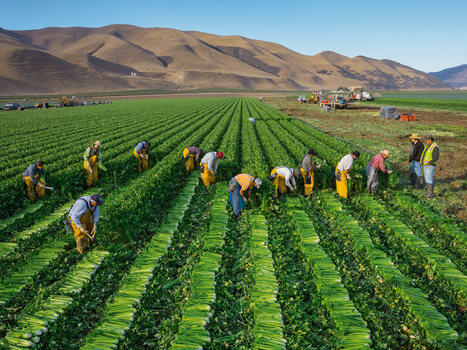
When we think about threats to the environment, we tend to picture cars and smokestacks, not dinner. But the truth is, our need for food poses one of the biggest dangers to the planet.
Scoop.it!

"Feedlots, a new series of images crafted by British artist Mishka Henner, uses publicly available satellite imagery to show the origins of mass-produced meat products."
Tags: Food, agriculture, agribusiness, unit 5 agriculture.

Sid McIntyre-DeLaMelena's curator insight,
May 29, 2014 11:35 AM
British artist Mishka Henner took photographs and enhanced the colors of feedlots to reveal the agribusiness of meat production. Photographs of feedlots are considered illegal and the legal repercussions of Mishka Henner are not clear at the moment, but the photographs are shocking and reveal again how little Americans know about their food production. Americans have changed the places and utilized them to build agribusiness empires and have introduced new problems to the landscape of feedlot and farming towns.

Shane C Cook's curator insight,
May 27, 2015 4:46 AM
This article makes me sickened. With previous knowledge of factory farms I know of the horrors that go on but this takes the cake. These pictures shown in the article depict the chemical and waste spill off which I am absolutely sure this is NOT good for the environment. 
BrianCaldwell7's curator insight,
March 16, 2016 3:56 PM
Beautiful imagery at one scale tells an unsavory story at another.
Scoop.it!

The Nature Conservancy facilitated one of the largest debt-for-nature swaps in history ¿ and scored a significant victory for tropical forest conservation in Guatemala in the process.
Adrian Bahan (MNPS)'s insight:
Great case study for you to utilize in Unit V geo-cards!
Scoop.it!

Medieval villages risked a "tragedy of the commons" when farmers — individually pursuing their economic self-interest — depleted a shared natural resource by collectively overgrazing it. Seán Cleary, founder of the FutureWorld Foundation, explains that in the hyperconnected world of today we risk a tragedy of the "global commons." Via jean lievens
Scoop.it!

Through his Vanishing Cultures Project photographer Taylor Weidman documents threatened ways of life. About his work in Mongolia, he states: "Mongolian pastoral herders make up one of the world's largest remaining nomadic cultures. For millennia they have lived on the steppes, grazing their livestock on the lush grasslands. But today, their traditional way of life is at risk on multiple fronts. Alongside a rapidly changing economic landscape, climate change and desertification are also threatening nomadic life, killing both herds and grazing land."
Adrian Bahan (MNPS)'s insight:
What factors are threatening pastoral herders way of life? Why?

Cam E's curator insight,
April 8, 2014 11:45 AM
Time for more pictures, my favorite part of scooping. Mongolia is almost entirely forgotten in US education, to the point where many of the people I know aren't even sure if there's a government at all. My favorite part of these pictures comes from the fusion of technology and tradition though. We see traditional housing and boys carrying water to their homes, and then a flat screen television in the makeshift house. Motorcycles are used to herd animals, and solar polar is used to power cell phones for the nomads. What I think is important here among other things is the idea that humanity has potentially reached a point where we cannot go backwards tech-wise. The dark ages in Europe saw knowledge being lost, and there are claims that humanity will wipe out its own tech in a great war, but now that we have the knowledge and ability to use solar panels and automobiles, I don't believe we'll ever lose them as a species. 
Matt Danielson's curator insight,
October 30, 2018 11:06 PM
the pictures really tell the story in this a lot. The Mongol nomad has its history as a proud people who's power was so great at one time (under Genghis Khan and the Khans that followed) that they conquered much of the known world. This nomadic lifestyle that gave them the advantage in conquest, is now at a disadvantage in the modern world. Forcing thes people to adupt more industrial lifestyles.
Scoop.it!

Did you know that on average, orange juice travels over 1,200 miles to reach your table? Check out just how much goes into these incredible journeys. Via Matthew Wahl

Courtney Burns's curator insight,
November 7, 2013 9:58 AM
I have eaten McDonalds fries and bunch of times and never thought about what 'golden standard" actually meant. McDonalds like it says in the article is one of the top potoate buyers in the world. I'm sure most other fast food places aren' too far behind. However since McDonalds is one of the top buyers of potatoes farmers much make sure they produce enough of the potatoes that McDonalds sells. However it doesn't stop there. Not only do farmers have to produce enough potatoes, but they have to produce quality potatoes. All of McDonalds fries look exactly the same. You never really get a french fry that looks extremely different. That is done on purpose. McDonalds only purchases potatoes that meet their "golden standard". This makes you think how much goes to watste. Farmers are probably discarding "bad" potatoes all the time that don't meet the "golden standard". Does it really matter what the fries look like, if they taste the same? There are people in the world who are hungry, yet we waste food like this all the time. I really don't think it is that big of a deal if not every french fry looks exactly the same. We should make an attempt at trying to limit our food waste. 
Kenny Dominguez's curator insight,
November 29, 2013 5:42 PM
Fries are the essential food that everyone enjoys in the world. But it is a good thing because if a potato has a growth defect probably that would affect someone and that is a law suit waiting to happen. In the United States people love suing for anything that they could probably win and receive money. The fries are delicious but they are so fattening that could really effect people if they have any issues with there health.
BrianCaldwell7's curator insight,
March 16, 2016 3:59 PM
The packaging on the McDonald's fry box states, "Why are our fries the gold standard? Because only a select number of potato varieties make the cut. I'm lovin' it®" This is a message is primarily aimed at millions of individual consumers. As geographers who analyze systems, we can look at this message for meaning beyond taste and quality control in how it affect both urban and rural places. Given that McDonald's is the United States' largest purchaser of potatoes, what are the economic and agricultural implications for their fry selection on the market(s)? How does this impact farmers, consumers, competitors and other groups? |
Scoop.it!

Driving through the farmlands of Iowa looking for fresh food to eat is a lot like sailing through the ocean looking for fresh water to drink. In th
Scoop.it!
The process of making orange juice on a humongous scale. The Americans drink so much of the stuff I'm surprised they still have any left for export.
Scoop.it!
Photos of the mass production of the Earth's natural resources
Scoop.it!

Mrs. B's curator insight,
March 23, 2016 6:02 AM
This conveys some important realities about the demographic necessities of agriculture, the economic impact and the cultural differences in agricultural production. As with all long infographics on this site, you can "scroll down" on the image by putting the cursor in the top right-hand corner of the image and sliding on the translucent bar. Tags: agriculture, infographic, unit 5 agriculture.
Scoop.it!

Many American food companies, responding to consumer demands, are looking for grain that's not genetically modified. It turns out that non-GMO corn and soybeans aren't hard to find. Years ago, grain traders set up a supply chain to deliver non-GMO grain from U.S. farmers to customers in Japan.
Scoop.it!

In Minnesota, ‘industrial’ operation shows effort to balance economic, environmental sustainability.

Marie-Ann Roberts's curator insight,
March 5, 2014 3:51 AM
Good for sessions on Animal Welfare and Farm Assurance.
Scoop.it!

"Stunning gallery of 15 images depicting agricultural landscapes."
Scoop.it!
"a short introduction into the idea of the commons, as well as a critical review of the so called "tragedy of the commons", Via jean lievens
Scoop.it!

Tibetan herder Gatou used to live a nomadic life on the grasslands of the Tibetan plateau before he was rehoused under a controversial Chinese government scheme. Now he inhabits one of scores of small brick houses that have sprung up in incongruously neat rows in the rugged and mountainous terrain of the Guoluo Tibetan Autonomous Prefecture in northwest China. "They are giving us houses for free, with electricity," Gatou told AFP. "Most people welcome this. But they are also making people settle down in fixed homes, which does not conform with the traditional lives of herders."
China has invested billions of dollars into resettling Tibetan herders, who have for centuries led a nomadic life, moving regularly to seek fresh grazing for their animals. Beijing says the policy is aimed at improving nomads' living standards, creating markets for their livestock and the traditional herbal medicines they gather and curbing rampant environmental degradation on the roof of the world.
But while some Tibetans welcome the changes, many worry about the disappearance of a lifestyle that has endured for hundreds of years, and see the resettlements as part of a broader erosion of Tibetan culture in China. Herders also complain of being forced to sell their livestock, of unfulfilled government promises of jobs, schools and medical facilities, and of corruption in the settlement scheme. "They promised me a job if I sold my herds and settled down," said a former nomad in his 40s who identified himself as Norbu. "But I can only find seasonal work and I can never make enough money to support my family. I feel cheated," he told AFP.
The UN Human Rights Council in January urged China to "suspend the non-voluntary resettlement of nomadic herders from their traditional lands." China should "examine all available options, including recent strategies of sustainable management of marginal pastures," and allow herders more say in how they seek out their livelihoods, it said. Via Committee of 100 for TIbet
Scoop.it!

a photodocumentary about nomadic life, een fotodocumentaire over nomadisch leven... ... Via Ana Cristina Pratas
Adrian Bahan (MNPS)'s insight:
What has been the realtionship between sedintary and nomadic people? How is this currently being played out?
Scoop.it!

A rice enriched with beta-carotene promises to boost the health of poor children around the world. But critics say golden rice is also a clever PR move for a biotech industry driven by profits, not humanitarianism.

Liam Michelsohn's curator insight,
December 4, 2013 3:07 PM
I thought this NPR broadcast was a great out of class referece to listen too. As it explaine all the work and research that was being done with GMOs, it also exposed them for there flaws and what the real motives behind them are. While this ex source of rice with extra vitman A will deffenitly provid more nutitonal value then regular rice, it also provides higher profit margins for the bioengneer compaines that make it. So its almost hard to say weather GMOs are a bad or good thing beacuse they do have benifts, but one thing is clear there not just being made to help the poor, there being made for big profit possibilities.
Shane C Cook's curator insight,
May 27, 2015 4:52 AM
Alright this is a reason GMF's can be used for good. Asian children do not get enough vitamin a. "When children are weaned, they're often weaned on a rice gruel. And if they don't get any beta-carotene or vitamin A during that period, they can be harmed for the rest of their lives,".
BrianCaldwell7's curator insight,
March 16, 2016 3:58 PM
This is a great podcast that emphasizes various geographic themes including agriculture, development and economics. This new genetically-modified rice was designed to provide vitamin A (something no natural rice provides) to impoverished diets. Skeptics point out that the history of the industry shows that the goal is to enrich a select number of corporations while some are hailing this as a major advancement that will benefit the poor. Where people side on this is often ideological, so those that are firmly against genetically modified foods find the flaw in the plan and vice versa. What do you think? How might this change food production and consumption worldwide and at a local scale? Tags: GMOs, development, NGOs, Food, agriculture, agribusiness, unit 5 agriculture. |






