


Drug Testing Index; A map of the U.S. depicting overall drug test positive rates

 Your new post is loading...
 Scoop.it! Drug Testing Index; A map of the U.S. depicting overall drug test positive rates 
No comment yet.
Sign up to comment
Scoop.it!

Mrs. B's curator insight,
March 23, 2016 6:02 AM
This conveys some important realities about the demographic necessities of agriculture, the economic impact and the cultural differences in agricultural production. As with all long infographics on this site, you can "scroll down" on the image by putting the cursor in the top right-hand corner of the image and sliding on the translucent bar. Tags: agriculture, infographic, unit 5 agriculture.
Scoop.it!
An unflattering look inside America's corporate controlled food industry
Adrian Bahan (MNPS)'s insight:
Watching the first 5 minutes gives you a great primer of the rise agribusiness. You will need to understand the impact that agglomeration and the industrialization of our food industry has on the location of where these operations are located.
Scoop.it!

UPDATE: The PBS episode "Food Machine" premiered on April 11th, 2012 on the series "America Revealed." Now the episode is available online.
"Over the past century, an American industrial revolution has given rise to the biggest, most productive food machine the world has ever known. In this episode, host Yul Kwon explores how this machine feeds nearly 300 million Americans every day. He discovers engineering marvels we’ve created by putting nature to work and takes a look at the costs of our insatiable appetite on our health and environment. For the first time in human history, less than 2% of the population can feed the other 98%."
Adrian Bahan (MNPS)'s insight:
This is a great video covering our industrial agricultural complex

Matthew DiLuglio's curator insight,
November 27, 2013 5:13 PM
The Industrial Revolution really changed things, but it is hardly an improvement, because so many people are without the benefits of the rich percentage. People's roles are becoming solid components that are entirely replacable and part of the machine rather than becoming creative- and by creative, I don't just mean artsy. I think that the Research and Development part of any machine entity is the part that allows it to adapt and modify in order to change for the better and the greater good. I look at humans as an alien species inhabiting a planet, and I could make the analogy to a college fraternity. The planet is a mess, people try to make a buck off each other at every given opportunity, and I particularly dislike that the rich people band together like frat brothers, instead of giving less-priveledged persons the opportunity to attain equal status. I don't think like everyone else, but I do make efforts to partake in realistic activism to cause change for the betterment of all beings- human or not. I do believe in predestination, and that everything around us is a material and spiritual echo from the dawn of creation, but I also believe that the flaws present today will disappear tomorrow through courses of events where chosen people will alter the formation of the future, for the benefit of all beings. Right now, with people undertipping pizza delivery men, and not donating the optional dollar at stop and shop, it is the flawed 'today' phase of the timeline, but the Industrial Revolution has made it easier for society to embrace component roles, however replacable or expendable, and that in the end will achieve greater contentment and universal success.
Scoop.it!
TED Talks Western countries throw out nearly half of their food, not because it’s inedible -- but because it doesn’t look appealing. Tristram Stuart delves into the shocking data of wasted food, calling for a more responsible use of global resources.
No one should be surprised that more developed societies are more wasteful societies. It is not just personal wasting of food at the house and restaurants that are the problem. Perfectly edible food is thrown out due to size (smaller than standards but perfectly normal), cosmetics (Bananas that are shaped 'funny') and costumer preference (discarded bread crust). This is an intriguing perpective on our consumptive culture, but it also is helpful in framing issues such as sustainability and human and environmental interactions in a technologically advanced societies that are often removed form the land where the food they eat originates.
Tags: food, agriculture, consumption, sustainability, TED, video, unit 5 agriculture.

Shelby Porter's curator insight,
November 4, 2013 10:39 AM
It isn't surprising that the more a country has developed, the more wasteful they are. I just think that we need to change this standard. We can not keep this up if we want to sustain ourselves for centuries to come. If we are going to change our consumption culture, we need to look at why it has become the way it is. Why do we see food as unappealing? This is an interesting video and certaintly makes you think twice about throwing anything away. 
Kenny Dominguez's curator insight,
November 29, 2013 6:13 PM
Ted explains it well how we all waste perfectly good food that people would like to eat. Also it was amazing how much food was in the dumpsters that was just a day or week old. That meat could feed hundreds of people that are struggling to eat and all that meet to waste. 
megan b clement's curator insight,
December 16, 2013 1:51 AM
Ted talks about just how wasteful our planet is. How we just ignore the issue and act like it will not affect us in the future. When he shows you video and pictures of massive piles of the ends of a loaf of bread or all the food that Stop and Shop throws out because it does not "look" good for the customer. How every little bit of help counts you can try to make a little bit of an effort to be less wasteful. We have so much unnecessary waste. Like when he uses the example of how many people throw away the ends of a loaf of bread then he shows the waste of the ends of bread in massive piles it makes you sick. Especially with all of the hungry people in the world we need to be more resourceful.
Scoop.it!
From
www

Americans eat more meat than almost anyone else in the world, but habits are starting to change. This may be in part because of health and environmental concerns. We explore some of the meat trends and changes in graphs and charts.
Often we hear about the dietary impact of meat consumption at the personal scale, but what are the environmental impacts of heavy meat consumption on a global scale? Even more telling than the podcast are the charts and infographics that are connected to this article. Not all meats have the same environmental impact (beef is much less environmentally efficient than chicken, pork or turkey). As globalization has spread, American cultural preferences have changed worldwide taste preferences. As the global population rises, the impact of meat consumption is now a major environmental concern.
Scoop.it!

This PBS video segment (2009) is dated, but the issues remain relevant. Brazil has implemented the first sustainable biofuel economy in the world with their copious amounts of sugar that are converted to ethanol. Is this a model for the future or just something that would only work in places with the right geographic qualities? Besides being a topic where the concepts of scale and region matter, the energy, economy environment and geopolitics all play a role in shaping the debate.

Jacob Crowell's curator insight,
October 20, 2014 1:25 PM
Its a fact that we need to move towards alternative energy sources. To do so many countries have to evaluate what resources they have that can help provide energy for their population. In Brazil, they have used their physical geography to their advantage and have made a very sustainable biofuel. But this kind of fuel is not as cheap for other countries than it is for Brazil. I think it is important to note how Brazil is using its resource advantages to find a way to produce fuel. In the US we need to find a way to use our geography to overcome reliance on foreign oil.
Scoop.it!
"93% of Americans want the FDA to label genetically engineered foods. Watch the new video from Food, Inc. Filmmaker Robert Kenner to hear why we have the right to know what's in our food."
Clearly this video has a political agenda, but this is a pertinent video to show in an Agriculture unit. Many countries around the world require the labeling of genetically modified food products, while the United States (currently) does not.
For more on the organization that sponsored this video see: http://justlabelit.org/
For a Health blog about how this impacts nutrition, see: http://blogs.prevention.com/inspired-bites/2012/03/14/french-women-dont-eat-what/
For more on political action currently underway in the United States, see: http://www.foodsafetynews.com/2012/03/55-congress-members-ask-fda-to-label-genetically-engineered-foods/
Adrian Bahan (MNPS)'s insight:
Why does the United States not have laws on the books that force companies to list GMO products on labels?

Liam Michelsohn's curator insight,
December 4, 2013 2:51 PM
When looking at the issue of GMO there is one things that clear... people want to know what food is Genneictly Modified. While most poeple dont read every lable of every food product, it is different when decided how many claories something has versus knowing weather its been genneitcly enginegnered or not. I also think anouther factor why the US hasnt enforced the labeling of GMO is beacuse many companies may be forced out of business and could have a efffects on encomy. 
Justin McCullough's curator insight,
December 12, 2013 12:43 PM
Looking at the issue of GMOs, I think it is important to label the foods that we are consuming. As it is stated over and over in the video, we do have a right to know. If cigarettes are labelled to be dangerous and hazardous to your health, shouldn't we do the same thing with our foods that we eat on a daily basis? I feel that the map that was given in this video was very helpful and exposing.
Scoop.it!

When horse meat was discovered in beef hamburgers in Ireland last month, governments, corporations and regulators assured a panicked public that it was complete
Tags: food, agriculture, consumption, unit 5 agriculture, globalization, agribusiness.
Adrian Bahan (MNPS)'s insight:
What trends in agribusiness are conveyed in this map?

chris tobin's curator insight,
February 28, 2013 2:09 PM
Horsemeat showed up in London and the media interviewed many people who were appalled and wondering "how safe IS our meat?" We now have to 'backtrack' to see where in the marketing loop in between countries this actually is occurring, and also to see how regulations fell through the 'cracks'.
chris tobin's comment,
February 28, 2013 3:44 PM
Yes the industry is all about money. The US needs to change their ways, especially in the beef and poultry business. Its mass production, inhumane to animals, and unhealthy .
Kenny Dominguez's curator insight,
November 29, 2013 5:30 PM
Why would someone want to do that to a horse? Horses are a great addition to the world because they can come in handy when it comes to pulling cargo and other objects also. Horses are having helped people for hundreds of years. I would go crazy if I found out I was eating horse meet. I am very surprised that those people from Ireland did not find out. There should really be an organization that checks the meet before it goes to supermarkets and other places.
Scoop.it!


Matthew Wahl's curator insight,
March 5, 2013 10:31 PM
This website gives instructions on when to plant certain crops according to a zip code...Good link to organic local agriculture. 
Adrian Bahan (MNPS)'s comment,
March 7, 2013 10:13 PM
Anyone who wants to convert their yard into a garden plot should check this out.
|
Scoop.it!
Here are some pictures of school lunches from around the world. Korea clearly wins this one (Japan would have if it wasn't for that spaghetti). Via Matthew Wahl
Matthew Wahl's curator insight,
March 6, 2013 10:34 PM
A good look at what students from around th world are eating...different priorities in the USA.
Adrian Bahan (MNPS)'s curator insight,
March 11, 2013 11:56 PM
Can you define the wealth of a country by what's in a lunch box?
Scoop.it!
See the full episode at http://video.pbs.org/video/2214315175 Meet the ordinary people who bring food production back to basics in this clip from AMERICA REV...
Adrian Bahan (MNPS)'s insight:
Yes!!!! Great clip on gardening in the urban core! Detroit Rock City reversing the Von Thunen time clock and getting back to traditional land usage. Very cool.
Scoop.it!

"77 Photos of the mass production of the Earth's natural resources. In the picture above, a Tibetan villager works in a salt field. Salt has been the most common food preservative, especially for meat, for thousands of years." Tags: consumption, agriculture, resources, labor, industry, economic, unit 6 industry.
Adrian Bahan (MNPS)'s insight:
intensive or extensive agriculture? Why?
Scoop.it!

Americans ate 475 million pounds of tilapia last year, making this once obscure African native the most popular farmed fish in the United States.
Industrial farming, human-introduced species, GMOs, outsourcing and environmental impacts are but some of the relevant themes from this video. How are global taste buds reshaping the geographic landscape?
Adrian Bahan (MNPS)'s insight:
How is the concept of agribusiness changing the way we think about food?

Courtney Holbert's curator insight,
February 3, 2013 10:55 PM
Agribusiness and the demands needed to be met to feed the world 
Cynthia Williams's curator insight,
July 25, 2013 12:44 PM
My concern is how safe is bioengineered food? How has its nutritional content been altered? Until some of our questions about bioengineered food can be answered by the FDA and other government officials I remain leery about the potential side effects that might occur from eating it and wonder how nutritious it really is.
megan b clement's curator insight,
December 16, 2013 1:59 AM
The video discusses how now alot of countries are industrially farm raising their fish. Tilapia is a perfect example Americans ate 475 million pounds of Tilapia last year. Ten years ago you would never even hear about Tilapia because it was not a popular fish. Times have changed how they raise them and then ship them out the video shows one of the farms where they grow the TIlapia.
Scoop.it!

Nearly $1bn was spent last year buying wheat, sorghum and other products for the controversial US 'in-kind' food aid programmes. Over 40 companies sold food aid last year Didion, a private, family-owned company headquartered in Wisconsin, has developed a special line of corn-based food aid products. Last year it was the government’s top supplier of corn-soy blend, a fortified food of choice for the UN’s World Food Programme. What Crops are being donated? To which countries? From which companies? The answers lie in this interactive feature.
Scoop.it!
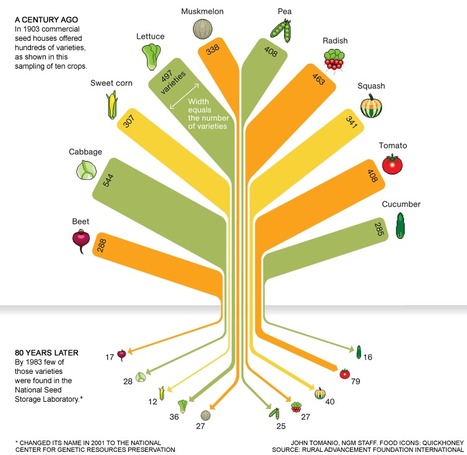
"As we've come to depend on a handful of commercial varieties of fruits and vegetables, thousands of heirloom varieties have disappeared. It's hard to know exactly how many have been lost over the past century, but a study conducted in 1983 by the Rural Advancement Foundation International gave a clue to the scope of the problem. It compared USDA listings of seed varieties sold by commercial U.S. seed houses in 1903 with those in the U.S. National Seed Storage Laboratory in 1983. The survey, which included 66 crops, found that about 93 percent of the varieties had gone extinct. More up-to-date studies are needed."
To show the other side of the issue, include this minor, yet crucial part of the article: "A 30-year-old plant pathologist named Norman Borlaug traveled to Mexico in 1944 to help fight a stem rust epidemic that had caused widespread famine. Crossing different wheat varieties from all over the world, he arrived at a rust-resistant, high-yield hybrid that helped India and Pakistan nearly double their wheat production—and saved a billion people from starvation. This so-called green revolution helped introduce modern industrialized agriculture to the developing world."

Alyssa Dorr's curator insight,
December 16, 2014 9:13 AM
This article is based on a study done by the Rural Advancement Foundation in 1983. Over the past century, it is hard to know what foods were lost and how many of each. But this study done by RAF gave us some information to solve the problem. It compared USDA listings of seed varieties sold by commercial U.S. seed houses in 1903 with those in the U.S. National Seed Storage Laboratory in 1983. The survey, which included 66 crops, found that about 93 percent of the varieties had gone extinct. 93 percent of these crops have gone extinct. That is a huge chunk that could be used as resources. This tree starts off with ten crops on it. The tree included: beet, cabbage, sweet corn, lettuce, muskmelon, peas, radish, squash, cucumbers, and tomatoes. In 1903, all these numbers were up, up, up. The lowest starting with beet at 288 ranging up to the highest with lettuce at 497. However, 80 years later in 1983, numbers dropped. The highest then shifted to tomatoes at 79 and the lowest shifted to sweet corn at 12. 
Alex Smiga's curator insight,
February 13, 2016 12:18 PM
From a scientific view point it almost seems like we are making ourselves into specialists in an ecological / dietary way. Limiting our available food resources and hoping against the odds that we don't suffer the same fate as other specialist species of the past.
Scoop.it!

This photoblog will also link you to a full article and video that explains how the American pork industry is supplying China's demand for protein as globalization forces (among others) has led the Chinese consumers to eat 10% more meat than they did just 5 years ago. WHat impact will this have on American agriculture? How to we explain fo the rise in meat demand in China?
Adrian Bahan (MNPS)'s insight:
Read the linked article. How is China dealing with its increasing appitite for meat?

Paige McClatchy's curator insight,
December 14, 2013 5:30 PM
Chinese farmers cannot keep with with Chinese demand from pork, so America is stepping in to fill the gap. The globalization of American pork seems like it would benefit American farmers and Chinese consumers, but the environmental cost of raising so many extra pigs on American land must be considered, as well as transportation costs to ship it to China.
Jacob Crowell's curator insight,
December 15, 2014 1:35 PM
We never focus on the goods leaving the United States and being imported to China. American pork is filling the demand in China and because globalization has made it cheap to ship exports, China is responding by eating more pork because it is affordable. This is important in keeping American exporting business afloat. There are plenty of pigs in the US to provide large numbers to foreign countries. I also find it interesting that what Americans would consider a staple of so called "Chinese food" is being exported from the US.
Scoop.it!

Hungary has taken a stand against biotech giant Monsanto and genetic modification by destroying 1000 acres of maize grown with genetically modified seeds.
Peru and Hungary have both banned GMOs. What are the reasons that many are critical of GMOs? What should the government's role be in agriculture and food systems? Are bio-tech companies too strong?
Courtney Holbert's curator insight,
February 3, 2013 10:57 PM
With Monsanto having such a large political power, this is very interesting tat Hungary took a stand. 
Maria Bustamante's comment,
February 22, 2013 11:56 AM
This article is about countries that are taking a stand against the company Monsanto. Many people in those countries are critical against the use of GMOs because they're not sure about how the genetic engineering will affect the crops. Already GMOs have had negative effects. The use of GMOs reduces the variety between the seeds. Not only that but the farmers are no longer getting the money the deserve for their hard work and they are not allowed to save their seeds. The government should have little control over the agriculture and what they decide to plant. They should take more precautions against the GMOs and they should make sure that the food system companies in charge of checking the safety food should not have a connection to the very food companies they are supposed to be condemning. Bio-tech companies are getting too strong because they're gaining too much control of the fields due to the patents they hold on their GMOs. This is dangerous because they could end up having a monopoly on the franchise and when they due if something happens to their crops it will happen to all the crops. It will be, for lack of a better word, very bad.
Scoop.it!

Myths and facts about health, corruption, and saving the world Tags: food, agriculture, agribusiness, locavore, unit 5 agriculture. Via Matthew Wahl
Adrian Bahan (MNPS)'s insight:
This article really cuts through the myths and skewed logic in the GMO debate. I love the Atlantic Monthly, one of the sacred texts of Geo-Scholars everywhere.
Matthew DiLuglio's curator insight,
November 27, 2013 4:59 PM
I mentioned this through an allusion in another article, but GMOs and the movements against them perplex me. I don't think that fossil-fuel burning engines are natural, but many anti GMO people that claim they are bad for the environment leave me completely stunned as to their intolerance for what could possibly benefit other people. I feel very much an outsider when I examine many topics of controversy related to GMOs, and I am quite sure that I have consumed them before -- and loved them? as for the FDA... I don't approve of the FDA. They like more money coming into their pocket more than bettered well-being of citizens. When I mentioned to my doctor that I wanted to apply for medical marijuana for a series of conditions that I have following a severe accident, I was told that they refused because it was not fully endorsed, approved, or even allowed by the FDA. That really pissed me off because I suffer from excruciating pain every day and night of my life. Could you imagine being a poor person in need of food, and the only viable way of getting food was through the production of GMOs...? and then some pseudo-hippie activists that didn't live through the 1960s trying to be all like, "We don't want anyone to have GMOs!"... I pose that abstractly, because I view most everything with a level of abstraction and distance from the situation, sampling perspectives with which I may empathize or consider. I keep thinking that this world around us all came from a big bang, with other possible universes before that, and something before that... and I really can't see Capitalism ever becoming as bad as it is, with such disregard for other people's wellbeing, until I look at today's world. 
BrianCaldwell7's curator insight,
March 16, 2016 4:02 PM
So many articles about organic or genetically engineered foods are written with someone with a very defined position on the subject (much like abortion, gun control or other controversial topics). This article is an attempt to separate out the good the bad and the ugly regarding genetically engineered foods.
Scoop.it!
The first in a series of videos on the consequences to the Honduran rainforest of slash-and-burn farming. Here, farmers consider a way of reversing the destruction Via Marc Crawford , Mankato East High School
|







Locate the Meth Belt