Las pedagogías emergentes son "el conjunto de enfoques e ideas pedagógicas, todavía no bien sistematizadas, que surgen alrededor del uso de las TIC en educación y que intentan aprovechar todo su potencial comunicativo, informacional, colaborativo, interactivo, creativo e innovador en el marco de una nueva cultura del aprendizaje". (Linda Castañeda y Jordi Adell)
When my colleagues and I have [taught with a flipped classroom], students do not perceive that a professor is teaching them at all, so we have comments such as, “We could just do this at home” or “Why am I paying all this tuition to just teach myself?” or “She doesn’t teach. She just expects you do do it all yourself. The class is pretty much pointless” or “If I wanted to learn on my own, I’d just take an online class or get a book out of the library.”
Divierte y vencerás. He aquí la sencilla fórmula del éxito educativo. Una fórmula que aumenta y se amplia de manera progresiva. Y es que las barreras que tradicionalmente han venido separando el ocio y el trabajo, lo formal y lo informal, lo serio y lo divertido, son cada vez más tenues.
It is a new idea for many classroom teachers/students to move from writing, reading and “doing” work, not only for themselves, supervisors/parents or for a monetary compensation/grade, to share their work openly and freely with others. The idea of putting oneself “out there on the internet” (on a larger scale than the teacher lounge) and publicly “brag” about successes, admit failures, ask for help or document one’s learning and teaching process, feels unnatural and even scares many of them.
So in this post, let me clear, first, about what a theory actually is, and then let me outline the ways in which connectivism can be thought of as a learning theory.
The mission of the Flipped Learning Network™ is to provide educators with the knowledge, skills, and resources to successfully implement Flipped Learning.
Interested in flipping your classes? This video is a great place to start. I talk about basic steps to flipping a class, where to start looking online for resources and give examples of different ways to flip, including a detailed description of my traditional and flipped class schedules.
The purpose of this document is two-fold: - to offer an online history of the development of the Massive Open Online Course (MOOC) - to use that history to describe major elements of a MOOC
Each chapter of this guide looks at one of the first MOOCs and some early influences. It contains these parts: - a description of the MOOC, what it did, and what was learned - a description of the element of MOOC theory learned in the offering of the course - practical tools that can be used to develop that aspect of a MOOC - practical tips on how to be successful
Do you use Instagram? As you may know, many of our students already do, and today I'm very excited to introduce you to a challenge that my friend Adelaida Martín (@amartinbosque), a Spanish instru...
Un hospital infantil de Houston ha decidido aprovechar las posibilidades de Google Glass para entretener a los niños enfermos que no pueden abandonar el recinto. El dispositivo de realidad aumentada de Google permite a los pacientes visitar el zoo virtualmente sin moverse de su habitación.
Aproximación al concepto de pedagogías emergentes que pretende hacer explícitas algunas de sus características –algunas análogas a las de las tecnologías emergentes–, así como delimitar algunos de los principios que actualmente las de!nen en el entorno educativo.
Creating with mobile devices can be a lot like baking. Though cookies, cakes and pies all begin with flour and eggs, the final products vary wildly. Similarly,smashing multiple apps can lead to extraordinary learning artifacts, so why not apply it to Chromebooks? In four steps, we have the potential to create and share something entirely new.
Students move through the modules of this blended learning course on Geography at their own pace. They build out content knowledge using a Personalized Map (through google maps) and the content delivered through this Digital Learning Farm method will be curated so that they can build out multiple pins on their map. This content is then used as content knowledge to increase their understanding of the region.
He wanted to experiment with a different type of note taking to add to students’documentation of gaining subject specific content knowledge.
Challenges to Research in MOOCs Helene Fournier, Rita Kop, and Guillaume Durand PDF
Participants' Perceptions of Learning and Networking in Connectivist MOOCs Mohsen Saadatmand and Kristiina Kumpulainen PDF
Case Study
MOOCs: Striking the Right Balance between Facilitation and Self-Determination Tita Beaven, Mirjam Hauck, Anna Comas-Quinn, Tim Lewis, and Beatriz de los Arcos PDF
Position Papers
MOOC Pedagogy: Gleaning Good Practice from Existing MOOCs Maha Bali PDF
Teacher Experiences and Academic Identity: The Missing Components of MOOC Pedagogy Jen Ross, Christine Sinclair, Jeremy Knox, Siân Bayne, and Hamish Macleod PDF
Aurasma is a free app for iPads, iPhones, and most Android devices. Using Aurasma you can create augmented reality layers, Aurasma calls them "auras," that pop-up when you scan objects with your phone or tablet.
Stephen Downes has been making a few waves lately with his recent brief summary of Connectivism as a Learning Theory, which is a great deal easier to read than his 616-page book on the subject (that I confess to only having skimmed, though I read and followed some of the articles that fed into it). David Wiley approves, but notes that the theory is incomplete. I approve too. Stephen is always a thought-provoking and interesting writer and this is his most succinct expression of the idea yet. But I'm not so sure that, as presented here, it is a learning theory at all. If it is - it is very hard to tell as it gets a bit fuzzy at precisely the point at which it seems to become one - then it is one that appears either inconsistent or very likely wrong. This doesn't mean Connectivism is not a good and useful theory. I think it is, at least in most of the ways it has been presented by George Siemens, of which more forthwith. It's just hard to fathom it as a learning theory that makes any sense. So this is my attempt to make sense of what Stephen means and, at the end of it, to explain why connectivism (small 'c'), as George Siemens has explained it, is such a good idea not just despite but because it is not a coherent learning theory.
Mas allá del Aula ANTES Temario: 1. Introducción 2. La Clase Invertida 3. Porque la Clase Invertida 4. Como Implementar la CI Reflexiones Finales Ramiro Aduv...
Google Docs is much more than just an online word processor. It is a tool for improving student writing.
Google Docs has many built-in features, as well as third party tools to help students with their writing. These include peer review, tracking revisions, having students' writing read aloud to them, giving feedback through text and voice comments, the integrated research tools and citation tools, bibliography add-on, publishing student work, and more.
Durante mi estancia en Nueva York, el otoño pasado, tuve el placer de pasar unos días en Connecticut con Pilar Munday (@mundaysa) y con su familia para celebrar el Día de Acción de Gracias. Recuerdo que me habló de Instagram y de la página de @fatmumslim, donde ella propone colgar una foto por día a partir de un hashtag propuesto previamente (en inglés). Entonces, Pilar me sugirió: ¿por qué no planteamos también algo así para nuestros estudiantes? Y nos pusimos a pensar. Este es el resultado.
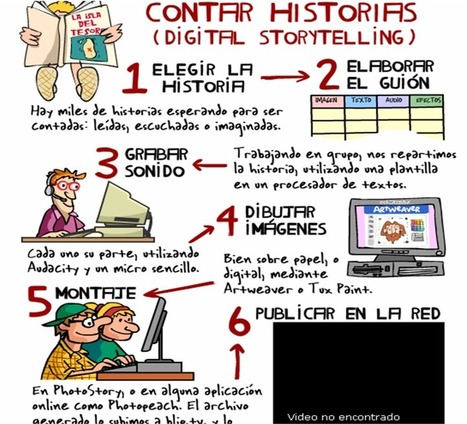
La narración en digital nos permite utilizar nuevos formatos como vídeos, imágenes en movimiento, podcasts o la creación de libros electrónicos multimedia para transmitir una historia que apelen a nuestro aprendizaje sensorial y visual. Realizar productos a medida, con nuevas dinámicas. Las Internet nos permiten que nuestras historias lleguen a más personas y más lejos.
Emerging Technologies in Distance Education showcases the international work of research scholars and innovative distance education practitioners, who use emerging interactive technologies for teaching and learning at a distance. This widely anticipated book harnesses the dispersed knowledge of international experts who highlight pedagogical, organizational, cultural, social, and economic factors that influence the adoption and integration of emerging technologies in distance education. Emerging Technologies in Distance Education provides expert advice on how educators can launch effective and engaging distance education initiatives, in response to technological advancements, changing mindsets, and economic and organizational pressures. The volume goes beyond the hype surrounding Web 2.0 technologies and highlights the important issues that researchers and educators need to consider to enhance educational practice.
Pretendemos que el lector pueda encontrar en este libro una introducción en profundidad al tema de los PLE, una visión cercana pero rigurosa de ese acrónimo que parece inundarlo todo en el discurso educativo de los últimos tiempos y que puede resultar indefinido, árido e incluso excesivamente utópico y optimista.
To get content containing either thought or leadership enter:
To get content containing both thought and leadership enter:
To get content containing the expression thought leadership enter:
You can enter several keywords and you can refine them whenever you want. Our suggestion engine uses more signals but entering a few keywords here will rapidly give you great content to curate.


 Your new post is loading...