Inspiring greatness is all about leading by example. The best leaders have these habits in common.


 Your new post is loading...
 Scoop.it! Inspiring greatness is all about leading by example. The best leaders have these habits in common. 
No comment yet.
Sign up to comment
Scoop.it!

Forget the monolithic change management programs and focus on the elements of your culture that drive performance.
To sustain a true competitive edge, your culture should accelerate business performance. This is the ultimate goal of the critical few.
Four indicators can reveal that your culture is boosting the business.
1. Your culture taps into the waiting reserves of energy within lots of people. If you have a culture focused on a certain set of performance outcomes, and employees buy into it, people start reinforcing one another informally. Simply put, they increasingly help one another feel good about what they need to do. As a result, you gain a greater level of emotional commitment to the work that matters most. 2. Your culture guides down-the-line decision making. If you have a strong culture, you don’t need to have prescribed policies for every permutation of a situation. Employees can rely on cultural influences to help determine what they should do—they will act with speed, and they’ll take initiative. You simply do not need all those formal sign-offs when you have the right kind of cultural support. When nobody is there to give the approval, the culture guides the individual in how to act. 3. Your culture builds enduring execution capability. Over time, critical behaviors are repeated; as they turn into habits, people become faster and better at executing. You see evidence of greater customer loyalty, higher levels of the kinds of employee engagement that matter most for performance, higher degrees of emotional commitment to what the organization is focused on, a more rigorous pursuit of continuous improvement, and greater resilience in downturns. 4. Behaviors in normal times emulate positive behaviors during crisis situations. We often hear executives praise the collaborative, selfless, and energetic behaviors of their people during a crisis—and lament the fact that they don’t see more of those kinds of interactions normally. This difference is in large part explainable by the activation of cultural forces that occurs during a crisis. When you are focused on activating those forces all the time, you get that “special” level of performance all the time. Via Kenneth Mikkelsen
Scoop.it!

Is it any wonder that employee engagement is reported to be at an all time global low while business continues to become increasingly complex?
Every leader wants more of link between an organization’s purpose and real action. This is where hacking work comes into play. We need to challenge ourselves and others and think about how we can better link purpose with action.
Via Kenneth Mikkelsen
Scoop.it!

Influence is becoming more and more challenging. It’s hard enough to attract attention, much less retain it or use that attention to shape the behavior of others. And yet, in a world of scarce resources and mounting pressure, the ability to influence others becomes more and more central to the ability to set big things in motion. Via Kenneth Mikkelsen

Sabine Henrichfreise's curator insight,
February 25, 2014 7:52 AM
We create influence and trust by accepting our magnificent imperfection ... 
Alex Watson's curator insight,
February 26, 2014 2:07 PM
Really insightful post about the changing nature of influence and the power of questions
Scoop.it!

Rosemary Tyrrell, Ed.D.'s curator insight,
February 18, 2014 12:56 PM
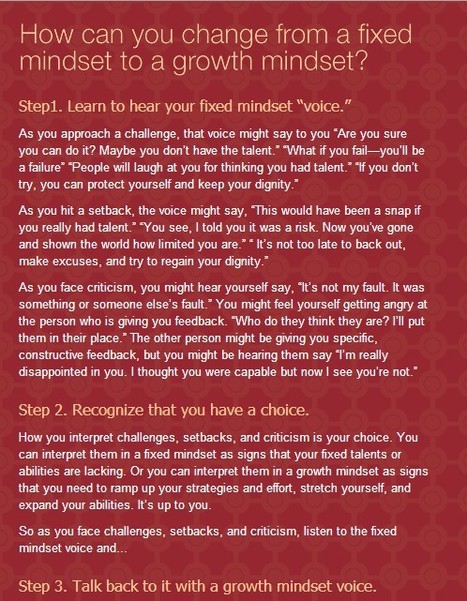
Carol Dwek's Mindset is based on a lot of research she has done over the years. It has applications throughout higher education. 
Parent Cortical Mass's curator insight,
February 19, 2014 8:19 AM
nice set of links about Carol Dweck's Mindset Theory. Every parent needs to know what Carol Dweck discovered in her research. 
Jaimee's curator insight,
March 5, 2014 10:09 AM
So one who wants to make a change must have a positive outlook on new situations or task that they are not used to?
This article is about how one can gain or become a part of the group that is a growth mind set. You gain success or become a better person by following these changes.
Scoop.it!

The Institute of Design (D.School) at Stanford has become one of the most talked about institutions recently because of the methodology they are spreading around the world to improve our lives thro...
Scoop.it!
From
99u

Simple co-founder and CEO Josh Reich shows us how his team wrangles with banking bureaucracy to create a product people love.
Scoop.it!

If there's one word that's almost certain to appear somewhere on every business's website, that word is talent. Companies of every size love to talk about talent! They can talk about talent all day long. It's easy to talk about talent on a website or in a recruiting brochure. It's easy [...]
Scoop.it!

Four lessons from diet research that can help leaders improve their planning chops.
Scoop.it!
From
99u
Trying to maximize every task and squeeze every drop of productivity out of your creative work is a recipe for exhaustion and procrastination.
Scoop.it!

Think Jar Collective founder Ben Weinlick interviews creativity expert Michael Michalko about creative problem solving and what helps foster it.
|
Scoop.it!

“Social is not appropriate for our industry”, some still believe. Guided by their spreadsheet, they feel safe in the familiar environment of meetings and emails, responsibility assignment matrix, alpha male leadership, controlled communications, and stakeholder “management”. Their size and longevity reflects their success. As a pledge to modernity, they brandish a corporate Twitter account or a brand Facebook page. Big deal. This is not going to save corporate dinosaurs from extinction. The social asteroid has exploded already, and its effects will be deadly if they don’t adapt.
Scoop.it!
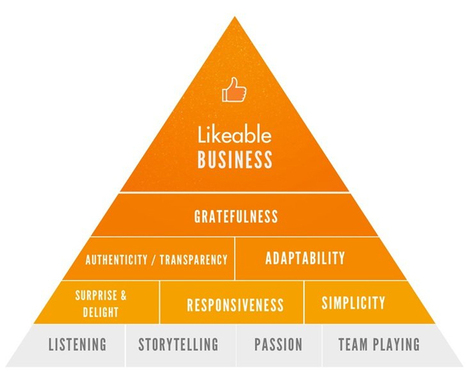
Being likeable will help you in your job, business, relationships, and life. I interviewed dozens of successful business leaders in my last book, Likeable Business, to determine what made them so Via Yesenia Sotelo
Scoop.it!

Jesse Soininen's curator insight,
February 22, 2014 4:11 PM
A Definitive Must Read for Everyone interested in the Future of Work! 
niftyjock's curator insight,
February 22, 2014 7:55 PM
I think trust the hardest thing for companies to develop. They can,t buy it they have to create trust.
Scoop.it!

Dan Pontefract's latest blog post about the state of Enterprise 2.0 - and the need for behavioural change in our organizations in the way we lead, learn and collaborate. If we are to talk about the next generation of the enterprise — Enterprise 2.0 — then we must also discuss behaviour, culture, learning or leadership in concert with the premise of collaborative-based technologies. Via Kenneth Mikkelsen
Scoop.it!

Before senior executives try to spread best practices, they should use seven techniques to clear out the negative behavior that stands in the way.
Via Kenneth Mikkelsen

Eli Levine's curator insight,
February 18, 2014 11:48 PM
"Destructive behavior—selfishness, nastiness, fear, laziness, dishonesty—packs a far bigger wallop than constructive behavior."
Funny how it is that ethics and basic tenants of morality (without the religious connotations) has a significant impact on how we operate and our chances of success on THIS level of being, not in Heaven "above".
Perhaps we weren't evolved enough to be able to handle the old teachings of the prophets, all those years ago and be able to interpret them on their most general level.
Silly brains. 
Tony Brugman (Bright & Company)'s curator insight,
May 3, 2014 4:59 PM
Excellent piece on strategy and leadership in McKinsey Quarterly from February. Bottom-line: Aiming for Organisational Excellence? Get rid of the negative behaviour in your organisation first! The authors (including Robert I. Sutton) give seven tips for breaking bad habits and behaviour.
Scoop.it!

As you sit down to work this morning, consider this: Are you filling your time with the right kind of work? Via Barb Jemmott
Scoop.it!
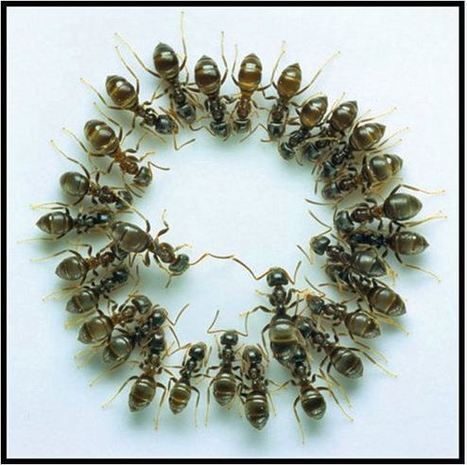
"As the regular General Assemblies are where all constituents gather to listen and contribute to the discussions using the methodology of the ‘stack’, which allows anyone seeking to propose a group or report on current activities, joins a queue and takes their turn to speak. This allows each their turn to vocalise and articulate for all to hear and vote on. In a ‘leaderless’ holarchic society, the necessity for a self organising infrastructure to support the intrinsic momentum, and the forum to voice the fomenting processes of each, are both vital components. What is being revealed here is the desire for a new manner of building community, responsive to those who have been inspired to collaborate, as working groups become the lifeblood of the movement." Via june holley, Howard Rheingold

luiy's curator insight,
February 10, 2014 8:49 AM
People work together well when the flexible framework of working groups accommodates their natural inclination to co-operate within the context of a big vision. They are a testament to our determination to stand up against disempowerment. We realise a greater autonomy when we work together in co-operative engagement inspired by our desire for freedom. This, to me, is the power of Working Groups. 
MyKLogica's curator insight,
February 18, 2014 2:05 PM
Cuando el fenómeno de la holacracia se extiende a la sociedad. 
Ali Anani's curator insight,
February 24, 2014 12:50 AM
Self-organizing or controlling? Which do you see fitter?
Scoop.it!

Have managers lost the ability to listen? Professor Jim Heskett reviews recent research that suggests we don't even listen to ourselves anymore. What do YOU think? Via Kenneth Mikkelsen

Luís Cochofel's curator insight,
February 6, 2014 10:09 AM
... so, this is the fourth article I was talking about previously... 
Steve Browne's curator insight,
February 6, 2014 10:29 AM
#HR make sure you take note of this and see how you approach this essential skill daily !! #workplace
Scoop.it!
"There's nothing so practical as a good theory." Here are ten of them, summarized by Professor Michael Zigarelli, for those who want to lead more effectively. Via Ana Cristina Pratas

María Dolores Díaz Noguera's curator insight,
January 29, 2014 2:39 PM
Excellent thanks for sharing.
Scoop.it!


AlGonzalezinfo's curator insight,
January 27, 2014 12:37 PM
This last week, Huffington Post columnist and learning expert, Angela Maiers, joined me on my podcast to discuss why we should never consider ourselves;
“Faking it till we make it”.
Instead, we should pursue our passion in life with a clear understanding that we will be;
“Learning it while we make it”! As Angela explained during the interview the "act of doing" enables the process of learning. Whatever action you pursue, you’ll get to do better the next time because you will be able to reflect on it.
To access my blog post, go to www.giveleadership.com |