


Actually, a new study shows that the opposite may be true, says Daniel Willingham; it depends on teachers’ perceptions.


|
Rescooped by
Mel Riddile
from Leading Schools
onto The Lead Learner is the Learning Leader May 5, 2014 9:28 AM
|
 Scoop.it!
Actually, a new study shows that the opposite may be true, says Daniel Willingham; it depends on teachers’ perceptions.


 Your new post is loading...
Scoop.it!

Do we ignore mistakes, brushing them aside for the sake of our self-confidence? Or do we investigate the errors, seeking to learn from the snafus? The latter approach, suggests a series of studies, could make you learn faster.
Jonah Lehrer writes:
One of the essential lessons of learning, which is that people learn how to get it right by getting it wrong again and again."
"Education isn’t magic. Education is the wisdom wrung from failure."
"A new study, forthcoming in Psychological Science, and led by Jason Moser at Michigan State University, expands on this important concept. The question at the heart of the paper is simple: Why are some people so much more effective at learning from their mistakes? After all, everybody screws up. The important part is what happens next. Do we ignore the mistake, brushing it aside for the sake of our self-confidence? Or do we investigate the error, seeking to learn from the snafu?"
Growth Mindset
"It turned out that those subjects with a growth mindset were significantly better at learning from their mistakes. Because the subjects were thinking about what they got wrong, they learned how to get it right."
"Fear of failure (fixed mindset) can actually inhibit learning."
Praise: How Matters
Students praised for their intelligence almost always chose to bolster their self-esteem by comparing themselves with students who had performed worse on the test.
In contrast, kids praised for their hard work were more interested in the higher-scoring exams. They wanted to understand their mistakes, to learn from their errors, to figure out how to do better.
The experience of failure had been so discouraging for the “smart” kids that they actually regressed.
The problem with praising kids for their innate intelligence — the “smart” compliment — is that it misrepresents the psychological reality of education. It encourages kids to avoid the most useful kind of learning activities, which is when we learn from our mistakes.
Foresaking Self-Improvement for the Sake of Self-Confidence
Unless we experience the unpleasant symptoms of being wrong the mind will never revise its models.
We’ll keep on making the same mistakes, forsaking self-improvement for the sake of self-confidence. Samuel Beckett had the right attitude: “Ever tried. Ever failed. No matter. Try Again. Fail again. Fail better.”
Scoop.it!
Education circles are abuzz with a new concept: that resilience and persistence are just as important as intelligence to predicting student success and achievement. But can "grit" actually be taught?
Scoop.it!

When you praise children for being smart, you expect them to fearlessly conquer new academic challenges because they believe they're smart. But many psychologists and educators claim the opposite is true: that labeling kids as
Scoop.it!

Most educators, policymakers, and parents agree that today's students need a mix of knowledge, skills, and dispositions to prepare them to be successful and engaged citizens. Given that students need
Scoop.it!

A journalist explores the possibility that cognitive exercises improve working memory and problem solving. Individuals who engage in cognitive exercise, the company claims, will be “better able to stay focused, ignore distractions, plan next steps, remember instructions and start and finish tasks.” The pool of people who could benefit from such training is vast, the site suggests: “children and adults with attention deficits or learning disorders, victims of brain injury or stroke, and adults experiencing information overload or the natural effects of aging.”
Scoop.it!
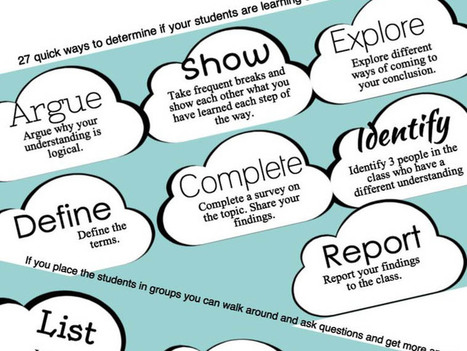
27 Simple Ways To Check For Understanding
Scoop.it!

"I told her that the first mice were less able to solve new problems than the other ones, and that brain development can only be created by trying, trying, trying. The effect was enormous. She suddenly wasn't afraid to fail anymore and she started seeking challenges."
Scoop.it!

Maine Middle School teacher shares a growth mindset classroom moment.One of the students in my special education class received the highest score possible on her mainstream health class test and was the only one to get a perfect score. She told me early in the year that she has a third grade brain and has triple brain damage due to traumatic events...
Scoop.it!

New research suggests that parental help with homework may be doing more academic harm than good.
Scoop.it!

The Things That Linger After They've Forgotten Everything You Taught 1. How You Make Students Feel 2. The Discoveries They Make About Themselves 3. The Networks, Communities, Habits, & Tools You Help Them Discover & Use 4. Learning Strategies 5. Reading Habits
Scoop.it!

Being the favorite is an enviable position, but it comes with the burden of high expectations. Bradford Tuckfield explains why favorites sometimes withdraw from competition when they're behind. Whe...
Scoop.it!

Focusing only on individualized learning is a mistake — educators and students alike benefit from learning communities. In the best of all possible worlds, educators experience both personalized and collaborative professional learning.
|
Scoop.it!

As every teacher knows, good classroom management can make the difference between a great class experience and a poor one. While technology doesn’t replace the need for a solid approach to classroom management, tech tools, including these, can certainly help.
Scoop.it!

Angela Lee Duckworth, a psychology professor at the University of Pennsylvania, became famous (famous for an academic, at least) for her theory of “grit”—the notion that long-term passion and perseverance in pursuit of one’s goals was a key ingredient for student success.
Scoop.it!
"Research has shown that these types of videos (Khan Academy) may be positively received by students. They feel like they are learning and become more confident in their answers, but tests reveal they haven't learned anything. The apparent reason for the discrepancy is misconceptions. Students have existing ideas about scientific phenomena before viewing a video. If the video presents scientific concepts in a clear, well illustrated way, students believe they are learning but they do not engage with the media on a deep enough level to realize that what was is presented differs from their prior knowledge. There is hope, however. Presenting students' common misconceptions in a video alongside the scientific concepts has been shown to increase learning by increasing the amount of mental effort students expend while watching it." My PhD: http://www.physics.usyd.edu.au/super/theses/PhD(Muller).pdf
Scoop.it!

Parents and teachers wrestle with all the time: Should we be making learning easier for kids—or harder? The answer, according to research in cognitive science and psychology, is both.
Scoop.it!

Carol Dweck's growth mindset research can lead to greater collaboration among co-teachers and help all students in inclusion classrooms master the Common Core.
Scoop.it!

Just because we are stuck with their policies doesn't mean we should be stuck with their mindset. - Michael Fullan
Scoop.it!

Strategies to help you integrate basic differentiation into your classroom.
Scoop.it!
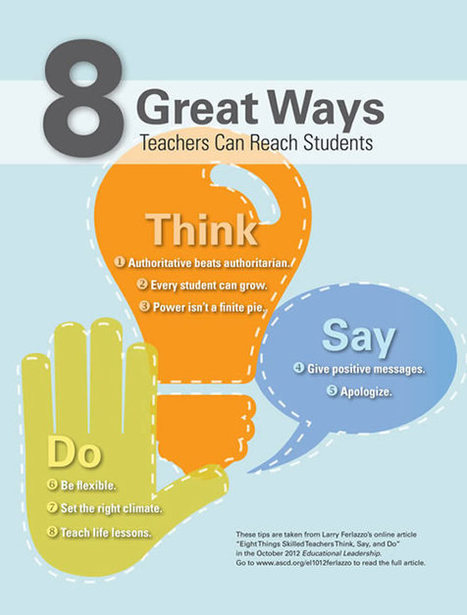
"In my nine years of teaching high school, I've found that one of the best approaches to engaging challenging students is to develop their intrinsic motivation. The root of intrinsic is the Latin intrinsecus, a combination of two words meaning within and alongside. It's likely that our students are intrinsically motivated—just motivated to follow their own interests, not to do what we want them to do. Teachers' challenge is to work alongside our students, to know their interests and goals, and to develop trusting relationships that help students connect their learning to their goals in a way that motivates from within."
Scoop.it!

Stanford psychologist Carol Dweck’s work on growth mindsets has dominated much of the attention around how students can influence their own learning. But there are other ways to help students tap into their own motivation, too. Here are a few other important mindsets to consider.
Scoop.it!
"In the act of learning, people obtain content knowledge, acquire skills, and develop work habits—and practice the application of all three to “real world” situations."
Scoop.it!

A new educational study offers evidence that simple and inexpensive changes to existing courses can help students learn more effectively. The study found that making a few changes to homework assignments significantly boosted student learning in an undergraduate engineering course.
Scoop.it!
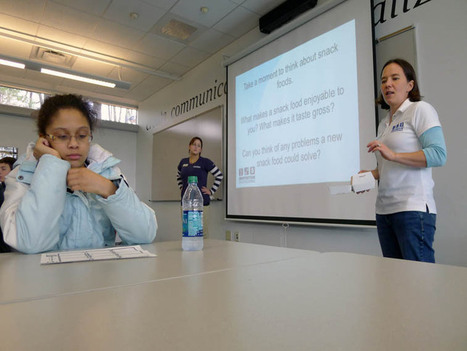
"Anyone who’s read Dan Pink’s book Drive or viewed the related TED Talk, understands that extrinsic and intrinsic motivations are not equal. Intrinsic motivators have a profoundly greater effect on engagement, it’s through intrinsic interests that people achieve great things. The ideal class would have every student engaged in productive, stimulating and interesting work 100% of the time. Of course that’s purely an ideal, but ideals can act as guides."

Rebecca Wilkins's curator insight,
July 30, 2015 10:23 PM
The best way to engage students is to get them to care about the content they should be learning. The only way to truly understand what would motivate students is through developing a relationship with each person. |








"...time spent on instructional leadership was not associated with student learning outcomes. But once “instructional leadership” was made more fine-grained, the picture changed.
Time spent coaching teachers — especially in math — was associated with better student outcomes. So was time spent evaluating teachers and curriculum.
But informal classroom walkthroughs — the most common activity — were negatively associated with student achievement. This was especially true in high schools.
I scooped this article because I have recently experienced a new administrator who is much more visible and who visits my classroom frequently. But the author reports that more frequent classroom walkthroughs actually is negatively associated with student achievement. This is especially the case if these visits are not opportunities to provide meaningful feedback. Time spent coaching teachers is an activity that has benefit.