Your new post is loading...
In August 1969, President Richard Nixon called Christopher DeMuth into his office for a new assignment. DeMuth, a recent Harvard graduate, had been working for Daniel Moynihan and had introduced Moynihan to Nixon. The meeting’s ostensible purpose was to begin assembling the 1970 State of the Union address. But Nixon had something else on his mind. “Chris,” declared Nixon, “I think that in the 1970s, the nature of domestic politics in America is going to change.” American politics, Nixon continued, had been dominated by traditional economic questions, such as bargaining between businesses and labor unions. But Nixon anticipated that quality of life concerns were going to become more important. And Nixon predicted that environmental policy was about to become a major political issue. DeMuth remembered being baffled. “I majored in government at Harvard,” he told me in an interview earlier this month. “I was a pretty sophisticated person. But I didn’t know what he was talking about.” Nixon’s conversation with DeMuth set in motion the events that led to the creation of the Environmental Protection Agency in 1970. Its creation was bipartisan. Senator Barry Goldwater supported Nixon’s initiative, and that same year, Governor Ronald Reagan signed the California Environmental Quality Act, modeled on federal legislation Nixon had signed. But the honeymoon period didn’t last long. For many conservatives, the creation of the EPA is now one of the blackest of black marks against the Nixon administration. It was an expansion of federal powers that bulldozed limited government, an engine of economically destructive regulations, and an unconstitutional delegation of power. Conservative criticisms of the EPA are not wrong. But the agency isn’t going anywhere.
The words "climate change" are slowly being removed from textbooks in Florida and from the state's education standards. A MARTÍNEZ, HOST: Students in Florida are reading watered-down versions of some science textbooks. Authors blew the whistle in 2024, saying the state pushed back on facts about human-caused climate change. Jessica Meszaros of member station WUSF and the Hechinger Report uncovered emails showing the state's demands. JESSICA MESZAROS, BYLINE: Climate change was swapped for changes in the environment in the Florida version of McGraw Hill's marine science book. The word polluting vanished from in front of coal-burning power plants in an environmental science text by publisher Cengage that's only available in Florida. And detailed facts were crossed out in both books, like how a World Health Organization study shows climate change is killing at least 150,000 people per year, or how college students helped their school buy renewable electricity. Ken Miller has authored one of the nation's most popular biology textbooks for nearly 30 years. But two years ago, he says, something shifted. KEN MILLER: The Florida Department of Education was pressuring publishers to reduce or eliminate coverage of climate change as a condition for getting on the approved list.
Scaleout deploys decentralized AI-driven learning to military bases and drones. As European militaries adapt to the use of AI and drones in modern warfare, a NATO-backed startup is helping to deploy AI-driven target detection and selection that can run on small drones for surveillance and attack missions. The company, Scaleout Systems, was originally founded by researchers from Uppsala University in Sweden in 2018, and initially focused on training and deploying machine learning models directly on the hardware available in commercial trucks and other vehicles. But once Russia launched its full-scale invasion of Ukraine in 2022, the company pivoted toward defense applications. “With the war in Ukraine and a shifting world, we realized that this technology can be very important to operationalize edge data and sensor data for machine learning to make sure that NATO allies have found that strategic advantage,” Andreas Hellander, cofounder and CEO of Scaleout Systems, told Ars. Instead of using frontier AI models from OpenAI or Anthropic, Scaleout is harnessing leaner ones, such as machine learning models that can perform computer vision tasks on the hardware of drones or computers used at forward bases. “They need to fit on forward-deployed hardware and edge hardware, which can vary quite a bit from small embedded devices to quite powerful edge workstations,” Hellander said.
18 September 2026 - BARNSTABLE, MA - A new county department builds on decades of work to create a focal point for Cape Cod regional emergency planning. The new Department of Emergency Management acts as a point of regional coordination for planning and response to hurricanes, blizzards, and other disasters. What is the new county department? This year – As Cape Cod moves into nor’easter, blizzard, and winter storm season – it has a new structure that sharpens the region’s ability to respond to disasters.
Many of the customers who chose Cambium did so for good reason. That's what makes this sting, says Jack Raynor, president of NetExperience. This month, Cambium Networks eliminated 53.6% of its global workforce and placed its UK subsidiary into administration, according to the company’s own SEC filing. Administrators are now searching for buyers for parts of the business, and the company has said it expects the remaining entities to be wound down. For the partners, resellers, and operators who built businesses on Cambium hardware, the practical questions are immediate. Who supports the deployed base? Where do firmware and security patches come from? What happens to margin if a forced re-platform lands on their own timeline and their own budget? There’s no satisfaction in watching this play out. Many of the customers who chose Cambium did so for good reasons: competitive pricing, solid performance, and a workable margin. That’s what makes this sting: it wasn’t a bad decision. It’s the risk that comes standard with any single-vendor architecture, regardless of which vendor is chosen.
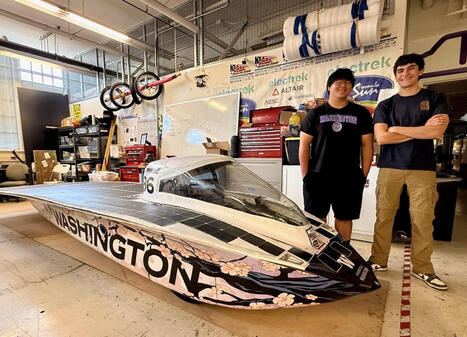
Over seven days in July and 1,778 miles from Minnesota to Texas, UW outpaced nearly every competitor to finish fourth overall and cross the line as the top-ranking American team in the American Solar Challenge. In a cramped corner workspace in a mechanical engineering building at the University of Washington, a team of students is working to harness the power of the sun. They operate on a fraction of the budget of elite international programs, fitting build hours around class schedules and other extracurriculars. Yet this summer, the scrappy crew took their handmade, solar-powered car — dubbed Sakura — out of the shop and onto the open road. Over seven days in July and 1,778 miles from Minnesota to Texas, they outpaced nearly every competitor to finish fourth overall and cross the line as the top-ranking American team in the American Solar Challenge. Now entering its fourth year, the Solar Vehicle Team at UW (SVTUW) is still a relative newcomer to collegiate solar racing. Officially affiliated with the university’s Mechanical Engineering Department, the roughly 50-person group has evolved into a broader interdisciplinary effort spanning electrical engineering, computer science, business, aerodynamics, and more.
I predicted its decline 25 years ago. Today, the U.S. has serious problems, but our rivals have even bigger ones. Is America an empire? That was the question on the minds of many U.S. citizens 25 years ago, in the wake of the September 11, 2001, terrorist attacks on the United States. And it is a question being asked again today, as the war with Iran drags into its seventh month, and Donald Trump continues to fantasize about annexing Canada and Greenland—to say nothing of the application of the “Donroe Doctrine” and the “Trump Corollary” in Venezuela and (coming soon) Cuba. In the years after 9/11, a standard left-wing interpretation was that Osama bin Laden and his suicidal hijackers had struck a blow against American imperialism in the Middle East. Surprisingly, some neoconservatives within the George W. Bush administration agreed. “We’re an empire now,” an unnamed “senior adviser” to President Bush told journalist Ron Suskind in 2004, “and when we act, we create our own reality. And while you’re studying that reality—judiciously, as you will—we’ll act again, creating other new realities, which you can study too, and that’s how things will sort out. We’re history’s actors. . . and you, all of you, will be left to just study what we do.” This was not the official line, of course. “We’re not an imperial power,” said President Bush in April 2005. “We’re a liberating power.” In his brilliant new history of the modern Middle East, The Cauldron, Simon Sebag Montefiore shows the ambivalence Americans have always felt about their imperial role in the region. At the height of the 1973–74 Arab oil embargo, Henry Kissinger threatened to seize the Saudi oil fields. He was bluffing. Nearly 30 years later, partly on Kissinger’s recommendation, Paul Bremer found himself installed as Grand Poo-Bah in charge of the Coalition Provisional Authority in Baghdad. It was May 2003. Within seven months he had to admit, in an email to his wife: “We are already halfway out of [here]. . . . We are not ready for empire!” And yet, and yet. There’s just something about unleashing a storm of steel against the Persians, as the United States has this year, that does seem kind of empire-y.
Experts warn of a global surge in PFAS production driven by AI and data centers. As a United Nations expert reiterated a call for a global ban on nonessential uses of per- and polyfluoroalkyl substances, a Swedish nonprofit on Monday released research on how rapidly advancing artificial intelligence and related data centers are helping to drive a surge in PFAS production. Often called “forever chemicals” because they don’t easily break down in human bodies or the environment, PFAS are tied to range of health issues, including various cancers. For months, advocacy groups, journalists, and researchers have stressed that “data centers have a PFAS problem.”
Big manufacturers planning to produce more of the forever chemicals to meet demand from datacentres. Pfas companies are launching a “tidal wave” of forever chemicals production to meet demand from the AI industry, a campaign organisation has warned. Despite alarm over the chemicals, which have been linked to cancer, a survey of the 10 biggest manufacturers found most had plans to increase production. Many frame their investments around the “AI revolution”, because of the role Pfas play in semiconductor production and next-generation datacentre cooling systems. But opponents warn that the chemicals, which never degrade in nature, are a ticking timebomb for human and planetary health. They say increased production risks undermining nascent moves to restrict Pfas in Europe, the UK and parts of the US.
A federal appellate court rejected the Trump administration's push to keep an aging Michigan coal plant open, a decision cheered by climate advocates fighting a range of similar orders.
How batteries, grid connections and AI are turning energy from a network cost into an infrastructure asset. What got me looking at this was Verizon. During Verizon’s second-quarter call, Dan Schulman explained that the company is removing old copper equipment from thousands of central offices. That is freeing up buildings that already have power, permits, backup systems, and network connections. Verizon is starting to reuse some of them as small data centers for AI inference, and Schulman said an early trial sold out its available capacity within 24 hours. At Goldman Sachs Communacopia this week, he went further. Verizon is already signing agreements around some of those decommissioned sites and expects the business to start generating noticeable revenue from inference and edge computing next year. Mobile operators probably consumed around 310 TWh of electricity in 2025, roughly 1% of global electricity use, and spent around $52 billion on energy. Operators also consume billions of liters of diesel and gasoline every year, while networks account for more than three-quarters of their electricity use.
A $2.5 billion factory in Georgia now produces solar panels from raw wafer to finished product, a milestone for U.S. manufacturing in an industry China has dominated for over a decade. Inside the vast QCells factory in Cartersville, Georgia, workers and a bevy of robots move ultra-thin slices of polysilicon through a lengthy series of machines and chemical baths to get what are known as wafers. “The $2.5 billion, the 3.5 million gallons of water, the 90 megawatts of power, the 60 tons of chemicals on site, and all of the football fields worth of infrastructure you've seen is to arrive at this,” said Scott Bell, vice president of external affairs at QCells, holding up one of the paper-thin blue wafers. It’s the basic building block of a solar panel. In June, the plant, about an hour northwest of Atlanta, expanded from assembling the major components of solar panels to bringing the whole production process under one roof. It’s a major milestone for the U.S. solar industry.
El Niño can affect agriculture, marine life and economies in profound ways, including slowing commerce at the Panama Canal. This El Niño is likely to be the strongest in over a century. El Niño is here, and forecasters warn that it’s likely to be bigger and stronger in 2026-27 than any El Niño event recorded in at least 150 years. During strong El Niños, global air and ocean temperatures spike, and precipitation patterns shift dramatically – flooding rains deluge places that are normally dry, and drought strikes some of the wettest locations on earth. With this El Niño arriving on top of already high global ocean and air temperatures, it carries the potential for extraordinary impacts to millions of lives throughout the world. Globally, August 2026 was the hottest month on record, according to data from Europe’s Copernicus climate service. Those effects are already showing up in Central and South America.
|
AI is the road to mad money in the US, according to the business press. How mad is this money? Let’s turn to the Forbes 400 list of the wealthiest people in America. The bar to join this list has never been higher, at $4.4 billion now. That’s an increase of $600 million, 60% of $1 billion, versus the past year. Living large has never been so, well, large. Nice work if you can get it, no? In a capitalist society, the accumulation of such mind-boggling wealth is the highest priority for the ruling class. In 2026, the AI mad money grab is on. AI is no benign thing that enables billionaires’ wealth. In fact, AI has grabbed much attention since an Anthropic researcher, Jacob Coxon, warned that AI “could kill us all by the end of the decade.” However, AI lethality is here now. Take the Israeli military, with the financial and political backing of Uncle Sam, using AI to maim and murder Palestinian civilians in Gaza. For these victims, Israel’s use of AI is rampant, according to author Chris de Ploeg in his new book, The Exterminating Empire: Capitalism’s War on Life from Palestine to the Burning Planet (Monthly Review Press, 2026). Further, de Ploeg writes: “Gaza has been turned into the world’s largest death camp ever to have existed. The murders are carried out, industrially, with bombs and algorithms.”
A little-known ocean phenomenon linked to El Niño is making its way toward California and could raise Bay Area sea levels by as much as a foot this fall, increasing the risk of coastal flooding across the region. Here's what to know about Kelvin waves.
After International Energy Agency executive director Fatih Birol labeled the ongoing global energy turmoil the “biggest energy security threat in history”. After International Energy Agency executive director Fatih Birol labeled the ongoing global energy turmoil the “biggest energy security threat in history” in April, events over the summer vindicated his warning. The United States authorized the grid operator Southwest Power Pool, Inc. to use backup generation resources in 17 states it serves amid growing demand and extreme heat in late July, while droughts forced European nuclear plants to reduce or halt operations in August. EU gas stocks reached a record low during the last week of August, and Bangladesh further tightened restrictions on business operating hours as its gas shortage worsened. Weather extremes continue to disrupt energy production and supply routes, alongside wars in the Middle East and Ukraine.
A lot of devices are deployed underwater for research and exploration purposes, but powering them all can prove to be difficult, especially if they’re under the waves for a considerable period of time. A new scientific paper, however, has shown that solar panels can be successfully used at depths of up to 10 meters, potentially presenting a new way to keep underwater tech powered up and ready for action. The paper was published in the Joule periodical and accompanied by a press release explaining its advances. The research was conducted by a team of scientists from Yunnan University in China, who said that a series of solar cells placed 32 feet (10 meters) below the water’s surface in the South China Sea were able to collect enough energy to power up a set of lithium-ion batteries in two hours.
The University of Washington’s CoMotion Labs is partnering with Microsoft and E8 to launch a four-month incubator tackling the growing environmental impact of AI data centers. The program will support early-stage startups developing solutions for energy storage, efficient cooling, e-waste reduction and low-carbon materials. As public concern grows about the environmental impact of AI data centers, the University of Washington is launching a startup incubator to support climate tech innovations addressing those challenges. UW CoMotion Labs is partnering with Microsoft and the investment network E8 to create a four-month program targeting technologies in areas including backup energy storage, grid improvements, efficient data center cooling, electronics waste reduction and low-carbon building materials. “This is a really important initiative,” said Karin Kidder, executive director of E8. “The other really great part about this is it’s elevating the Pacific Northwest. There’s so much good work happening here.” CoMotion has previously run two climate tech incubator cohorts, the second of which wrapped up Tuesday with a public demo event. The new effort is the first to focus on a specific industry within the climate space. Organizers are seeking early-stage applicants with technologies ready to commercialize, deploy as pilot projects or scale.
Fluxnium's fibers can extract uranium directly from seawater, which has enough of the nuclear fuel to power thousands of generations. The U.S. has ambitious plans to triple the capacity of its nuclear power plants by 2050, but that goal might hit a roadblock if plant operators can’t buy fuel at reasonable prices. Prices for yellowcake, a form of unrefined uranium, are up 75% in the last five years, according to the U.S. Energy Information Administration. Further complicating matters, the U.S. doesn’t have significant resources within its borders — unless you consider the ocean. The ocean has over 4 billion metric tons of uranium in it, enough for 50,000 years or so. “It’s like a thousand times more than all identified hard rock mines combined,” Jeff Green, founder and CEO of the clean tech Fluxnium, told TechCrunch. Fluxnium thinks it has solved the problem of how to extract uranium from seawater. Using technology developed at U.S. Department of Energy national labs, the company has an approach that could be competitive with existing uranium mines.
A natural gas supply crisis pushes Alaska utilities to look for alternatives to supply the region’s electricity, and community energy came calling. For this episode of the Local Energy Rules Podcast, host John Farrell is joined by professor of history and cooperative utility board member Dr. Philip Wight.
In what is being described as "another gift to the fossil fuel industry," the Trump administration plans to end rules limiting the release of planet-heating emissions from power plants that burn coal and gas.
Google's emissions rose 48% since 2019, driven by AI energy demands, putting its 2030 net-zero goal under serious pressure. Google published its 2024 Environmental Report in July 2024, and the headline number is difficult to spin: total greenhouse-gas emissions reached approximately 14.3 million metric tons of CO2e in 2023, up 48% from 2019, the company’s own baseline for its net-zero target. That 13% single-year jump came while Google was running some of the most energy-efficient data centers globally.
Bill Gates-backed US nuclear fusion firm Commonwealth Fusion Systems has secured an investment from South Korea’s Hyundai Motor Group to help build its commercial power stations. The funding was completed as part of a recent $1 billion capital raise, which will allow both organisations to explore engineering partnerships for commercial fusion power stations known as ARC. “Fusion energy has the potential to play an important role in addressing growing global energy demand while supporting a more sustainable future,” said Hokeun Chung, Executive Vice President of Hyundai Motor Group.
Ookla data identifies the individual Starlink satellites that powered Spain's emergency satellite service during its record wildfires, revealing how, where, and for whom the direct-to-cell layer worked. In the last week of July 2026, the Sierra Oeste fire complex burned more than 60,000 hectares across Ávila, Madrid and Toledo. Officials described it as Spain’s largest wildfire on record, prompting the country’s first national wildfire emergency and knocking out mobile coverage across dozens of rural communities. Within 48 hours, MasOrange and Starlink opened their five-month-old satellite direct-to-device (D2D) pilot, free of charge, to Movistar customers as well as MasOrange’s own, under an exceptional permit from Spain’s telecoms ministry. This analysis reconstructs the D2D activation from the device side using Ookla® background signal scan data, cross-checked against the constellation’s published orbital elements, official fire perimeters from the Copernicus Emergency Management Service, and crowdsourced outage reports from Downdetector.
Five newspaper publishers in New York City agreed in 1846 to pool resources in order to speed the delivery of news about the U.S. war with Mexico using a pony-express relay through Alabama to a telegraph office. Those beginnings gave birth to an organization that in many ways became the backbone of the news industry. The AP claims some 4 billion people, nearly half of the world’s population, see news produced by the company on a typical day. Many don’t realize that. For most of its history, the AP has effectively been a utility, providing material for other news outlets to print, broadcast or carry online, its journalists largely anonymous. AP reporters weren’t even identified with bylines until World War I. But the company has chronicled the nation’s big moments for much of the 250-year history of the American republic. Although horses long since gave way to the internet, the journalism remains. Here are some stories behind the stories the AP has chronicled.
|