Exploration of the planet Mars - facts, rover, mission, videos, pictures and information
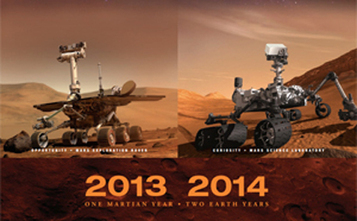
Opportunity rover was built for a three-month mission on Mars, but continues to return valuable scientific data 10 years later. NASA will reflect on the rover's work in a news conference at 11 a.m. PST (2 p.m. EST) Thursday, Jan. 23.
The event will originate from NASA's Jet Propulsion Laboratory in Pasadena, Calif., and be carried live on NASA Television and streamed online.
Participants will be:
Michael Meyer, lead scientist, Mars Exploration Program, NASA Headquarters, WashingtonRay Arvidson, Mars Exploration Rovers deputy principal investigator, Washington University, St. Louis, Mo.John Callas, Mars Exploration Rovers project manager, JPLSteve Squyres, Mars Exploration Rovers principal investigator, Cornell University, Ithaca, N.Y.
Opportunity, one of NASA's twin Mars Exploration Rovers, reached the Red Planet Jan. 24, 2004 (PST). It landed three weeks after its twin, named Spirit. Both rovers made important discoveries about wet environments that could have supported microbial life on ancient Mars. Spirit stopped communicating with Earth in 2010. Opportunity is continuing to provide scientific results, and currently is investigating the rim of a crater 14 miles (22 kilometers) wide.
The briefing will be Webcast live at: http://ustream.tv/NASAJPL . For NASA TV streaming video, downlink and scheduling information, visit: http://www.nasa.gov/nasatv .
For more information on the missions of Spirit and Opportunity, visit:
http://marsrovers.jpl.nasa.gov .
Mars: Namesake Roman god of war
Mean Distance from the Sun 227.94 million km (141.63 million mi)
Orbit Period 1.8807 Earth years (686.98 Earth days)
Orbit Eccentricity (Circular Orbit = 0) 0.0934
Orbit Inclination to Ecliptic 1.8 deg
Inclination of Equator to Orbit 25.19 deg
Rotation Period 24.62 hr
Successive Sunrises 24.660 hr
Equatorial Radius 3,397 km (2,111 mi)
Mass 0.10744 of Earth’s
Density 3.934 g/cm3 (0.714 of Earth’s)
Surface Gravity 0.38 of Earth’s
Atmosphere Primary Components: carbon dioxide, nitrogen, argon
Temperature Range –87 to –5 deg C (–125 to 23 deg F)
Known Moons* 2
Rings 0
Significant Dates:
1877 — Asaph Hall discovers the two moons of Mars.
1965 — NASA’s Mariner 4 sends back 22 photos of Mars, the
world’s first close-up photos of a planet beyond Earth.
1976 — Viking 1 and 2 land on the surface of Mars.
1997 — Mars Pathfinder lands and dispatches Sojourner, the first
wheeled rover to explore the surface of another planet.
2002 — Mars Odyssey begins its mission to make global observations and find buried water ice on Mars.
2004 — Twin Mars Exploration Rovers named Spirit and
Opportunity find strong evidence that Mars once had long-term
liquid water on the surface.
2006 — Mars Reconnaissance Orbiter begins returning high-resolution images as it studies the history of water on Mars and seasonal changes.
2008 — Phoenix finds signs of possible habitability, including the
occasional presence of liquid water and potentially favorable soil
chemistry.
2012 — NASA’s Mars rover Curiosity lands in Gale Crater and
finds conditions once suited for ancient microbial life on Mars.
Via
Dr. Stefan Gruenwald


 Your new post is loading...