Your new post is loading...

|
Scooped by
Roxana Marachi, PhD
August 27, 2017 1:53 AM
|
By Joy Resmovits "The California Department of Education is delaying the release of state standardized test scores. The Department was preparing to release the results of the California Assessment of Student Performance and Progress early next week, on Aug. 29. But on Friday, department spokesman Bill Ainsworth said the release was delayed indefinitely. "Release of the California Assessment of Student Performance and Progress (CAASPP) test results for 2017 will be postponed to address a recently identified data issue," he said in an email. This will mark the third consecutive year of results for the test, which is aligned to the Common Core standards."... _________ For more on Smarter Balanced 'data issues', cut/paste URL below into a web browser: http://www.scoop.it/t/testing-testing?q=Smarter+Balanced For original post on LA Times see: http://www.latimes.com/local/education/la-essential-education-updates-southern-california-s-standardized-test-score-1503703716-htmlstory.html
|
|
Scooped by
Roxana Marachi, PhD
December 6, 2015 7:11 PM
|
By Alan Singer
"Last week the House of Representatives voted overwhelmingly to jettison penalties for schools, districted and states mandated by the Bush era No Child Left Behind law. NCLB was signed into law by George Bush in 2002 and was supposedly designed to expose and solve "achievement gaps" in American education. It did this by mandating the continuous testing of students and required that all gaps be eliminated by 2014. While the testing industry has overwhelmed American schools, achievement gaps have not disappeared. The Senate is expected to pass the new bill, known as the Every Student Succeeds Act or ESSA, this week, maybe as early as Tuesday.
In the last fifteen years a lot of children have been left behind. A recent study published by the National Center for Education Statistics based on 2011 middle school math tests found that Black student performance was significantly lower than the performance by White students and the gap increased for Black students who attended racially segregated schools with large numbers of children from poor families. The scoring gap between Hispanic and White non-Hispanic students was not as high, but it continued to be large. NCLB forced almost every state to apply for a series of waivers from requirements because they could not possibly ensure that no child was left behind.
In 2009, President Barack Obama signed the American Recovery and Reinvestment Act that established his signature educational program, Race to the Top. Obama-ED promised states educational grants if they imposed Common Core-aligned skill-based tests on public schools and used student scores to evaluate students, teachers, schools, and school districts. To get the competitive federal grants states made impossible promises that stirred up deep resentment from teachers and led to open rebellion by parents opposed to the high-stakes testing regime. It also became an excuse not to address the fundamental problems causing poor academic performance by Black and Latino youth, racial and ethnic segregation, persistent poverty and unemployment in their communities, and inadequate school funding. Even the federal Department of Education had to concede that RTTP was not working. In 2015, student performance declined on math tests for the first time since 1990.
Finally, with bipartisan support in Congress, there is a new educational miracle drug, the Every Student Succeeds Act. There are, however, three very quick questions I need to ask. (1) In the highly charged partisan politics dividing the United States as it enters a Presidential election year, how can any bipartisan bill be more than a conglomeration of pay-offs that will have very little impact on education or the achievement gap? (2) Why are supporters of the bill pretending that every student is ever suddenly going to succeed and what are they going to succeed at? (3) Will there ever be national discussion of what is important for students to know and why or what is meant by college and career readiness?
Major provisions of the ESSA include repeal of annual federal yearly progress reports that will be replaced by individual state-designed accountability systems. ESSA transfers responsibility to states to identify and provide support for struggling schools and prohibits the federal government from interfering in state and local decisions. There will be continuing annual, statewide assessments in reading and math in grades 3 through 8 and once in high school and science tests three times between grades 3 and 12, but states will develop their own standards and have greater "flexibility to develop and implement innovative assessments." Basically, under ESSA states are free to develop pretend standards and assessments while the federal government kicks in dollars to support teacher development and improved education for at-risk students, but there will be minimal to no oversight how states spend the funds. I will be glad to see NCLB left behind and RTTT stopped, but I do not see how ESSA is a victory for education in the United States. Does anyone believe that low-funded poorly performing states like Alabama, Mississippi, and Louisiana, New Mexico, and West Virginia will create meaningful accountability systems and tests that will expose the low quality public education they offer Black and Latino students?
Other problems emerge as well when you do a close read of the bill. Buried in the new law is a provision lobbied for by private and religious schools. State education officials will be required to set aside funds for "equitable services" for eligible children who attend private and religious schools. The bill also requires that state education departments create an ombudsman position to ensure private and religious schools get what they consider to be their fair share of federal dollars.
Kenneth Zeichner, a professor of teacher education at the University of Washington at Seattle, believes that ESSA lowers the standard for teacher preparation. He uncovered provisions in the legislation for establishing "teacher preparation academies" designed to promote "entrepreneurial programs like those funded by venture philanthropists. These include fast-track teacher education programs such as Teach For America, Relay and TNTP, which place individuals in classrooms as teachers of record before they complete certification requirements."
In her blog, Mercedes Schneider points out that ESSA largely keeps the high-stakes testing regime in place and poses a new threat to parents and communities that want to opt-out of the testing. According to Schneider "ESSA pushes for that 95-percent-test-taker-completion as a condition of Title I funding and leaves states at the mercy of the US secretary of education to not cut Title I funding in the face of parents choosing to refuse the tests."
ESSA, as did NCLB and RTTT, avoids any discussion of meaningful content so as not "offend" rightwing ideologues and religious fundamentalist. The biggest criticism of American education may be the gaggle of Republican Presidential candidates who do not believe in science, reject global climate change, and argue positions on economic policy, immigration, and war without any apparent need for supporting evidence. But an even bigger criticism may be that people actually plan to vote for them.
Teacher unions endorsed ESSA praising new federal flexibility but mostly they welcome changes in how their members will be evaluated. I suspect they will abandon opposition to high-stakes testing once teachers will no longer be penalized. TheNational Council for the Social Studies is ecstatic that there may be more money to support social studies education and is rallying its membership to support authorization, but has not addressed other issues. The National Governors Association supports ESSA, but they also took credit for Common Core.
Civil Rights activists have been much more wary about ESSA and share many of my concerns. According to a coalition of civil rights groups, including the Southern Poverty Law Center and the New York chapter of the NAACP Legal Defense and Educational Fund, federal oversight of education will be much too weak to ensure education for Black and Latino students in many of the "red states' and ESSA does not address disparities in school discipline procedures and suspension policies that target minority boys. Gary Orfield, an education and law professor at the University of California-Los Angeles, who has documented increasing racial segregation in United States schools, charges that "Now we're going to get something that's much worse -- a lot of federal money going out for almost no leverage for any national purpose.
"Let's be clear," a catchphrase frequently used by President Obama, this is not a law that will improve education in the United States. It is a mishmash of compromises between political parties that agree on almost nothing. It rewrites bad laws that made things worse, but offers little that will make education better and hidden in the recesses of the 1061-page law are new toxic arrangements, some that may take years to completely emerge.
I am not a fan of Common Core and a big opponent of the high-stakes testing regime, but I suspect in the end ESSA will stand for Excusing States for Student Abandonment."...
For full post, click on title above or here: http://www.huffingtonpost.com/alan-singer/will-every-student-succee_b_8730956.html
|
|
Scooped by
Roxana Marachi, PhD
August 20, 2016 11:30 AM
|
[The following is the Spanish translation of the Open Letter to the CA State Board of Education on Release of [False] SBAC Scores]
"Estimados miembros de la Junta de Educación del Estado de California:
La primavera pasada, 3.2 millones de estudiantes de California (de grados 3-8 y 11) tomaron los nuevos exámenes computarizados de Matemáticas y Desarrollo del idioma inglés/Lectura/Escritura CAASPP (California Assessment of Student Performance and Progress [Evaluación de California sobre el desempeño y progreso de los estudiantes]). Los exámenes fueron desarrollados por el Consorcio para evaluaciones “Más inteligentes y equilibradas” (SBAC: SmarterBalanced Assessment Consortium), y administrados y calificados por ETS (Educational Testing Service [Servicio de exámenes educativos]). Los costos se estiman en $360 millones de dólares provenientes de impuestos federales y $240 millones de dólares provenientes de fondos estatales para 3 años de administración y calificaciones.
Pese a la fallas documentadas de los exámenes para cumplir los estándares básicos de exámenes y rendición de cuentas, está programada la publicación de las calificaciones [inválidas] el 9 de septiembre.
De acuerdo con la información de los medios, las calificaciones del 11no grado serán utilizadas para tomar decisiones educativas para cerca de 200 instituciones de educación superior y universidades en seis estados. Para obtener documentos detallados, ver Preguntas críticas sobre evaluaciones computarizadas y calificaciones de exámenes (SmarterBalanced), el reporte de SR Education sobre la invalidación de SBAC, el siguiente video, y su transcripción provista aquí.
En la reunión de la Junta de Educación del Estado, el 2 de septiembre de 2015, ustedes escucharon comentarios públicos del Dr. Doug McRae, un experto, jubilado de exámenes y medidas que durante los últimos cinco años ha comunicado directa y específicamente a la junta de educación los problemas de validez de las nuevas evaluaciones. Ha enviado los siguientes comentarios escritos para el Punto #1 [Actualización de CAASPP] en la última reunión y habló de nuevo sobre la falta de evidencia, sobre la validez, confiabilidad y justicia de las nuevas evaluaciones."...
Carta abierta a la Junta de Educación del Estado de California respecto a la publicación de calificaciones [Falsas] #SBAC
|
|
Scooped by
Roxana Marachi, PhD
September 21, 2015 12:48 PM
|
By Nick McCrea
"AUGUSTA, Maine — After its debut year, Maine appears to be on the path to dumping its brand new statewide test meant to measure what students have learned. That means whatever state assessment comes next would be the third that Maine schools have seen in as many years. On Monday, members of the Legislature’s Education and Cultural Affairs Committee voted unanimously in favor of LD 1276, An Act To Improve Educational Assessments of Maine Students, which seeks to end the state’s membership in the Smarter Balanced Assessment Consortium. The Department of Education would issue a request for proposals to provide new tests.
“For more than a year, we have heard stories as to the pitfalls of the test, as well as the errors in it that confuse students and make taking the test a stressful and frustrating event,” said Lois Kilby Chesley, president of the Maine Education Association. She said her organization was “ecstatic” about the vote.
The bill now goes to the House and Senate for votes. “The committee understood that Smarter Balanced contract wouldn’t be renewed by the governor under any circumstance, and the political turbulence around testing this year is intense,” Rep. Brian Hubbell, D-Bar Harbor, said Monday night in an email explaining the committee’s vote.
Smarter Balanced officials said Monday night that they were “disappointed” by the committee vote. “Maine has been a leader in Smarter Balanced with hundreds of Maine teachers building the assessment,” said Tony Alpert, executive director of the assessment company. “States all over the country use Smarter Balanced because it measures critical thinking and problem solving and colleges and universities have given the test their stamp of approval. In the first year of deployment, there are always bumps in the road. We worked with Maine as issues arose and believed Maine was in an excellent position to continue giving an online, high-quality assessment like Smarter Balanced.”
This spring, the Smarter Balanced consortium issued its first official Maine test, replacing the New England Common Assessment Program, a test that Maine students in grades three through eight had been taking in reading and math since 2009. It also replaced the SAT, which had been used to test 11th-graders since 2006. The Smarter Balanced contract was $2.7 million in its first — and possibly only — year, with $900,000 in annual dues, according to acting Education Commissioner Tom Desjardins. Desjardins said there is no financial penalty for withdrawing from the consortium.
Smarter Balanced has come under fire in other states for major failures and bugs that delayed testing. In Montana, for example, a series of widespread technical problems caused the state to make the testing optional in its debut this spring. North Dakota and Nevada also reported problems.
While Maine hasn’t experienced any “major statewide disasters,” according to Desjardins, representatives of the Maine Education Association say some districts or parents have reported that students experienced “freezes” while taking the test, lost work “for no explainable reason,” or struggled with “vague and poorly worded questions.”...
For full post, click on title above or here:
http://bangordailynews.com/2015/05/18/politics/state-house/panel-votes-to-dump-smarter-balanced-school-test-after-debut-year/
|
|
|
Scooped by
Roxana Marachi, PhD
February 22, 2016 12:52 AM
|
"Failed log-ins. Frozen screens. Server crashes. Service denials
Students, teachers and administrators recall all too well the woes that plagued Florida's most ambitious attempt at computerized testing last spring. As this year's testing season approaches, they're working to avoid a repeat.
"We'll have a first glimpse of whether or not the issues have been resolved" when Florida Standards Assessments in writing begin Feb. 29, said Gisela Feild, research and assessment director Miami-Dade schools. "We hope we won't see the same problems again."
The Florida Department of Education, its testing vendor American Institutes for Research, along with districts and schools, have taken several steps to prevent such troubles. Those include expanding bandwidth, upgrading defenses against outside attacks and improving testing software.
Even with such moves, though, the department warned that students still might encounter interruptions beyond their control. And that, said FairTest public education director Bob Schaeffer, could hurt some children.
Imagine the impact when the screen goes blank for a seventh-grader taking a civics test required to get out of middle school, Schaeffer said. "For an emotional adolescent to experience that, it's a scary situation."
Yet there's almost no way to guarantee trouble-free computerized testing on a stage as large as Florida's, experts said. That's because the undertaking is "not just a test, but a massive technology project" that involves so many moving parts in a decentralized system, said Doug Levin, founder of EdTech Strategies, a consulting firm.
The tests originate at the vendor's servers, move over the Internet through district providers, and enter schools with varying levels of networks, hardware and infrastructure.
"Some of the devices are going to be quite old. Some of the school networks won't be as strong," said Levin, who helped develop the nation's first education technology plan in 1996. "Inherently, it is a somewhat challenging endeavor."
No test is foolproof, whether on computers or paper, noted Marianne Perie, director of the University of Kansas Center for Educational Testing and Evaluation.
"The same year that we were hit by a cyber attack, UPS also lost a batch of Scantron answer sheets off the back of their truck," Perie said. "They were returned to us torn, dirty, soaked in motor oil and covered in tire tracks. We had to throw several dozen out because they were unreadable, and had to rebubble hundreds of others to get them to go through the machine."
Paper tests also can be more susceptible to cheating, more expensive to administer and less nuanced in depth, said Greg Cizek, a testing expert at the University of North Carolina. Still, many Florida educators have called for a return to paper and No. 2 pencil as a less time-consuming and less glitch-ridden way to check student knowledge.
They have yet to see the value in moving to computers, which were sold as a way to make testing go more smoothly and deliver results more quickly. Neither has happened in Florida. "At present, there is just no way to get around the problems, the way technology currently is and the way schools are equipped to handle technology," Cizek said.
Florida has experienced interruptions since it first introduced computerized testing to a handful of students retaking the FCAT a decade ago. Regardless of which vendor, test or system was used, the state has seen servers crash, providers implement unsupported changes, even construction crews accidentally cut cables to schools.
And Florida is not alone. Earlier this month, Tennessee canceled its computerized testing after one day amid major testing platform outages across the state. It is now sending all schools paper tests instead, at its vendor's expense.
"Despite the many improvements to the system in recent months, we lost confidence in the system's ability to perform consistently," said Tennessee Department of Education spokeswoman Chandler Hopper.
Indiana, Minnesota, Virginia and Montana are among several states that had computer testing interruptions in the past year. "The fact that this has happened so often in Florida and around the country should be a wake-up call to policymakers to go slow on computerized testing and have backups available," Schaeffer said. "Be prepared would be our warning."
The state and districts are trying to prepare. Florida Department of Education spokeswoman Meghan Collins provided a list of actions the state has taken to prevent problems. It improved its testing servers to combat cyber attacks, developed a system to warn students before a large amount of text is deleted, and enabled students to restore past versions of their responses.
"This is not an exhaustive list of improvements," Collins said via email. "But we hope that it does serve as a reassurance that we take very seriously the concerns expressed last year."
The state's testing vendor, AIR, declined to comment."...
For full post, click on title above or here: http://www.tampabay.com/news/education/testing/despite-fixes-computer-testing-troubles-still-likely-for-florida-schools/2266066
|
|
Scooped by
Roxana Marachi, PhD
November 9, 2015 1:35 AM
|
By Valerie Strauss
November 7th, 2015
"It’s not common for education policymakers to tell parents that they can give short shrift to their child’s scores on Common Core standardized tests (or on pretty much any test, for that matter), but that’s what the Vermont State Board of Education has just done.
Meeting earlier this week, the board, which includes the state’s education secretary, Rebecca Holcombe, approved a remarkable message for parents about scores on the 2015 Common Core tests known as SBAC, for the multi-state Smarter Balanced Assessment Consortium, which created the exams.
The SBAC, along with tests created by another multi-state consortium, the Partnership for the Assessment of Readiness for College and Careers, or PARCC, were designed to be more sophisticated and better able to evaluate what students have learned than earlier-generation standardized tests. But the exams are not the “game-changing” assessment instruments the Obama administration — which funded their creation — had predicted because of time and money constraints.
With the recent release of the 2015 scores from tests taken in the spring, Vermont’s State Board, of which Holcombe is a member, approved a memorandum telling parents and guardians not to worry about the results because their meaning is at best limited. It says in part:
"We call your attention to the box labeled “scale score and overall performance.” These levels give too simplistic and too negative a message to students and parents. The tests are at a very high level. In fact, no nation has ever achieved at such a level. Do not let the results wrongly discourage your child from pursuing his or her talents, ambitions, hopes or dreams.
These tests are based on a narrow definition of “college and career ready.” In truth, there are many different careers and colleges and there are just as many different definitions of essential skills. In fact, many (if not most) successful adults fail to score well on standardized tests. If your child’s scores show that they are not yet proficient, this does not mean that they are not doing well or will not do well in the future.
We also recommend that you not place a great deal of emphasis on the “claims” or sub-scores. There are just not enough test items to give you reliable information."...
##
For main post and link to full letter, click here:
https://www.washingtonpost.com/news/answer-sheet/wp/2015/11/07/vermont-to-parents-dont-worry-about-your-childs-common-core-test-scores-they-dont-mean-much/
|
|
Scooped by
Roxana Marachi, PhD
October 9, 2015 4:01 PM
|
[Selected quotes from original blogpost at Exceptional Delaware]
By Kevin Ohlandt
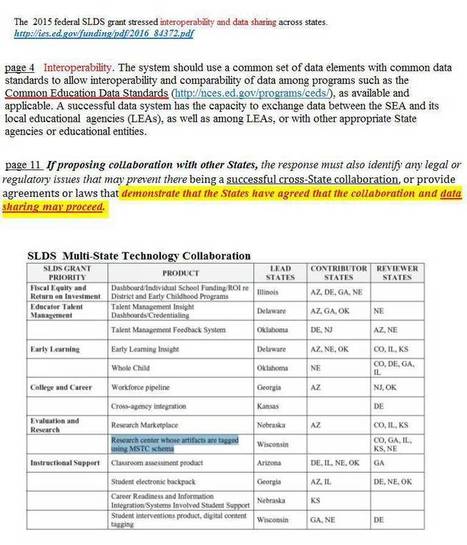
"One picture. Nine cross-state collaborations. And a company that houses all of the big testing companies and many of the big education reform players as well as some unusual shockers."...
...
..."Similar bills went through in other states, and nearly all of them had the same amendments added and the lobbyists swarmed in to make sure the following language was added, which is taken from the final legislation for Senate Bill 79:
(6) Nothing in this subsection prohibits an operator from using student data for any of the following:
a. Maintaining, delivering, supporting, evaluating, or diagnosing the operator’s Internet website, online or cloud computing service, online application, or mobile application.
b. Adaptive learning or customized student learning purposes.
(7) Nothing in this subsection prohibits an operator from using or sharing aggregate student data or de-identified student data for any of the following:
a. The development and improvement of the operator’s Internet website, online or cloud computing service, online application, or mobile application, or other educational Internet websites, online or cloud computing services, online applications, or mobile applications.
b. Within other Internet websites, online or cloud computing services, online applications, or mobile applications owned by the operator, and intended for school district, school, or student use, to evaluate and improve educational products or services intended for school district, school, or student use.
c. To demonstrate the effectiveness of the operator’s products or services, including their marketing."...
______
"A company called IMS Global Learning Consortium has ALL the major players involved. They are an umbrella company for data to be shared between all of these companies"... "Contributing Members Act, American Institutes for Research, Bill & Melinda Gates Foundation, Blackboard, California State University, Data Recognition Corporation, ETS, EduCause, Harvard Business Publishing, Houghton Mifflin Harcourt, IBM, Indian River School District, Intel, Learning.com, Lumen, McGraw Hill Education, Measured Progress, MediaCore, Microsoft, National Student Clearinghouse, Northwest Evaluation Association, Pacific Metrics Corporation, PARCC, Pearson, Public Consulting Group, Qualcomm Education Inc., Questar, Samsung, Schoology, Smarter Balanced Assessment Consortium and numerous other companies and universities in the United States and around the world.
Affiliates ACE Learning, College Board, Google, Red Clay Consolidated School District, Scantron, Scholastic, SunGard K-12 Education (houses Delaware e-school and IEP Plus), WestEd and many more.
And then they have hundreds of Alliance Participants. You can see what all the members get for their dues to IMS."...
###
For original full post on Exceptional Delaware, please click on title above or here:
https://exceptionaldelaware.wordpress.com/2015/10/08/the-data-consortium-that-allows-student-information-to-be-shared-with-hundreds-of-companies-universities-globally/
For additional background about data sharing: http://colohub.weebly.com/data-connect-the-dots.html
|
|
Scooped by
Roxana Marachi, PhD
September 16, 2015 6:59 PM
|
|


![Carta Abierta a la Junta de Educación del Estado de California Respecto a la Publicación de Calificaciones [Falsas] SBAC // (Spanish Translation of Open Letter on EduResearcher.com) | "Testing, Testing, 1, 2, 3..." | Scoop.it](https://img.scoop.it/-ZvOglyelf10b1e6cI995Tl72eJkfbmt4t8yenImKBVvK0kTmF0xjctABnaLJIm9)