


Take a cue, or two, from these successful TED Talk speakers to improve your own presentations.

 Your new post is loading...
 Your new post is loading...
Your new post is loading...
 Scoop.it!
Take a cue, or two, from these successful TED Talk speakers to improve your own presentations. 
No comment yet.
Sign up to comment
Scoop.it!

"If you have been tempted to look down at your phone in the middle of a presentation – no matter how relevant the content – you suffer from The Swipe Effect."
Bovee & Thill's Online Business Communication Magazines's insight:
"The Swipe Effect is the influence our phones have on our ability to stay focused in the moment. It is the consequence of our curiosity (or anxiety) about what could be waiting for us: a text, a voicemail, a post – a message of any kind. It is more habit than disinterest. It is what draws us away from the presenter to our mobile devices." . . .
Scoop.it!

First you must grab your listeners' attention--then you need to hold it. Check out these simple ways to do both.
Bovee & Thill's Online Business Communication Magazines's insight:
"Here are 10 techniques that are guaranteed to earn you more attention without losing any of your professional credibility." . . .
Scoop.it!
Bovee & Thill's Online Business Communication Magazines's insight:
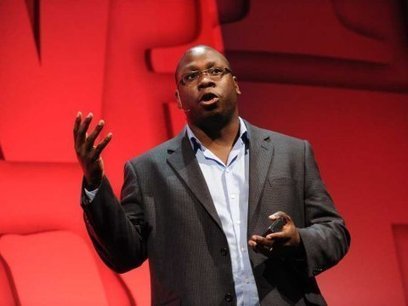
To make sure you don’t lose your audience, here’s Boris Veldhuijzen van Zanten, serial entrepreneur and founder of TwitterCounter and The Next Web, with 10 things you should never say during your presentations:
Scoop.it!

Kenny Nguyen started with $1,000 in his pocket. It's been a little over a year and Kenny Nguyen, the 21-year-old founder of Big Fish Presentations, is telling Fortune 500 companies how to do presentations the right way. "I realized the world's top companies have forgotten how to present and rely on software to do the talking," Nguyen told us. . .
Scoop.it!

Presenting to a group of employees or to investors are important activities for a business owner or manager, and letting nervousness prevent you from delivering what you need to deliver is something you want to do your utmost to prevent.
Whether it is inexperience, fear, lack of preparation or any other factor making you nervous, there are ways you can overcome nervousness, and make a professional presentation.
This excellent article offers 12 tips to help you overcome your nervousness and prevent you from delivering a poor presentation. Via Kenda Morrison, Daniel Watson, Bovee & Thill's Online Business Communication Magazines
Scoop.it!

If your list of career resolutions for this coming year doesn’t include, “Improve public speaking skills,” maybe it should.
Bovee & Thill's Online Business Communication Magazines's insight:
Here are key lessons that I've learned as a public speaker. . .
Scoop.it!

Tomorrow you're delivering a sales presentation to your company's biggest client. Your boss and the client company's CEO will be there.
A lot's riding on a deal going through; what you say and how you say it will really count. This article from Harvard Business Review looks at Good Stress vs Bad Stress, and provides valuable tips.
Scoop.it!

The definition of emotion is a rather dubious one: “an affective state of consciousness in which joy, sorrow, fear, hate, or the like, is experienced.”
In short, emotion is how we feel, whether that is anger, fear, sadness, happiness, anxiety, guilt, shame or jealousy. Emotion is complicated, and sometimes given a bad rap.
The word ‘emotional’ has a myriad of negative connotations associated with it; usually it’s a sign of weakness or lack of self-control. However, humans are a fundamentally emotional species. We laugh, we cry, we smile, we seethe and we emphasize.
The use of emotion should be thoughtfully considered when preparing a presentation. When used correctly, it can significantly strengthen a presentation’s message. . . Via Donna Lipman
Scoop.it!
Scoop.it!

Here are 10 quick tips to help you add polish at the podium, enjoy your public speaking experience and influence your listeners.
Scoop.it!
Steve Jobs was regarded as a marvellous presenter, through traits such as: connect to the audience … be your authentic self … tell stories rather than facts … reveal your personal life struggles. See what you can learn from these examples.
Scoop.it!

Here's what you can learn from them. ;
Bovee & Thill's Online Business Communication Magazines's insight:
One of the things that differentiates the leaders people gravitate to, connect with, and follow is their ability to communicate. That doesn't just mean speeches. Informal events can take as much skill as a speech in front of thousands. . .
|
Scoop.it!

From
www

Have you ever felt like you're talking, but nobody is listening? Here's Julian Treasure to help. In this useful talk, the sound expert demonstrates the how-to's of powerful speaking — from some handy vocal exercises to tips on how to speak with empathy. A talk that might help the world sound more beautiful.
Scoop.it!

The experience of sitting through a truly terrible presentation is nearly universal. The dozens of identically-themed PowerPoint slides stacked with text, the useless handouts, the tense, miserable minutes of silence during the time allotted for Q&A--presentations rarely energize a team or allow the speaker to fully display the depth of their knowledge.Most people have attended one of these monstrosities and, whether anyone would willingly admit it or not, quite a few of us have likely also given one of these anemic performances.So how can you ensure you never find yourself flailing while packed room blinks back at you?
Scoop.it!
Bovee & Thill's Online Business Communication Magazines's insight:
This assessment of your skills at using PowerPoint will help you understand what skills you need to learn in order to be a more proficient user of PowerPoint for your presentations. If you came to this page directly from outside this website, this is one of two assessments that are more fully described on this page introducing the PowerPoint Effectiveness Assessment. Resources for Learning You can learn many of the skills in the list by using the PowerPoint Tutorials on this site. These short videos have you sitting beside me as I demonstrate a skills. You can see the list of more than 30 videos here. . .
Scoop.it!
Bovee & Thill's Online Business Communication Magazines's insight:
A lot of people are talking about telling stories during a presentation. Why is that? Stories are
Here’s a related post from Garr Reynolds, “We learn from stories and experiences” . . .
Scoop.it!
Matt Helmke, Director with Zer0 to 5ive provides an overview of key take-aways from author Garr Reynolds' book, Presentation Zen.
Scoop.it!

Drowning in a sea of mediocrity? Use these easy tricks to make your presentations more compelling & persuasive. . . Via Donna Lipman, Antonios Bouris
Scoop.it!

Stanford students each had to give a one-minute speech, and then their talk was evaluated by the group. Not surprisingly, the presenters who were the most polished got rated most highly. But then the researchers got clever: . . .
Scoop.it!
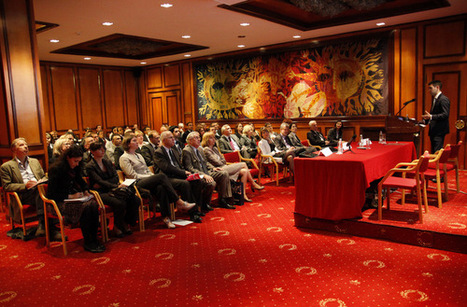
It is all too easy to let other people distract you from being amazing. Let me tell you how I really learned that lesson all over again a few days ago. As a popular speaker, I have the unique and wonderful opportunity to speak all over the world to big companies, business organizations, and non-profits. Like much of what you read on my blog, the discussion is an unconventional one. . .
Scoop.it!
Great presenters understand how people think, learn, and react. In this video, Dr. Weinschenk shares five things from her book, "100 Things Every Presenter Needs To Know About People," . . .
Scoop.it!

Quite often when you are listening to a speaker, teacher or seminar leader, you are thinking to yourself that this person is either a really good presenter or a boring one. For some reasons you are not totally sure of, you have put that person in your mind in one of these two classifications. . .
Scoop.it!
From
vimeo
An effort to eliminate "death by PowerPoint." Good advice here for that guy in your organisation (not you of course) who uses PowerPoint as a crutch ... and a sedative.
In my own work with coaching clients, we always look for creative ways to use PowerPoint (or Keynote for Mac users) and whiteboards and flip charts.
Scoop.it!
Bovee & Thill's Online Business Communication Magazines's insight:
Stories are a very integral part of being persuasive. You’d think that as a guy that loves research and data, I’d be averse to storytelling as a whole.
|










"While captivating an audience is a skill that takes years to develop, there are some simple ways to instantly improve your speaking and presentation skills. Here are simple tips for preparing, practicing, and rapidly improving your skills."