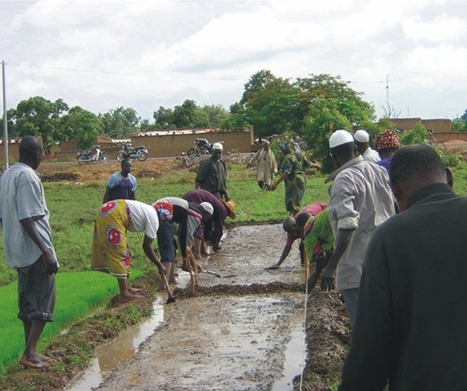
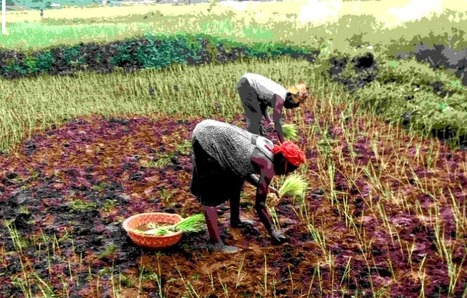
Programme Tinga Neere: En soutenant Amapad al technique du SRI, en plus de notre objectif nes général de développement de pratiques agricoles économe en eau, respectueuses de l’environment et performantes, notre projet est d’aider le riz du Burkina a trouver sa place sur le marché locals. La première colaboration entre Ingalañ et Amapad s’est déoulée en 2012 pour une formation reçu par des producteurs et productrices de Banfora, chef lieu de la province du Comoé. La coopérative de Padre, province du Kadiogo en Région du Centre a été accompagnée les 2 années suivans. Ce fût ensuite au tour de producteurs et productrices Komki Ipala en Kadiogo également.
SRI-Rice's insight:
Tinga Neere Program: In addition to the general objective of developing water-efficient, environmentally friendly and efficient agricultural practices, the SRI project set out in 2012 to help Burkina Faso rice producers beginning with Banfora, capital of the Comoé province. The Padre cooperative, Kadiogo province in the Center Region was supported for the next 2 years, followed by producers Komki Ipala in Kadiogo.
Les nouvelles versions de Simulgames sont de retour mettant ainsi fin, à l'ancienne version. Ceux qui ont cette version ancienne, sont priés de télécharger la nouvelle version disponible en français, Ewe et Kabyè, renseigne le Ministre de l’Agriculture, de la production animale et halieutique.
Le premier objectif est de permettre à un agriculteur d’accéder à un ensemble de connaissances et de pratiques qui contribuent à améliorer ses revenus, la qualité et les rendements de chaque culture grâce à l’acquisition des pratiques de la méthode SRI (système de riziculture intensive). Deuxièmement, les jeux visent à changer le regard des jeunes sur les métiers de l’agriculture, et démontrer qu’avec ce travail, il est possible de gagner sa vie et de produire des emplois pour les habitants des villages.
SRI-Rice's insight:
The Simulgames project is intended to boost employment and agricultural production capacities with the massive training of young people in villages with simulation games on mobile. A new version is now available in French, Ewe and Kabyè languages. The game allows a farmer to access a set of knowledge and practices that contribute to improving his income, quality and yields of each crop through the acquisition of practices of the SRI method (System of Rice Intensification). The games also aim to change the way young people view agricultural professions, and demonstrate that with this work it is possible to earn a living and create jobs for the inhabitants of the villages.
Productions to produce a new show abaaaaaaaout the Beefmaster breed. We continuously receive positive feedback from breeders and commercial acattlemen, so we continue to rely on The American Rancher for advertising opportunities. Great experience!”mineral for our cows this past spring. Now we are using the Vita Charge® Stress Tub and Stress Tub HEAT®. Even with the stress of …Read More
A great book for all ages! livestockanimalexchange.com
Animal Farm is a very good book. I personally think that it’s a book for all ages. For example, little kids can read it and just think it’s a fairy tale about animals whereas, older kids will probably get the true message and understand that it’s about power.
Animal Farm does not exactly fit the ideal of a modernist novel, as it is written using traditional forms—fable, fairytale, allegory—but it does fit the first two characteristics, at least to some extent. Orwell’s fable is a critique of the modern world, especially of Soviet i recomment https://www.livestockanimalexchange.com/
LEICESTER LONGWOOL SHEEP FOR SALE Leicester Longwool sheep for sale The Leicester Longwool is one of the “luster longwool” breeds, so designated for the sheen and brilliance of their wool. The sheep appear to shine just after shearing, when the clean wool next to their skin catches the sunlight and makes them glisten for a…
Here at https://www.livestockanimalexchange.com/ , we understand the value of purebred Brahman genetics. We emphasize performance, soundness, fertility and beef production in our Brahman herds. With both gray Brahman and red Brahman cattle for sale, Moreno Ranches is one of the top sellers of Brahman cattle in Florida and now in Texas, too. In fact, people looking for Brahman…
HOLSTEIN HEIFERS CATTLE FOR SALE, beef carcass meat, pregnant heifers as well as customers special orders based on the shipping within usa
Contact Us Today
Name *
First
Last
Numbers
Email *
Comment or Message *
CONTACT US ONLINE 24/7 LIVE CHAT
Contact Rent-A-Center online through our customer service inquiry and you will … make your experience more enjoyable, please call us or send us a message. Get answers to the most popular FAQs and easily contact us through either a secure email address, a mailing address WE ARE ALSO ONLINE 24/7 ON OUR LIVE CHAT FEEL FREE TO CONTACT US if we have been this successful in business, it’s because we are honest, reliable and always satisfy our customers,
The American Brahman breed of cattle originated fromBos Indicus cattle. These hardy cattle were originally brought to the United Stated from India. The American Brahman was the first beef cattle breed developed in the United States. The American Brahman are for the most part the result of a cross of four different Indian cattle breeds: Gyr, Guzerat, Nelore and Krishna Valley. Best place to buy livestock online at Livestock Animal Exchange.
The American Brahman cattle originated from a nucleus of approximately 266 bulls and 22 females of several Bos indicus varieties of cattle which were imported into the United States between 1854 and 1926. The American Brahman has been used to develop numerous other U.S. Beef Breeds of cattle including Brangus, Beefmaster, Simbrah and Santa Gertrudis.
Brahman cattle are known for their extreme tolerance to heat and are widespread in tropical regions. They are resistant to insects due to their thick skin. Brahman cattle live longer than many other breeds, often producing calves at ages 15 and older. Best place to order livestock online
At Bulter Brahmans we have both Polled Brahman Cattle as well as Horned Brahman Cattle. If you are looking for Polled Brahman bulls, Polled Brahman heifers, horned Brahman bulls or horned Brahman heifers, we always have a nice selection of American Brahman Cattle available for sale. Best place to buy livestock online within USA and worldwide with express delivery.
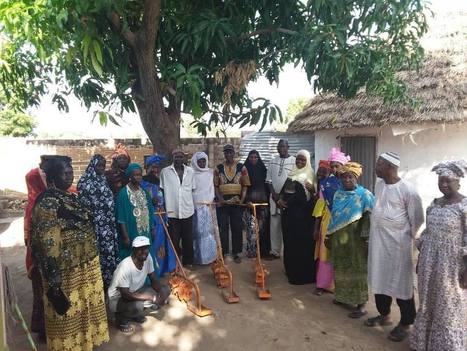
The System of Rice Intensification (SRI) was introduced in the Mwea irrigation scheme in Kenya in 2009. After introduction and testing of various weeders there, foundries were asked to make the most effective weeders and farmers were encouraged to use them.
It is now over 10 years since SRI was introduced in Kenya. As SRI adoption has spread, the demand for weeders has grown, and individual farmers started ordering for weeders directly from the foundries. Today, rotary weeding is the preferred mode for weeding in Mwea, Ahero and West Kano irrigation schemes. The weeders are sold for between 20 to 30 USD and farmers are able to buy locally-made weeders without project support. It is a win-win value-chain development, creating employment opportunities and reducing the drudgery of labour in paddy rice production.
L’Office Riz Mopti a adopté un budget en hausse de 45% pour sa campagne 2020/21, estimé à 1,599 milliard de FCFA (€ 2,4 millions). ..L’adoption d’un Système de Riziculture Intensive (SRI) introduite par le PPAAO apparait aujourd’hui comme une formidable opportunité pour renverser la tendance actuelle, accroître durablement la production de riz et lutter contre l’insécurité alimentaire au Mali.
Le projet régional de « Développement et diffusion à grande échelle du Système de Riziculture Intensive (SRI) en Afrique de l’Ouest” s’inscrit dans le cadre du Programme de Productivité Agricole en Afrique de l’Ouest (PPAAO) à travers le Centre National de Spécialisation-Riz du Mali.
Le système de riziculture intensive, ou SRI, est une approche agro-écologique qui permet aux agriculteurs de riz de maximiser leurs rendements tout en diminuant au même temps les intrants tels que l’eau, les engrais chimiques, les herbicides et les pesticides.
SRI-Rice's insight:
This article explains that rice is a staple food in Mali but they are required to import nearly half of their rice. "SRI has the strong possibility of reversing this trend, doubling rice production and reducing food insecurity". The article further explains WAAPP/PPAAO (the program that disseminated SRI) and describes the agroecological approach.
Erika Styger presents her work on scaling-up the agro-ecological methodology--the System of Rice Intensification (SRI)--in West Africa. This journey began with one farmer in Mali 12 years ago, and had grown to 50,000 farmers in 13 countries of West Africa by 2016.
[Watch the video too!] Gambia native Nfamara Badjie grows rice in the Hudson Valley using centuries-old, West African techniques of the Jola people., have been farming rice for 1,000 years. Cornell rice expert Erika Styger is working with Badjie to study which Jola rice techniques work best in the Northeast. “Rice can be part of a new cultural and ecological landscape that adapts to climate change in New York, which makes a lot of sense in so many ways,” said Styger.
Together they are testing how an African rice variety called Ceenowa fares in the Hudson Valley climate when reared in traditional Jola rice nurseries and grown with SRI methods and staggered transplant timings. They integrated some best practices from the SRI system such as transplanting younger and single seedlings. If the SRI/Jola method proves productive, other Northeast farmers would have another technique to try. One thing is clear: Their product is in demand.
Rice cultivation in Africa: How traditional practices relate to modern opportunities-- Presentation by Pascal Gbenou on June 26, 2019, at The International Rice Development Conference and Seminar on China-Africa Development in Changsha, China
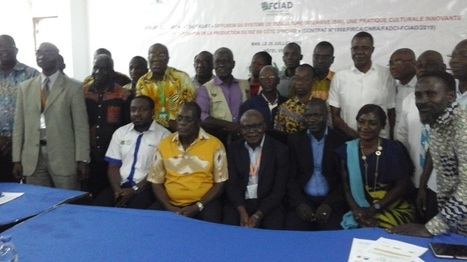
Un projet de riziculture intensive a été lancé, jeudi, à Man à l’occasion d’un atelier initié par le centre national de recherche agronomique (CNRA) en collaboration avec plusieurs parties prenantes. Cet atelier s’est tenu autour du thème “Diffusion du système de riziculture intensive (SRI), une pratique culturale innovante pour l’amélioration de la production du riz en Côte d’Ivoire”.
SRI-Rice's insight:
An intensive rice project was launched in Man at a workshop initiated by the National Center for Agricultural Research (CNRA) in collaboration with several stakeholder groups.This workshop was held around the theme "Diffusion of intensive rice farming system (SRI), an innovative cultural practice for the improvement of rice production in Côte d'Ivoire".
Despite several studies conducted on the adoption of Sustainable agricultural technologies, they remain poorly understood in Mali. Thus, research that could inform policies capable of simultaneously addressing low agricultural productivity and environmental degradation is obstructed. To begin to fill this research gap, we use cross-sectional data from rice farmers in Mali. Stochastic production frontier is adopted for rice production and technical efficiency analysis in a one-step estimation using maximum likelihood method. The results reveal that adoption of the system of rice intensification, a sustainable agricultural technology, is consonant with cleaner production concept. Particularly, adopters are more technically efficient than non-adopters. The policy implication is that, if all farmers adopted system of rice intensification, their efficiency would increase by 17% while waste in production would reduce to 4.8%. Therefore, our study puts forward substantial empirical evidence to encourage the adoption of system of rice intensification as it could eventually enhance agricultural sustainability.
The SRI-Africa website is the home of the new System of Rice Intensification (SRI) Resource Center for Africa, which is in the early stages of forming a regional network for SRI in Africa. Check out their new pages and also the SRI-Africa Research Database! SRI-Africa is headed by Dr. Bancy Mati at Jomo Kenyatta University of Agriculture and Technology in Kenya.
Presentation by Robert Bimba (Community of Hope Agriculture) to the Ministry of Agriculture in Liberia (January 11, 2019). CHAP, an SRI pioneer in Liberia, has been helping to improve farmers' productivity since 2008. Among other activities, CHAP provides leadership in SRI/SCI extension and helps farmers adapt and access new equipment, acquire certified seed, develop local markets for rice, and trial organic inputs.
SRI-Rice's insight:
CHAP just finished working on a two year project associated with the Japanese Rice Grant (entitled ‘Economic recovery of Liberian rice farmers in Ebola affected counties’). The project, which worked with 9,000 farmers in five counties and promoted SRI, was funded by the Japanese Govt. through IFAD. See impact report on the SRI-Rice website for more information.
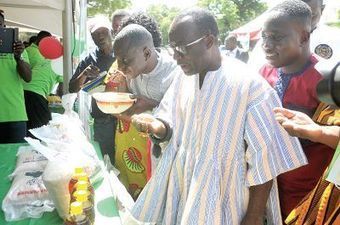
The President of the Ghana Rice Inter-professional Body (GRIB), Nana Agyei Ayeh II, speaking at the fifth Ghana National Rice Festival held in Accra on Friday, said incentives (access to credit, provision of mechanisation services, and concessionary financing) could motivate the farmers to "intensify production by adopting tried-and-tested technology of systems of rice intensification (SRI) to increase yield and boost production by at least 50 per cent."
Cette formation de 5 jours sur le SRI est en pratique et sur place au centre de formation. Le système de riziculture Intensif (SRI)... introduit au Mali par AFRICAIRE et mis en échelle par l’USAID dans certaines régions.
Les objectifs visés par la formation, c’est de diffuser à grande échelle cette technologie afin de réduire le coût de la production tout en augmentant le rendement. Cette formation est utilisée dans la pratique à l’aide d’une démonstration pratique sur les différents principes du SRI.
SRI-Rice's insight:
This five-day SRI training (Nov. 12-16, 2018) Agroforma training is being organized by CEFE Niono in Niono, Mali. Contact the website for other training opportunities for SRI and other topics.
Le FIRCA, unité de coordination technique et fiduciaire du Programme de Productivité Agricole en Afrique de l’Ouest (PPAAO/WAAPP), a introduit technologies agricoles dans le secteur du vivrier en Côte d’Ivoire, sur la période de 2011 à 2016. M. KOUAKOU Marcel est l’un des précurseurs en Côte d’Ivoire, producteur de riz vivant à Yamoussoukro.
SRI-Rice's insight:
FIRCA, technical and fiduciary coordination unit of the Agricultural Productivity Program in West Africa (WAAPP/PPAAO), introduced agricultural technologies in the food sector in Côte d'Ivoire from 2011 to 2016. M KOUAKOU Marcel is one of the pioneers in Côte d'Ivoire, a rice producer living in Yamoussoukro, who continues to promote SRI.
Since the outbreak of the COVID-19 global health crisis is also affecting food security across Liberia and throughout Africa, the Community of Hope Agriculture Project (CHAP) initiated ways of keeping her out-grower scheme farmers under the “Rice Investment for Empowerment” (RISE) growing food during this crisis period in support of Government Liberia C-19 Food Security Plan through the Ministry of Agriculture, calling on everyone to grow something during the lockdown.
According to Robert Bimba, CHAP continues promoting SRI principles for growing rice under the current health crisis as was done during the Ebola crisis in 2014-2015 through the regional SRI-WAAPP program. An interesting development is that many farmers see the SRI principles as similar to the COVID-19 health precautions. These include wider spacing (social distancing), single seedlings (avoiding crowds), AWD (frequent hand-washing), and increased soil health (keeping healthy), to name a few. [For the rest of the list, see Robert Bimba's article.]
[French language video on SRI for farmers in Burkina Faso.] Le Système de riziculture intensive (SRI) permet de réduire les coûts de production du riz car utilise peu de semence, d’eau et d’engrais chimiques tout en assurant une augmentation des rendements.
GODFREY Pascal is one of young rice growers in Kilosa District who are benefiting from the Partnership for Sustainable Rice Systems Development in Sub-Saharan Africa project. ...He describes that project and the System of Rice Intensification (SRI) as a game-changer due to the fact that it triples rice production per acre which in turn addresses food securtiy and poverty.
Il y a trois ans, des riziculteurs de la préfecture de Zio ont bénéficié d’une formation sur le système de riziculture intensive (SRI). Aujourd’hui, ils sont heureux à l’instar de Padawi Siou, l’un des tous premiers producteurs du riz d’Agbélouvé Centre à avoir adopté ce système. Au vu des bienfaits de ce système, il ne cache pas sa joie pour avoir réussi.
...90% des producteurs de riz ont adopté le SRI. Ce qui donne à présent un rendement considérable et amélioré. 4,95 tonnes de riz à l’hectare contre 2,49 tonnes à l’hectare pour la méthode dite conventionnelle et où on sème à la volée le riz. A Agbélouvé, les formateurs procèdent par des séances de formation pratiques. Selon Abra Mafili, gérante de l’unité de transformation, grâce à l’approche du PPAAO dans la vulgarisation du SRI, il y a augmentation du rendement.
SRI-Rice's insight:
Three years ago, rice farmers from Togo's Zio Prefecture participated in System of Rice Intensification (SRI) trainings. Padawi Siou, one of the first rice producers of Agbélouvé Center to adopt SRI after attending trainings through the NGO GRAPHE via the West Africa Agricultural Productivity Program (WAAPP), credits SRI with his improved financial conditions.
... 90% of rice producers associated with the Agbélouvé Center have adopted SRI, which now gives an improved return: 4.95 tons of rice per hectare against 2.49 tons per hectare for the conventional method.
Sud du Togo, Préfecture du Zio. Des agroéleveurs se sont perfectionnés dans le choix des semences de riz, la réalisation des pépinières et la mise en terre des plants de riz. Les agroéleveurs de l’UCA-ZIO, GRAPHE, ESFT et ESF vous présentent les avancées obtenues suivant les méthodes du Système de Riziculture Intensive.
SRI-Rice's insight:
South of Togo, Prefecture of Zio.Farmers improved rice seed selection, nurseries and transplanting.The success of these activities depends on the quantity of rice and straw produced: Local rice that can satisfy Togolese consumer demand and straw that can be used for animal feed orcompost production. In this video, the agro-pastoralists of UCA-ZIO, GRAPHE, ESFT and ESF present the progress made with SRI.
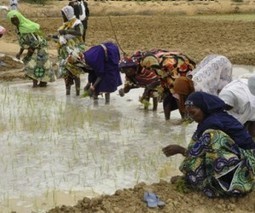
Gambia Commercial Agriculture and Value Chain Management Project (GCAV), in partnership with Department of Agriculture (DoA), conducted a ‘System of Rice Intensification’ (SRI) or single planting of rice training in Central River Region (CRR) from 20th – 23rd of July 2019.
The training targeted the communities of Tuba Demba Sama, Wellingara, Kerewan in CRR South and Kuntaur in CRR North; and a total of 60 farmers, mostly women, benefited from the training.
Rice is the second most important staple food in Ghana. The system of rice intensification (SRI) technology has been introduced in farmers' fields, and its adoption is increasing. Using a bivariate probit model and maximum likelihood estimation methods, the study tests whether or not there is a complementarity relationship between adoption of SRI technology and membership in a cooperative. Results reveal that there is positive relationship between the SRI adoption and social capital participation. The study identified covariates including age, gender and educational level of respondents as influencing both the adoption of SRI technology and participation in a cooperative
SRI-Rice's insight:
Yahaya, Iddrisu, et al. 2019. Complementarity of technology adoption and social capital participation: The case of Systems of Rice Intensification in Ghana. Journal of International Development (online first July 1). doi: 10.1002/jid.3420
The Community of Hope Agriculture Project (CHAP) in collaboration with authorities at the Ministry of Agriculture (MoA), recently launched the “Love Liberian Rice Campaign,” which aims at improving food security in the country through rice production, processing and marketing. CHAP has taught the farmers the “System of Rice Intensification” to increase the production of rice. Montserrado District #2 Representative, Jimmy Smith, who launched the campaign on behalf of the Vice President Jewel Howard-Taylor, called on all Liberians to support the process and promised to purchase 200 bags CHAP's rice to promote the campaign. Paynesville City Mayor, Palm Belcher-Taylor, pledged L$85,000 in support of the Campaign as well.
CHAP Executive Director, Robert Bimba said that the initiative aims at soliciting a volunteer contribution of US$1 from each individual, mainly those that are engaged in agriculture activities, to purchase farming implements to empower smallholders’ farmers. He said about 5,000 smallholder farmers, mainly women, are expected to benefit from seed rice under the program beginning with farmers in Bomi County.
SRI-Rice's insight:
CHAP has a new website!! You can read more about the Community of Hope Agriculture Project (CHAP) here: http://www.chapliberia.org/
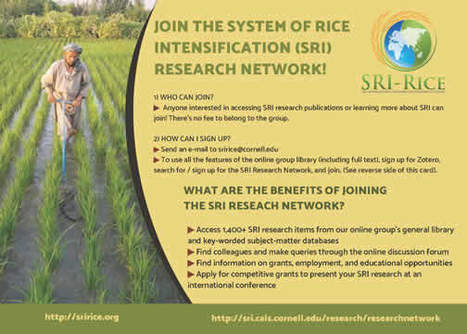
Visit the SRI Research Network's Africa Collection, which now has 125 research items. In addition to the 84 journal articles about the System of Rice Intensification in Africa, there are also theses, presentations, and other documents. Join the SRI Research Network (it's free!) [ALSO!!: The SRI-Africa site will soon have its research database online! Stay tuned!]
SRI-Rice's insight:
What's can you find at the SRI Research Network site? Information on upcoming global events, grants, jobs, and educational opportunities. Members can also apply for competitive travel grants to present SRI research at upcoming international events [Open to those in Asia, Africa and Latin America]
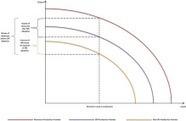
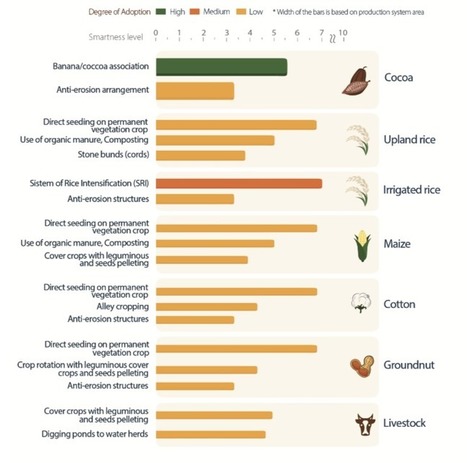
The climate-smart agriculture profile of Côte d’Ivoire defines entry points for investing into and scaling climate-smart practices to achieve sustainable development. Climate-smart agriculture (CSA) is proposed as a solution to guide actions needed to transform and reorient agricultural systems to effectively support development and ensure food security under a changing climate. The approach aims to tackle three main objectives: sustainably increase agricultural productivity and incomes; adapt and build resilience to climate change; and reduce or remove greenhouse gas emissions, where possible. [NOTE THE "SMARTNESS LEVEL" and "DEGREE OF ADOPTION" fFOR THE SRI ENTRY IN THE GRAPH!!]
SRI-Rice's insight:
The graph in this CCAFS article shows that, compared with other CSA innovations in Côte d’Ivoire, SRI is at the highest "smartness" level achieved there and is the second most adopted CSA innovation in Côte d’Ivoire!!
La Direction régionale de l’agriculture de Gao, en partenariat avec le Centre d’innovations vertes pour le secteur agro-alimentaire (CIV) de la coopération allemande au développement (GIZ), a organisé, jeudi dernier, une journée porte ouverte sur le Système de riziculture intensive (SRI). La parcelle vitrine n°10 de feu Abdoul Aziz Moussa à Forgho Almata a servi de cadre à cette activité.
Le maire de la commune de Soni Ali Ber, Abdoul Razack Maïga, dira que sa commune possède 22.000 ha irrigables. Ici, avec le SRI et le PASSIP, les conditions de vie des paysans ont été améliorées et aujourd’hui ils ne vont plus à l’exode parce qu’ils parviennent surtout à économiser. Il a invité les techniciens de l’agriculture et leurs partenaires à consolider cette pratique et à accompagner les agriculteurs afin que l’agriculture nourrisse son homme.
To get content containing either thought or leadership enter:
To get content containing both thought and leadership enter:
To get content containing the expression thought leadership enter:
You can enter several keywords and you can refine them whenever you want. Our suggestion engine uses more signals but entering a few keywords here will rapidly give you great content to curate.


 Your new post is loading...












Tinga Neere Program: In addition to the general objective of developing water-efficient, environmentally friendly and efficient agricultural practices, the SRI project set out in 2012 to help Burkina Faso rice producers beginning with Banfora, capital of the Comoé province. The Padre cooperative, Kadiogo province in the Center Region was supported for the next 2 years, followed by producers Komki Ipala in Kadiogo.