Dr.Yang Saing Koma| បិតាប្រពលវប្បកម្មដំណាំស្រូវស្រុកខ្មែរ|King of SRI in Cambodia|ប.វ.ស|
SRI-Rice's insight:
While the video is in Khmer language, it is great to see the scope of work on SRI and other agricultural innovations by Yang Saing Koma over the past 15+years. Koma is the first in Cambodia to try SRI and has provided leadership to the SRI community there for many years as head of the NGO CEDAC.
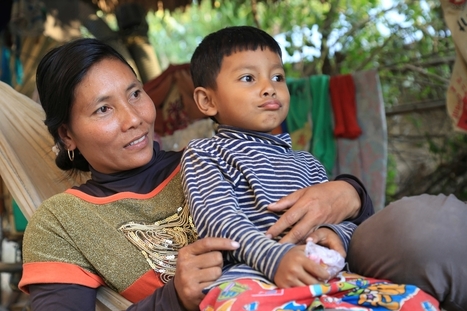
Mrs Tea Sarim is one of the participating farmers in a European Union funded multi-country (Cambodia, Lao PDR, Vietnam and Thailand) project called "Sustaining and Enhancing the Momentum for Innovation and Learning around the System of Rice Intensification (SRI) in the Lower Mekong River Basin" (http://www.sri-lmb.ait.asia/). Mrs Sarim is from Kampot Province in Cambodia, where she farms paddy rice. Read her story here.
Women farmers usually also have family caregiving responsibilities, as well as pressure to produce food and earn cash. The pressure to feed and educate all her younger siblings was sometimes too much for Sopheap. ... a few years of improved rice production using SRI has changed everything. First, she grew enough to eat and to sell. She fixed up her house, got all her brothers and sisters in school, and encouraged others to try SRI practices. Her ability as a trainer gained her respect, and she became deputy chief of her village.
It is said that ‘rice is grown on women’s backs’. Globally, around a billion people cultivate rice, of which 50 to 90 percent are women. With conventional practices, they perform backbreaking tasks like seedling removal, transplanting and weeding in bent posture and under wet conditions for more than 1000 hours per hectare. In addition, they are exposed to chemicals. But the System of Rice Intensification (SRI) enables farmers to work under healthier conditions while creating various other physical and social benefits. The consequences are significant, as we learn from women in India, Malaysia and Cambodia.
We simply cannot end hunger and poverty without tackling climate change. The new global goals recognize this and world leaders must also. ....By following a special technique to grow rice called System of Rice Intensification (SRI) and support from Oxfam, the women farmers I met were able to produce up to 150 percent more rice with less water and less labor.
Ches, Sophy, and Eiji Yamiji. 2015. Labor requirements of System of Rice Intensification (SRI) in Cambodia. Paddy and Water Environment (July) http://t.co/HNTGMLGW9h Findings showed little or no difference between SRI labor requirements and conventional practices. Also, the degree of SRI adoption shows no correlation between the home-to-plot distance and availability of farmer-family labor or hired labor. The key factors for improving the degree of SRI adoption are farmer zeal and careful attention rather than the home-to-plot distance and availability of labor. [See article for complete abstract, which details other labor-related findings.]
When Chuk Meun told his 22-year-old daughter Phaly that she could plant some rice on a small section of his land, it was the beginning of a growing season he will never forget, and a period of conflict he never expected. Phaly had SRI training from an Oxfam-supported organization called Srer Khmer, which has trained nearly 8,000 farmers in SRI. To Meun, now 64, it all looked bad. “After she transplanted I looked at the field.. it made me angry, [and] was a waste of time and land.” Phaly says he started talking with her again when he saw the results double the normal harvest in this field.” Meun slowly gave up his skepticism of SRI, and Phaly says that starting in 2011, he only plants using SRI. As a former village chief, Meun is using his status to get more farmers to try SRI. ... because it can help people increase their income and get out of poverty. Meun thinks about Phaly differently now. “I really appreciate Phaly’s agricultural skills,” he says. “I hope she can gain the trust of others to teach them SRI. I think she’s able to be a village chief in the future.”
A regional collaborative project is being implemented in rainfed areas of the Lower Mekong River Basin (LMB) countries. (http://www.sri-lmb.ait.asia/). As part of the action-research, more than 120 sets of field experiments have been carried out at 60 FPAR sites in Cambodia and Thailand, directly involving 3600 farmers. The yields were 60 and 100% higher than the average baseline yield in the region, 3.14 t/ha. The economic gains for farmers were found to be higher in rainfed areas when using the new methods.
FAO office, January 5, 2016, I was interviewed by 2 students (one Cambodian student and one Vietnamese student) from LKY University to discuss policy related to climate change adaptation measures on Cambodia's rice production. Three policy options include the implementation of System of Rice Intensification (SRI), Crop Insurance, and the Use of Climate-resilient Crop Varieties…
The TEEB study suggests that if Senegal was to change all of its irrigated lowland systems from conventional management to SRI, about US$11 million of savings in water consumption related health and environmental costs would be generated. At the same time, the rice producer community would gain a total of US$17 million through yield increases – a clear synergy.
+If the Philippines were to change all their rainfed lowland systems from conventional management to SRI, the rice producer community would gain a total of US$750 million through yield increases.
+ If all rice farmers in rainfed lowlands systems in Cambodia would change to SRI, they would increase the producer price value of rice by US$801 million. At the same time, society would incur lower GHG emissions costs (US$258 million). (See Appendix II on page 73 for the full report on SRI)
SRI-Rice's insight:
The Economics of Ecosystems and biodiversity (TEEB) is a global initiative focused on “making nature’s values visible.” Its principal objective is to mainstream the values of biodiversity and ecosystem services into decision-making at all levels.
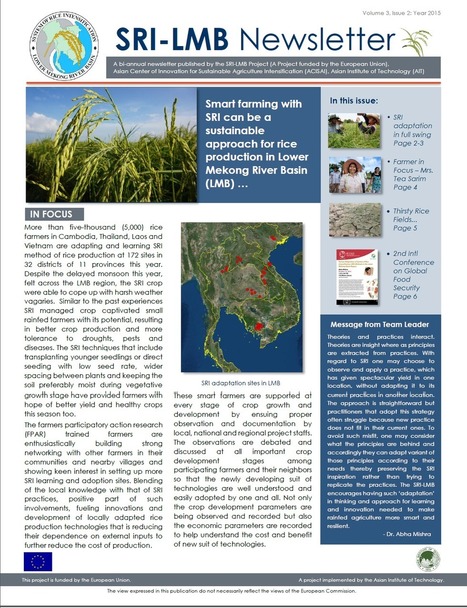
According to the Dec. 2015 project newsletter (vol III, no.2) , more than 5,000 primarily rainfed rice farmers in Cambodia, Thailand, Laos and Vietnam have been learning and adapting SRI methods at 172 sites in 32 districts of 11 provinces this year. Despite this year's delayed monsoon the SRI fields were able to cope up with harsh weather vagaries. Small rainfed farmers continued to adopt SRI methods due to better crop production as well as increased tolerance to droughts, pests and diseases. The SRI-LMB Project is spearheaded by the ACISAI Center at the Asian Institute of Technology in Pathumthani, Thailand.
Ten years ago, 5 enterprises received the first SEED Awards. Since then an additional 170 innovative social and environmental start-up enterprises have been honoured with a SEED Award. Celebrating the 10th anniversary of the SEED Awards this year, the time has come to let the public choose among ten of these outstanding 175 SEED Winners and decide upon which Winner they would like to honour with a Special Recognition Award.
SRI-Rice's insight:
PLEASE DO REMEMBER TO VOTE FOR THE SRI PROJECT IN CAMBODIA... if you feel it's the best project, that is.. Every user can assign up to 10 “SEEDs”. The SEED Winner that has received most “SEEDs” by 31 July will partake in the SEED Africa Symposium on 9-10 September 2015 and will be honoured on stage by UNEP Deputy Executive Director Ibrahim Thiaw.
To get content containing either thought or leadership enter:
To get content containing both thought and leadership enter:
To get content containing the expression thought leadership enter:
You can enter several keywords and you can refine them whenever you want. Our suggestion engine uses more signals but entering a few keywords here will rapidly give you great content to curate.


 Your new post is loading...


 Scoop.it!








While the video is in Khmer language, it is great to see the scope of work on SRI and other agricultural innovations by Yang Saing Koma over the past 15+years. Koma is the first in Cambodia to try SRI and has provided leadership to the SRI community there for many years as head of the NGO CEDAC.