Une mission de contrôle de la mise à l’échelle du SRI (Système de riziculture intensive) qui est un système innovant de culture du riz, introduit dans la région de Matam depuis 2008 par le Projet de développement Agricole de Matam (PRODAM), s’est rendue le jeudi 07 juillet dernier dans les périmètres agricoles de Diowol.
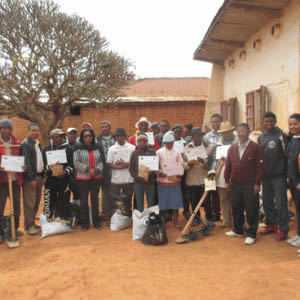
La clôture officielle de la saison rizicole 2015-2016, s’est tenue le 21 juillet dernier, pour les quatre communes bénéficiaires du Programme Avotra, dans la région Itasy. Il s’agit d’un programme d’agriculture biologique et de SRI.
Programme Avotra, an SRI project funded by the French NGO CODEGAZ in the Itasy region of Madagascar, wrapped up the rice growing season on July 21. With an average production of 11t / ha, the four municipalities in this project rank among those with the most significant returns in the country. A farmer reported "We did well to practice the system of rice intensification, as it allowed us to triple our returns.”
...The System for Rice Intensification is a global community of rice farmers who use the Internet to trade advice on agronomy practices for raising traditional rice – without pesticides or herbicides. It amounts to a kind of open-source agriculture that engages farmers from Sri Lanka and Cuba to Indonesia and West Africa. I call it an “eco-digital commons” to emphasize how Internet collaborations and natural resources are integrated. The SRI methodology has increased yields by 20 to 50 percent, and often more, and made farmers more knowledgeable, active stewards of their land. The system has developed entirely outside of government ministries and markets...
David Bollier, who has been studying the Commons for 20 years, gave this presentation outlining his vision of the commons as an alternative vision of "development." on June 21 at the Agence Française de Développement in Paris.
Robert Bimba presented this ppt on "Community of Hope Agricultural Project - SRI in Liberia" on June 15, 2016, at the SRI-Rice seminar series at Cornell University, Ithaca, New York.
On the verge of abandoning Kenya’s third most popular staple, however, Francis heard of a new technology that could reverse his dwindling fortunes. The System of Rice Intensification (SRI), introduced for the first time at the neighbouring Ahero Irrigation Scheme in 2011, had forayed into West Kano, raising hope for Francis and his contemporaries.
A UNDP-funded project by Children Care Development Organization is using SRI to help farmers cope with the adverse effects of climate change in three divisions of Pawga, Kaenga and Isimani in iringa rural district of the Iringa Region of Tanzania.
At first I thought there were few young researchers at the third Global Conference on Agricultural Research for Development (GCARD3) on 5-8 April 2016 in South Africa. That was until I met Febri Doni. He is currently doing research in the System of Rice Intensification (SRI) in the Malaysian region and is a member of Malaysian Agroecological Society for Sustainable Resource Intensification (SRI-MAS).
..Through her trainings, field trials, and positive yields, Kinsa's work spread the SRI methodology to 74 of the other women in her community. It wasn't easy, .... With experience though comes understanding, and as the other farmers tried SRI, they too became convinced. And in the process Kinsa became a model for other farmers in the region.
Find out more about the 'Improving and Scaling up the System of Rice Intensification in West Africa' (SRI-WAAPP), the 3-year first phase of a regional World Bank-financed project to increase rice productivity throughout a 13-country Economic Community of West African States (ECOWAS) project area.
"Time seems to be up for paddy rice farming as researchers unveil a new method of growing the important cereal. In Ahero and West Kano irrigation schemes, farmers are currently learning a new method of rice farming called Systems of Rice Intensification (SRI), introduced by the National Irrigation Board (NIB) in partnership with Ag SRI, an organisation from India."
Dr. George Acheampong, Southern Zone Coordinator for the System of Rice Intensification in Ghana, is encouraging the government to help SRI rice farmers mechanize.
The Ghana Rice Inter-Professional Body (GRIB) has developed a certification logo, a mark of quality rice that will be on all Ghana Rice brands to promote locally produced rice. This certification is aimed at promoting the consumption of Ghana Rice among rice consumers in the country. According to GRIB president, Imoro Amoro, “.. To be able to compete with others in the market and eliminate the idea local rice is inferior, we need to produce good quality rice that meets the expectation of consumers...We are training the farmers with a system known as rice intensification -- a system based on transplanting instead of the traditional broadcasting method, whereby one seed can grow so much rice and the paddy also comes out clean and of very high quality. So this is what we are doing to improve the quality of the local rice.”
You can now VOTE! for SRI-Rice’s proposal, “Unleashing the climate-smart potential of Africa’s forgotten rice,” which a finalist in both the Land Use and Adaptation categories in the Climate CoLab contest. The Climate CoLab is an idea innovation contest run by the Massachusetts Institute of Technology (MIT) to harness the collective intelligence of thousands of people globally to address global climate change.
The results of the study revealed that SRI plants responded better to the soil amendments and were superior to those using farmer practice in all parameters measured. See the freely available article for a detailed description of the various treatments studied.
Are you interested in adapting rice production equipment to use with the System of Rice Intensification? Come join the SRI Equipment Innovators Exchange! Just push the "join" button... and if you have an interest in small-scale weeders, transplanters, markers, direct-seeders, etc., you can begin to talk about SRI equipment with other people who are on the same page....
The National Agency for the Promotion of Rural Development (ANADER) led a first attempt at SRI in Côte d'Ivoire, training 155 rice farmers in SRI at nine test sites. Yield increases of up to 67% and farmer interest by 92% resulted. These extension efforts inspired SRI adoption outside of test sites.This major success and unanticipated rapid spread is thanks to the efforts of various people who have stepped up as SRI champions. Two dynamic extension agents, Gnamien Kouakou and Saïbou Idée, led trainings with rice producers outside of the project scope....
This study evaluated the characteristic of rice produced under SRI and conventional practices in Chimala Area in Mbarali District of Mbeya Region in Tanzania. The evaluation considered the farm management practices, rice yields and the characteristic of the rice grains. Bird scaring is among the activities which increased the production cost of rice grown under SRI practices. Rice yields under SRI practices where more than 16ton/ha against less than 8ton/ha for conventional rice growing practices. The rice grains grown under SRI practices was observed to be suitable for seeds. The quality of cooked rice indicate that rice produced under SRI practices has higher aroma and fragrance when compared to that produced under conventional practices.
Katambara, Zacharia Saimon, Marco Mng’ong’o, Consolatha Chambi, el al. 2016. Characteristics of rice produced under direct and indirect SRI practices in Chimala Area in Mbarali district Tanzania. Journal of Agriculture and Sustainability 9(1): 15–30
..Rice farmers in the SAN community unanimously agree that the SRI is a sustainable alternative to boost economic growth by increasing income in the targeted value chains including rice, to ensure food security and reduce poverty in communities...
WHRC’s Projet Equateur in the Democratic Republic of the Congo (DRC) has recently embarked on an effort to engage a village community in a sustainable rice growing venture to increase food production while reducing deforestation. Using SRI, last fall the project team sought out one of many degraded swamp areas to introduce a ‘wetland rice’ paddy. The first harvest of wetland rice has shown a remarkably successful yield and impressed the local community...
This WHRC project joins other SRI ventures in the DRC, including, among others, the Italian NGO Mazao's work with the "Social Rice Supply Chain" in the province of Tanganyika and the Belgian NGO VECO's testing of SRI in South Kivu.
Italian audio for the IFAD video production featuring Abeline Razanamamy, an elderly widow growing rice with SRI methods in central Madagascar. (See original English version)
Erika Styger 's presentation "Scaling Up Climate-smart Rice Production in West Africa" presented on February 11, 2016 Cornell University's Issues in African Development Seminar Series
M. Amadou Bonkano, Champion SRI et M. Sita Rami, technicien qui conduit les tests sur le périmètre, avec un cultivateur local qui décrit son première teste SRI dans la zone d'irrigation Sébéri (en français et djerma).
-->(English translation) A demonstration plot farmer shares his experiences with SRI, alongside SRI Champion Amadou Bonkano and technician Sita Rami at the Sébéri irrigation scheme southwest of Niamey, Niger (in French and Zarma languages).
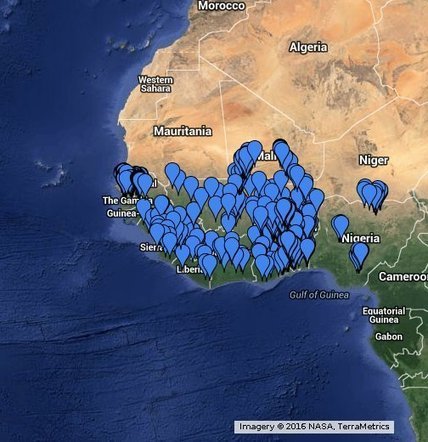
Here's the location (on google maps) of where the farmer interviews took place. Fascinating! While the farmers are talking about their SRI plots in Zarma, there is a French translation if you wait for it.. These plots are the first ones in Niger that we know of...
To get content containing either thought or leadership enter:
To get content containing both thought and leadership enter:
To get content containing the expression thought leadership enter:
You can enter several keywords and you can refine them whenever you want. Our suggestion engine uses more signals but entering a few keywords here will rapidly give you great content to curate.


 Your new post is loading...



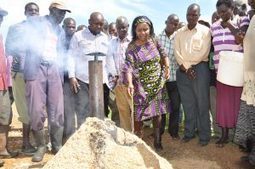


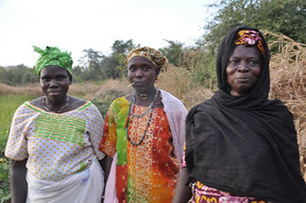
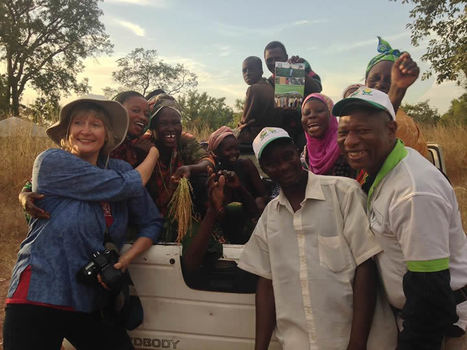

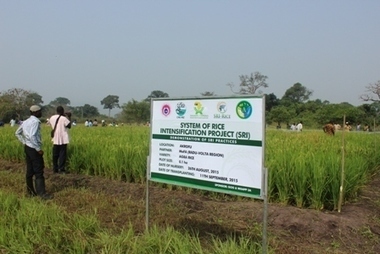








SRI was introduced into Senegal's Matam region in 2008 by Projet de développement Agricole de Matam (PRODAM). This article has lots of photos!