Farmers at the SISU Irrigation Scheme in Ifakara, Tanzania are achieving major improvements in rice production after hands‑on training on the System of Rice Intensification (SRI), locally known as kitalu mkeka, delivered through FtMA.
Previously, farmers used 20 to 30 kg of paddy seeds to plant an acre, driving up production costs and resulting in weak seedling establishment. With SRI, they now require only 3 to 6 kg of paddy seeds per acre. This has significantly reduced seed costs by 70 to 85% while producing healthier, uniform seedlings that boost field performance. SRI has also improved crop spacing, survival rates, and overall yield potential, allowing farmers to reinvest savings into fertilizers and labor. Video from: Farm to Market Alliance - LinkedIn https://www.linkedin.com/company/farmtomarketalliance/
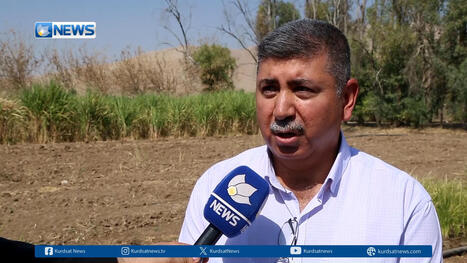
A field day to highlight the System of Rice Intensification (SRI) was held on October 7, 2025, at Kani Panka Research Station, Directorate of Sulaimanayah Agriculture Research, in northern Iraq. Follow-up was provided by SRI expert Khidhir Abbas Hameed from Al-Mishkhab Rice Research Station. The aim of the field day was to compare and contrast SRI with the traditional method of growing rice that has been practiced for many years by local farmers. SRI is especially advantageous in Iraq in general and Kurdistan in particular as rice production has been declining due to climate change-related water shortages. See full report here: https://tinyurl.com/4c5knuvd
This video by Warasha Najmin was inspired by an interview with Ashraf Uddin, a farmer from Dinajpur, Bangladesh. It explains the principles and practices of the System of Rice Intensification (SRI).
The theme of this webinar is "Insect Diversity and Dynamics in System of Rice Intensification (SRI) Cultivation" Date: 27 March 2025 Speaker: Padmavathi Chintalapati (Principal Scientist, Entomology, ICAR - Indian Institute of Rice Research, India) This is seminar #4 of the SRI Global Research Network's webinar series. See https://SRI-research.org for details
Don't miss the next SRI Global Research Network webinar (#5) on July 10, 2025! Sonali McDermid will speak on integrated climate-crop-economic SRI modeling assessment with an overview of work in Vietnam, Bangladesh, and India. Details are forthcoming...
CLICK TO WIn $1000 GIVE AWAYCLICK TO WIn $1000 GIVE AWAY `CLICK TO WIn $1000 GIVE AWAY CLICK TO WIn $1000 GIVE AWAYCLICK TO WIn $1000 GIVE AWAYCLICK TO WIn $1000 GIVE AWAYCLICK TO WIn $1000 GIVE AWAY
Validación de tecnologías del Sistema Intensivo del Cultivo de Arroz (SICA) sobre prácticas agrícolas arroceras para mejorar la productividad y el uso eficiente de agua.. Parcela Piloto SICA - Comunidad de Buenos Aires, Corregimiento El Bebedero del Distrito de Tonosí, Provincia de Los Santos.
Validation of SRI (SICA in Spanish) to improve productivity and efficient use of water in rice production. SICA Pilot Plot - Community of Buenos Aires, Corregimiento El Bebedero of the District of Tonosí, Province of Los Santos, Panama. .
WEEDBLAZER merupakan alat pembasmian gulma presisi pada lahan padi SRI menggunakan laser. WEEDBLAZER menggunakan baterai akumulator sebagai sumber daya. WEEDBLAZER dilengkapi dengan panel surya untuk pengisian ulang daya baterai sehingga memungkinkan alat beroperasi dalam jangka waktu lama, selama terdapat energi matahari yang dapat diserap oleh photovoltaic. --PKM KC 2024 IPB University
WEEDBLAZER is an autonomous precision weeding tool for SRI rice fields made as a prototype by students at IPB University in Indonesia. It uses an accumulator battery as a power source and is equipped with a solar panel for recharging the battery. WEEDBLAZER works with the deep learning object detection algorithm that allows the laser to precisely shoot the centroid point of the detected weed. It is hoped that WEEDBLAZER can increase the efficiency of weed eradication without damaging and polluting the environment.
Rice production contributes about 10% of the world's methane emissions. Reining in rice methane is a sticky problem. An innovative SRI method developed in Madagascar in the 1980s increases yields and has the promise of reducing greenhouse gas emissions. Also covered is the collaboration between cooperative efforts of Chinese and US researchers to develop perennial rice that could be a game changer for our ever-warming planet. [This is a production of Sustainable Asia podcast series.]
French language System of Rice Intensification (SRI) video from World Bank-funded PRéCA (Projet de Résilience et Compétitivité Agricoles -- Agriculture Resilience and Competitiveness Project) in Burkina Faso
Video: La plaine rizicole de Karfiguéla s'est transformée grâce au projet « Eau, CLÉ du Développement Durable » (ECDD). Autrefois désespérée en raison du changement climatique et de pratiques agricoles inefficaces, cette région prospère à nouveau. Le projet ECDD a expérimenté avec succès des pratiques agroécologiques sur une superficie de 500 m². Des agriculteurs témoignent de l'impact positif sur leurs rendements et la qualité de leurs cultures. Le projet, mis en œuvre par l’Organisation néerlandaise de développement (SNV) et l’ONG World Waternet.
English: The rice-growing plain of Karfiguéla has been transformed thanks to the “Water, Key to Sustainable Development” (ECDD) project which successfully experimented with agroecological practices, including SRI. Farmers testify to the positive impact on their yields and the quality of their crops. The project, implemented by the Netherlands Development Organization (SNV) and the NGO World Waternet.
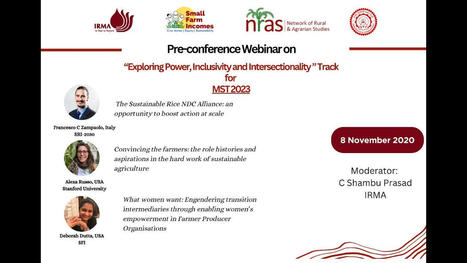
As part of the International Conference on “Managing Sustainable Transitions in Agriculture (MST 2023)," IRMA hosted a Nov. 8 pre-conference webinar on "Exploring Power, Inclusivity and Intersectionality." The first 20 minutes features Francesco Carnevale Zampaolo of SRI-2030 discussing "The Sustainable Rice NDC Alliance: An Opportunity to Boost Action at Scale." (More on the MST conference 2023 - https://www.irma.ac.in/conference/mst-2023/home)
NDC, or Nationally Determined Contribution, is a climate action plan to cut emissions and adapt to climate impacts. Each Party to the Paris Agreement is required to establish an NDC and update it every five years. To learn more about the Sustainable Rice NDC Alliance, visit https://www.sri-2030.org/the-alliance. For more information on SRI-2030, see https://www.sri-2030.org/
Burmese language video on transplanting and Inter-cultivation with SRI: 'စပါးအစွမ်းဖွင့်စိုက်ပျိုးရေး' အပိုင်း (၂) ကောက်စိုက်ခြင်း၊ ပေါင်းထိုးတမန်းနှိုးခြင်း. This is part of a series of 3 SRI videos on the C4RD channel (YouTube), which features Thein Su, Myanmar's most active SRI trainer.
The UK LINKS programme (Powering Economic Growth in Northern Nigeria), which began in 2021, is a £12m UK government-funded programme designed to support development of a vibrant, inclusive, and diversified economy in three northern Nigeria States of Kano, Kaduna and Jigawa. The aim was for farmers to increase yields and become more resilient in the face of climate change while reducing Greenhouse Gas (GHG) emissions in the country. As a result of the work with the System of Rice Intensification, 45,000 farmers were trained over four seasons, and over 26,000 farmers in Kano, Kaduna, and Jigawa are now actively using SRI. On average yields were doubled, costs were lowered, farmer income were six times highter, and GHG emissions were reduced by 40%.
Something new is often initially rejected, later accepted and down the line aspired! Hear first hand from our farmer in Vikramgad, Palghar whom we introduced the SRI method of rice cultivation, to help farmers get a better yield.
This short AI-generated video on YouTube's "World of Agriculture" channel explains in 3 minutes System of Rice Intensification (SRI) practices and how they offer flexibility for farmers to tailor the methods according to local conditions. This adaptability makes SRI an excellent option for smallholder farmers in regions where resources may be scarce.
Discover how Tanzanian farmers are boosting rice production despite climate change using System of Rice Intensification (SRI)! Learn key practices like young seedlings, reduced water use, less fertilizers, and smart spacing to grow more rice with fewer resources.
The theme of this January 21, 2025, webinar is “System of Rice Intensification (SRI) Research in Africa” (This is the third in the SRI Research Webinar Series, which is hosted by the SRI Global Research Network.) Speakers were: 1. Aisha Abdulkadir (Ahmadu Bello University, Nigeria) presented “Enhancing Food Security in Africa through SRI: Challenges and Opportunities” 2. Primitiva Andrea Mboyerwa (Sokoine University of Agriculture, Tanzania) presented “Eco Rice: The SRI’s Pathway to Multiple Sustainable Development Goals”
"Asia Initiatives and Dilasa Janvikas Pratishthan tested the System of Rice Intensification (SRI) in combination with social capital credits (SoCCs) in one of their projects to empower women in Sindhudurg district of Maharashtra, India. By promoting sustainable farming practices, they are not just enhancing livelihoods but also fostering climate resilience and environmental conservation for those most vulnerable to climate catastrophes in some of the marginalized regions of the world."
The theme of this second webinar (Oct. 24) in the SRI Global Research Network Series is "The Integration of System of Rice Intensification (SRI) with Intercropping." Event speakers were: 1. Francesco Carnevale Zampaolo (SRI-2030, UK) spoke on "Compatibility between Conservation Agriculture and the SRI" 2. Tavseef Mairaj Shah (CinSOIL GmbH & Hamburg University of Technology, Germany) spoke on "iRice - Intercropping Beans with Rice under the SRI as an Innovative Agroecological Approach" For more info, visit the SRI Global Research Network: https://sri-research.org
It’s late summer and the rice is high and ready for harvest. Nazirahk Amen of Purple Mountain Grown in Maryland (USA) has been growing rice for almost a decade and today he is harvesting one of the seven varieties that he grows and sells. Find our more about how he has adapted the System of Rice Intensification (SRI) for conditions on his farm in Prince Georges County, Maryland.
How can we produce rice in a way that uses fewer resources and regenerates nature? In this episode Ellen MacArthur Foundation's Transforming Tradition series, we hear why a growing number of farmers around the world are changing the way they produce rice, by adopting an agroecological approach called the System of Rice Intensification (SRI).
[Video]: Economic empowerment of Women through the application of the System of Rice Intensification (SRI) method in Sindhudurg District, Maharashtra, India (2022-23)
Konda Mason is co-founder and president of Jubilee Justice, a non-profit dedicated to regenerative agriculture, racial justice, cooperative practices, and healing the wounds of Black American land loss and racism. They are in the fourth year of a rice-growing program, the system of rice intensification (SRI), a dry-land technique for growing rice that’s healthy for land and consumers and efficient and productive for farmers.
(This podcast is a collaboration between Quivira Coalition and Mary-Charlotte Domandi of Radio Cafe.)
Discover the inspiring story of Zambian entrepreneur Henry Ngimbu and how he’s making a difference in rural communities in his home country through the System of Rice Intensification (SRI). Learn about the four key areas he believes are paramount to growing SRI in Zambia and the potential for SRI adoption in the country. TO LEARN MORE ABOUT HENRY"S JOURNEY, READ HERE: www.sri-2030.org/blog-post/henry-ngimbu-zambia-sri-story
To get content containing either thought or leadership enter:
To get content containing both thought and leadership enter:
To get content containing the expression thought leadership enter:
You can enter several keywords and you can refine them whenever you want. Our suggestion engine uses more signals but entering a few keywords here will rapidly give you great content to curate.


 Your new post is loading...