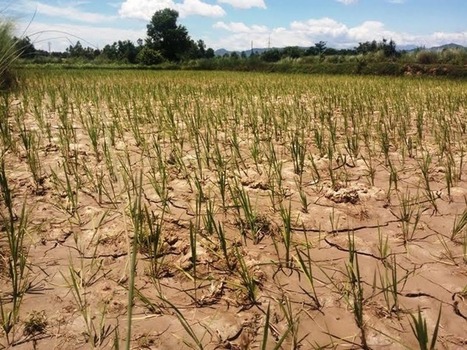
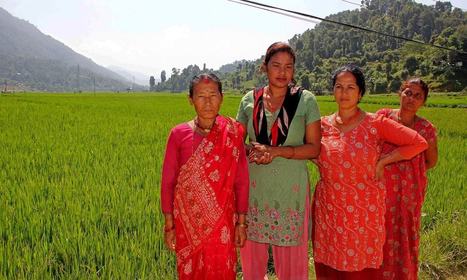
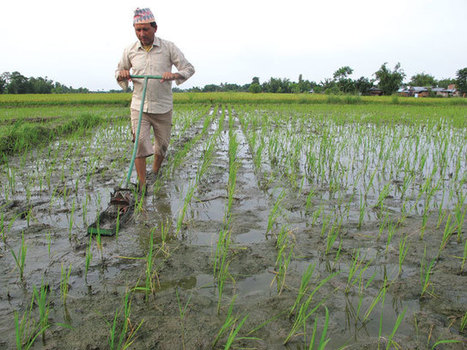
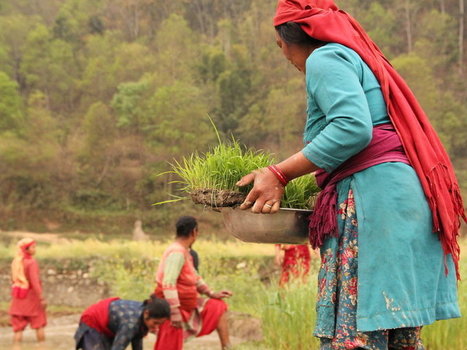
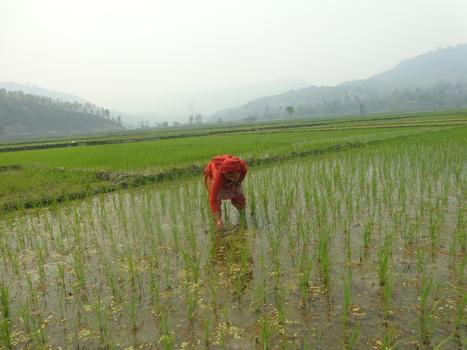
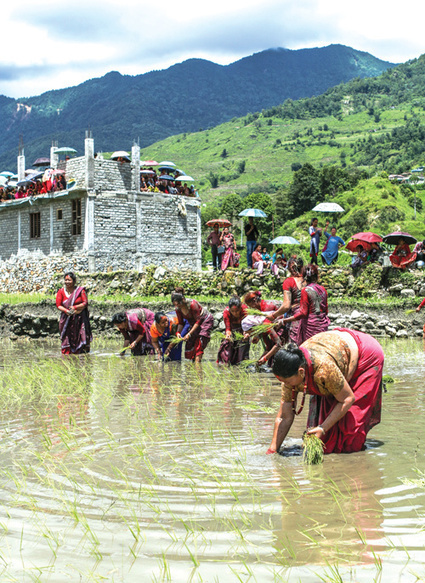
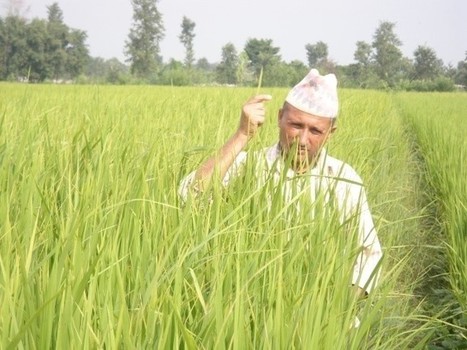
: In Udaypur, Nepal, Mana Maya Samal used to farm the way her parents and grandparents always had: laboring in knee-deep water, pouring expensive fertilizers into the mud, and hoping the season would be kind. But today, fields tell a different story—one of a quiet revolution that is putting more food on the table and more money in the pockets of local families.
Mana is at the forefront of the System of Rice Intensification (SRI), a method that seems almost counterintuitive to traditional wisdom. Instead of flooding her fields and crowding her plants, she plants fewer seedlings and feeds the soil with organic compost rather than chemicals. The shift required a leap of faith, but the reward was undeniable.
Mana’s yield doubled. "It wasn't just about growing more rice," she explains, "it was about growing it better." With SRI, her crop matures two weeks faster than usual—So she can get her rice to market before the rush, securing a better price for her family.
The beauty of this "less is more" approach is its simplicity. Mana and other female farmers in the district are saving massive water, restoring their land, and are no longer dependent pesticides, thanks to support and training from World Neighbors. For Mana and her neighbors, rice isn't just a crop—it’s the path to a more resilient, self-sufficient future.
ASLF Bulletin Voume I Aavash Shrestha, 4th Sem, B.Sc.Ag, AFU Rampur.
In the same year when the national average rice productivity was less than 4 tonnes per hectare (Ministry of Agriculture and Livestock Development), the farmers of Morang district achieved a bumper harvest of 7 tonnes per hectare. But the farmers of Morang district achieved this feat not by using some new, high-yielding, improved rice seed or excessive amount of chemical fertilizers and pesticides. On the contrary, they adopted changes in the management of soil, water, nutrients, plants, and human labor increasing the productivity from a small but well-tendered number of seeds while using less amount of seed, water & chemical fertilizers, and pesticides. In short, they adopted SRI (System of Rice Intensification).
During June found two SRI videos from Nepal. You can find the second one on the A for Agriculture channel: https://www.youtube.com/watch?v=wyLWqJ7FN_g . It is a Nepali language video on how and why to implement the System of Rice Intensification.
This study evaluated the effects of Trichoderma inoculation of rice plants under SRI management compared with transplanted and flooded rice plants, considering also the effects of different means of fertilization and different varieties in rice. The results indicated significantly better performance (P = 0.01) associated with Trichoderma inoculation in terms of grain yield and other growth-contributing factors, compared to non-inoculated rice cropping. Relatively higher effects on grain yield were recorded also with organic compared to inorganic fertilization; for unimproved (heirloom) varieties compared with improved varieties; and from SRI vs. conventional flooded crop management. The yield increase with Trichoderma treatments across all trials was 31% higher than in untreated plots (4.9 vs 4.5 mt ha−1). Economic analysis indicated that expanding the organic cultivation of local landraces under SRI management should be profitable for farmers where such rice has a good market price due to its premium quality and high demand and when SRI enhances yield. These varieties’ present low yields can be significantly increased by integrating Trichoderma bio-inoculation with SRI cultural methods.
Khadka RB, Uphoff N. 2019. Effects of Trichoderma seedling treatment with System of Rice Intensification management and with conventional management of transplanted rice. PeerJ 7:e5877 https://doi.org/10.7717/peerj.5877
An article by World Neighbors documents the process by which the farmers in Mahadevsthan achieved and monitored their their success. Seven women farmers came forward to do experimentation with SRI, and WN trained them in SRI principles and practices, and then provided them with regular technical support. The farmers used a local variety of rice seed and also used organic fertilizer to give their seedlings a good start. People were very excited with the yield results, which were 30-50 % higher than obtained with general practice
...[Nepal's Ministry of Agricultural Development](MoAD) will carry out drought resistance plantation technology in the districts where planting is yet to be carried out. “We plan to introduce System of Rice Intensification (SRI), which needs less water and less seedlings, because seedbeds in these districts are overaged or crossed the plantation period.” Under the SRI technology, paddy can be planted using 35 per cent less water compared to normal plantation method. The MoAD has set a target to increase the paddy output by 3.25 per cent in this year to 5.4 million metric tonnes.
This PhD thesis by Rajendra Uprety deals with agricultural intensification in Nepal. The initial focus of the study was the System of Rice Intensification (SRI), as introduced in Nepal from 2001. The multiple factors affecting SRI adoption, modification and dissemination together with the option to apply SRI in different combinations of its components result in a variety of SRI applications. For the same reason the effect of SRI on overall agricultural and livelihood development of Nepalese farmers has to be evaluated within the variety of farming systems in which it is applied.
Congratulations, Rajendra! Citation: Uprety, Rajendra. 2016. Agricultural intensification in Nepal, with particular reference to systems of rice intensification. PhD dissertation, Wageningen University (The Netherlands). doi:10.18174/392853 (204p. pdf)
Presenters: Juna Shrestha and Benjamin Huber Title: Carbon offsetting to sustainably finance the System of Rice Intensification (SRI) in Nepal Date: October 4…
This video on the System of Rice Intensification (SRI) in Far Western Nepal, is in Nepali language.. However, for those interested, it is not difficult to figure out what's going on!
Some of the farmers in this video are also featured in Flooded Cellar Production's English language production on SRI in Nepal that can be found at https://www.youtube.com/watch?v=Z9neQbC7cko
This master's thesis explores how the adoption of SRI in two villages in Nepal has influenced livelihood assets and how the availability of the asset has influenced adoption. From the field study in the villages Govindapur in Koshi Haraincha Municipality and Lohasur in Motipur VDC, Rana concluded that the access to certain physical and natural resources determined the successful adoption of SRI technique leading to a better livelihood. With better access to resources, Govindapur village delivered better results with SRI methods than Lohasur village, which lacks access to resources.
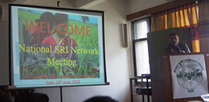
A meeting for sharing knowledge on SRI and organizing a new National SRI Network for Nepal was held on June 19, 2015, at the Nepal Agricultural Research Council (NARC), in Khumaltar, Lalitpur.
...Nepal faces major challenges in rice production, such as low productivity, low soil fertility, land degradation, and climate-change impacts. The System of Rice Intensification (SRI) offers a sustainable solution to many of these challenges. Trials with SRI in Nepal began in 1999. However, since the majority of Nepalese farmers are accustomed to conventional rice farming methods, the adoption of SRI has been slow. The objectives of this thesis was to a) assess the adoption behavior of farmers and b) compare (with conventional system) potential environmental benefits of SRI in the context of climate change. The major determinant factors that influenced the adoption of SRI by the farmers were labor demands, mechanization options, research, extension, and irrigation facilities. Outreach, extension practices and policies will be necessary to accelerate the implementation and adoption of SRI, which will also assist in preserving the natural environment. SRI can best be promoted by investments in research and extension, initiatives that promote mechanization and irrigation services.
Paddy farmers in Nepal’s Province 1 are using a low-water and labour-intensive growing method called System of Rice Intensification (SRI) in a bid to increase yield. A decade ago, Rajendra Upreti introduced the system in Nepal after reading a news article about the SRI method published in a magazine in the Netherlands. He then wrote to Norman Uphoff, a professor at Cornell University, explaining the technology in detail. Upreti had then piloted it in Bahuni of Morang with a handful of seeds using SRI. Nepal’s average paddy productivity is less than 4 t/ ha; the average yield, after adopting the SRI in Morang, was 7 tonnes. The maximum yield reported was 12 t/ha. In Morang, more than 500 farmers have been planting paddy with SRI.
Upreti said that the ministry was working to promote this system more widely. At first, Upreti was afraid while requesting farmers to adopt this method. “Many farmers called me crazy. But they were surprised when they saw the yield,” Upreti told the Post. According to Upreti, if the government makes this technology mandatory for all farmers in the lowlands and hills, it will boost national food security with increased productivity.
Kathmandu, Nepal, April 13, 2019: While climatologists, health experts and others believe a more diverse food supply is preferable, rice will remain a staple for years to come.
Efforts can focus on growing rice in way that puts much less stress on natural systems. Since so much of this staple is grown by family farmers, that's a good place to start. That's exactly what's happening in Nepal with the System of Rice Intensification (SRI). The result is faster and greater yields with far less water and minimal if any chemical fertilizers and pesticides. This means lower costs—and higher profit--for family farmers.
These farmers are assisted by World Neighbors, a development group with a focus on female-led projects that use sustainable techniques. Please contact the author at 202 554-5796 to interview World Neighbors staff.
Excepts from the National Public Radio (NPR) broadcast on Jan. 28. 2019] - Click on the blue arrow at left to listen to the interview: BHOLA MAN SINGH BASNET: We are getting more than 50% or in some cases 100% increase in yield by following the SRI. DANIELLE PREISS: Bhola Man Singh Basnet is a retired agronomist from Nepal's National Agriculture Research Council. He says SRI is not a technology but a set of practices that helps plants grow stronger roots and more seeds per plant. Small farmers in India have broken yield records, and Nepal plans to incorporate it into next year's agriculture policy. ...SRI appeals to Basnet because there's no need to invest in new technology or buy seeds. BASNET: I like this SRI system very, very much as an agronomist, also because farmers, without spending extra money, they can increase yield.
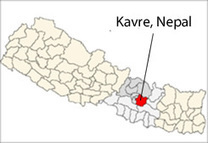
World Neighbors works in Mahadevsthan Village, Kavre with small landholders, most of whom are women. The experience to date is farmers using SRI are experiencing an average yield 30% higher than farmers using standard practices. Yield increases have been as high as 62%. Based on this success, WN is also now working to introduce SRI to farmers in Udaypur.
"...Nepal has an annual rice deficit of about 1 million tons even during years with good monsoons. Rice production is averaging about 5 million tons because only 18% of the land is irrigated, and productivity is low. This year, only 40% of rice fields have been planted because of late monsoons and elections. However, hope may be at hand. Three irrigation projects that will divert water to the Tarai are about to launch in the central and western plains. This means farmers will be able to plant spring rice as well. New techniques like SRI and cross-breeding by farmers like Adhikari have improved yields, and these techniques need to be scaled up.
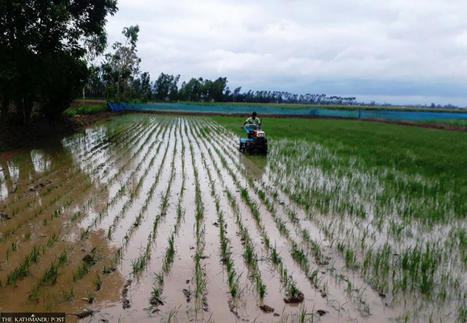
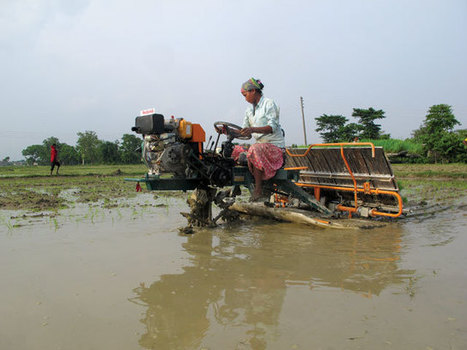
.SRI is now being practised in 12 districts and has doubled the yield in many places, while using half the amount of seedlings and much less water. SRI combined with mechanisation has boosted productivity in Tarai farms from an average of 3 tons/hectare to 9 tons/hectare at a lower cost. Says Rajendra Uprety at the Regional Directorate of Agriculture in Biratnagar and a strong proponent of SRI: “We need to grow more rice to achieve food security, and need a new methodology for local seeds for higher yields. SRI is suitable to achieve that objective...”
Ram Bahadur Khadka's PowerPoint presented at Cornell University on Dec. 9, 2016: New Directions for the System of Rice Intensification in Nepal: Mechanization and Biofertilizers
A year-end report on SRI and rice production in Morang district notes that integration of some of the recommended SRI practices into conventional rice farming system has become popular in the Morang district. Farmers' increasing awareness about the importance of younger seedlings, fewer seedling/hill, wider spacing, mechanical weeding, and AWD has resulted in greater savings and income for farmers through reduction of seed rate, in water use, and lower production costs, which are associated with higher yield. With conventional methods, only 9.25% farmers in Morang using conventional methods produced more than 6 tons/ha yield while this proportion was 40% for SRI farmers.
Floodedcellar productions an international film & TV production company produces a variety of documentaries on SRI and other topics. Here are the urls for both the ENGLISH and FRENCH SRI videos from Rwanda, Nepal, Sierra Leone and elsewhere.
This blog post was written by Rajendra Uprety, a senior agriculture development officer in the Department of Agriculture in Nepal. With years of experience working in the Nepalese District Agriculture Development Office, Rajendra has worked extensively in agricultural extension—with a focus on systems of rice intensification—throughout Nepal and abroad.
While Nepal’s average rice production is 2.8 tons/hectare, mechanised SRI in cooperatives here yield up to 9 tons/hectare, using half the amount of seeds and slashing costs. Adding mechanization to SRI is proving quite successful.
To get content containing either thought or leadership enter:
To get content containing both thought and leadership enter:
To get content containing the expression thought leadership enter:
You can enter several keywords and you can refine them whenever you want. Our suggestion engine uses more signals but entering a few keywords here will rapidly give you great content to curate.


 Your new post is loading...


 Scoop.it!