

That is why broadband expansion is so vital for these areas. Lightweight tools: These are applications that are simple self-management tools or behavioral management tools. Apps such as “American Well” offer patients ...


|
Scooped by
Chuck Sherwood, Former Senior Associate, TeleDimensions, Inc
onto Surfing the Broadband Bit Stream October 13, 2011 12:25 PM
|
 Scoop.it!
That is why broadband expansion is so vital for these areas. Lightweight tools: These are applications that are simple self-management tools or behavioral management tools. Apps such as “American Well” offer patients ...

 Your new post is loading...
Scoop.it!

From
www

A shareholder has sued Nvidia and CEO Jensen Huang, accusing them of deceiving investors about Huang's affair with a purported Chinese spy.
The complaint comes after President Donald Trump said the FBI is investigating the affair, which Huang has acknowledged and apologized for. Trump said Monday that Huang told him he had no idea the person could be involved in espionage.
The affair, which is also being scrutinized by Nvidia's board, has raised concerns that Beijing is using nefarious means to gain access to Nvidia 's cutting-edge microchips which power the development of artificial intelligence but face export restrictions to China.
Scoop.it!

The National Digital Inclusion Alliance (NDIA) and AARP collaborated to create the Digital Opportunity Model State Legislation, a suite of templates digital inclusion champions can tailor to meet the digital inclusion needs of their state’s residents.
Scoop.it!

The Construction Industry Doesn't Need Another Software Platform. It Needs the Ones We Already Have to Work Together. INTRODUCTION: WE KEEP BUILDING SOFTWARE TO SOLVE PROBLEMS WE HAVEN'T LEARNED TO MANAGE.There's a growing problem across the construction, engineering, and commissioning industries, particularly within hyperscale data centers and mission-critical infrastructure.And it isn't a shortage of software. It isn't a shortage of dashboards.It isn't a shortage of digital inspection forms, automated checklists, AI-generated reports, or document management platforms.
It's a shortage of practical integration, accountability, communication, and execution.
Scoop.it!

New York is preparing to enforce its sweeping AI safety law, requiring major developers like OpenAI and Anthropic to register, disclose safety practices, and report critical incidents or face fines.
Scoop.it!

From
karlbode
From dodgy DOGE bros to White House systems compromised by foreign intelligence, Trump cybersecurity damage will take decades and untold billions to repair.
Last week a cybersecurity firm named Layer3 Intel quietly announced that they'd found something troubling: numerous Trump administration officials had installed dodgy Russian proxy spyware on their computers at the White House, potentially allowing unauthorized access to U.S. government networks.
Needless to say, this shouldn't be happening at ordinary companies with competently run IT departments, much less the White House, where you can now apparently access extremely-sensitive government IT networks and secrets for far less than the cost of a cup of coffee.
Scoop.it!

Tesla CEO Elon Musk is defending the Cybertruck and the company’s decision to stop producing the polarizing steel-clad truck, claiming that the order rate far exceeds its production.
Tesla will shut down production of the Cybertruck in about eight months Musk said in an X post on Monday. He also said the company will try to make as many of the vehicles as possible before then, though Tesla will “have to return deposits for a lot of people.” Musk argued the Cybertruck was not unprofitable, and that Tesla was ending production because the “opportunity cost of the complexity of Cybertruck is vastly outweighed by the value of incremental Cybercab production.”
Scoop.it!

AI's data center boom could require 3.6% of GDP in annual investment through 2032, and financing is shifting toward structures that make risk harder to see.
Three papers presented on September 25 at the Brookings Papers on Economic Activity (BPEA) fall conference examine potential risks and rewards of the boom in artificial intelligence (AI): Why is AI so contentious, The vanishing advantage of specialization, and Financing the AI buildout.
Financing the AI buildout projects that AI investment in data center buildings, power systems, networking infrastructure, and specialized chips and other equipment will total an enormous $10.3 trillion from 2025 to 2032, or an average of 3.63% of U.S. gross domestic product per year.
“The projected buildout would be larger relative to the economy than the major U.S. canal, railroad, electrification, highway, and telecommunications investment booms,” writes the author, Stijn Van Nieuwerburgh of Columbia University.
Scoop.it!
SpaceX and Qualcomm threaten to topple US market's cozy 5G order | by Iain Morris | LightReading.com
Elon Musk's plans for a fourth American 5G network look both reactionary and radical, with potential consequences for the whole telecom industry.
Video shows a SpaceX rocket spurting a jet of flame while it reverses from the skies into the giant basketball hoop of a launchpad's scaffold. It is uncanny to watch, as if the footage itself is playing backward in slow motion. The rockets that carry its Starlink satellites into orbit are not required for the next phase of Elon Musk's telecom plan, a definitively land-based rollout of 5G infrastructure across tens of thousands of US mobile sites. But it threatens to be as explosive and potentially reusable as anything the tech billionaire has fired into space.
It is a curious mixture of the reactionary and the radical. Reactionary because it entrusts much of the hardest work to a 40-year-old American company that holds more of the most valuable 5G patents than any other player, according to some measures. Qualcomm is not primarily known as a developer of 5G network products. On US turf, the leaders in that market would be Ericsson, Nokia and Samsung. Yet Qualcomm, unlike Musk, is very much an establishment figure in wireless. Above all, perhaps, the plan is a tacit recognition of satellite's inability to disrupt in mainstream 5G. Small cells, touted earlier this year by SpaceX, seem to have been forgotten, as well.
Scoop.it!
We divided this up into 2 parts.
During the election and in the interviews with some of the winners during the wrap up, Governor Josh Shapiro, Pennsylvania, said “Look objectively at what happened. They promised lower prices, and drain the swamp, Instead, prices have skyrocketed, And the swamp is more corrupt than ever before, with no accountability.”
While state issues are paramount -- What is happening — the FCC is out of control, removing the rights of cities and states, as well customer protections and rights in all things dealing with telecom, broadband, wireless, satellite, including Internet. The broadcast and media attacks have helped to hide all of Carr’s other deeds.
This memo from FCC Chairman Brendan Carr states that there will be a vote to examine the harms cause by California — to AT&T as the state will not let AT&T off the hook for providing phone service to utility customers for telecommunications services.
AT&T California, formerly Pacific Bell, is one of the original Bell system utilities, which Wikipedia claims was created in 1906, while Connectbase claims it was 1880. “Founded in 1880, Pacific Bell has a long history…”
Part 1: Block the Soviet Style Voting and Adding to the Swamp.
Scoop.it!

I rarely write about politics, but it’s hard not to think that the blue wave election on November 3 will result in some changes in broadband policy and programs.
Of course, there is a chance that there will be little or no change in the short run. The new Congress might get so wrapped up in other issues that broadband won’t make it to the top of their pile. It’s also possible that the Trump administration and agencies will dig their heels in and fight everything proposed by the new Democratic majority and might pretend the election never occurred. I certainly don’t have any crystal ball when it comes to predicting Congress and the White House.
But there are some areas where a new Congress could change the trajectory of various broadband issues. This list is purely my speculation, but these all seem more possible than just a few weeks ago.
Scoop.it!

Antoine Haywood, University of Florida College of Journalism and Communications (UFCJC) Journalism assistant professor, was featured in “TEAM-NY Acts and Community Media,” an episode of The Bronx Social Justice and Anti-Violence Forums posted on YouTube.
Podcast host Daren Jaime interviewed Haywood on the importance of the Technology, Education and Arts through Media Act, also known as the TEAM-NY Act. The bill aims to secure stable, long-term funding for community media centers ensuring they can continue providing essential technology access, as well as media literacy training and local programming for generations to come. Haywood also shares highlights of his research on local media. He explores how communities use collaborative media production to foster civic engagement, digital equity and social change.
Scoop.it!

From
www
SAN FRANCISCO (AP) — With public anxiety growing over mounting reports about out-of-control artificial intelligence agents, the tiny U.S. government division charged with assessing the safety of new AI offerings lacks a permanent leader and has stopped publishing its research.
Officials with the Center for Advancing Innovation and Standards for Super Intelligence, or CAISSI, an independent division of the Commerce Department, recently were asked to informally report to an office of the White House. That's according to two former government officials with knowledge of the ongoing conversations who spoke to The Associated Press on condition of anonymity to avoid repercussions for current staffers.
The new arrangement concerns some critics, who worry that the executive branch might be politicizing decisions that could affect everything from cybersecurity to bioweapons and that the center's findings could be altered or muted in deference to the tech industry, which has been largely entrusted to police itself.
Scoop.it!
Starlink Rival Viasat Has Lost Over 80% of Its US Satellite Subscribers | by Michael Kan | PCMag.com
From
www
The company has only 100,000 fixed broadband subscribers in the US, down from 603,000 in September 2020, when Starlink first launched. Can Viasat's F2 satellite turn things around?
|
Scoop.it!

The Commonwealth of the Northern Mariana Islands (CNMI) is 183.5 square miles, which, for reference, is approximately half the size of Rhode Island and twice that of the US Virgin Islands. The islands are home to ~55K people, or 7% of our least populous state, Wyoming.
As all Northern Marianans are American citizens (whether or not you’re familiar with CNMI), the island is a recipient of BEAD dollars. And it is the only recipient to designate 100% fiber to subgrantees. Though the archipelago is made up of 14 islands, most CNMI residents live on one of three: Saipan, Tinian, and Rota. CNMI voted to become part of the United States in 1975 with 80% in favor.
I spoke with an extremely upbeat Glen Hunter, CNMI’s broadband director, and it’s hard not to ‘catch’ his enthusiasm. “Getting the island universally connected should happen within the next few years, far in advance of what I ever thought was possible.”
Scoop.it!

Anthropic’s S-1 warns of many risks. It may omit one: the government could seize control of the company on the cheap, Keith Porcaro hypothesizes.
Anthropic's IPO marketing kicks off this week. As is typical for investor disclosures in the age of AI, its publicly filed S-1 is full of warnings to investors, from ballooning computing costs to the possible extinction of humanity. Despite such a broad sweep, the S-1 may be missing a particular risk: that the United States government might try to seize control of the company, and that it might be able to do so at a steep discount to Anthropic's $1.4 trillion target IPO valuation.
The federal government (and its state and local counterparts) has broad power to seize private property: anything from land to copyrights and patents to corporate stock. The Fifth Amendment's Takings Clause requires "just compensation" for the seizure of private property, but doesn't otherwise limit *what* the government can seize.
How might this work?
Scoop.it!
A week later, my head is still spinning at the nationwide rebuke of Trumpism — Georgia! Texas! Kansas! Mississippi?! — and with newfound hopefulness for the political possibilities ahead.
I hear you, cynics. Donald Trump is still president. Stephen Miller got a promotion. And what about all the problems in the world that electoral politics won’t solve?
We shouldn’t let well-earned skepticism of politicians obscure the opportunity to both repair the damage of the Trump regime — and reclaim the idea that policymaking should meet public needs.
At Pressing Issues, we focus on media and technology. The new Congress and the next two years present a chance for legislators to show what it looks like to demand accountability and fight for the rest of us.
So in the spirit of seizing the moment, here are five achievable, meaningful and winnable things that federal legislators can do next year to show which side they’re actually on — and to set the stage for more transformative changes in the future.
Scoop.it!
It sounds like California and NTIA are at an impasse over releasing the $1.42 billion in BEAD funds to the state to support broadband infrastructure grants, with the controversy involving net neutrality.
Before diving deeper into the details of the dispute, let me provide the context behind the disagreement. California passed net neutrality legislation in September 2018. The California net neutrality rules are similar to what eventually was approved by the FCC. The U.S. Department of Justice and others immediately sued California over the legislation, which put implementation of the law on hold. The California law was finally upheld in January 2022 by a unanimous ruling of the U.S. Ninth Circuit Court of Appeals.
The FCC under Chairperson Jessica Rosenworcel adopted federal net neutrality rules in April 2024. You may recall that the docket had millions of comments filed by the public, the most ever for an FCC proceeding. The FCC ruling was also challenged in court. In January 2025, the U.S. Sixth Circuit Court of Appeals ruled that the FCC lacked the legal authority to order net neutrality, partially based on the Supreme Court’s Loper Bright decision that said that federal agencies didn’t have the authority to make major rulings that had not been directed by Congress. The new FCC Chairman Brendan Carr did not appeal the court ruling since reversing the net neutrality ruling was high on his agenda for the FCC. The court relieved the FCC from having to vote on the issue.
Scoop.it!
BATON ROUGE, La. — Three Louisiana advocacy groups sued the Louisiana Public Service Commission on Monday, seeking to overturn a policy that fast-tracked approval of billions of dollars in electricity infrastructure for Meta's massive data center in north Louisiana.
The lawsuit could disrupt Entergy's plans to build seven new natural gas-fired power plants and transmission lines to serve Meta's Hyperion data center in Richland Parish. The Louisiana Landowners Coalition, Louisiana Citizen Advocacy Group and Save My Louisiana Inc. allege regulators violated the state constitution by approving the policy without adequate public notice or input.
Scoop.it!

From
www
Explore how cable providers in the U.S. and Canada are improving upload speeds through network upgrades, with new Speedtest data revealing patterns, gains and gaps.
Cable’s upload upgrades are delivering improved speed where they’ve landed, but most cable customers aren’t accessing them yet.
Cable internet providers are working hard to raise their upload speeds. Cable still serves more U.S. broadband customers than fiber and fixed wireless, per the FCC’s “Internet Access Services: Status as of June 30, 2025,” but on upload speed it trails fiber and needs to keep its lead over fixed wireless access (FWA).
Cable companies are partway through a multi-year effort to address that gap with “splits,” which partition more of their network’s spectrum to support upload traffic. Last year, in the Ookla Research article, Level Up: Cable Providers Are Improving Uplink Speeds, we looked at initial, city-level results.
Now, with another year of deployments and Speedtest data, we examine the patterns emerging across cable providers in the U.S. and Canada.
Scoop.it!

Anthropic bought billions of dollars' worth of natural gas turbines in a deal that could give it buyer's remorse.
AI’s power crunch has become so acute that Anthropic, a company that has generally avoided buying physical infrastructure, is spending $3.4 billion on natural gas turbines.
The AI company, which is planning to go public this year, is buying Caterpillar generators that equipment supplier OnePWR had originally ordered, according to a Financial Times report. The generators are capable of producing up to 1.7 gigawatts of electricity. Historically, Anthropic has preferred to rent rather than buy. The company disclosed in its S-1 filing in May that it is paying SpaceX subsidiary xAI $1.25 billion per month through May 2029 to use xAI’s computing power.
“We expect to enter into additional similar services contracts,” Anthropic stated in the filing, meaning more deals to rent computing power.
Scoop.it!
The story dominating business and international news on Monday was Nvidia CEO Jensen Huang’s admission that he had an affair with a woman suspected of being a spy for China.
The company’s board has said it's launching an investigation into the matter.
This issue is complicated for Nvidia because its public identity is deeply intertwined with Huang. He has led the company since 1993 and has developed something of a cult following among investors. He’s also been close with President Donald Trump.
Having a CEO who is basically synonymous with a brand isn’t all that rare — especially in tech. It can be a good thing: it puts a human face on a corporation, according to Margarethe Wiersema, professor emeritus at The Paul Merage School of Business at the University of California, Irvine.
“A company is kind of abstract — like, who is McDonald's?” Wiersema said.
That company’s CEO is Chris Kempczinski — not a household name. But think Tesla or SpaceX — that’s Elon Musk. OpenAI — that’s Sam Altman. If a celebrity CEO resonates with the public that can generate more customers, Wiersema said.
Plus, CEOs matter to analysts who rate whether public company stocks are worth buying.
“When they evaluate these companies, the CEO is a large part of that valuation,” Wiersema said.
Scoop.it!

The Senate Commerce Committee will hold a confirmation hearing at 10:30 a.m. ET on Tuesday, Nov. 10, in Room 253 of the Russell Senate Office Building for Danielle Thumann Severs, President Donald Trump's nominee to the Federal Communications Commission, according to the Senate Commerce hearing notice.
If the Senate confirms her, Republicans would hold a 3-1 Republican majority and the commission could lose Democrat Anna Gomez without losing its three-member quorum, which would leave a 1982 party-balance clause as the contested legal question over whether three Republicans alone can lawfully approve the licenses, spectrum rules and mergers that carriers, broadcasters and broadband customers depend on.
Scoop.it!

For years, mysterious electrical anomalies have been flummoxing grid managers around the world. Every 60 seconds, the frequency on the grid would drop a tiny bit.
Even weirder: The sags happened at the exact same time on power grids across countries and continents. It was a mystery that Dirk Witthaut, a researcher at Forschungszentrum Jülich in Germany, couldn’t pass up.
Mystery solved: Coordinated power drops have been haunting power grid worldwide, but a team of researchers in Germany found the culprit.
Scoop.it!
From
www
Efforts to reshape the military include modernizing the technology soldiers will use on the battlefield and the further integration of artificial intelligence.
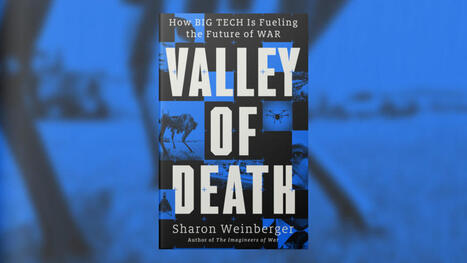
Some of the biggest names in Silicon Valley are working with the Pentagon and cashing in. Amna Nawaz discussed more with Sharon Weinberger, author of "Valley of Death: How Big Tech Is Fueling the Future of War."
Scoop.it!

The midterm elections are being reflected in the markets, and in the brazen behaviors of business leaders who don’t seem to think elections matter. Are they right?
The big news of the week was obviously the midterm elections. Antimonopolists soared in the midterms, as we wrote up earlier in the week. There were lots of other things, too, like the CEO of the most important chipmaker in the world being outed as having an affair with a Chinese spy, a major media distribution merger that represents the further consolidation of Hollywood and media, and one of the largest self-inflicted breakups in history. We’ll get into all of that. There’s a lot of good and bad news in the antimonopoly world, as usual, for paid subscribers after the jump.
First, I want to focus on the stock market crash last week, a decline that took place because of the midterm elections. What’s interesting is that the attitude of Wall Street and Silicon Valley leaders is generally unchastened. Many of those leaders lashed out publicly, making statements to the effect that the actions of voters are irrelevant.
And yet, the financial carnage was real.
|





