

Vince Jordan, an advocate for broadband competition in Longmont, Colorado, wrote the following op-ed for the local paper about the upcoming referendum 2A. He has given us permission to reprint it here.


|
Scooped by
Chuck Sherwood, Former Senior Associate, TeleDimensions, Inc
onto Surfing the Broadband Bit Stream October 7, 2011 1:12 PM
|
 Scoop.it!
Vince Jordan, an advocate for broadband competition in Longmont, Colorado, wrote the following op-ed for the local paper about the upcoming referendum 2A. He has given us permission to reprint it here.

 Your new post is loading...
 Your new post is loading...
Your new post is loading...
Scoop.it!

California initiated its Middle-Mile Broadband Initiative (MMBI) in July 2021 with $3.25 billion in funding authorized by Senate Bill 156. On April 2, Governor Newsom announced that the first portion of the network would be activated and ready to provide wholesale broadband access.
MMBI is an extensive fiber network that stretches across the state, as shown on the map below. What’s not obvious on this map is how the network reaches throughout cities like Los Angeles to reach underserved and low-income neighborhoods.
Scoop.it!
From
www

Globalstar provides satellite connectivity on iPhones, but Amazon and Apple say the $11.6 billion deal won't change anything. For now, it creates a new rival to SpaceX's Starlink Mobile.
Scoop.it!

Damon Lindelof is an Emmy Award-winning writer and producer, best known for co-creating Lost, The Leftovers and Watchmen. He’s among more than 1,000 creators and professionals across the film and TV industry who signed an open letter opposing the Paramount Skydance-Warner Bros. Discovery merger that was released on Monday. The following post from Lindelof’s Instagram feed is reprinted in Pressing Issues with his permission.
When I was asked to sign a letter that openly opposed the sale of Warner Brothers to Paramount Skydance, I felt two things. The first was that yes, absolutely, of course, I opposed it. The second was, oh shit, I’m afraid to say so publicly.
Fear is embarrassing. No one wants to be the guy puking in the boat in Saving Private Ryan. They want to be the ones storming the beach. So why was I afraid?
Some implied retaliation? Being put on some list of rabble-rousers? Getting kicked off the beloved Warner Brothers backlot I have called home for the last 15 years?
I actually sort of know my (potential) new boss, David Ellison. We produced a few things together not too long ago, and I found him to be bright, ambitious and passionate. He loved movies and trusted the people he made them with. But still …
Better not to risk it. Me opposing an inevitable merger would be pointless, and signing a letter that will evaporate into the shitstorm of an unrelenting news cycle would be even more pointless.
But is it?
Pointless?
Scoop.it!
From
www
In July 2024, a voltage fluctuation rippled through Northern Virginia’s “Data Center Alley” and knocked 60 data centers offline simultaneously. Gone in an instant: 1,500 MW of load, roughly equal to a mid-sized city. The grid operator, PJM, scrambled to stabilize frequency. It was a 10-second glimpse of a problem that’s only getting worse.
Electricity demand is surging on both sides of the Atlantic, driven by AI data centers, EV adoption, and the electrification of heating and industry. U.S. winter peak load could climb 21.5% over the next decade. The EU wants electricity to reach 50% of its final energy mix by 2040. But the grid wasn’t built for this, and new infrastructure takes years to permit and construct.
The standard playbook offers two bad options: wait years for new connections, or curtail the very loads (data centers, factories) driving economic growth. A new report from the Schneider Electric Research Institute proposes a third path. The report’s case is simple: smarter buildings can free up grid capacity faster than new infrastructure can.
Scoop.it!
Long a hobbyhorse for futurists and sci-fi authors, the prospect of a catastrophe precipitated by AI has lawmakers asking who would pay for the damage.
Last week, Wired reported that OpenAI is backing an Illinois state bill that would protect frontier AI companies from liability for causing serious widespread injury that affects more than 100 people or does more than $1 billion in property damage, such as in the case of a chemical, biological or nuclear catastrophe.
Also known as SB 3444, the bill would provide developers with civil immunity as long as they didn’t act “intentionally or recklessly,” and agree to comply with certain safety and transparency provisions in the European Union’s Artificial Intelligence Act.
Scoop.it!

I read that T-Mobile was thinking about buying the fiber assets of UNITI, which includes the fiber assets of Windstream. Regardless of whether that sale happens or not, it made me wonder about what happens to the customers served by copper who don’t go with a sale. Copper customers would be those served with telephone copper who are buying traditional TDM telephone service, DSL, and T1s and related products.
The concept of buying only fiber customers from an ISP seems to be a new industry theme. Lumen sold its fiber customers to AT&T but retained the copper customers. We know Lumen’s stated plans when it sold fiber customers to AT&T. The company publicly said it would retain and care for its copper-based consumer services since they continue to provide a strong ongoing financial contribution to the company.
Scoop.it!
T-Mobile and the private equity firm TPG are among companies rumored to potentially buy all, or parts, of Uniti Group, according to the research group TMT Finance. The speculation caused Uniti’s stock to rise from about $8 per share on Monday to more than $10 today.
T-Mobile is interested in Uniti's Kinetic fiber-to-the-home (FTTH) business, while TPG is eyeing Uniti’s enterprise fiber business, according to the TMT Finance report published on Tuesday. One TMT unidentified source told the publication that T-Mobile and TPG could be partnering for an offer for the entire company. It wouldn’t be unusual for T-Mobile to partner with a private equity firm to purchase a fiber provider. That’s what T-Mobile has done to purchase both Lumos and Metronet.
Scoop.it!

The four bipartisan bills are designed to expand broadband while lowering the cost for broadband access for people in rural America.
Scoop.it!
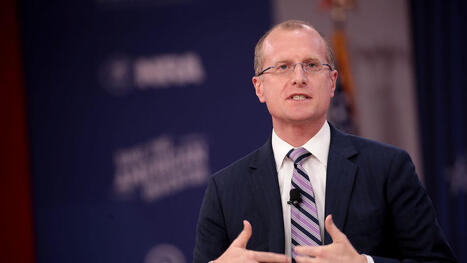
The following is an open letter to FCC Chairman Brendan Carr, by Robert Corn-Revere, who served as Chief Counsel to former FCC Chairman James H. Quello. He is currently Chief Counsel for the Foundation for Individual Rights and Expression. Checks & Balances is a newsletter of the Society for the Rule of Law Institute.
Dear Chairman Carr,
Pam Bondi’s sudden and ignominious end as Attorney General is an important cautionary lesson about what happens to officials in this administration who over-promise in order to curry favor with the man they see as their boss, but who under-perform because of the limits of their authority.
Bondi promised the President she would prosecute his political enemies and failed miserably. The President rewarded her misplaced loyalty by denying her the graceful exit she sought, and instead fired her during a cross-town limo ride to watch a Supreme Court argument.
You have recently threatened to revoke the licenses of broadcasters who air what you call “fake news,” which apparently includes any skeptical reporting about the war in Iran—something you know you cannot do legally.
My advice? Don’t get into a car with the president anytime soon.
Scoop.it!

Apple and Google recently announced a multiyear, $20 billion partnership to integrate Google’s Gemini technology into Apple's own AI features.
On January 12, 2026, Apple and Google announced a multi-year partnership between the companies, in which Apple will use Google’s Gemini models and cloud technology to power its artificial intelligence features, including an AI-powered Siri.
This partnership is partly due to weak remedies handed down in the U.S. v. Google case, where the Department of Justice and a bipartisan group of states proved that Google held an illegal monopoly in the online search market. Judge Amit Mehta imposed several behavioral remedies, but they don’t go far enough to restore competition or meaningfully restrict Google’s anticompetitive practices. These remedies include limits on Google’s ability to form long-term, exclusive contracts.
However, rather than preventing Google from entering billion-dollar default agreements, the Court’s Order simply limits these agreements to one-year terms. While this change is meant to encourage partners to reconsider their options each year, it may do little to increase real competition.
Scoop.it!
A panel of satellite experts discussed the excitement (and perhaps some trepidation) in the telecom world from the entrance of direct-to-device (D2D) satellite connectivity.
During a recent virtual event, Fierce asked the question on everyone’s mind in telecom: Will D2D be complementary to telecom, or will it pose a competitive threat?
Scoop.it!

IBM agrees to pay $17 million to resolve US Department of Justice probe over diversity hiring practices, the first settlement under Trump's anti-DEI initiative.
Scoop.it!

From
ground
Barbara Johnson has been fighting coal pollution for decades in her mostly Black neighborhood of North St. Louis as an organizer with Metropolitan Congregations United – one of many activist groups campaigning for cleaner air in a city that has some of the country’s dirtiest.
She sees environmental progress reversed by Trump's policies supporting data centers. The rollback of Biden's soot standards could prevent Ameren's plant from reducing emissions, threatening St. Louis's air quality amid AI-driven power demands.
|
Scoop.it!

An important conversation around what happened when federal agents came to Minnesota—and how communities responded.
In this episode of the podcast, Chris Mitchell is joined by David Brauer and Lisa for a candid conversation about what happened when federal agents came to Minnesota and how communities responded.
The episode begins with a timeline of events, from early organizing efforts to a significant escalation, when thousands of federal agents, including ICE and Border Patrol, came to Minnesota. They discuss how rhetoric increased over time, how certain communities were targeted, and how a “multi-jurisdictional” federal presence took shape.
From there, the conversation focuses on what people experienced on the ground.
Scoop.it!

From
www
For too long, businesses on Cape Cod and across Southeastern Massachusetts have faced an uncomfortable choice: build and maintain their own costly server rooms, or ship their critical IT infrastructure hours away to a major metro data center they can rarely visit. OpenCape's Data Center changes that equation entirely.
Scoop.it!
From
www
FESTUS, Missouri — Voters in a small Missouri town, unhappy with the city council’s approval of a $6 billion data center, struck back at the polls last week, ousting all four incumbent council members running for reelection.
Tuesday’s election in Festus, Missouri — a city of 12,000 people along the Mississippi River a half-hour south of St. Louis — is the latest example of growing public backlash against cities agreeing to host hyperscale data centers over the objections of residents concerned about their local impacts.
On the same day as the Festus election, voters in Port Washington, Wisconsin, a Milwaukee suburb, where tech giants Oracle and OpenAI are building a $15 billion data center campus, also registered their disapproval by overwhelmingly passing a first-of-a-kind referendum to restrict future projects. At least three other cities across the country will vote on similar measures this year.
Scoop.it!

From
techcrunch
Amazon is moving in on the orbital mobile connectivity market that’s currently dominated by Elon Musk’s Starlink. The company on Tuesday said it had agreed to buy satellite company Globalstar, known for powering Apple’s “Emergency SOS” feature, for $11.57 billion in cash.
The $90-per-share deal will net Amazon all of Globalstar’s satellite operations, infrastructure, and mobile satellite services spectrum licenses, enabling the larger company to flesh out its young satellite business, Amazon Leo, with direct-to-device services ahead of its launch later this year.
Scoop.it!

Soon, Clermont, Eustis, Minneola, Mount Dora, and Tavares, FL will join Leesburg neighbors in connecting to Wire 3’s symmetrical speeds of up to 10 Gigs.
Scoop.it!

From
karlbode
Lazy access journalism is pathologically obsessed with helping unremarkable, unethical weirdos cultivate elaborate supergenius engineer mythologies while covertly undermining the public interest.
Scoop.it!
Brightspeed — a broadband company that was created in 2022 from assets it acquired from Lumen Technologies — today claims it’s the nation’s third-largest fiber builder, and it has now surpassed three million fiber-enabled locations.
The top two fiber deployers in terms of current build rates in the U.S. are AT&T and Verizon. For Brightspeed, 2026 will mark the company’s second consecutive year of building more than one million fiber passings, putting it on track to reach four million homes by the end of this year. Ultimately it aims to pass more than five million homes and businesses across its 20-state footprint.
Scoop.it!

Rather than retreat from Iran-Contra and other scandals, conservative operatives inside the White House — led by Attorney General Edwin Meese — went on the offensive.
Drawing on newly uncovered documents and exclusive interviews, we trace how Meese helped turn a fringe idea into doctrine: that all executive power belongs to the president alone.
This is the origin story of the unitary executive theory.
Scoop.it!

A group of Hollywood actors, directors, and producers on Monday published an open letter demanding the proposed merger between Paramount and Warner Bros. Discovery be blocked.
In their letter, the Hollywood heavyweights outlined the harms that would come from allowing Paramount—which is owned by David Ellison, son of billionaire Trump donor Larry Ellison—to acquire Warner Bros. Discovery.
“This transaction would further consolidate an already concentrated media landscape, reducing competition at a moment when our industries—and the audiences we serve—can least afford it,” the letter states.
Scoop.it!

Today’s blog takes a deeper dive into the upcoming case at the Supreme Court concerning appeals by AT&T and Verizon over fines levied by the FCC. The original appeals followed an FCC finding that all three major U.S. cellular carriers were liable for violating customer privacy by selling access to customer location data.
This data showed every place that a customer visited during the day, something that should make every cell customer uncomfortable. The FCC fined AT&T $50 million, T-Mobile $80 million, and Verizon $47 million, with smaller fines against a few other carriers. The case at the Supreme Court looks specifically at the FCC’s ability to levy fines against the carriers for violating consumer privacy rights.
Scoop.it!

A conversation with Asad Ramzanali, Director of AI and Technology Policy at the Vanderbilt Policy Accelerator for Political Economy and Regulation.
If you read, watch, or listen to financial news, you’ll find there is a boom in discussion over whether the AI boom is a bubble, and what the consequences might be if it bursts. Today’s guest says that if such a crash occurs, it will represent a significant policy opportunity—a potential point of intervention that could lead to meaningful reform of the tech sector.
Scoop.it!

Meta Platforms must face a lawsuit by the Massachusetts attorney general alleging that as the parent company of Facebook and Instagram, it deliberately designed social media features to addict young users, the state’s top court ruled on Friday.
The ruling by the Massachusetts supreme judicial court marked the first time a state high court has considered whether a federal law that generally shields internet companies from lawsuits over content posted by their users would also bar claims that companies like Meta knowingly addicted young users. Writing for the unanimous court, Justice Dalila Argaez Wendlandt said the lawsuit brought by the attorney general, Andrea Campbell, does not seek to hold Meta liable for content created by its users, which section 230 of the Communications Decency Act of 1996 generally shields companies from, but targets the company’s conduct.
|





