
... National Association of State Utility Consumer Advocates and AARP today sent a joint letter to the Federal Communications Commission (FCC) to raise serious concerns about the broadband industry's proposal to restructure the Universal Service...
Get Started for FREE
Sign up with Facebook Sign up with X
I don't have a Facebook or a X account


|
Scooped by
Chuck Sherwood, Former Senior Associate, TeleDimensions, Inc
onto Surfing the Broadband Bit Stream October 6, 2011 5:43 PM
|
 Scoop.it!
... National Association of State Utility Consumer Advocates and AARP today sent a joint letter to the Federal Communications Commission (FCC) to raise serious concerns about the broadband industry's proposal to restructure the Universal Service...

 Your new post is loading...
 Your new post is loading...
Your new post is loading...
Scoop.it!

From
rollcall

The Trump administration has asserted for months that its “bargain” version of the federal $42.5 billion grant program to expand access to broadband internet would save taxpayers money. That made states and their representatives in Congress nervous that funds left over after deployment proposals would be clawed back.
Under pressure from senators at an appropriations hearing, Commerce Secretary Howard Lutnick last month sought to calm fears when he said that so-called “non-deployment” funds under the Broadband Equity, Access and Deployment, or BEAD, program would not be rescinded.
But with no guidance so far from the department’s National Telecommunications and Information Administration, which was expected but delayed this week, lawmakers and others are pushing to have their voice heard on exactly how states will be able to use the $21 billion pot of money.
Scoop.it!

SUGARLOAF, Penn., March 13, 2026 (AP) — For John Zola, the 40 acres were like a paradise: apple orchards tucked into northern Pennsylvania's rolling hills, a barn, meadows and more than enough land for four houses: one for himself and his wife and each of his three adult children.
It’s been “hell,” however, since a contractor hired by the local power utility knocked on Zola's door in late 2024 and informed him that it planned to build a 500-kilovolt power line through his property.
High-voltage power lines cost tens of billions of dollars a year and are the latest front line in the battle over tech giants' massive operations.
This line and others like it are being planned in accelerating numbers in the United States to deliver power, sometimes across hundreds of miles, to enormous data centers run by the world's biggest tech companies.
Scoop.it!

Utah became the first state to allow AI to prescribe drug refills. Creepy and crazy ... or a solution to health care woes?
Scoop.it!
The BEAD road has been a long one. BEAD was first created by Congress in November 2021, meaning we’re now more than four years into the program. There are now a handful of BEAD projects under construction in a few states, but in most places, the BEAD grant program is still mired in the paperwork process that precedes releasing funds to ISPs.
To contrast BEAD with other large broadband programs, two large federal grant programs were approved by Congress in March 2021 as part of the American Rescue Plan Act of 2021 (ARPA). I estimate that the Coronavirus State and Local Recovery Fund (SLFRF) funded at least $9 billion in fiber projects. The Capital Project Funds (CPF) funded at least $11.5 billion in fiber projects. These programs were initiated only nine months before BEAD, yet the construction for awards for both programs must be completed by the end of this year.
That is blazingly faster than the BEAD timeline.
Scoop.it!

A new research report documenting how a new wave of journalism funds work, they impact they’re having and the lessons for others to follow.
What is community-centred mediaCommunity-centred media is an approach to meeting communities’ needs for information and connection. It is different to traditional journalism through being deeply rooted in listening to and understanding the needs of communities, particularly marginalised groups, centring their voices and concerns, and ensuring the media reflects and serves them.
As well as focusing on listening and building strong relationships with communities, it often goes beyond this through co-creation and active participation. It ultimately aims to build community connection, resilience, and power to make positive change in their lives and communities.
Scoop.it!

The federal government’s big effort to build out broadband is facing a problem you don’t see often in Washington: There’s now more money left over in the program than anyone knows what to do with.
Almost five years ago, Congress committed approximately $41 billion to connect all Americans to high-speed internet as part of its bipartisan infrastructure bill. But in a rare moment of wisdom, the Trump administration revamped the effort last year by nixing a number of ill-conceived rules that had slowed its progress and added to costs. That included removing most requirements unrelated to broadband deployment and opening up more opportunities for traditional fiber cable alternatives — like fixed wireless and low-Earth orbit satellite constellations — to service households.
In short, the initiative got an abundance-style overhaul with a laser focus on delivering on the core goal of getting all Americans connected.
Scoop.it!

WASHINGTON, March 12, 2026 – A Maryland-based provider is asking federal regulators to preempt state rules it says prohibit the deployment of telecom services. State agencies say their policies are valid.
The dispute stems from Talkie Communication’s effort to deploy a utility pole with fixed wireless equipment in a right-of-way controlled by the Maryland State Highway Administration. Talkie argued in a Jan. 28 petition to the Federal Communications Commission that it should be exempt from county zoning rules and annual fees charged by the state’s Department of Information Technology.
Scoop.it!
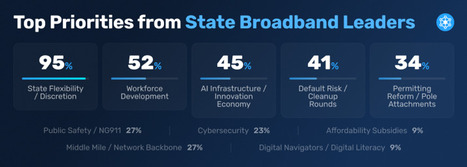
As we wait for delayed non-deployment guidance from the NTIA, I wanted to revisit the listening sessions. NTIA Administrator Arielle Roth cited the “voluminous and passionate responses to our call for input. Across three listening sessions, we had more than 1,700 attendees and 175 speakers participate. We also received 188 written comments from industry, state officials, and broadband advocates.”
So, in the words of the late, great Marvin Gaye… What’s going on? When I last examined the public comments, I only focused on session one (closed to SBOs) and session two (public). Since then, there has been a third session, seeking public feedback again.
So, let’s first take a look at the SBOs/States’ input/direction for non-deployment dollars. I got my hands on the transcripts from three listening sessions (two public sessions and one “SBOs only” session) and broke down the categories of investment mentioned by the 44 states and territories that submitted comments.
Scoop.it!

From
www
Benton Senior Fellow and Public Advocate Gigi Sohn spoke with former Deputy Assistant Secretary of State Phil Verveer, who served as lead counsel in United States v. AT&T, the case that led to the breakup of AT&T, about the structural preconditions that led to the Telecommunications Act of 1996.
Scoop.it!

In the race to meet the demands of the energy transition, biodiversity hotspots such as Palawan in the Philippines are being increasingly mined for critical elements
Moharen Tahil Tambiling lowers himself from the fishing boat into the water and gingerly picks his way over the reef circling the bay. At low tide here in Brooke’s Point on Palawan, a long, rugged island in the south-west of the Philippines archipelago, the coral is just under the surface, and it looms suddenly under the waves, scraping at the boat’s wooden hull.
Beneath his feet are brain-like mounds and curling fingers of coral. Leaning over the side of the fishing boat, the men point out different kinds: some which were once vibrant orange and others that should be delicate pink. Now, almost everything is the same dull khaki, covered by a thick film of silt. Another man jumps overboard, stirring the sediment. A cloud rises like thick smoke over the reef.
Plunging his hands into the water, Tambiling, a farmer and Indigenous leader from the nearby village, draws up a thick, viscous clump of goop: grey threaded with orange. “Laterite,” he says, his face set in a grim line against the drizzle.
Scoop.it!

From
newrepublic
Palantir CEO Alex Karp thinks his AI technology will lessen the power of “highly educated, often female voters, who vote mostly Democrat” while increasing the power of working-class men.
“This technology disrupts humanities-trained—largely Democratic—voters, and makes their economic power less. And increases the economic power of vocationally trained, working-class, often male, working-class voters,” Karp said in a CNBC interview Thursday. “And so these disruptions are gonna disrupt every aspect of our society. And to make this work, we have to come to an agreement of what it is we’re going to do with the technology; how are we gonna explain to people who are likely gonna have less good, and less interesting jobs.”
This sounds like a direct, long-term pitch to the GOP from a CEO whose tech firm already has numerous government contracts and is deeply embedded in the Pentagon. Karp’s message is loud and clear: My technology will take political capital away from one of your greatest enemies—liberal women with degrees—and give one of your favorite demographics to patronize—working-class men—more political power to transfer to you. He’s aligning his technology with both GOP political strategy and the larger male-centered culture war that the right has been waging for the better part of a decade now. And how exactly would his technology only hurt Democrat women?
Scoop.it!

Tom Wheeler draws lessons from the telephone and internet to argue for proactive policy to ensure open competition in AI.
March 10, 2026, marks the 150th anniversary of Alexander Graham Bell’s first telephone call. His words—“Mr. Watson, come here; I want to see you.”—were simple but launched a revolution in human connectivity.
Ninety-three years later, another revolution began with a far less dramatic message. On Oct. 29, 1969, researchers attempting the first ARPANET connection between UCLA and Stanford tried to type the word “login.” The system crashed after the first two letters, so the first message ever sent across what would become the internet was simply “Lo.”
Those two moments—Bell’s call and ARPANET’s stutter—bookend a critical lesson for the AI era. Each communications revolution builds on the last, but each creates its own economic logic and governance challenges. Policy mistakes happen when we assume the future will behave like the past.
The telephone network evolved into what economists call a “natural monopoly.” The logic was that duplicating wires and switches made little sense, so each area gravitated toward a single network. But in exchange came obligations such as requiring nondiscriminatory access and interconnection.
That principle of open access mattered more than anyone anticipated.
Scoop.it!

From
www
John Solly, a software engineer and former member of the so-called Department of Government Efficiency (DOGE), is the DOGE operative reportedly accused in a whistleblower complaint of telling colleagues that he stored sensitive Social Security Administration (SSA) data on a thumb drive and wanted to share the information with his new employer, multiple sources tell WIRED.
Since October, according to a copy of his résumé, Solly has worked as the chief technology officer for the health IT division of a government contractor called Leidos, which has already received millions in SSA contracts and could receive up to $1.5 billion in contracts with SSA based on a five-year deal it signed in 2023. Solly’s personal website and LinkedIn have been taken offline as of this week.
|
Scoop.it!

The time for careful consideration of AI regulation options is now. In a few years, it could be too late.
A few weeks ago, I wrote that, from a legal perspective, 2026 would be a make-or-break year for AI.
The regulatory Wild West we are currently living in cannot possibly persist without chaos reigning and people realizing that they are fully unprotected from the negative consequences of AI development and deployment.
We are still in March, but it has already become clear that this is the year in which democratically elected authorities must take bold decisions on AI. - An important factor that has led us to where we are now is that the risk profile and the social impact of AI have been clearly underestimated over the past 10-15 years of AI policy debates. They did not take into ac
Scoop.it!

On Sunday stars will take to the red carpet for the 98th Academy Awards in front of a heavy backdrop of fascism, war and corruption coming straight from the White House.
We’ve already seen household names from Samuel L. Jackson to Billie Eilish using their celebrity to decry ICE at previous awards shows. We hope that artists continue to speak out against the xenophobia tearing apart our country, illegal wars and the innocent lives lost.
We also need to be talking about how Trump is angling to capture Hollywood and control its movie-making machine. That’s why Free Press is driving a billboard around Los Angeles this weekend showing Trump pulling the strings behind the massive media merger that threatens to upend Hollywood and the news business, too.
Paramount Skydance has won the bidding war for Warner Bros. Discovery, a storied studio that also happens to own CNN, Nickelodeon and HBO. David Ellison, the son of tech centibillionaire and Trump ally Larry Ellison, runs Paramount Skydance, and the Ellisons have made it no secret that they’re willing to contort their massive media conglomerate into a Trump propaganda megaphone.
We couldn’t have scripted a more detestable cast of bad guys.
Scoop.it!
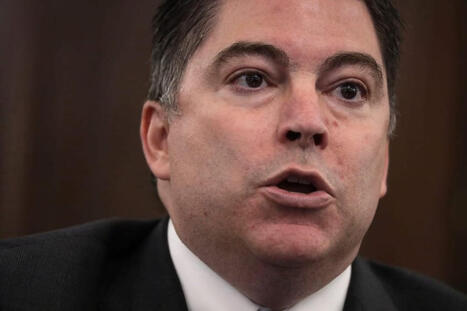
WASHINGTON, March 13, 2026 – Can you have too much of a good thing? Former Republican FCC Commissioner Michael O’Rielly seems to think so.
The former Republican FCC Commissioner sees USDA programs as wasteful and unnecessary.
In an op-ed published Wednesday, O’Rielly called on Commerce Secretary Howard Lutnick to oppose the renewal of three broadband programs run through the Department of Agriculture, arguing that National Telecommunications and Information Administration’s (NTIA) Broadband Equity Access and Deployment Program (BEAD) program and the FCC’s Universal Service Fund make these programs unnecessary.
Scoop.it!

From 1G to 6G, telecom history shows a shift from analog voices to AI agents, creating a seamless digital and physical world interconnection.
Every generation of mobile networks, from 1G to 5G, has rewritten the rules of how the world lives and works. The coming 6G revolution, by decade’s end, will represent a new direction still, toward a universal data fabric where millions of agents collaborate in real-time across the digital and physical worlds.
The story of wireless connectivity is often told in speeds and standards—megabits per second, latency, and spectrum bands. But these generational shifts in device specs obscure a deeper pattern. Each generation, from 1G to 5G, rewrote the relationships between three elements: the Devices we carry, the Networks that connect them, and the Applications that run on them. We call this connectivity’s DNA. With 6G, that DNA of interconnection is about to change fundamentally.
As with the “7 Phases of the Internet”—an article we published with IEEE Spectrum last October—mobile networks’ 6 generations follow a similar arc toward system-wide intelligence. That arc traces through every generation of wireless, revealing a steady advancement of the reach and scope of connectivity itself.
Scoop.it!
GFiber, formerly known as Google Fiber, is spinning off from its parent company Alphabet to merge with private equity-backed operator Astound Broadband.
Stonepeak, which acquired Astound in 2021 for $8.1 billion, will have majority control over the combined company, while Alphabet will retain a minority stake. Financials terms of the transaction weren’t disclosed, but the deal is expected to close in Q4 2026.
Ruth Porat, president and chief investment officer at Alphabet and Google, said in a statement the merger is “an exciting next phase” of GFiber’s growth. GFiber first turned up service in 2012 and as of 2025 it passed about 2.8 million fiber locations across 15 states, per New Street Research (NSR) data.
Scoop.it!

WASHINGTON, March 12, 2026 – States have continued to prioritize affordable broadband service, with Connecticut passing legislation last year that will likely help close the digital divide.
A Pew broadband project by Jake Varn applauded Connecticut’s broadband affordability law, which establishes a Net Equality Program. The law will require internet service providers that “contract with the state to offer a low-cost plan of $40 per month or less to eligible households” that receive government assistance.
Scoop.it!

WASHINGTON, March 12, 2026 – A new report commissioned by rural broadband trade group NTCA said the $8.5 billion federal Universal Service Fund is critical to maintaining broadband and voice networks in rural communities, where providing service would otherwise be economically challenging.
The 33-slide report released March 11 by NTCA–The Rural Broadband Association and consulting firm Cartesian analyzes the finances of rural network operators and finds that without high-cost USF support many providers would face unsustainable operating margins and negative cash flow, threatening the long-term viability of existing networks.
Scoop.it!

The interactive data dashboard below summarizes Connect Illinois Round 4 (BEAD) eligibility, classifying locations as served, underserved, unserved, and not BEAD-eligible.
This tool specifically emphasizes past programming from the Illinois Office of Broadband and Illinois Broadband Lab, while providing a detailed breakdown of digitally vulnerable population groups and the latest broadband adoption statistics.
Accompanying maps are included to visualize locations and program hubs for additional context. Page 2 aggregates these population and adoption statistics by the 10 economic regions in Illinois.
Scoop.it!

USTelecom offered a series of recommendations to the NTIA on the best use of BEAD's $21 billion in non-deployment funds late last week. In a letter to the federal body, USTelecom CEO Jonathan Spalter called on the NTIA to prioritize funds for modernizing 911 systems, cybersecurity training for the broadband workforce and permitting reform.
Scoop.it!

Washington, D.C. – Spectrum for the Future applauds Senator Deb Fischer (R-NE) and Senator Ben Ray Luján (D-NM) the bipartisan leaders of the Senate Commerce Committee’s Telecommunications and Media Subcommittee, for urging the Federal Communications Commission (FCC) to preserve the existing rules and power levels governing the Citizens Broadband Radio Service (CBRS) band (3.55–3.70 GHz).
Scoop.it!

From
xarticl
On November 17, 2023, something unprecedented happened in Silicon Valley. The board of directors of the most powerful AI company on the planet fired its CEO. Not for financial mismanagement. Not for a failed product. For lying.
Sam Altman, the man who had become the public face of artificial intelligence, the person more associated with the future of AI than anyone alive, was removed from OpenAI because — in the words of the board — he "was not consistently candid in his communications." That's corporate-speak for: he deceived the people whose one job was to keep him in check. What happened next is the part everyone remembers. 745 of OpenAI's 770 employees threatened to quit. Microsoft applied pressure. The investors rallied. Within five days, Altman was back. And the board members who had fired him? They were the ones who got removed. It was a spectacular display of power. And it should terrify you. Because here's what most people seem to have forgotten: the board was right.
Scoop.it!

From
www
A bipartisan privacy coalition in the United States Congress introduced legislation on Thursday that would impose a strict warrant requirement on the FBI’s backdoor searches of Americans’ communications, aligning federal law with a 2025 federal court ruling that found the warrantless practice unconstitutional.
The bill, the Government Surveillance Reform Act of 2026, repeals controversial expansions of the government's warrantless wiretapping authority while overhauling key aspects of federal surveillance law—setting up a showdown with the US intelligence community and its congressional allies weeks before a sweeping global spy program sunsets on April 20.
|





