Your new post is loading...
For too long, this law has allowed the government to evade privacy protections and spy on Americans. Reform is overdue. Congress will soon vote on the reauthorization of a surveillance authority known as Section 702 of the Foreign Intelligence Surveillance Act (FISA), which is set to expire on June 12. Although Congress passed the law to facilitate surveillance of foreigners overseas, the government also uses Section 702 to spy on Americans — a practice that has resulted in widespread abuses and made the law deeply controversial. The upcoming reauthorization is an opportunity for Congress to enact long-overdue protections for Americans’ privacy. President Trump is encouraging Congress to renew Section 702 without such protections, known as a straight reauthorization. Lawmakers from both parties, however, have expressed opposition to an extension without reforms. At this stage, it remains unclear whether congressional leadership will allow proposed reforms to receive a vote — but it is equally unclear whether reauthorization can move forward without reforms.
Chair Ciresi, Chair Ortitay, and Members of the Committee, thank you for the opportunity to present today on the importance of affordable, high-speed broadband in the Commonwealth of Pennsylvania. It is an honor to be here and share my research on broadband policy and the digital divide with you and the committee. I speak as an individual expert in this field and not on behalf of my employer, Penn State University. In my time today, I want to share recommendations for broadband policy improvement in our Commonwealth. These recommendations stem primarily from a white paper authored by myself and colleagues at the Pennsylvania Broadband Research Institute called The Cost of Inaction: Pennsylvania’s Broken Broadband Governance and the Path Forward. I first want to set the scene by telling you what I heard from a rural firefighter who participated in a focus group I held for a project sponsored by the Center for Rural Pennsylvania about how the lack of internet impacts first responders and public safety in rural Pennsylvania:
Elon Musk's plan to compete against AT&T, T-Mobile and Verizon through a network of small cells has been widely ridiculed. Several more wireless experts serve harsh judgment on Elon Musk's plan to build a US network of small cells. For years, subscribers to satellite services have installed dishes at their homes for watching TV or connecting to broadband. Smartphone customers, by contrast, aren't normally required to set up a basestation and cover the related property fees. Elon Musk wants to change all that through a widely ridiculed plan of Starlink, the satellite comms subsidiary of his overvalued SpaceX business. Experts with anything positive to say about it seem to be rarer than Mars landings. The small cell technology Musk wants to combine with Starlink's satellite receivers would naturally sit on your rooftop. But it wouldn't be for your exclusive benefit, instead providing coverage for passersby on Starlink plans.
Author: Federal Communications Commission Adopted: August 13, 2026 Released: August 14, 2026 Docket: GN Docket No. 25-223 Commission: Chairman Brendan Carr and Commissioner Olivia Trusty issued separate statements supporting the report; Commissioner Anna Gomez concurred and issued a separate statement. Overall determination The Federal Communications Commission finds that advanced telecommunications capability is being deployed to Americans in a “reasonable and timely fashion.” The finding rests on continued expansion of fixed wireline, fixed wireless, mobile 5G and satellite infrastructure between June 2023 and June 2025. The Commission stresses that this does not mean every American already has adequate broadband. Approximately 10.58 million people still lacked access to terrestrial fixed broadband at the FCC’s 100/20 Mbps benchmark in June 2025. More than nine million of them lived in rural areas, while approximately 500,000 lived on Tribal lands. Instead, the majority interprets Section 706 as asking whether deployment is progressing at a reasonable rate. It rejects the argument that the statute requires universal availability before the FCC can make a positive finding.
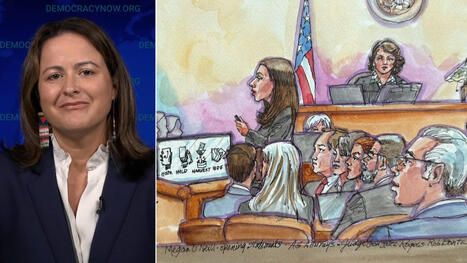
We look at major media news with Jessica González, co-CEO of the advocacy organization Free Press. She discusses the landmark lawsuit against Meta for making its social media platforms addictive for young people, efforts to halt the Paramount-Warner Bros. megamerger, and Disney’s lawsuit against the Federal Communications Commission over what it calls the Trump administration’s “retaliatory campaign” against the ABC television network.
González says President Donald Trump’s “authoritarian takeover attempt of our media system” must be opposed.
Ookla recently published a research article that documents the implementation of WiFi 7 in the U.S. and around the world. WiFi 7 routers were introduced to the market in early 2024, and Ookla reports that deployment of WiFi 7 routers has already grown to 7.2% in the country. That’s a pretty big uptake in a year and a half, considering that broadband customers generally hang on to WiFi routers unless changing service providers.
Proton’s CEO is a champion of encryption for everyone. So why is he going all in on un-encryptable AI? In the eyes of many privacy advocates, AI is just another surveillance technology. It supercharges online tracking and real-world spying tools, sifts through vast troves of everyone’s data to spit out its results, and then encourages users to share their deepest secrets and desires with a cloud-hosted large-language model. Surveillance capitalism made AI possible, and AI returns the favor by making surveillance more powerful and the businesses that run on it more data-rich and profitable than ever. Andy Yen is among the most influential voices in the tech industry who equates AI with privacy invasion. He’s the founder and CEO of Proton, one of the world’s most popular encryption-focused tech companies. He says the push to integrate AI into every consumer tech product—whether people want it or not—is driving new users in droves to Proton’s products, which are, put simply, the end-to-end encrypted versions of every Google service from Gmail to Google Docs, Sheets, Calendar, and Meet.
The size of a Starlink Direct-to-Cell beam can be measured in the real world using the phones that actually observed one. To our knowledge, this is the first real-world measurement of a Starlink D2C beam footprint at global scale (instead of an estimate modelled from regulatory filings).
When two phones in our background signal scans report the same decoded satellite ID and beam index at the same time (i.e., decoded from the broadcast LTE cell identity, which embeds the satellite ID and a trailing beam index), we treat them as being inside the same D2C beam. We independently verify each satellite assignment against archived orbital data (via Space-Track) at the time of observation. Thousands of these matches across thirteen markets let us measure the beam footprint directly.
As a robustness check, scrambling the beam indices (within the same satellite and 10 min window, preserving timing/geography) increases the median separation between matched phones from under 1 km to about 192 km.
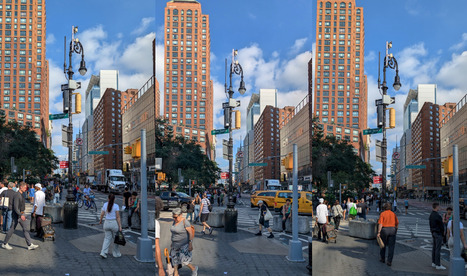
As spying becomes big business, more people are mobilizing to resist mass surveillance. For many, Labor Day signifies a time of transition, the end of summer and the return to business as usual, whether it be school or work. But the holiday weekend was born out of a more radical past, and at a place charged with a history of protest and free expression. On Sept. 5, 1882, more than 10,000 workers sacrificed a day’s pay to march on Union Square and demand an eight-hour workday and an end to child labor. The success of their protest paved the way for Labor Day to become a federal holiday in 1894. Initially a fenced-in enclave for New York’s wealthiest, architects Frederick Law Olmsted and Calvert Vaux redesigned Union Square in 1872 as an open plaza for public assembly and patriotic demonstration. By the beginning of the 20th century, Union Square became the epicenter of radical American politics, a setting for protests by anarchists and socialists. Noted activist Emma Goldman frequently used the public plaza to challenge government censorship and advocate for women’s reproductive rights and free speech. Fenced in by surveillance technology Today, however, Union Square has been fenced in by a barricade of a different sort. Ringing the plaza is a spiky array of cameras, installed on streetlights by a New York Police Department seeking to surveil New Yorkers and anyone else who happens by the square.
The conflict between Disney’s ABC and Donald Trump’s Federal Communications Commission has been intensifying for months, leading to questions about whether the network might take the matter to court. Those questions now have an answer: On Tuesday morning, ABC filed a case in federal court in Washington, D.C., accusing the FCC of trying to interfere with the network’s First Amendment rights. From the court filing. "Again and again, the Administration has attacked ABC’s speech — the stories its journalists report and the viewpoints its network programs air. Over time, those attacks have escalated into express demands that ABC be stripped of its broadcast licenses because of its speech."
Starlink’s Capacity Growing. An analysis by MoffettNathanson estimated a huge increase in potential capacity based upon a migration to the new V3 rockets. The analysis said that the current capacity with the V2 satellites is between 8 and 16 customers per square mile, which limits the overall penetration to 2% - 3% of U.S. households, even when the current 15,000-satellite constellation is completed. The new V3 satellites should bring a lot of additional capacity, including the opportunity to sell broadband in denser population areas. MoffettNathanson estimates the overall capacity, assuming that two-thirds of satellites are upgraded to V3 by 2030, is between 24% – 35% of households, or the capacity to serve 35 million to 50 million potential subscribers. This increase is fully dependent on the company being able to regularly launch the new Starship rocket, which will only be able to carry 60 V3 satellites per launch. SpaceX successfully launched a Starship rocket on July 27 that carried twenty V3 satellites into space. This was a test, and the satellites were allowed to quickly deorbit.
A decade ago, young adults were flocking to vaunted tech giants like Google and Apple in pursuit of exciting jobs on the cutting edge of tech. In 2026, however, the status quo of young people who are uncritically enamored with the tech industry and its billionaire overlords has gone completely out the window. A new survey conducted by CNBC‘s Generation Labs asked over 1,000 US adults aged between 18 and 34 to share their thoughts on politics, AI, and the country’s economy. A new survey of 1,000 young adults in the US found that nine of the top tech executives are deeply loathed.
Congressional defunding of public broadcasting has created challenges for many stations, but KVPR is using the cuts as a catalyst for growth. It has been just over a year since the Republican-led Congress cut federal funding for public broadcasting, citing allegations that PBS and NPR stations exhibited a liberal bias. The intent was clear: to silence these stations. That effort has not succeeded, but the loss of federal funding has weakened some public broadcasters, particularly those serving rural communities. But in the San Joaquin Valley, the region’s NPR station has turned the funding challenge into an opportunity to broaden its reach. Since the defunding, KVPR has expanded its fundraising efforts, strengthened its local programming, and brought more journalists into the newsroom.
|
There has been a lot of talk about how AI is putting stress on broadband networks, and many analysts are claiming that we need faster broadband speeds to accommodate growing AI traffic. I was particularly struck by a comment from NTCA – the Rural Broadband Association in a filing at the FCC earlier this year in the FCC docket looking at USF reform. NTCA wrote, “The burgeoning growth of [artificial intelligence] demands modern networks with upload speeds much closer to symmetrical to support the applications and devices that it supports.” The National Rural Electric Cooperative Association (NRECA) told the FCC in 2025 that the 20 Mbps upstream standard is far too low and should be increased to 100 Mbps. The FCC definition of broadband of 100/25 Mbps was adopted in March 2024. However, Commissioner Rosenworcel had been pushing for the increase to 100/20 Mbps for several years before that. It had been clear to everybody but the Ajit Pai FCC that the 25/3 Mbps definition of broadband was obsolete when the FCC’s mapping in 2022 showed that 90% of homes already had access to 100 Mbps download speed. All of this leads me to ask if the 100/20 Mbps definition is already obsolete. Recent data from OpenVault says that 43% of U.S. households now subscribe to speeds faster than 500 Mbps download and 70% of homes subscribe to speeds of 200 Mbps or faster. It’s hard to look at these statistics and think that 100/20 Mbps should be the standard. Unfortunately, the definition of broadband has political and financial overtones.
Today, The Future of Universal Service Reform Task Force, co-chaired by Mignon Clyburn and Rachelle Chong, released a comprehensive policy framework, “Moving Toward Opportunity for All: The Future of Universal Service Reform,” addressing the long-term structural, legal, and financial sustainability of the $8+ billion Universal Service Fund, or USF. The Universal Service Fund has served as the backbone of the nation’s digital infrastructure for nearly three decades, ensuring that students, healthcare providers, and families stay connected. However, shifting technology landscapes, evolving economic realities, and recent legal challenges require a modernized approach to secure its long-term viability for current and future generations. Convened by Keep Our Communities Connected (KOCC) and the Schools, Health, and Libraries Broadband (SHLB) Coalition, the Task Force represents a balanced cross-section of consumer advocates, industry leaders, educational stakeholders, and healthcare experts – including experts at Public Knowledge. Public Knowledge agrees that modernizing the USF – essential for connecting our communities – remains a major priority and that this report helps chart a path forward.
An expert from Clearfield explains why distributed fiber optic sensing has become popular with carriers that want to boost their ROI. Distributed fiber optic sensing technology is a hot item in the telecom industry right now because it allows operators to leverage existing cables, says Robert Paul, who works with the strategy and market development team for fiber-optic technology producer and manufacturer Clearfield. Recently, in July, Clearfield announced an expansion of their broad fiber portfolio to include distributed fiber optic sensing technology. Currently, Clearfield says their distributed fiber optic sensing portfolio includes three types of sensing cables designed to monitor different conditions across fiber routes and facilities:
As public opposition to AI data centers grows nationwide, Microsoft points to its 20-year success in Quincy, Wash. But can this rural model survive today's energy crisis? As data center backlash builds nationwide, Microsoft is pointing to Quincy, Wash., as Exhibit A in making the case that it’s a company communities can trust. But it’s not clear whether the conditions that made things work 20 years ago in the rural city still apply today. On Thursday, Microsoft celebrated the community as the home of its first data center, hosting a public party and awarding $210,000 in grants to local organizations. Over its two decades in Quincy, the company has created jobs and contributed to property taxes that helped fund infrastructure including a high school and police station. The local poverty rate more than halved over 10 years, dropping to 13% in 2023. “The story of Quincy, Washington, and Grant County is a story of data centers gone right,” Microsoft President Brad Smith said in a GeekWire interview.
The Yakama Nation is among the opponents, citing the cultural importance of the site.
The FCC’s broad power to require broadcast media to operate in “the public interest, convenience, and necessity” has long been a loaded gun available for abuse, and it has lately been used to justify a shocking rise in government speech suppression. The next Congress must pass legislation to narrow and define it.
After Noel Pichardo called out his city's embrace of Flock surveillance cameras, he was subjected to five internal affairs investigations in less than two years. On an early fall afternoon in 2023, midway through a shift in Pawtucket’s District Five, Rhode Island police officer Noel Pichardo noticed a strange camera perched on a utility pole over West Avenue. Pichardo was 28, five years into the job, and alone in his cruiser during one of the brief lulls between responding to the typical churn of radio calls for domestic disputes, petty disturbances, and welfare checks. The camera was compact and solar-powered, angled down toward passing traffic. Pichardo made a U-turn and drove beneath it again, more slowly this time, to get a better look. He then began searching for the cameras on roads near highway ramps, at major intersections, along the routes into and out of the city. He found them again and again. By the time Pichardo finished circling the district, he knew exactly where he had seen them before. Two years earlier, officers had gathered on the second floor of a small police substation in Pawtucket for a presentation about a surveillance system made by Flock Safety.
For the past year or so, booksellers have suspected that AI firms are buying up huge lots of rare books, then destroying them after scanning them to train AI. But this was hard to prove until now, as 404 Media reports that an Airtag hidden in a rare book shows that at least one tech giant, in the race to advance its frontier models, is behind some of the bulk orders: Amazon. On Monday, 404 Media revealed that it had connected with a bookseller who agreed to plant an Airtag in a rare book that was part of a bulk order. That Airtag was then tracked to an Amazon AI training facility in Las Vegas that housed a team focused on tearing books from their spines and scanning pages, 404 Media reported. Apparently tone-deaf to the escalating backlash over destructive book scanning, a logo on the door of that team’s warehouse, VGT3, showed a Tyrannosaurus rex preparing to devour a book, 404 Media documented.
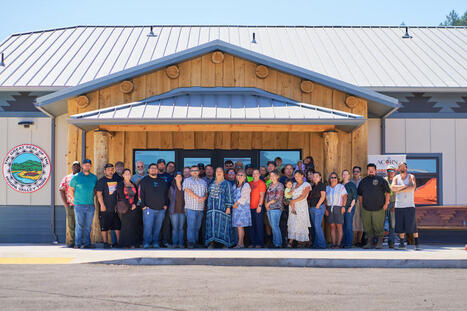
The Hoopa Valley Tribe has opened a new data center that will serve as an operational hub for its expanding fiber broadband network in Northern California. The new NTIA Data Center is the latest step in the tribe’s broadband expansion across the Hoopa Valley Indian Reservation, Willow Creek and Trinity County. Hoopa Valley Tribe Vice Chairman Jordan Hailey said the project reflects years of work to strengthen local digital infrastructure. The facility was built using funding from the Tribal Broadband Connectivity Program administered by the National Telecommunications and Information Administration (NTIA). The Hoopa Valley tribe received a $65 million grant from the NTIA in 2022, per prior Tribal Business News reporting. The federal funding has been part of a broader effort by the tribe to shift from vulnerable wireless connections to more resilient fiber infrastructure and expand broadband on and beyond the reservation.
Americans film ICE raids and police violence at personal risk. The footage shapes news cycles - then disappears. What if listening were built into democracy the way voting is? Lessons from India. Key Takeaways -
Trust in American news is collapsing while ownership consolidates — but the appetite for credible information has never been higher. -
Ordinary people filming ICE raids, police violence, and the deaths of neighbors like Renée Good, Alex Pretti and George Floyd at the hands of federal agents or police are doing democratic work the press alone can’t do. -
This citizen witnessing is largely treated as episodic activism. It should be treated as civic infrastructure — public, sustained, built to last beyond the viral moment. -
India shows where unchecked media capture leads. It also acts as a mirror: looking at how Indian civil society has confronted the invisibility of the poor reveals blind spots Americans rarely name about their own media. -
The missing piece in US media reform isn’t more speech. It’s listening infrastructure — public systems built to receive lived experience and route it into journalism, policy, and governance. When people can tell their own stories and see those stories shape news and policy, they stop being subjects of coverage and become participants in democracy — and the decisions made about their lives start to reflect the realities they actually live.
Disney is going to court to defend its ABC television stations from the Trump administration’s pressure campaign. On Tuesday, the media company filed a lawsuit in federal court alleging that Trump’s FCC is violating its First Amendment rights. The administration “has waged a retaliatory campaign against ABC for a single reason: it disapproves of what ABC broadcasts,” the lawsuit filed in DC District Court alleges. The legal action comes as the FCC investigates the ABC talk show “The View” and mounts an unusual challenge to the licenses held by ABC stations.
The Federal Communications Commission voted 2-1 on Thursday to wipe out a longstanding limit restricting the reach of any one TV station owner to no more than 39 percent of U.S. households, setting the stage for bigger broadcast mergers in the years to come. But the FCC is also bound to face court challenges, with many detractors arguing the agency is treading past its own statutory limits and warning about the potential ills of media consolidation. Lawmakers first ordered the FCC to set the ownership cap at 39 percent in a 2004 appropriations law, reflecting longstanding belief that no one broadcast company should be allowed to grow too powerful. However, FCC Chair Brendan Carr and the broadcast industry have argued that the law didn’t prohibit future agency leaders from reconsidering the specific limit.
|


 Scoop.it!