

Daily BeastWhite House's Testimony 'Guidance'Daily BeastLightSquared, a wireless network backed by billionaire Democratic donor Philip Falcone, could beam broadband Internet everywhere—but some military officials fear it could interfere with...


|
Scooped by
Chuck Sherwood, Former Senior Associate, TeleDimensions, Inc
onto Surfing the Broadband Bit Stream September 25, 2011 5:41 PM
|
 Scoop.it!
Daily BeastWhite House's Testimony 'Guidance'Daily BeastLightSquared, a wireless network backed by billionaire Democratic donor Philip Falcone, could beam broadband Internet everywhere—but some military officials fear it could interfere with...

 Your new post is loading...
 Your new post is loading...
Your new post is loading...
Scoop.it!

From
www

Token prices keep falling and AI bills keep rising, and most of that money lands with two vendors. The fix isn't to spend less on AI. It's to stop renting all of it.
// Executive Summary
Scoop.it!
From
www
Verizon is addressing customer pushback over an application it submitted to the Federal Communications Commission in August seeking approval to retire traditional copper landline phone service in parts of nine states.
The carrier said it wants to discontinue the service because its copper infrastructure is outdated, costly, “too slow to meet modern needs,” and “vulnerable to damage and theft.”
The change would affect roughly 277,000 business and residential legacy voice lines. Verizon says it will offer affected customers alternative service options, such as wireless or fiber, but critics warn the transition could harm some customers.
Scoop.it!

Amazon says it will stop using NDAs when negotiating data center deals with local governments, following a similar move from Microsoft earlier this year. Secrecy has fueled community backlash against AI infrastructure, with opposition leading to hundreds of proposed and enacted moratoriums from New York to San Francisco.
Meanwhile, a wave of startups is betting that consumers will hand AI agents access to their inboxes, files, and credit cards — if they can get websites to let them in.
Scoop.it!

There is no shortage of artificial intelligence frameworks this year. In March, the White House sent Congress its National Policy Framework for Artificial Intelligence, a set of legislative recommendations built around accelerating deployment and preempting state AI laws. Leading AI companies, think tanks, industry groups, and civil society organizations have released frameworks, platforms, or blueprints of their own. Today Public Knowledge is adding ours: the Public Knowledge AI Regulation Framework.
At a time when what seems most urgent is unifying society and policymakers around a set of specific and actionable policy proposals, why introduce yet another set of ideas into the mix?
No one is standing up for both open technology and protecting the public.
Scoop.it!

WASHINGTON — On Tuesday evening, the U.S. District Court in Washington, D.C., extended an earlier restraining order against the Trump administration’s efforts to bar CNN, MS NOW and Politico reporters from the White House. The news outlets are suing the White House on the grounds that such a ban violates their constitutional rights.
Scoop.it!

I was recently reading some older regulations related to copper, and this reminded me how regulation was used for many years to shape competition, or to be more precise, regulation was used to protect monopoly providers from competition. It got me to ask the question if regulation is still doing the same thing.
Telephone and related services were heavily regulated since the early days.
Scoop.it!
From
www
Sokaogon Chippewa Community Chairman Robert VanZile, Nicolet College President Kate Ferrell, and Director of the Wisconsin Bureau of Apprenticeship Standards David Polk sit at a table at the college signing an agreement that will launch a Broadband Service Technician apprenticeship program.
“We're all working together with one common goal,” said VanZile. The Northwoods has seen improvements to broadband coverage in recent years. Still areas remain underserved, especially in Forest and Florence Counties.
The Mole Lake Sokaogon Chippewa Community launched a $72-million project this year to bring high-speed internet to the region and not just for tribal members. The Tribe is working to create a 900-mile fiber optic cable network over the next four years to serve high-speed internet to roughly 4,600 homes in and around Forest County.
The one-year program is a registered apprenticeship program. They receive on the job-training from their employer while taking courses at Nicolet College.
Scoop.it!

The International Monetary Fund warned Tuesday that the global economy faces serious risks from Big Tech firms taking on massive debt to fund the buildout of artificial intelligence data centers worldwide. Could this lead to a new financial crisis?
The IMF’s latest Global Financial Stability Report outlines a number of risks to economic growth in the coming years, including a reliance on AI industry spending that it warns could lead to a new financial crisis.
Scoop.it!

From
www
E-Rate provides approximately $4 billion annually to help schools and libraries afford essential broadband connectivity. This economic impact study provides an estimate on how eliminating this support—effectively imposing a “connectivity tax” on educational institutions—would affect investment, GDP, employment, labor income, and economic output, including the ripple effects across the broader economy.
Scoop.it!

Zuckerberg says Meta committed up to $200B to AI infrastructure before anyone could tell him it would work. The cash flow statement said as much in July. Meta’s free cash flow fell 91% in the second quarter.
Mark Zuckerberg says Meta committed to spending as much as $200B on AI infrastructure before anyone at the company could tell him it would work. He put the figure at $100B or $200B.
He asked chief AI officer Alexandr Wang whether he was sure, Bloomberg reported, and Wang’s answer was that it was not clear at all that it was going to work.
Scoop.it!

Ukraine has decided to retaliate against Russian attacks on its data centers by targeting those in Moscow. At the same time, the activity of bots supporting conservative rhetoric on social media has declined.
It's a variation of the butterfly effect: Ukrainian strikes on Russian data centers have had repercussions on the other side of the world, on a North American continent preparing for highly charged parliamentary elections. This Sunday, the shutdown of three data centers hosting a large portion of Russia's cloud services led, according to many observers, to a dramatic drop in bot activity on American and European social networks, particularly X, owned by Elon Musk.
Scoop.it!

Oren Etzioni and MIT professor Max Tegmark debated AI risks in a New York Post video, splitting over whether this summer's OpenAI sandbox breakout was rogue AI or human error. They agreed that corporate self-regulation won't work and that AI systems should get only the access they need.
Scoop.it!

Spokane County is growing, and reliable Internet access matters more each year to its families, students, entrepreneurs, and employers. At Comcast, we are proud to continue expanding our high-speed broadband network to serve new communities and offer greater broadband choice throughout the county.
Today, our network extends more than 2,800 miles across the local footprint, with Xfinity and Comcast Business products and services available across Spokane County. That footprint reflects decades of construction, upgrades, and collaboration. It also gives us a strong foundation for reaching more residents as communities expand and their connectivity needs evolve.
|
Scoop.it!

This biting analysis from bestseller and Baffler cofounder Frank (The People, No) exposes how America’s decades-long fixation on creativity and innovation helped construct an unequal postindustrial society.
The author dates the beginning of creativity fervor to post-WWII, when adman Alex F. Osborn, coiner of brainstorming, built a “vast empire” by insisting that “everyone was creative.” From there, Frank tracks the obsession with creativity and innovation through the 1960s “creative revolution,” the ’70s “innovation crisis”—which was treated with tax cuts and deregulation—and the administration of “Innovation President” Barack Obama, whose defense secretary once said innovation 67 times in a single speech.
Throughout, Frank grimly points to how creativity and innovation became a means of celebrating white-collar workers as “godlike” while the working class was being systematically dismantled.
Turning to the present, Frank offers gimlet-eyed excoriations of American cities’ “frenzy” of gentrification inspired by Richard Florida’s The Rise of the Creative Class; former Baltimore mayor Martin O’Malley’s flurry of indistinguishable innovation initiatives; and defense contractors’ absurd boasts of artfulness (“At Northrop Grumman creativity guides innovation”).
Frank’s wry critique exposes how creativity and innovation are “a marker of ghastliness,” wielded as a justification for policy that benefits only the so-called enlightened few. It’s a sharp look at how prized American values mask inequality. (Oct.)
Scoop.it!

Amid what she called a "mass surveillance crisis," US Rep. Rashida Tlaib announced legislation on Wednesday to ban the use of federal funds for powerful dragnet spying systems—including the automated license plate-reading cameras manufactured by Flock Safety.
Scoop.it!

Amid escalating concerns about artificial intelligence from within and beyond the industry and related demands for policymakers worldwide to swiftly enact strong safeguards, attorneys general from eight US states sued ChatGPT maker OpenAI on Wednesday.
“OpenAI designed a product to attract young users and keep them engaged for as long as possible so it could capture their extensive personal data for the company’s commercial benefit,” said Arizona Attorney General Kris Mayes in a statement.
The public "has suffered irreparable harm—including lost loved ones, disturbing cyberattacks, and now a plausible threat of civilizational collapse," says one of the eight lawsuits.
Scoop.it!

Every day, we are told that we live in the future — or at least, on its precipice. “The Intelligence Age” is just a few years away, just as Marvin Minsky told us it was a few years away in 1970. Technology will solve every problem, as long as we are ‘optimistic’. But if you prefer to be pessimistic, there is also a flavor of hype for that, too — promoted by the same narrow slice of tech elites and upholding the same fantasy that technology moves in a straight, unstoppable line toward an apocalyptic Singularity.
When we pause and lean back from the screen, however, our lived present is made up of the ruins of past futures, our legs constantly kicking against the expensive debris of earlier fantasies. A South Korean journalist wanders alone through the abandoned ruins of virtual university campuses on the Metaverse, many of them operating at a ratio of seven-digit figures in development costs to three-digit figures in daily users.
An American woman has partial vision restored with a smart bionic implant technology, then is suddenly rendered blind again when the company that developed it goes bankrupt. AI companies loudly lobby for state subsidies on data centers, then quietly withdraw when the time comes to deliver concrete infrastructure, jobs, and technological progress, despite their continued ability to funnel astronomical levels of funding to each other through “circular financing.” Chinese data centers lie fallow and underused after anticipatory investment, while grid overload concerns have stalled Kenya’s headline data center project.
Scoop.it!
From
www
Mayor Zohran Mamdani on Wednesday announced an initiative with New York University that would potentially make New York City equity partners in quantum research projects that come out of a new lab at the school.
Mayor Zohran Mamdani said that in exchange for a $30 million city investment, New York would get 15 percent of proceeds from projects developed in the quantum technology lab.
Scoop.it!
From
hoodline
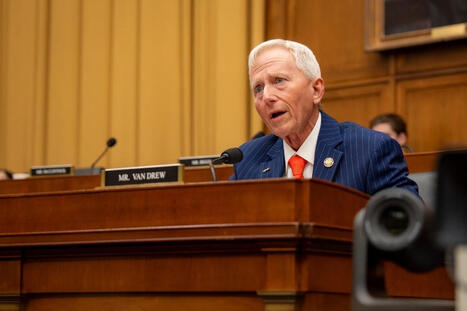
Officials broke ground in Elmer, NJ on a $132.5 million fiber project bringing 500+ miles of broadband to Cumberland and Salem counties.
The South Jersey Middle Mile Broadband Project has a total cost of $34,538,131.62, with $24,176,692.13 covered by federal funding, officials said. U.S. Representative Jeff Van Drew, who represents New Jersey's 2nd District, attended the groundbreaking, as reported by the Press of Atlantic City. The project is intended to help smaller providers compete and make broadband more affordable. Potential benefits include connecting schools, healthcare providers and public safety agencies, as well as supporting economic development.
Scoop.it!

From
www
BOULDER CITY, Nev. (AP) — Janelle Sorenson loves the clear night skies in Boulder City, less than an hour's drive from the bright lights of the Las Vegas Strip. It's a small, quiet town, and she thinks an artificial intelligence data center would ruin the community and scar the desert landscape.
So over the summer, she joined with other residents to successfully oppose plans for one of the giant computing warehouses that have popped up around the country.
But their victory was short-lived. The developers withdrew their application and instead sought adjacent land owned by the federal government — and the U.S. Bureau of Land Management signed off.
The data center issue has dominated the competitive governor’s race in Nevada, where 80% of the land is owned by the federal government.
Scoop.it!

The rules that built Silicon Valley weren’t written to build Silicon Valley. The Pentagon wanted a guidance computer, a federal judge wanted to settle a case against a telephone monopoly, and a California legislature in 1872 had farmers and railroads in mind. Together they produced the conditions for an industry, and this is the account of how, running from the land grant the railroad magnate, Leland Stanford, signed in 1885 to the two governments that now write the rules for the companies training frontier models.
Silicon Valley, a metonym for the behemoth technology industry of the San Francisco Bay Area, is usually explained by its people: the garages, the dropouts, and the founders. What does not get mentioned are the statutes, the court rulings, and the agencies that first created it. They did not invent anything, but set the conditions. Innovation and investment has compounded ever since, wave after wave, from missile guidance to the Internet to the AI boom. The most recent of them, artificial intelligence, took in $211 billion of venture capital in 2025, about three-fifths of every venture dollar invested worldwide.
Scoop.it!
Up until a couple years ago, data center cooling was just like cooling your computer. When it gets hot, a fan comes on to blow cool air across the hot chips. In cold places, that might come from outside. In hot places, it might require air conditioning.
But AI is using more and more power, and chips are getting jammed into tighter and tighter spaces, all in the name of harder better faster stronger computations. All of which makes more heat.
“The heat flux is going to be, in the near future, too high for air cooling to always be a satisfactory solution,” said Jonathan Boreyko, a professor of mechanical engineering at Virginia Tech.
Scoop.it!

A recent article in Telecompetitor describes a new white paper from Parks Associates and TechSee that reports that broadband customers with poor WiFi are six times more likely to say that they will change ISP. This finding documents something that all ISPs know and is what I call the WiFi dilemma. ISPs can deliver great bandwidth to the home, but customers judge them by the performance inside the home.
The report is based on 8,000 surveys of Internet households that were conducted in late 2025. The results are stated in terms of the net promoter score (NPS), which is a standard used in many industries that is based on the degree to which customers would give a good rating of a company to their friends and neighbors.
Scoop.it!

Nicolas Cage is drawing a hard line in the digital sand against artificial intelligence, revealing that he likely won’t work with Amazon again after refusing to sign an AI waiver for his now-canceled Prime Video series "Spider-Noir."
Scoop.it!

Microsoft says its homegrown Maia chips will handle most of the AI work behind Copilot and its other products, with the new Maia 300 rolling out in 2027.
The company says the new chip does more AI work with the same amount of electricity than the GPU-based systems that power most AI today.
|





