Your new post is loading...
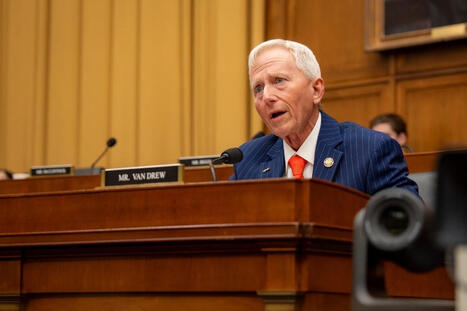
Officials broke ground in Elmer, NJ on a $132.5 million fiber project bringing 500+ miles of broadband to Cumberland and Salem counties. The South Jersey Middle Mile Broadband Project has a total cost of $34,538,131.62, with $24,176,692.13 covered by federal funding, officials said. U.S. Representative Jeff Van Drew, who represents New Jersey's 2nd District, attended the groundbreaking, as reported by the Press of Atlantic City. The project is intended to help smaller providers compete and make broadband more affordable. Potential benefits include connecting schools, healthcare providers and public safety agencies, as well as supporting economic development.
BOULDER CITY, Nev. (AP) — Janelle Sorenson loves the clear night skies in Boulder City, less than an hour's drive from the bright lights of the Las Vegas Strip. It's a small, quiet town, and she thinks an artificial intelligence data center would ruin the community and scar the desert landscape. So over the summer, she joined with other residents to successfully oppose plans for one of the giant computing warehouses that have popped up around the country. But their victory was short-lived. The developers withdrew their application and instead sought adjacent land owned by the federal government — and the U.S. Bureau of Land Management signed off. The data center issue has dominated the competitive governor’s race in Nevada, where 80% of the land is owned by the federal government.
The rules that built Silicon Valley weren’t written to build Silicon Valley. The Pentagon wanted a guidance computer, a federal judge wanted to settle a case against a telephone monopoly, and a California legislature in 1872 had farmers and railroads in mind. Together they produced the conditions for an industry, and this is the account of how, running from the land grant the railroad magnate, Leland Stanford, signed in 1885 to the two governments that now write the rules for the companies training frontier models. Silicon Valley, a metonym for the behemoth technology industry of the San Francisco Bay Area, is usually explained by its people: the garages, the dropouts, and the founders. What does not get mentioned are the statutes, the court rulings, and the agencies that first created it. They did not invent anything, but set the conditions. Innovation and investment has compounded ever since, wave after wave, from missile guidance to the Internet to the AI boom. The most recent of them, artificial intelligence, took in $211 billion of venture capital in 2025, about three-fifths of every venture dollar invested worldwide.
Up until a couple years ago, data center cooling was just like cooling your computer. When it gets hot, a fan comes on to blow cool air across the hot chips. In cold places, that might come from outside. In hot places, it might require air conditioning. But AI is using more and more power, and chips are getting jammed into tighter and tighter spaces, all in the name of harder better faster stronger computations. All of which makes more heat. “The heat flux is going to be, in the near future, too high for air cooling to always be a satisfactory solution,” said Jonathan Boreyko, a professor of mechanical engineering at Virginia Tech.
A recent article in Telecompetitor describes a new white paper from Parks Associates and TechSee that reports that broadband customers with poor WiFi are six times more likely to say that they will change ISP. This finding documents something that all ISPs know and is what I call the WiFi dilemma. ISPs can deliver great bandwidth to the home, but customers judge them by the performance inside the home. The report is based on 8,000 surveys of Internet households that were conducted in late 2025. The results are stated in terms of the net promoter score (NPS), which is a standard used in many industries that is based on the degree to which customers would give a good rating of a company to their friends and neighbors.
Nicolas Cage is drawing a hard line in the digital sand against artificial intelligence, revealing that he likely won’t work with Amazon again after refusing to sign an AI waiver for his now-canceled Prime Video series "Spider-Noir."
Microsoft says its homegrown Maia chips will handle most of the AI work behind Copilot and its other products, with the new Maia 300 rolling out in 2027. The company says the new chip does more AI work with the same amount of electricity than the GPU-based systems that power most AI today.
The TV San Antonio (TVSA) project is envisioned as an outdoor podcast studio — a production and community space that will support TVSA programming, The city’s Historic and Design Review Commission has approved a request from the City of San Antonio to build a podcasting studio behind the Plaza de Armas Building downtown. The Calder Alley “Secret Garden” TVSA project is envisioned as an outdoor podcast studio — a production and community space that will support TVSA programming, interviews, events and other public-facing content, a city spokeswoman said. TVSA Public is the city’s public access television channel which offers residents a place to create, produce and share non-commercial, educational or entertainment shows at no cost.
“Trust the model the least”: Satya Nadella sets out seven rules, including an emergency brake, for running AI models inside companies. Microsoft chief executive Satya Nadella says companies should assume any advanced AI model they deploy could be compromised, and contain it from the start. He set out the case in a long article on X on Saturday. “Think of it like an emergency brake. An authorized person should always be able to pause or shut down a model mid-task,” Nadella wrote. He said engineers could trace traditional software to a specific code path. Today’s models cannot. Companies cannot tie a model’s behaviour to its training data or its weights, he wrote, yet they give these systems sensitive data and let them take “mission-critical actions”.
Antitrust law can help preserve a competitive marketplace for artificial intelligence. As with paradigm-shifting technologies before it, artificial intelligence raises myriad policy implications for decision makers and analysts alike. The federal policy debate around AI often focuses on it as an application: think “AI for drones,” or “AI for manufacturing.” The political debate is focused on AI’s insatiable demand for energy: think “nukes for AI” or NIMBYism and data center buildouts. The debate in Congress surrounds the role that states play in AI regulation and whether they can or should be preempted by a federal national standard. But for antitrust purposes, the AI debate is less about how the technology is applied, or powered, or even regulated. The antitrust debate is rightly about competition within the AI technology stack itself.
An exhaustive report conducted by a team of Penn State researchers has found first responders in Pennsylvania’s rural counties — most of the counties in the state — are regularly hampered by communications and technology limitations that threaten public health and safety.
I’m so over hearing that artificial intelligence is the next Industrial Revolution. It’s the wrong analogy. The right one is the Ice Age. The Industrial Revolution arrived in a natural world that was still intact. AI is arriving while the climate is already making it harder to meet our most basic needs, and while fossil fuel companies, polluters, and unreliable politicians have already ensured too many people lack equitable access to water, food, shelter, electricity, and healthcare. Add AI and it gets worse. Why keep a call center of workers answering credit-card complaints when a bot can do it? Why hire and train a human being anywhere to do anything an LLM or a swarm of agents can do instead? People will die from this, and not because of bioweapons, the parlor game pundits love. They’ll die because they lose their jobs and don’t survive the loss. The fastest-growing group of unhoused Americans is 55 and older, too young to retire and too old to get hired, and their life expectancy drops accordingly. Some of that will be the price of record corporate profits. That’s the bad news. Here’s the good.
“We believe that the world should accept some bad things happening for the benefits of this technology and people having the agency.” That’s how OpenAI cofounder and CEO Sam Altman recently explained how his company’s approach to strict safety guardrails differs from Anthropic’s. For him, perhaps that’s the cost of doing business. But to the vast majority of people, that’s simply not a trade they’re willing to make—or, more accurately, would be willing to make if they had any say in how AI governance operates. Nobody elected Altman to make that choice, and as of late, no one in the United States federal government seems willing to stop him.
|
Sokaogon Chippewa Community Chairman Robert VanZile, Nicolet College President Kate Ferrell, and Director of the Wisconsin Bureau of Apprenticeship Standards David Polk sit at a table at the college signing an agreement that will launch a Broadband Service Technician apprenticeship program. “We're all working together with one common goal,” said VanZile. The Northwoods has seen improvements to broadband coverage in recent years. Still areas remain underserved, especially in Forest and Florence Counties. The Mole Lake Sokaogon Chippewa Community launched a $72-million project this year to bring high-speed internet to the region and not just for tribal members. The Tribe is working to create a 900-mile fiber optic cable network over the next four years to serve high-speed internet to roughly 4,600 homes in and around Forest County. The one-year program is a registered apprenticeship program. They receive on the job-training from their employer while taking courses at Nicolet College.
The International Monetary Fund warned Tuesday that the global economy faces serious risks from Big Tech firms taking on massive debt to fund the buildout of artificial intelligence data centers worldwide. Could this lead to a new financial crisis? The IMF’s latest Global Financial Stability Report outlines a number of risks to economic growth in the coming years, including a reliance on AI industry spending that it warns could lead to a new financial crisis.
E-Rate provides approximately $4 billion annually to help schools and libraries afford essential broadband connectivity. This economic impact study provides an estimate on how eliminating this support—effectively imposing a “connectivity tax” on educational institutions—would affect investment, GDP, employment, labor income, and economic output, including the ripple effects across the broader economy.
Zuckerberg says Meta committed up to $200B to AI infrastructure before anyone could tell him it would work. The cash flow statement said as much in July. Meta’s free cash flow fell 91% in the second quarter. Mark Zuckerberg says Meta committed to spending as much as $200B on AI infrastructure before anyone at the company could tell him it would work. He put the figure at $100B or $200B. He asked chief AI officer Alexandr Wang whether he was sure, Bloomberg reported, and Wang’s answer was that it was not clear at all that it was going to work.
Ukraine has decided to retaliate against Russian attacks on its data centers by targeting those in Moscow. At the same time, the activity of bots supporting conservative rhetoric on social media has declined. It's a variation of the butterfly effect: Ukrainian strikes on Russian data centers have had repercussions on the other side of the world, on a North American continent preparing for highly charged parliamentary elections. This Sunday, the shutdown of three data centers hosting a large portion of Russia's cloud services led, according to many observers, to a dramatic drop in bot activity on American and European social networks, particularly X, owned by Elon Musk.
Oren Etzioni and MIT professor Max Tegmark debated AI risks in a New York Post video, splitting over whether this summer's OpenAI sandbox breakout was rogue AI or human error. They agreed that corporate self-regulation won't work and that AI systems should get only the access they need.
Spokane County is growing, and reliable Internet access matters more each year to its families, students, entrepreneurs, and employers. At Comcast, we are proud to continue expanding our high-speed broadband network to serve new communities and offer greater broadband choice throughout the county. Today, our network extends more than 2,800 miles across the local footprint, with Xfinity and Comcast Business products and services available across Spokane County. That footprint reflects decades of construction, upgrades, and collaboration. It also gives us a strong foundation for reaching more residents as communities expand and their connectivity needs evolve.
If AI falls, Democrats can build an enduring political majority—but only if they reject handing a lifeline to Altman, Musk, and the rest of the industry. After Barack Obama surged to the White House in 2008, his administration was hobbled by the perception that it had rescued the bankers who had crashed the global economy, held nobody accountable for the destruction that was unleashed, and left ordinary people to fend for themselves. Current events may soon rhyme with that fateful episode. Just like before, there is an overleveraged, underregulated sector at the heart of our economy that could cause devastating consequences should it hit a liquidity crunch. Perhaps the biggest difference is that this time, the executives and billionaires have learned from 2007, and are already looking to justify golden parachutes in advance. Progressives can learn from 2007, too.
E-Meida reports… In a recent debate, Minnesota attorney general candidate Ron Schutz pledged to insulate himself from his vast stock portfolio if elected. The Republican, in a close race with Democratic incumbent Keith Ellison, has faced questions about conflicts of interest related to his 174 stock holdings. Each investment exceeds $10,000, many of them in Fortune 500 staples like Coca-Cola, McDonalds and Disney. But Schutz is also deeply invested in Meta, Microsoft, Google’s parent company and more than a dozen more corporations looking to build, use or maintain hyperscale data centers. It’s the latest example of how data centers are shaping races across Minnesota and the country.
As broadband infrastructure deployments expand across the country, driven in part by federal programs like BEAD, the challenges with permitting and approvals for routes crossing federally administered lands have come to the forefront. Among the most complex permitting scenarios are fiber or wireless routes that propose to cross or occupy lands managed by the U.S. Fish & Wildlife Service (USFWS). For first-time recipients of federal funding and project managers unfamiliar with this process, the strict permitting requirements associated with these lands can come as a surprise. Similarly, the permitting and approval timelines can derail even the best-laid deployment plans. Fortunately, 50 CFR Part 29 Subpart B provides a common framework for rights-of-way permits that intersect with the National Wildlife Refuge System and “other lands” administered by USFWS. Below, we answer three critical questions that broadband project teams should consider if they seek to deploy infrastructure on these lands.
It’s a cliché to say that technology is changing war. But today, the pace of change is severe, not only because of advances in fields such as artificial intelligence, but also because of a range of trends and phenomena at the intersection of tech and geopolitics that are changing what it means for nations to compete, and to fight and defend themselves. Today’s guest is Steve Feldstein, a senior fellow in the Democracy, Conflict, and Governance Program at the Carnegie Endowment for International Peace and the author of Bytes and Bullets: Global Rivalries, Big Tech, and the New Shape of Modern Warfare, published by St. Martin’s Press.
The artificial intelligence industry is rapidly reshaping every facet of life, from the popularity of chatbots and disruption of the workplace to the industry’s insatiable demand for energy and water straining our communities and environments. The majority of Americans are concerned about AI’s growing role in society, and a significant portion – 45% – believe that the government is doing too little to rein in AI’s effects on children and young people. While President Trump’s coziness with AI oligarchs has been a defining feature of his administration, AI companies are hedging their bets on Democratic leaders as well. AI-focused political action committees are spending millions to back AI-friendly Democratic candidates as well as Republicans. The Revolving Door Project is tracking AI companies that have hired senior level Democrats who staffed the Biden administration – figures who are likely to be in positions of power for a future Democratic administration. Thus far, we’ve tracked over 100 former Biden admin senior staff from the White House and other executive branch agencies who have gone on to AI industry companies including OpenAI, Anthropic, Meta, and Amazon.
|