Your new post is loading...
An independent study commissioned by the City of Seattle says the city should protect the big tech employers it has while building a more diverse economy on top of them. The 127-page report also says Seattle's tax structure is unique among its peers in penalizing the hiring of senior, high-compensation workers. Overall, Seattle’s business taxes are actually in line with competing cities, write researchers from the economic consulting firm Formation in the new report. But Seattle’s taxes are “particularly distortionary when it comes to hiring high-wage employees,” they add. Mayor Katie Wilson helped design the tax, known as JumpStart, before taking office. But even the strongest supporters of new local and state taxes would concede that Seattle is “reaching the limits of how much it can tax the industries and people that it is depending upon to drive its growth,” the researchers write. Another risk for the city is the resulting concentration of the tax base. Three-quarters of the payroll tax on large employers comes from 10 companies. Nine of them are in tech-related sectors.
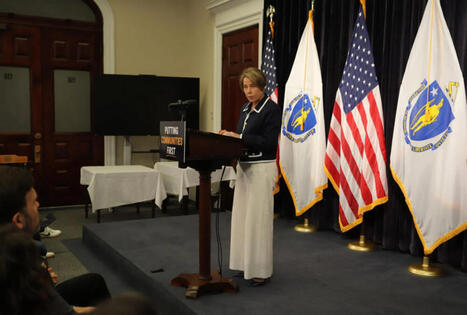
Pending data centers will now need to strike community benefits agreements with host communities that align with state standards before state permitting can get underway. Gov. Maura Healey signed an executive order Tuesday subjecting proposed data center projects to local approval before developers can move on to state permitting, representing her administration's latest crackdown on the facilities after halting tax breaks earlier this summer. As the artificial intelligence boom marches on, pending data centers in Massachusetts will now need to strike community benefits agreements with host communities that align with state standards before state permitting can get underway. The order also blocks the use of non-disclosure agreements between state agencies and data centers to "ensure a transparent and fair approval process," Healey's office said. "Unless a community says yes to a data center, we're saying no," Healey said at a press conference Tuesday afternoon.
President Donald Trump’s directive to accelerate data center development on federal lands is facing public backlash and legal hurdles. Behind the scenes, the Trump administration is pushing full steam ahead and sparking concerns it is prioritizing corporate needs over the public good. The Bureau of Land Management has asked its state directors to identify public land ripe for data center development, according to two people familiar with the request, and those leaders have compiled lists for Interior Department leadership.
Five newspaper publishers in New York City agreed in 1846 to pool resources in order to speed the delivery of news about the U.S. war with Mexico using a pony-express relay through Alabama to a telegraph office. Those beginnings gave birth to an organization that in many ways became the backbone of the news industry. The AP claims some 4 billion people, nearly half of the world’s population, see news produced by the company on a typical day. Many don’t realize that. For most of its history, the AP has effectively been a utility, providing material for other news outlets to print, broadcast or carry online, its journalists largely anonymous. AP reporters weren’t even identified with bylines until World War I. But the company has chronicled the nation’s big moments for much of the 250-year history of the American republic. Although horses long since gave way to the internet, the journalism remains. Here are some stories behind the stories the AP has chronicled.
Almost every conversation and vendor pitch in telecoms now suggests orchestration as the necessary fabric to exploit AI. It implies abstracting away the growing complexity and numbers of integration touch-points between sub-systems, as well as external issues such as regulation, identity, 3rd-party tools or apps, and security. The term itself isn't new in telecoms, its use seems to have proliferated in recent months. I think that many vendors have recognised that:
Can local governments build modern public safety infrastructure without sacrificing citizen privacy or handing millions to private cloud vendors? Former Shreveport CTO Keith Hanson joins Chris to break down the hidden costs of vendor-owned surveillance, the realities of municipal IT bureaucracy, and how cities can use creative, low-cost solutions to retain control over their own data. The conversation begins with Keith’s experiences leading technology initiatives in Shreveport, including the establishment of a civilian-led Real-Time Crime Center and the deployment of local camera systems. Keith explains why he opted to build low-cost, off-the-shelf camera systems rather than paying steep subscription fees to private vendors who harvest public data into centralized cloud databases.
The delay comes amidst a firestorm, if not hysteria, set off by Anthropic’s Jacob Coxon, who just quit to call attention to what he considers the threat of human extinction posed by fast developing and ever more powerful AI models. To fan the flames of concern, Evan Hubinger, Anthropic’s own Lead for Alignment Science, agreed with Coxon but went further: Former AI Czar David Sacks even floated the idea Anthropic must delay its IPO to sort out Coxon’s comments, although it looks like Sacks is being facetious:
One of my recent blog posts reviewed a new book, Digital Equity Ecosystems, by Colin Rhinesmith. A reader asked me about some of my other favorite telecom books. I have a personal interest in the history of telecom, so many of these books discuss major events in telecom history. I’m sure I’m missing some great books, but here is the list that first came to mind. Feed free to add others in the comments. The Unauthorized Bio of the Baby Bells & Info-Scandal by Bruce A. Kushnick. This is one of a series of books by the author that looks at how the Baby Bell companies like Bell Atlantic and BellSouth were able to gain huge concessions from regulators in return for promises to build future-looking broadband networks, and how most of those promises were broken. Farm Fresh Broadband: The Politics of Rural Connectivity by Christopher Ali. This book discusses the federal broadband policies that led to the stark digital divide between urban and rural broadband. I wrote a review of this book when it first came out in 2021, and it’s still an interesting read today.
No one knows when or if California AG Rob Bonta will agree to hold settlement talks with Paramount Skydance regarding its merger with Warner Bros. Discovery – but David Ellison has a "few tricks up his sleeve," On The Money has learned.
A researcher at the AI company Anthropic resigned with a warning that the entire artificial intelligence industry is designing tools that humans will soon lose control of. SACHA PFEIFFER, HOST: A researcher from the AI company Anthropic resigned yesterday. How he did it is what we're talking about today. Jacob Coxon said he fears the company's work could lead to disastrous consequences for humanity. In a series of public posts on X, Coxon also said both Anthropic and its rival OpenAI are, quote, "gambling with our lives." This is not the only warning about AI safety lately, and NPR's Huo Jingnan is here to help us process. Hi. HUO JINGNAN, BYLINE: Hello. PFEIFFER: So I saw some of these tweets today, and some of them are quite alarming. Tell us more about what Jacob Coxon said this week. JINGNAN: So he says he spent the last three years training AI models, first at OpenAI and then at Anthropic. And in his post, Coxon said, quote, "neither company is acting responsibly."
NATE: The Communications Infrastructure Contractors Association today led a coalition of 12 communications industry, broadband, and public safety organizations in a letter to Senate Committee on Commerce, Science, and Transportation Chairman Ted Cruz and Ranking Member Maria Cantwell urging the Committee to favorably report the nomination of Danielle Thumann Severs to serve as a Commissioner on the Federal Communications Commission (FCC) so the full Senate can move swiftly to confirm her. “We write in strong support of the nomination of Danielle Thumann Severs to serve as a Commissioner for the Federal Communications Commission and respectfully urge the Senate Committee on Commerce, Science, and Transportation to report her nomination favorably so the full Senate can move swiftly to confirm her,” the coalition wrote. “Few nominees bring both a command of the Commission’s institutional record and firsthand knowledge of what it takes to permit, build, and maintain a network.”
The model is the cheapest thing you'll ever switch. The contract, the compliance letter, and the SDK are the commitment. Executive Summary
Enterprises are about to lock in Q4 platform decisions during the loudest launch week of the year. In seven days, OpenAI shipped a new flagship, Google shipped its third Flash model in six weeks, Nvidia agreed to buy Hugging Face, and Anthropic's IPO came into view.
The evidence says the model is the cheapest thing you'll ever switch. The real commitment is the cloud contract it bills through, the compliance letter it ships with, and the developer tooling your teams wire it into. Enterprise generative AI spend more than tripled to $37 billion last year. Hold that flat for a three-year contract and this is a $100-billion-plus decision. Buy the stack the way you'd have bought a database in 2005: on the contract, the compliance letter, and the developer ecosystem. Treat this week's model launches as pricing news, not platform news.
Anthropic says it has identified and disrupted attempts to use its AI model for "malicious activity" that could support biological and conventional weapons development. The company's AI model Claude was also used in a Russia-linked cyber espionage campaign and by an Iranian propaganda institution, according to Anthropic's latest threat intelligence report. The cases of concern detected over the past eight months ranged from fake dating apps and hotel Wifi scams, to surveillance built to identify dissidents. The revelations come after warnings from a top safety researcher at Anthropic about AI's potential risks to humanity. Anthropic has also accused Chinese AI firms of trying to replicate Claude's capabilities.
|
Abstract Using artificial intelligence (AI) in local journalism is more likely to yield civic benefits if it begins with the culture and needs of the community. AI should be used not simply to reproduce traditional journalism more efficiently but to improve residents’ lives by providing useful information and enhancing local representation. Those hoping to use technology to “save” local journalism should shift the discussion about AI in local news away from efficiency and replacement, and toward highlighting the concerns and observations of community members. Drawing on theories of service journalism, civic AI, and political accountability, I argue that adopting AI tools in local journalism should go hand in hand with implementing more equitable, civically-focused, participatory forms of journalism. This approach is exemplified by the “Documenters” program from City Bureau in Chicago, which pays regular residents to take notes at government meetings and uses those notes as the basis for local news. Using several recent examples and a chatbot trained on Documenters’ notes, I show how these participatory approaches offer several concrete civic benefits that AI and traditional journalism alone cannot provide. The AI-assisted journalism of tomorrow should not look like a propped-up version of the stories, narratives, institutions, and inequities of the past. AI should shape and accelerate journalism’s transition, which is already underway, into a force for promoting civic empowerment and political accountability.
When Congress created FirstNet, it required FirstNet to build “a nationwide, interoperable public safety network.” Section 6202(b) of the Middle Class Tax Relief and Job Creation Act of 2012 (47 USC 1422(a)) (emphasis added). In light of numerous concerns with regard to the construction, management, and integration of FirstNet into the broader first responder ecosystem, the House reauthorization bill amends existing Section 1422 to include separately, as a mandatory network component: “such technologies and services as necessary to enable secure,
interoperable, resilient, and prioritized broadband communications for public safety entities.” H.R. 7386 Sec. 6. Instead of embracing this standard and complying with the statutory interoperability requirement, FirstNet and the FirstNet Contractor (AT&T) have resisted. The Federal Communications
Commission has repeatedly refused to enforce the FirstNet statute’s explicit interoperability requirement – and closed the pending proceedings on the subject in December 2025.1 Congress must therefore use the reauthorization process not merely to emphasize interoperability (as the House bill does).
This past spring, Canvas, the learning management system software I use to teach courses at Rutgers University, was hit by a global security breach that affected thousands of colleges and universities. The company that operates Canvas rolled back features while it addressed the breach. The timing of the hack couldn’t have been worse. For several days, software rollbacks prevented students from accessing course materials and kept instructors from proctoring exams and uploading final grades during the last weeks of the spring semester.[1] Two weeks before, the infrastructure Rutgers owns failed when the university’s data center lost power for most of a day, and nearly all our cloud-based software systems, from course registration to payroll and financial aid, were inaccessible. The campus-wide wireless internet networks and Rutgers’ Clinical Research Data Warehouse were also impacted.[2] For students, staff, researchers, and faculty at a university serving tens of thousands of people, most work stopped due to the outage. I teach archives, digital curation, and public interest technology to graduate students training to become public librarians and archivists. I work at one of the oldest (and largest) public research institutions in the U.S. The word “public” means many different things today, and we can see these differences depending on how it’s applied and by whom. Public can mean the way that Benjamin Franklin’s post office meant public: a service any person could use to reach any other person. Public can also mean a resource held in common, funded collectively by a geographically connected community, open to whoever walks in the doors, the way we might understand our local libraries. Public can also mean the ways that corporate firms serve people online. For platform owners like Elon Musk and Mark Zuckerberg, public means the online “town square” that millions of Americans use every day and that firms can reconfigure at will. Importantly for the computing services sector, the modifier public in “public cloud” does not mean public ownership, or universal access, or public governance with obligations to act in the public interest. So, when I ask how public the public cloud really is, I’m asking us to think about which definition applies to our computing infrastructure, and at the same time, I am pointing to how dependent our institutions have become on this technology to meet obligations to their stakeholders.
Los Angeles, Cali. (September 10, 2026) — Connected Nation (CN) today announced that Netflix is supporting the national nonprofit's attempt to earn a GUINNESS WORLD RECORDS™ title for the “longest internet literacy live stream.” Netflix joins more than 25 national and international organizations participating in “25 Hours. One Connected World,” a global event aimed at expanding access to digital skills training and raising awareness of the Digital Divide. "Every community deserves the chance to connect, learn, and be entertained by great stories – and that starts with reliable access to the internet," said Gina Haspilaire, Vice President of Open Connect Partnerships and Infrastructure, Netflix. "We've long worked to strengthen internet access and quality for our members, and we're proud to support Connected Nation in bringing this world record attempt to life, shining a light on the importance of turning access into opportunity for communities across America."
Twenty-five leading mathematicians signed an open letter arguing that AI labs are threatening their intellectual work as they seek to one-up each other with solutions to famous math problems. Each signatory has been awarded the Fields Medal, considered the most prestigious prize in mathematics. This week, NYU professor Tristan Buckmaster accused OpenAI of pressuring him not to credit a collaborator who works for Anthropic for solving an important math problem, and wondered if the company had used their work with Codex to produce its own groundbreaking proof over a marathon weekend of inference. On Thursday, OpenAI withdrew its sponsorship of a math event at CalTech after the company was criticized by researchers at the university. While the ability of AI models to solve the world’s outstanding mathematical challenges could be a boon to humanity, the signatories of the new letter argue that will only be the case if those solutions can be understood and communicated by the math community and, ultimately, the rest of the world.
MPR reports… A Virginia-based developer has withdrawn from a deal to transform the former Star Tribune printing facility in Minneapolis into a data center. The proposal drew heavy criticism from residents of the city’s North Loop neighborhood. Minneapolis spokesperson Jess Olstad confirmed that Legacy Investing withdrew a land use application for the proposed facility, which would have included a 20-megawatt data center as well as other developments at nearby parcels. More info…
Why are big AI firm trying to create billionaires from a technology they say may end the world? There are real risks to AI, but something is very off about the latest social panic. Something very weird is going on in our political economy discourse. Over the past month, the executives at the top AI companies have engineered a slow motion panic over AI, snowballing into an argument that they are on the verge of creating a technology with a reasonable chance of ending human civilization. A few days ago, Jacob Coxon, a 27-year old at Anthropic, resigned his role and posted a thread on X, arguing these companies are building super-intelligent systems that may destroy the world. Coxon’s comments garnered a front page Wall Street Journal story, more than 110 million views, and wide commentary from Senators, CEOs, AI experts, and journalists. Then another 20-something Anthropic employee, Evan Hubinger, chimed in to say that most employees at Anthropic agreed with Coxon, and “do earnestly believe AI could kill all humans,” putting the odds at 10% within the next decade. These are extraordinary claims, and the people making them are nicknamed “AI Doomers” or sometimes called the “AI Safety” movement. This group loosely encompasses the network that used to surround disgraced crypto billionaire Sam Bankman-Fried, a quasi-religious order known as effective altruists, who believe a cadre of hyper-rational elites can guide humanity. Despite their weirdness, it is true that the capabilities of this technology are improving, and there have been some dangerous recent events.
COLR, Carrier of Last Resort. Over the last 15 years, all of the incumbent state utility phone companies have applied to shut off the copper and get rid of basic obligations to provide at least phone service, known as COLR, carrier of last resort. AT&T, for 20 states, included a package of deceptive information that left out fundamental basic facts. All of these statements were made only using an accounting of households, which does not include business lines, data lines — about 70–90% of all lines. When I first saw this perverse list showing how every AT&T state used a deceptive, manipulated accounting claiming that only 1–3% of households was still using a copper-based phone line — I realized it was one of the ugliest collections, designed to deceive the public, that I have ever witnessed. It means that the companies who have been in control of our critical infrastructure, let it all deteriorate as the copper wires are part of the original Bell company system Ma Bell, which was transferred in 1984. And it was always profitable because customers have been overcharged continually for upgrades they never received. Worse, the construction budgets were illegally diverted to build the wireless networks.
A little-known Pentagon office staffed by Big Tech alums is dismantling safeguards and accelerating AI warfare as their former employers compete for lucrative military contracts. As lawmakers demand Congress put artificial intelligence safeguards in place amid new warnings from AI whistleblowers, the Trump administration is using a new, obscure office to do exactly the opposite. The agency, which is dedicated to turning the U.S. military into an “AI-first warfighting force,” is staffed by alumni of Amazon, Palantir, Meta, and Salesforce. All firms that are at the center of the government’s AI contracting boom and which have the most to gain from the minimal implementation of AI safeguards. The Department of Defense founded the little-known Chief Digital and Artificial Intelligence Office (CDAO) in 2022 when it merged multiple offices, including the Joint Artificial Intelligence Center, the Defense Digital Service, and the Chief Data Officer, into a single entity. It now leads all things AI at the Pentagon, from “the development and deployment of algorithmic warfare” and drafting AI-related policy to helping guide the procurement of AI systems from private contractors like Amazon and Palantir. Under President Donald Trump, the CDAO has focused on integrating AI systems into weapons, combat decisions, surveillance regimes, and target identification processes.
In a move that could further politicize the Federal Communications Commission (FCC), Trump has nominated Danielle Thumann Severs, a longtime senior counsel to FCC Chairman Brendan Carr, to fill one of the agency’s two vacant seats. The nomination has raised concerns about further politicizing an agency that’s supposed to operate independently of the White House. If confirmed by the Senate, Thumann Severs would increase the Republican majority from 2-1 to 3-1. Typically the majority party maintains a single vote advantage. Without simultaneously confirming an additional Democratic appointee, the majority will now have a 2-vote advantage. This makeup would enable Carr and his allies to pass measures without any support from Anna Gomez, the FCC’s lone Democrat.
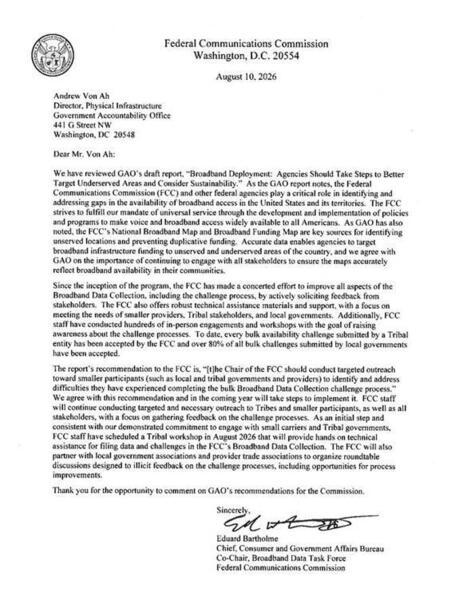
What GAO Found: Since 2020, four federal agencies administered the bulk of federal funding for broadband deployment through the nine programs GAO reviewed. These were the Federal Communications Commission (FCC), National Telecommunications and Information Administration (NTIA), and Departments of Agriculture and the Treasury. For example, NTIA oversees the over $42-billion Broadband Equity, Access, and Deployment (BEAD) program, which provides grants to states and territories that select providers to deploy broadband networks to underserved areas. As of February 2026, all nine programs had begun distributing funding.
Why a fully capable commercial successor to the ISS and uninterrupted U.S. human presence in low Earth orbit is key to preserving U.S. scientific, commercial and industrial competitiveness. Since 2000, humans have lived and worked in space without interruption aboard the International Space Station. The ISS has enabled thousands of groundbreaking research investigations and provided a testing and training ground for human spaceflight, underpinning humanity's exploration of the moon and the push toward Mars. However, as the ISS approaches retirement in 2030, the U.S. and its partners face a pivotal opportunity to sustain that presence and preserve their momentum in innovation and leadership in space. Starlab, a NASA-supported next-generation commercial space station, is ready to meet this moment. Developed by Voyager Technologies and joint venture partners, Starlab’s size, scalability, design and operational readiness make possible a seamless transition to commercially-led low Earth orbit capabilities. As a successor to the ISS, it stands ready to preserve American scientific, commercial and industrial leadership in space while expanding economic opportunity on Earth. Read on to see how Starlab is positioned to anchor the next generation of scientific discovery and space-based business.
|